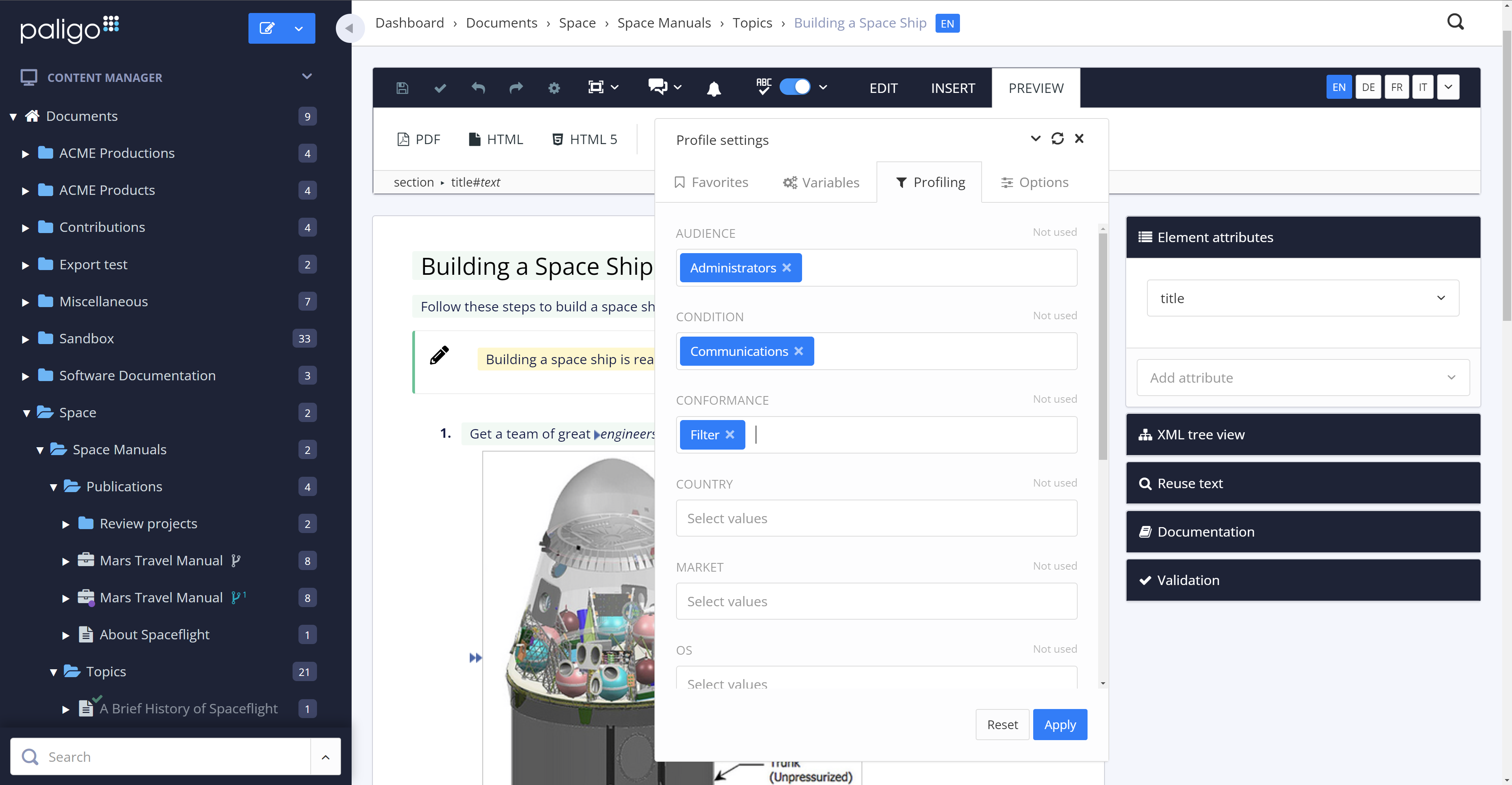
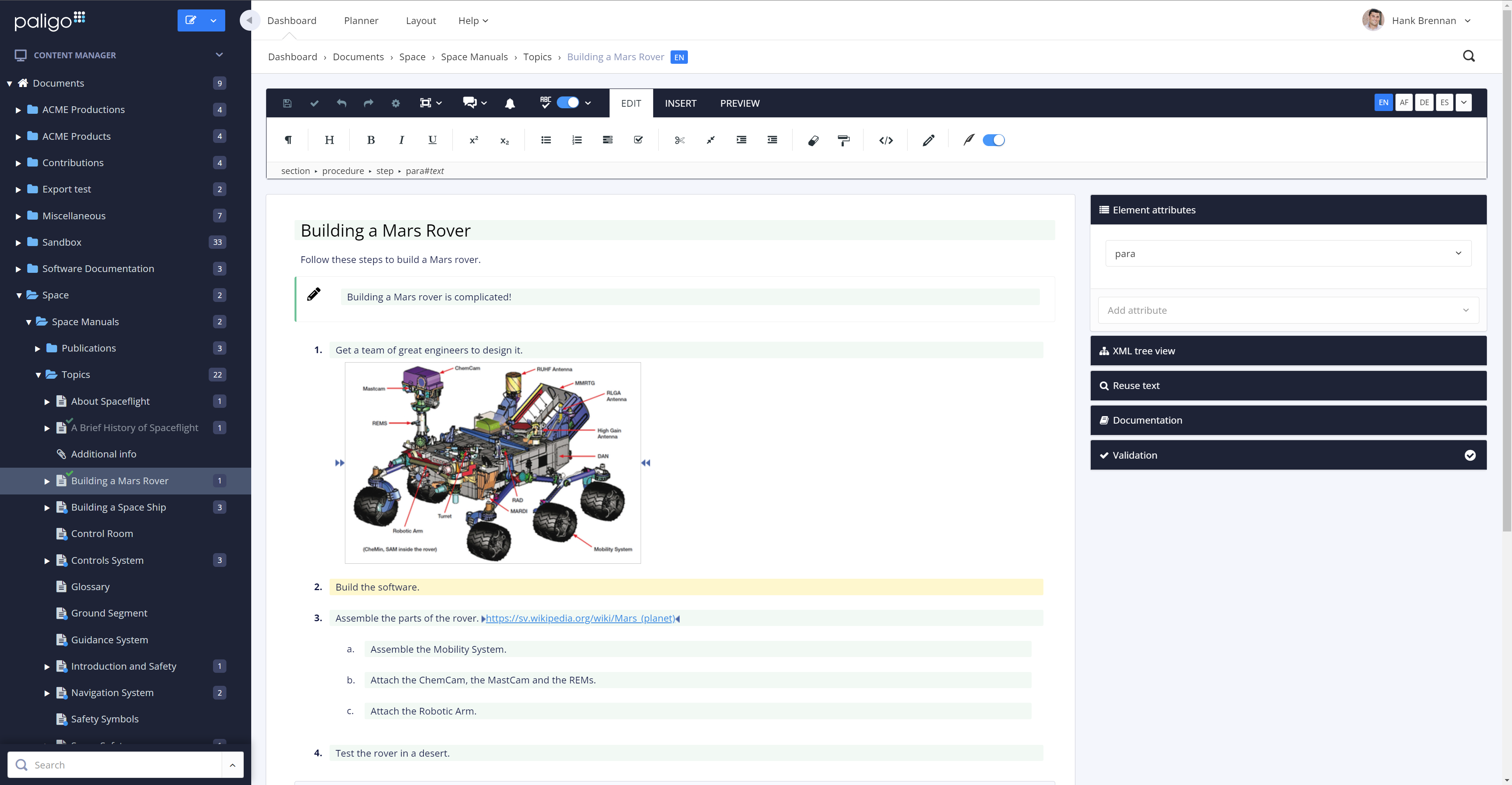
Paligo is a component content management system (CCMS) that helps teams manage complex technical documentation through structured authoring, content reuse, and controlled publishing.
$4,800
per year per seat
Sitecore Digital Experience Platform
Score8.9 out of 10
N/A
The Sitecore Experience Platform (Sitecore XP) is a digital experience platform used to build websites and create customer experiences online. The solution boasts fast content authoring, built-in personalization features, testing and other optimizations, as well as analytics and marketing features.
One of the biggest strengths is the structured authoring, which not only gives clean content for users but is also well-suited for providing AI content. I also make good use of content reuse, which simplifies maintenance and documentation updates when features change. The taxonomy has allowed me to create versioned documentation on our site that correlates with customers' installed software versions. We're switching over to using the API for publishing to our website and that will be a nice switch from the publication structure we've used previously. The tool doesn't, at this time, allow me to connect it to a custom GPT or create one that would be based on our style guide. There also isn't an MCP server option to work better with my Claude configurations.
A de minimis incentive was given to thank the reviewer for their time. The incentive was not used to bias or drive a particular response, nor was the incentive contingent on a positive endorsement. More Info
Sitecore offers Content Hub with Product Content Management and Content Management Platform. The Digital Experience Platform and Content Hub can both host structured content and publish the finalized version to Experience Edge. Both platforms offer different ways to manage content. During a technical and business evaluation, the evaluation panel must understand the difference between a Content Modelling focused approach, or a layout management focused approach. Sitecore Digital Experience Platform is also best not to be used to host many files and images in the Media Library. That responsibility should be offloaded to a digital asset management company like Sitecore Content Hub DAM. The technology evaluation panel must also understand how to work with a Headless CMS, where the HEAD needs to be hosted, and the costs associated with the HEAD. Composable DXP is fantastic, but everyone must understand the various cost components. Marketers and the data team will need to go into the CDP and Personalize the platform with an excellent understanding of how a composable "installation" works. All the Martech vendors have similar challenges that data and development teams need to work through with a full experience. Any CDP/analytics platform will, at some stage, require further data enrichment from other sources. Understanding the Sitecore Search features and limitations is also essential.
A de minimis incentive was given to thank the reviewer for their time. The incentive was not used to bias or drive a particular response, nor was the incentive contingent on a positive endorsement. More Info
The review mode is super convenient. Comparing a snapshot of the previous versions with the current one clearly outlines the respective changes and reduces the necessary content to review tremendously.
The option to reuse text fragments is another handy feature. Text fragments will be updated whenever the original text fragment is altered is also extremely helpful.
Managing a content's structure was never easier. An intuitive drag & drop functionality allows you to design your document's structure however you like.
You can also fork content, in addition to reuse text fragments. This is another helpful option that no longer requires you to create repetetive chapters over and over.
A de minimis incentive was given to thank the reviewer for their time. The incentive was not used to bias or drive a particular response, nor was the incentive contingent on a positive endorsement. More Info
Comprehensive Solution: Sitecore offers a fully integrated suite of products that cover the full spectrum of DXP capabilities, including search, personalization experimentation and more, delivering a complete composable DXP solution for customers.
Beyond Headless: XM Cloud provides more than just headless capabilities, featuring in-built tools like authoring host, page editor, etc., enabling faster and more powerful implementations.
Focus on AI: Sitecore has now got an excellent AI offering called Stream; it looks promising; however, it would be too early to give feedback on the same.
Customization: Sitecore's backend is highly customizable, allowing for deep modifications through pipelines and patch configurations.
A de minimis incentive was given to thank the reviewer for their time. The incentive was not used to bias or drive a particular response, nor was the incentive contingent on a positive endorsement. More Info
The amount of CSS/JS required to customize a site's appearance can be cumbersome
Product documentation can be lacking, specifically with integrations; in some cases, support offered no real help when trying to solve a problem with an integrated service
Some features require extensive development experience to use, which can sometimes be an obstacle to less-experienced team members
A de minimis incentive was given to thank the reviewer for their time. The incentive was not used to bias or drive a particular response, nor was the incentive contingent on a positive endorsement. More Info
Experience Editor is a little old fashioned and sometimes slow to use.
Bulk operations in the Content Editor
Sitecore serialization is should be part of the Content Editor to provide visual reference for items which are serialized and will be overwritten by future deployments similar to what Unicorn does so well
A de minimis incentive was given to thank the reviewer for their time. The incentive was not used to bias or drive a particular response, nor was the incentive contingent on a positive endorsement. More Info
A de minimis incentive was given to thank the reviewer for their time. The incentive was not used to bias or drive a particular response, nor was the incentive contingent on a positive endorsement. More Info
Sitecore has proven that it can deliver on its promise of a robust, reliable enterprise CMS solution with plenty of features. Also, they keep updating it with more and better features. Now that we are highly trained on it we have started on getting the most out of it and we plan to keep doing more of that in the future.
Reuse feature was the main reason for selection Paligo. It is the most powerful feature for us as now we have only one source of content that is used in all other documents through reuse. Makes it very easy when we need to update the content (in some cases at least once a quarter) and batch publishing makes it very easy to publish 100s of documents in one click
A de minimis incentive was given to thank the reviewer for their time. The incentive was not used to bias or drive a particular response, nor was the incentive contingent on a positive endorsement. More Info
We use Sitecore extensively because it provides a single platform for managing content, personalization, and digital experiences across multiple web properties and customer journeys. At our scale, the biggest value is consistency, governance, and the ability for marketing teams to manage experiences without needing engineering support for every change. It also integrates well with the broader CRM/marketing stack, so it becomes quite embedded once deployed.
A de minimis incentive was given to thank the reviewer for their time. The incentive was not used to bias or drive a particular response, nor was the incentive contingent on a positive endorsement. TR verified that a representative sample of customers was invited. More Info
All the support requests I've submitted have been resolved in one way or another. Sometimes it takes some back and forth, which is to be expected. This is where being on a different continent becomes a drawback. Since we became Enterprise users, we've also had an additional level of help and support from a dedicated account manager in the US, and the resolutions seem to come more quickly
A de minimis incentive was given to thank the reviewer for their time. The incentive was not used to bias or drive a particular response, nor was the incentive contingent on a positive endorsement. More Info
1. Customized software development & maintenance. 2. Technology Consulting - Consulting-based services for technology solutions data engineering or cloud solutions. 3. Used for tapping into multiple data sources such as CRM and marketing automation systems and, creating automated data extracts with a high-end visual representation of data. 4. Implemented for scheduling an existing report to automatically refresh and be delivered to specific users at a specific regular interval.
A de minimis incentive was given to thank the reviewer for their time. The incentive was not used to bias or drive a particular response, nor was the incentive contingent on a positive endorsement. More Info
Sitecore captures and remembers every single interaction your customers and prospects have in any part of the system, allowing you to build comprehensive, ever-learning profiles of each individual. From email marketing, to social media, to online shopping, Sitecore remembers where each interaction left off so you can automatically continue the conversation. Sitecore helps you manage your content for each and every experience your customers enjoy. Customize what content you want and the system will take care of how it's displayed.
A de minimis incentive was given to thank the reviewer for their time. The incentive was not used to bias or drive a particular response, nor was the incentive contingent on a positive endorsement. More Info
Make sure you work with a partner that can help you take advantage of the entire platform. Specifically we see a lot of customers not taking advantage of Sitecore DMS and thus missing a huge opportunity. Sitecore is a platform that is meant to be constantly optimized and improved upon.
We moved from Flare to Paligo. One of the main reasons was the fact that Paligo is a cloud product. Collaboration with anyone outside of our team was more difficult with Flare. Also, maintaining a server for Flare content was going to become an issue, and overall I felt the Flare desktop product was prone to errors and issues. The flexibility of assigning Paligo licenses was a huge factor, as was the stability of the cloud platform.
A de minimis incentive was given to thank the reviewer for their time. The incentive was not used to bias or drive a particular response, nor was the incentive contingent on a positive endorsement. More Info
Really the only comparable product to Sitecore DXP is Adobe Experience Manager. Both are very well established and robust content management platforms. Products like Contentful and Contentstack are very lightweight and do not have as many built-in features like DXP, so it is not a fair comparison. For highly complex enterprise type engagements, Sitecore DXP and AEM are always brought to the table together for consideration.
A de minimis incentive was given to thank the reviewer for their time. The incentive was not used to bias or drive a particular response, nor was the incentive contingent on a positive endorsement. More Info
I am not involved in the financial decisions for my company regarding Paligo; the decision to migrate our content to this environment predates my hiring. However, I know that the migration effort from WordPress to Paligo was an initially heavy lift, but any content migration effort would be. I believe that ultimately, getting our content out of WordPress was a positive move, and I look forward to seeing what Paligo will help us accomplish in the future. Sorry, no hard numbers from me. :)
Since moving the site to Sitecore we have had an increase in conversion - that's the ultimate goal of all these things. It's likely to be partly tied in to the re-design that happened at the same time, but the way in which you can personalise and change things really helps give the best customer journey.
The negative impact we've seen is mainly due to expectations around how easily things can be shared between separate instances of Sitecore - if you haven't built stuff sharable it won't be sharable, but the business have been sold Sitecore (partly) on the basis that things would be easily sharable.
My developers don't all like working in Sitecore - it takes time to learn, takes a long time to build and run as well as requiring a few processes around it, like Unicorn Sync, etc. One of my devs has actually asked to not work on it again! So, a potential recruitment issue.
A de minimis incentive was given to thank the reviewer for their time. The incentive was not used to bias or drive a particular response, nor was the incentive contingent on a positive endorsement. More Info