Red Hat Enterprise Linux is a Linux distribution mainly used in commercial data centers.
N/A
Veeam Data Cloud for Microsoft 365
Score 8.8 out of 10
Mid-Size Companies (51-1,000 employees)
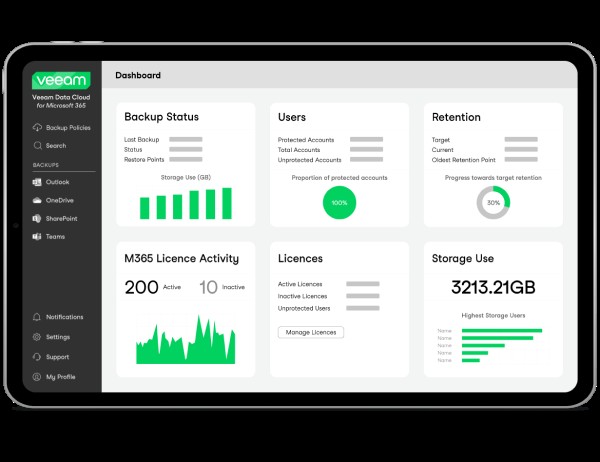
Veeam Data Cloud for Microsoft 365 is a BaaS (Backup as a Service) solution used to back up and restore Microsoft 365 data, including Microsoft Exchange, Microsoft SharePoint, Microsoft OneDrive for Business and Microsoft Teams data.
Red Hat Enterprise Linux (RHEL) is better than all of the operating systems I've used, except for MacOS. MacOS gives the best of both worlds, smooth and clean GUI with tabs for everything you could possibly need, along with the strengths of Red Hat Enterprise Linux (RHEL) with …
Red Hat Enterprise Linux (RHEL) has less content and less attractive desktop offerings, but it offers an easy to use integrated set of tools for customizing and mass deploying Red Hat Enterprise Linux (RHEL). Compared to other options, Red Hat Enterprise Linux (RHEL)'s tooling …
Alpine is an excellent distribution for its niche, and challenging for more general-purpose environments. I think Ubuntu makes an excellent workstation operating system, but I prefer the RHEL paradigm. (I realize I have never used RHEL as a workstation and can't speak to that.)
We demoed several backup solutions when we were scouting for an option, Veeam Data Cloud was by far the easiest to setup and implement, which was critical for a small team supporting over 5 different companies.
First and foremost, Veeam's reputation stood out. They have been a leader in the backup vendors for a few years. That reputation along with recommendations from colleagues sold us on Veeam Data Cloud for Microsoft 365. The other vendors that we did demo's with were lacluster in …
The usability of Veeam Data Cloud surpasses that of the aforementioned applications, in addition to being highly accessible in terms of its licensing model.
La usabilidad de Veean Data Cloud está por arriba de las aplicaciones mencionadas, adicional a que es muy accesible en …
Veeam Data Cloud for Microsoft 365 is simpler to use then each alternative I've tried. Besides Synology, it's also the most cost effective. I also appreciate Veeam includes pricing on their website so I don't have to fill out a form or call someone. I don't like having to wait …
I find Microsoft Windows Server is a much easier OS to deploy and administer. It does require more resources to run, requires more security updates and overall has a larger footprint. Rebooting the Windows Server takes a much longer time than RHEL for example. An administration …
Windows Server blows any of the Linux flavors I've used out of the water. Even after gaining experience with Linux, I'm able to achieve the same results in Windows Server from a command line much quicker than in Linux simply because Windows Server, especially with the …
Windows Server is much easier to work with and it's widely adopted. It have a lot of features and a nice gui. In the other hand linux systems are more robust and often more secure , but the learning curve and technician needed for it are much higher. Depend on the usage you got …
They are different experiences, and while the other solutions offer enterprise-grade stability and, in some cases, address Windows server shortcomings (such as patching), they all do the trick, but the other solutions require a deeper technical background/configuration of items …
It is really all about application support. The only option we really have is Windows Server, and where we can choose we continue to use it for consistency as well as compatibility with the systems where we are forced to use Windows Server).
We've utilized docker and debian for very specific applications and they have been useful - overall Windows Server provides a better package. I would choose VMware ESXi over Windows Server for virtualization as it's far more reliable in our experience. I can't imagine using a …
There are plenty of other server solutions out there which may be better suited for certain tasks, but Windows Server is the way to get a Windows environment going. For simple setups, there are many alternatives, but often there are key features lacking, or a restriction on …
Windows Server is more cost-effective and skills are easier to find to support the products. The deployment and management of the product can be automated with Microsoft SCCM. In my opinion, Linux seems to be more secured but takes more time and effort to learn than Windows …
These are just very different products. They can all have the same functionality but the specific product knowledge with Linux is much higher. This slows down troubleshooting and can leave you with limited options for high end support. There are absolutely good use cases for …
I didn't use any other system which gives the same functionality and I am not aware of any. The full integration between all components and especially the ability to integrate mail via Exchange or even via a hybrid setup with the Ofice365 cloud, including the ability to …
For our more experienced users and for simple web apps we will go the RHEL route but with Windows Server such an industry standard the the ease of use of the GUI it just makes more sense for most applications that use it. It also generally has a lot more interoperability …
Linux is great, but support is harder to come by. You also need to pay linux admins more as it is a much smaller group of people that can support it. Windows is the industry standard with the most support available. Going with another platform just didn't seem to make sense …
I have some basic experience using various builds of Linux and have always found myself coming back to Windows. Perhaps after years of working with Microsoft products they all have a similar feel and configuration options. Microsoft products are my typical first choice where …
We have various servers or appliances that run on various flavors of Linux that do their jobs well, but we configure and manage them very lightly at the OS level. Most of the admin on these devices is sone inside the applications themselves. We don't shy away from new …
All the other products I have used in the past OS2 servers, Novell Netware, Banyan Vines etc don't show up in the search list, which i guess goes to show that the best wins.
I have used/administered several servers using systems like Ubuntu, Debian, and CentOS. While these systems are great in their own rights, you are typically using a command-line interface or shell in order to administrate the system. This requires a lot of commands to be …
For our purposes it came down to picking between Windows and Linux and at the end of the day we picked both. We use Windows for 80% of our server needs to run our Web, File, Print, DHCP, Internal DNS, Active Directory, SQL, Web and other windows based servers. We use linux …
Windows Server has become one of the industry standards for providing file and directory services for the majority of users because of the ease with which it interacts with the common desktop OS, as opposed to needing to provide esoteric support for users to be able to work …
About any linux distro can be setup to handle services that a Windows Server can do, except I have not personally found anything nearly as convenient of a replacement for Active Directory, Group Policy, or an RD Gateway. There are alternatives to those services, they just …
Windows Server is by far the easiest server option to get started with because they offer the same kind of interface with windows that most users are already familiar with. Plus, it's the most graphically friendly option, so it is easy to navigate. Lastly, it is the most …
There's a lot of things that can and can't be discussed. But as I mentioned earlier, cloud computing and on-prem, and very much like in the cloud, having a standard image ISO, deploying that, the configurations with Ansible or packages installed via Ansible, instead of just a Kickstart script, you have a set of scripts that run in a pipeline that deploy Red Hat. So I'd say the environments, every time I've used Red Hat Enterprise Linux as a computing solution has been, like I mentioned, reusable, scalable, positive. And I don't think I've ever found any situations where I wish I were using something other than Red Hat Enterprise Linux, because the support is not there for anything else as much as it is for Red Hat Enterprise Linux.
Analyzing campaign performance is a great area where the Veeam Data Cloud for Microsoft 365 is well-suited, and it’s working well. In the past, when we analyzed campaign performance, we had to use outside vendors, which was a time-consuming, laborious, and costly process.
Anytime I need a server for something, whether to test a new platform or app, devote a server to hosting something, etc., Windows Server is my go-to choice. Recently I needed a new server to host a web server and web application, so I spun up a Windows Server 2025 VM and was up and running in no time at all.
Virtualization, like the operating system level task. I see this product is very good and it blends very well with the middleware components like all the JBoss and other things. And other than that, either you install it or a virtual machine or physical servers, it works seamlessly anywhere. And if you want to go further, like Red Hat OpenShift or those things also work very nice with it.
Price. Red Hat Enterprise Linux (RHEL) can be cheaper for us to use. We pay a lot for these software packages.
Perpetual licensing. Buy it and forget it would be great, with support as an option. this would be a great option for products that can ship with the OS and will see little internet use.
I would like the option to remove users from the backup and set them to an alternate storage location/ archive location. Currently, my backups are at 7 TB, and I would like to segment out data with lower data retention requirements.
Microsoft needs to minimize the update frequency by making the product more secure. It can become very exhausting trying to keep updated if you don't have a dedicated support team. It can become challenging where the business is unable to allow downtime for reboots as part of the update process.
Prone to security and audit vulnerabilities.
The operating system needs more CPU and memory resources compared to other options such as Linux.
Understanding the licensing model can be abit confusing.
Comes with a standard firewall, but not the most secured one available. Would suggest using a more secured firewall as part of your antivirus software.
Due to the number of vulnerabilities and the operating system being a target for hackers, anti-virus software is a must.
Veeam Backup for Microsoft 365 just works so well and is so easy to use. I researched multiple options for Office 365 backup and none seemed to be as easy to setup and use as Veeam Backup for Microsoft 365 and the pricing was very comfortable to us. I can't imagine any reason why we would change away from Veeam Backup for Microsoft 365.
I've carefully reviewed the servers and services currently running on Windows Server 2012, and given the opportunity would renew them as is going forward. There are two systems I currently have in place, one is a very large Linux implementation for a large ecommerce site, and one is a very large backup solution front ended by FTP servers running Linux. Neither are well suited for Windows, but the overall network infrastructure is and will be Windows Server for the foreseeable future.
In order to securely deploy Red Hat Enterprise Linux (RHEL) it has to be installed without a user interface. Administrative tasks through a command line interface can be challenging. Looking up commands and testing them, documentation is often required in order to run the same commands in the future if the changes are infrequent and not practiced often by an administrator.
The interface is simple, but powerful. It's easy to setup, easy to use. It's able to restore individual files and emails with ease. Would like to see the wording on some features cleared up, as it's caused us some confusing learning the tool.
There are simply too many different parts of Windows Server to make it a cohesive piece of software. While some of the newer features found in Windows Server 2012 and 2016 have nice UIs that are logically laid out, there are enough parts of the system that is still based on old code with clunky UIs and confusing options to make Windows Server a particularly user-friendly experience.
We have a lot of data, and pulling backups out of the store sometimes takes a bit of time - but this is within acceptable tolerances. I don't expect restores to be instantaneous, and I can't quantify if the speed is software or data repository.
Red Hat support has really come a long way in the last 10 years, The general support is great, and the specialized product support teams are extremely knowledgeable about their specific products. Response time is good and you never need to escalate.
The setup support we received was extremely helpful. They allowed us to learn as they created the policies and managed the handoff between setup and guided setup very well. This resulted in active, usable policies and us having the knowledge to adapt these as our needs change in the future.
Microsoft's support is hugely wide-ranging from articles online to having to contact them directly for the more serious issues. In recent years when I have contacted them directly, I have found the support o be excellent as I have found myself connected to very knowledgeable people in the field in which I needed the support. The online support available is vast and I tend to find most of the time that there is always someone out there who has had the same issue as me in the past and knows something about how to resolve it! This is the advantage of using industry standard and long-established systems such as Windows Server.
Make sure that you have detailed processes in place for every server instance you plan to install/upgrade, if possible get the base OS loaded and Windows Updates applied ahead of time, and if using a VM take a snapshot prior to installing each role, as well as along the way.
Red Hat Enterprise Linux (RHEL) has less content and less attractive desktop offerings, but it offers an easy to use integrated set of tools for customizing and mass deploying Red Hat Enterprise Linux (RHEL). Compared to other options, Red Hat Enterprise Linux (RHEL)'s tooling is better and easier to work with, and has larger community adoption. The built-in image building tools aren't as nice as kiwi, but they work well enough for basic cases. The content issue is mostly fixed with adding EPEL and it's straightforward to add through the tools to deployments and images. Red Hat Enterprise Linux (RHEL) made sense to select because despite the weaker content set built-in, the large community around it and the equally large ecosystem meant that filling in the gaps was straightforward and not as much of a blocker as it could have been.
First and foremost, Veeam's reputation stood out. They have been a leader in the backup vendors for a few years. That reputation along with recommendations from colleagues sold us on Veeam Data Cloud for Microsoft 365. The other vendors that we did demo's with were lacluster in setup and performance. Veeam Data Cloud for Microsoft 365 immediately won us over.
I find Microsoft Windows Server is a much easier OS to deploy and administer. It does require more resources to run, requires more security updates and overall has a larger footprint. Rebooting the Windows Server takes a much longer time than RHEL for example. An administration task such as expanding a drive in Windows can be very simple, however in RHEL it is not.
It has done wonders for my career because I come from a Linux background, HPUX, Solaris and AIX. So made this transition to Linux 20 years ago. So it has really put my career at the forefront of what we do in the company. We're still primarily a window shop, but with Red Hat and what they're doing with the Kubernetes integration with OpenShift, with the East Satellite Management, the Ansible stuff, all based on Red Hat. It's taken off at my company and we're very happy about it.
The only real impact is from a compliance standpoint. Our company is expected at a regulatory level to be protecting our data and even though the tenant has little traffic there could still be some regulated data in there. We have to be able to tell an auditor that it's being backed up by an enterprise grade solution, and that's what VDC was intended for.