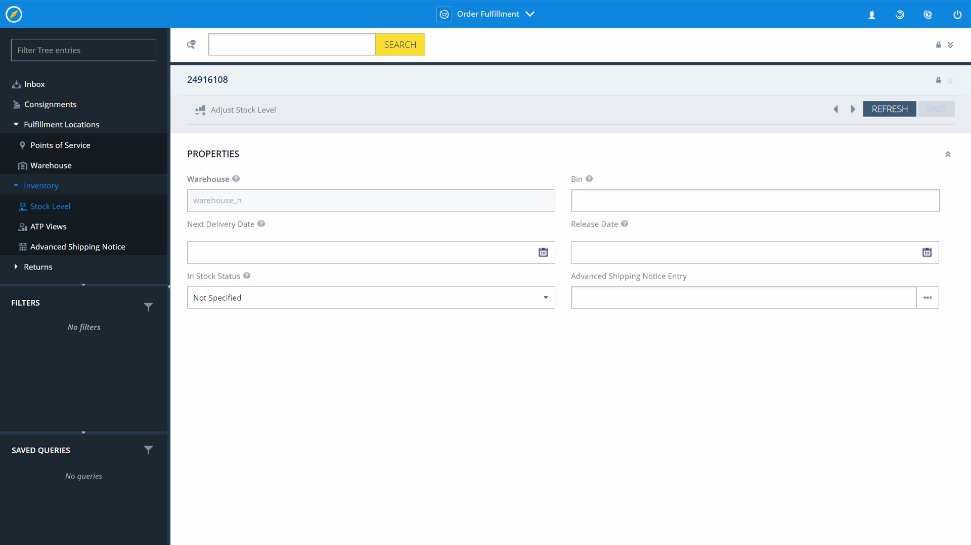
SAP Commerce Cloud (formerly Hybris) is designed to help businesses sell more goods, services, and digital content through every touchpoint, channel, and device through their multichannel ecommerce and order management solution, available as a SaaS or on-premise.
N/A
Tableau Desktop
Score 8.4 out of 10
N/A
Tableau Desktop is a data visualization product from Tableau. It connects to a variety of data sources for combining disparate data sources without coding. It provides tools for discovering patterns and insights, data calculations, forecasts, and statistical summaries and visual storytelling.
$1,380
per year (purchased via a Creator license)
Pricing
SAP Commerce Cloud
Tableau Desktop
Editions & Modules
No answers on this topic
Tableau Creator License
$115
per month (billed annually) per user
Offerings
Pricing Offerings
SAP Commerce Cloud
Tableau Desktop
Free Trial
No
No
Free/Freemium Version
No
Yes
Premium Consulting/Integration Services
No
Yes
Entry-level Setup Fee
No setup fee
No setup fee
Additional Details
—
All pricing plans are billed annually. A Creator license includes Tableau Desktop, Tableau Prep Builder, and Tableau Pulse. Discounts sometimes available for volume.
We chose SAP Commerce Cloud over the other e-commerce platforms because it had integrated B2B and B2C capabilities. It is user-friendly and you can personalize it to make it your own. SAP Commerce Cloud's functionalities met the vast majority of our project requirements.
SAP Commerce Cloud is well-suited for large enterprises requiring robust personalization, seamless multi-channel integration, and the ability to handle high-volume transactions, especially during peak periods like Black Friday. Its scalability and advanced features make it ideal for businesses needing to manage complex product catalogs and global operations.Enough development capacities are needed to have a best in class shop
The best scenario is definitely to collect data from several sources and create dedicated dashboards for specific recipients. However, I miss the possibility of explaining these reports in more detail. Sometimes, we order a report, and after half a year, we don't remember the meaning of some data (I know it's our fault as an organization, but the tool could force better practices).
Centralized Data Management: SAP Commerce Cloud excels in centralizing data from various operational sectors, which is pivotal in the chemicals industry. This feature allows for better oversight and management of complex supply chains, regulatory compliance, and customer interactions. Having a single source of truth for crucial business data minimizes discrepancies and promotes informed decision-making.
Real-Time Data Processing: The real-time data processing capability of SAP Commerce Cloud is invaluable. It aids in timely adherence to regulatory changes and helps in meeting customer demands promptly. In a sector where regulations and market conditions are ever-evolving, real-time data processing is fundamental for maintaining compliance and ensuring customer satisfaction.
An excellent tool for data visualization, it presents information in an appealing visual format—an exceptional platform for storing and analyzing data in any size organization.
Through interactive parameters, it enables real-time interaction with the user and is easy to learn and get support from the community.
It's a little pricey; further cost reductions will expand product selection; also, trained operators are required.
HAC occasionally functions extremely slowly and does not provide any problem messages; it simply gets stuck. Logging into the Backoffice for testing purposes causes a lot of trouble; it does not enable us to log in in one attempt, and the page refreshes every time we enter in the credentials.
SAP Commerce and Spartacus together becomes one of the omnichannel powerhouse of commerce application. It also comes with edge advantage with out of the box integrations with many SAP applications and also non-SAP applciations which gives it edge advantage over other tools. The main reason being the integration becomes easier as SAP shares the common data schema and model across all its product line and new feature releases are compatible with all the SAP product line.
Our use of Tableau Desktop is still fairly low, and will continue over time. The only real concern is around cost of the licenses, and I have mentioned this to Tableau and fully expect the development of more sensible models for our industry. This will remove any impediment to expansion of our use.
More true headless and a more rationale pricing. Since moving from the Hzbris Monolyth towards SAP Commerce Cloud a lot of progress has been made, but dissecting the monolyth into composable components where you just pay for what you use is still a longer journey and here pricing should be more realistic. Things become so expensive once they have the SAP stamp on them (example the SAP CIAM)
Tableau Desktop has proven to be a lifesaver in many situations. Once we've completed the initial setup, it's simple to use. It has all of the features we need to quickly and efficiently synthesize our data. Tableau Desktop has advanced capabilities to improve our company's data structure and enable self-service for our employees.
When used as a stand-alone tool, Tableau Desktop has unlimited uptime, which is always nice. When used in conjunction with Tableau Server, this tool has as much uptime as your server admins are willing to give it. All in all, I've never had an issue with Tableau's availability.
Tableau Desktop's performance is solid. You can really dig into a large dataset in the form of a spreadsheet, and it exhibits similarly good performance when accessing a moderately sized Oracle database. I noticed that with Tableau Desktop 9.3, the performance using a spreadsheet started to slow around 75K rows by about 60 columns. This was easily remedied by creating an extract and pushing it to Tableau Server, where performance went to lightning fast
We have the right to open a ticket or submit request to SAP support teams for all the problems we have experienced. They also provide solutions for critical issues within 48 hours. In addition, the product has support documents such as a user guide and admin guide. In addition, there is a strong community of users. In this way, we can access solution of some specific problems that we have fallen on from there.
Tableau support has been extremely responsive and willing to help with all of our requests. They have assisted with creating advanced analysis and many different types of custom icons, data formatting, formulas, and actions embedded into graphs. Tableau offers a weekly presentation of features and assists with internal company projects.
It is admittedly hard to train a group of people with disparate levels of ability coming in, but the software is so easy to use that this is not a huge problem; anyone who can follow simple instructions can catch up pretty quickly.
I think the training was good overall, but it was maybe stating the obvious things that a tech savvy young engineer would be able to pick up themselves too. However, the example work books were good and Tableau web community has helped me with many problems
Scalability of the product was good Seamless integrations were helped in reducing the implementation for the development team to integrate with the SAP ERP Product framework helped customer to customize and adapt the new features which were developed basis business processes and ease of customer experience. Deployment and creation of the build becomes very easy with the CCv2 setup.
Again, training is the key and the company provides a lot of example videos that will help users discover use cases that will greatly assist their creation of original visualizations. As with any new software tool, productivity will decline for a period. In the case of Tableau, the decline period is short and the later gains are well worth it.
SAP Cloud is much better than GoDaddy. it was a smooth transition and every aspect of the program is easier. My scalability increased greatly from GoDaddy to SAp Commerce Cloud and sales are now tracked easier and inventory is at the touch of a button, making sales much easier than previous software.
I have used Power BI as well, the pricing is better, and also training costs or certifications are not that high. Since there is python integration in Power BI where I can use data cleaning and visualizing libraries and also some machine learning models. I can import my python scripts and create a visualization on processed data.
The business users/admins were able to quickly segment products by brand, allowing for unique branding and header-less page design. As new products are added to the SAP backend, all characteristics and pricing automatically migrate to Commerce Cloud. We also segment our user sign-on (domains) by brand and allow targeting displays.
Tableau Desktop's scaleability is really limited to the scale of your back-end data systems. If you want to pull down an extract and work quickly in-memory, in my application it scaled to a few tens of millions of rows using the in-memory engine. But it's really only limited by your back-end data store if you have or are willing to invest in an optimized SQL store or purpose-built query engine like Veritca or Netezza or something similar.
It has a positive impact on my client's business and ROI is higher than expected. As orders count is increasing due to smooth and better experience.
My current client's customers have given very positive experience about new website built on SAP Commerce Cloud.
Due to SAP Commerce Cloud website rollout is very easy and due to it, my current client has introduced around 25 websites. As SAP Commerce Cloud logic needs to develop once and can be reused for multiple websites easily with minimal effort.
Branding is also very easy as promotions, events can be implemented on the website easily and with minimum time.
SAP Commerce has helped our client to integrate the Recommendation tool ISS which is easy to configure after this tool product sale is increased. The best thing was that integration was very easy and quick.
One option of Blue/Green deployment helping us to check the production release in advance on production environment. Prev we don't have this option and many times face P1 issue in prod which had ruined client reputation. But now this feature is helping lot
Tableau was acquired years ago, and has provided good value with the content created.
Ongoing maintenance costs for the platform, both to maintain desktop and server licensing has made the continuing value questionable when compared to other offerings in the marketplace.
Users have largely been satisfied with the content, but not with the overall performance. This is due to a combination of factors including the performance of the Tableau engines as well as development deficiencies.