Splunk is software for searching, monitoring, and analyzing machine-generated big data, via a web-style interface. It captures, indexes and correlates real-time data in a searchable repository from which it can generate graphs, reports, alerts, dashboards and visualizations.
N/A
Splunk IT Service Intelligence (ITSI)
Score 10.0 out of 10
N/A
Splunk supports IT operations analytics with the Splunk IT Service Intelligence premium offering, a software application available to subscribers to Splunk Cloud or Splunk Enterprise log analytics and SIEM platforms.
N/A
Splunk Observability Cloud
Score 8.4 out of 10
N/A
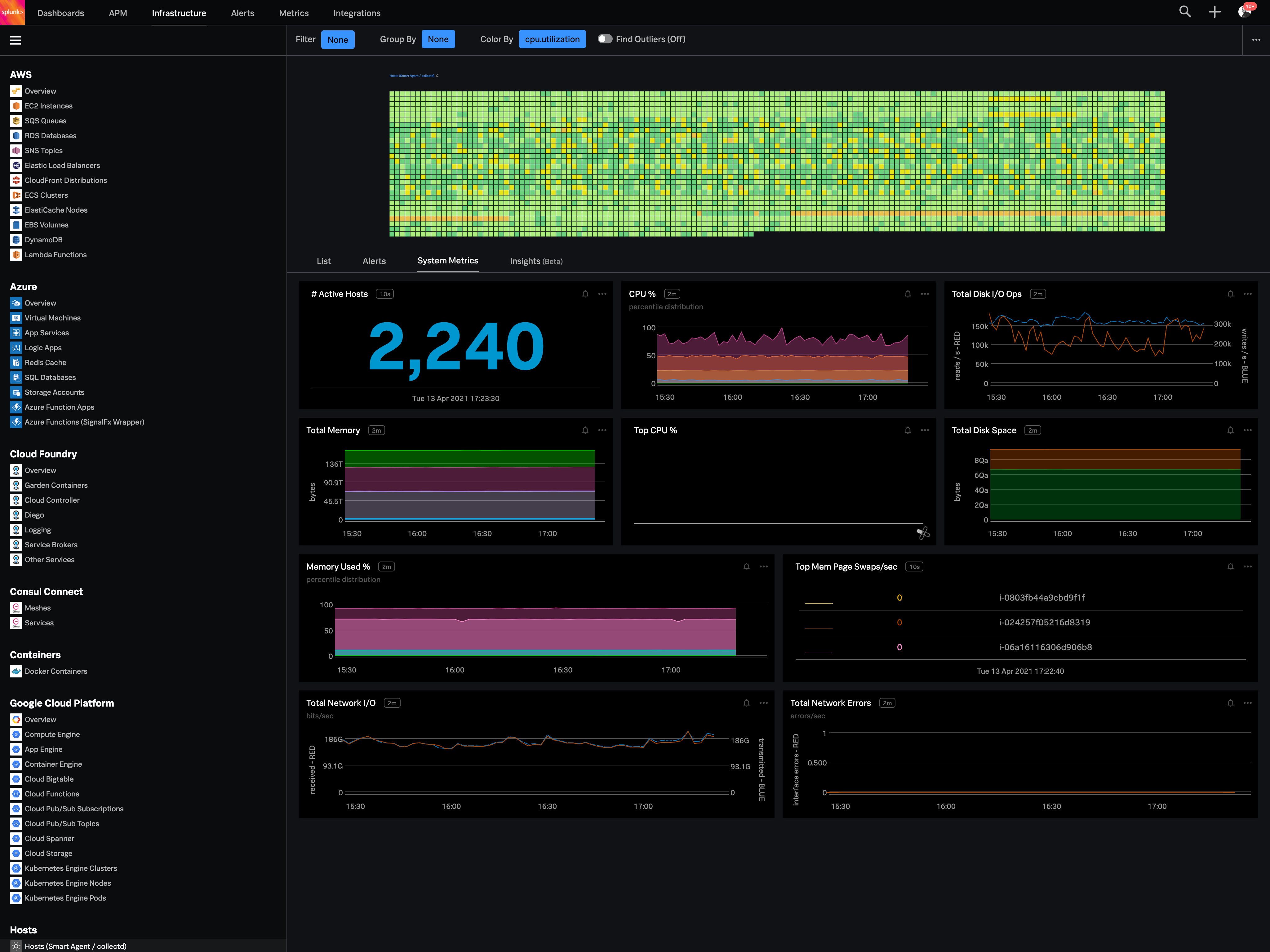
Splunk Observability Cloud aims to enable operational agility and better customer experience through real-time AI-driven streaming analytics allowing accurate alerts in seconds. It is designed to shorten MTTD and MTTR by providing real-time visibility into cloud infrastructure and services.
I have not used any other product like Splunk IT Service Intelligence. The Splunk IT Service Intelligence can be applied across all the information you have in your Splunk environment. You can correlate the events with Splunk IT Service Intelligence and use it as an APM tool or …
Splunk ITSI provides a holistic methodology for collecting and utilizing telemetry data that most other "basic" monitoring technologies and products in this space do not. By allowing us to model our ecosystem's components and services, Splunk ITSI observes and reports at a …
It's able to quickly detect and resolve issues across the entire spectrum of deployments including on-premises, public cloud, private cloud, hybrid cloud and multicloud
It's well suited for what I do, which is network security operations. And that's for anything from troubleshooting incidents, troubleshooting performance, troubleshooting for the purpose of a compliance and auditing. It's not best suited for users who are new in terms of they're new to the product and they have expectations that probably Splunk cannot meet.
Splunk ITSI is a great tool (and toolbox) for combining together numerous and varied monitoring regimes to bring more holistic analysis and reduce alert fatigue. By leveraging the Splunk ITSI service and KPI modeling regime, ecosystem telemetry can be turned into a more reliable, clearer, high-level perspective on the current state of your components and services.
Its great if you need real-time visibility across complex or regulated environments. Also strong for hybrid or multi-cloud setups where uptime, observability and fast IR are required. It’s probably overkill for smaller teams or environments that don’t have constant changes or compliance reporting needs. It's expensive and has a steep learning curve. Also, in my opinion, do not get yourself into a consumption based model. Costs can certainly get out of control quickly.
The first one is its Kubernetes container monitoring.
I really like this features because as we know how much K8s is vast and to manually monitor each part of the Kubernetes it takes so much time but Splunk Observability Cloud makes it easier. And even once we integrate K8s with Splunk Observability Cloud it gives us some prebuilt dashboards which gives holistic view of our Cluster and its nodes, pods, etc.
The dashbaord feature of Splunk Observability Cloud, it gives us full flexibility to customize our dashboard with a wide range of predefined chart types.
Now it also supports OTEL, which is a plus point for observability. As now everyone is moving towards Otel and in current market there are only few tools who supports OTEL based integrations, Splunk Observability Cloud is one out of them.
You can use table-like functionality to generate dashboards, but these queries are heavy on the system.
It could be easier to give insight into what type of line parsing is used for specific documents in a company-managed environment and/or show ways to gain the insights needed.
I would like to see ways to anonymize specific data for shared reports without pre-formatting this in a dashboard on which reports could be based.
We are using Splunk extensively in our projects and we have recently upgraded to Splunk version 6.0 which is quite efficient and giving expected results. We keep track of updates and new features Splunk introduces periodically and try to introduce those features in our day to day activities for improvement in our reporting system and other tasks.
We have replaced our monitoring platform with Splunk & ITSI, and with the success, it's seen at our organization thus far we would be hard-pressed to pivot to another tool. Frankly, our business partners and application teams love Splunk & ITSI.
Good: Stable system with low error rate Easy to use for simple use cases Bad: UI is not very clear for complex usage Mobile view (when logged in from phone) is bad No library for .net
You can literally throw in a single word into Splunk and it will pull back all instances of that word across all of your logs for the time span you select (provided you have permission to see that data). We have several users who have taken a few of the free courses from Splunk that are able to pull data out of it everyday with little help at all.
Splunk IT Service Intelligence (ITSI) is a platform with extended functionality and provides various functionalities which can be utilized to improve the efficiency and accuracy in analyzing the data and detecting the attacks.
When there is an issue, it’s a win if one can easily identify the root cause. To do the same, it should allow the user to dig deep with multiple data points and compare the data and identify the anomaly. In this use case, it’s good to drive from Splunk 011y.
Splunk maintains a well resourced support system that has been consistent since we purchased the product. They help out in a timely manner and provide expert level information as needed. We typically open cases online and communicate when possible via e-mail and are able to resolve most issues with that method.
During POC, pre-planning, and implementation, we have had interactions with numerous folks at Splunk. Everyone from sales & engineering to markets analysts to specific IT component SMEs, and a small professional services engagement to get started. They have all been exceptionally helpful and go above and beyond the call of duty. They actively reach out to ensure success is being realized and find ways to help proactively, instead of having to simply open support cases with the vendor.
The online course was simple clear and described the main capabilities of the solution. There is also an initial module that can be done for free so anyone can familiarize themselves with the functionality of this solution. On the other hand, however, there could be more free online courses. Maybe even with a certificate, this would broaden the group of people who are familiar with the platform while increasing familiarity with the solution itself.
I didn't get to fully evaluate Logstash as our corporation was already using Logstash, but both seemed like viable solutions to the problem that we were having. I wanted to evaluate Logstash some more, both did seem like they would work for the business needs that we had, we went with splunk as many teams were already using it.
Splunk has raised itself as a platform not just as a tool unlike other products in the market. If I talk about Moogsoft it also has similar capabilities but Splunk ITSI has more visibility and its GUI is making a different impact on the users. ServiceNow and Splunk are equally capable products however Splunk seems to have more tech-savvy people tools than ServiceNow.
Splunk Infrastructure Monitoring provides far superior options for anybody using a complex hybrid multi-cloud environment and allows both your SOC and NOC to work together on the same data while driving their own insights. We found other products are still in the old world view of servers and agents residing together within a single data centre, but modern apps are no longer like this.
I don't have any numbers to share but Splunk has positively served as a 24/7 monitoring tool that has saved hours of work by self-detecting, saving statistics and alerting problems in the system or from external interfaces as soon as they happen.
Splunk dashboards does a solid job in collecting, analyzing data and creating reports that contain an entire day's activity and then automatically sent out to the business.
Splunk is very easy to learn and very useful to any program or business application.
Splunk ITSI has reduced the number of alerts exposed to our Network Operations Center by 100x while increasing the context around outages.
Splunk ITSI has increased the accuracy of our incident detection by leveraging the Event Analytics system to weigh the behavior of the many characteristics of each component together instead of independently.
Splunk ITSI has reduced our incident MTTR (mean time to restore) by detecting issues faster, presenting them more clearly, and surfacing the salient details about the underlying issue.