Adobe Captivate is an elearning authoring and course design tool (or LCMS). It supports mobile HTML5 content. Captivate’s users are commonly midsized businesses to enterprises. Adobe Captivate includes some prebuilt assets as well as customizable workflows.
$33.99
per month
Articulate 360
Score9.2 out of 10
N/A
Articulate 360 is an e-learning platform for creating workplace training. Users can build engaging courses with AI-enhanced authoring, simplify collaboration, and quickly share content. A subscription includes robust onboarding resources and access to a community of 1.5M pros.
$1,449
per year per user
Pricing
Adobe Captivate
Articulate 360
Editions & Modules
Subscription
$33.99
per month
Student & Teacher Edition
$399
one-time fee
Upgrade
$499
one-time fee
Pereptual License
1,299
one-time fee
Articulate 360 AI - Personal Plan
$1,449
per year
Articulate 360 AI - Teams Plan
$1,749
per year
Frontline
Starting at $500
Offerings
Pricing Offerings
Adobe Captivate
Articulate 360
Free Trial
Yes
Yes
Free/Freemium Version
No
No
Premium Consulting/Integration Services
No
No
Entry-level Setup Fee
No setup fee
Optional
Additional Details
—
If you’re new to Articulate 360, you can try it out free of charge. After the trial period is over, you can subscribe to one of the following packages:
Articulate 360 AI
Teams plan: $1,749 per user per year
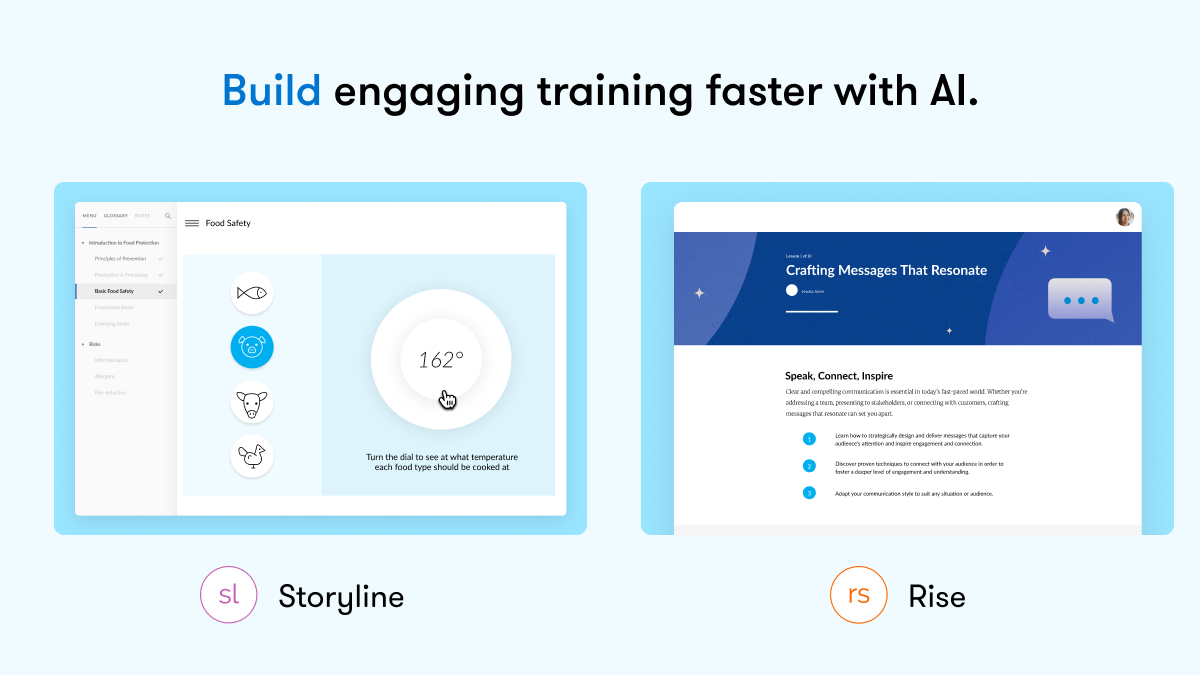
Rise: Build beautiful training that automatically adapts to every screen
Storyline: Create deeply custom, interactive courses
AI generation: Guide AI to draft complete courses and other formats from source material
Collaboration: Get stakeholder input, share for review, and finalize faster
Integrations: Stay in your flow of work with connections to Google Drive, OneDrive, Claude, ChatGPT, and more
Flexible distribution: Share trackable links, export to your LMS, use our native LMS—Reach—or download in more formats
AI tutor: Give learners personalized, in-context guidance and coaching
Analytics: Track engagement and completion, with insights to improve effectiveness
Advanced workflows available with credits (purchased separately)
Personal plan: $1,449 per user per year
Rise: Build beautiful training that automatically adapts to every screen
Storyline: Create deeply custom, interactive courses
AI generation: Guide AI to draft complete courses and other formats from source material
Review: Get stakeholder input, share for review, and finalize faster
Integrations: Stay in your flow of work with connections to Google Drive, OneDrive, Claude, ChatGPT, and more
Flexible distribution: Share trackable links, export to your LMS, use our native LMS—Reach—or download in more formats
AI tutor: Give learners personalized, in-context guidance and coaching
Analytics: Track engagement and completion, with insights to improve effectiveness
Advanced workflows available with credits (purchased separately)
Frontline: Starting at $500
Complete training kits: Turn source content into a connected set of training assets, with the right mix of formats chosen for what you're trying to teach
Formats that fit the job: Create training decks, guides, scenarios, interactive videos, and quick references, each built for a different training need
Quick updates and editing: Use AI to quickly update a whole kit, individual format, or specific sections
Insights and analytics: Gather data from surveys, track engagement and completion, and see what questions your team has to improve effectiveness
Easy distribution: Share trackable links anywhere your team already works: Slack, Microsoft Teams, email, or text
Integrations: Stay in your flow of work with connections to Google Drive, OneDrive, Claude, ChatGPT, and more
AI avatars: Create presenter-led videos, no filming required
Multi-format translation: Translate each output into 80+ languages in a click
AI tutor: Give learners personalized, in-context guidance and coaching
A de minimis incentive was given to thank the reviewer for their time. The incentive was not used to bias or drive a particular response, nor was the incentive contingent on a positive endorsement. More Info
Verified User
Chose Adobe Captivate
I think Captivate has more features to customized learning. However, Articulate 360 is more straight to the point and less hassle to use because of the limited features.
A de minimis incentive was given to thank the reviewer for their time. The incentive was not used to bias or drive a particular response, nor was the incentive contingent on a positive endorsement. More Info
Director, Digital Learning in Sales at Bluegreen Vacations (Hospitality, 5001-10,000 employees)
Chose Adobe Captivate
Adobe Captivate is perfect for advanced users or users who want to create innovative content. The restrictions are limited to how much/how little a user knows about Adobe Captivate and its features. On this note, beginners may have an easier time getting familiar with and …
A de minimis incentive was given to thank the reviewer for their time. The incentive was not used to bias or drive a particular response, nor was the incentive contingent on a positive endorsement. More Info
Learning and Development Specialist in Human Resources at Cellular Sales (Retail, 5001-10,000 employees)
Chose Adobe Captivate
I think that Articulate360 is more user-friendly and has a cleaner, more updated look. If you can edit a PDF, then you can use Articulate 360. Adobe Captivate may be more challenging for the designer, but it has more features. We chose Adobe Captivate because we want the option …
A de minimis incentive was given to thank the reviewer for their time. The incentive was not used to bias or drive a particular response, nor was the incentive contingent on a positive endorsement. More Info
Verified User
Chose Adobe Captivate
I prefer Articulate 360 over Adobe Captivate. While Captivate does have more features overall, Articulate 360 is much easier to navigate and nice, clean courses can be created in a fraction of the time.
A de minimis incentive was given to thank the reviewer for their time. The incentive was not used to bias or drive a particular response, nor was the incentive contingent on a positive endorsement. More Info
Verified User
Chose Adobe Captivate
Adobe Captivate is an okay software program, but it is not something I'd pick over Articulate Storyline or Articulate 360. I only selected Captivate because it was mandatory for my course plus I wanted to explore it to find out how it worked. But after using it, I didn't find …
A de minimis incentive was given to thank the reviewer for their time. The incentive was not used to bias or drive a particular response, nor was the incentive contingent on a positive endorsement. More Info
Corporate Trainer in Corporate at Bank of the Pacific (Banking, 201-500 employees)
Chose Adobe Captivate
Articulate 360 offers a both Storyline and Rise as eLearning authoring tools, as well as a Stock Library with over 100,000 images for $1200/year. Adobe Captivate is a stand alone product for $30/month. If you are only using eLearning authoring tools the cost is significantly …
A de minimis incentive was given to thank the reviewer for their time. The incentive was not used to bias or drive a particular response, nor was the incentive contingent on a positive endorsement. More Info
A de minimis incentive was given to thank the reviewer for their time. The incentive was not used to bias or drive a particular response, nor was the incentive contingent on a positive endorsement. More Info
Training Specialist in Research & Development at American Homes 4 Rent (Real Estate, 1001-5000 employees)
Chose Adobe Captivate
I use Camtasia for video editing, however, we have Premier Pro and are now learning to use it. Camtasia and Snagit we use for smaller projects. For bigger projects, we use them all.
A de minimis incentive was given to thank the reviewer for their time. The incentive was not used to bias or drive a particular response, nor was the incentive contingent on a positive endorsement. More Info
Verified User
Chose Adobe Captivate
We are looking for easier templates, automated features, simulations, interactivity activities, and collaboration features.
A de minimis incentive was given to thank the reviewer for their time. The incentive was not used to bias or drive a particular response, nor was the incentive contingent on a positive endorsement. More Info
Verified User
Chose Adobe Captivate
Articulate currently has some benefits over Captivate in flexibility and responsive design, but I think these are being addressed in the next version of Captivate. Articulate is also more fiddly. Mac support is important to our users, who are majority Mac users.
A de minimis incentive was given to thank the reviewer for their time. The incentive was not used to bias or drive a particular response, nor was the incentive contingent on a positive endorsement. More Info
A de minimis incentive was given to thank the reviewer for their time. The incentive was not used to bias or drive a particular response, nor was the incentive contingent on a positive endorsement. More Info
Verified User
Chose Adobe Captivate
Adobe Captivate is much more powerful than the Articulate products. It can take your training much further. If you can imagine it, you ca create it in Captivate. It also makes it easy to maintain simulations as they are recorded a individual pages making it easy to make a quick …
A de minimis incentive was given to thank the reviewer for their time. The incentive was not used to bias or drive a particular response, nor was the incentive contingent on a positive endorsement. More Info
Verified User
Chose Adobe Captivate
Adobe Captivate is superior in 360 view courseware development. It's outstanding and a delight to work with. That's about it. Unfortunately, Articulate dominates in everything else.
A de minimis incentive was given to thank the reviewer for their time. The incentive was not used to bias or drive a particular response, nor was the incentive contingent on a positive endorsement. More Info
A de minimis incentive was given to thank the reviewer for their time. The incentive was not used to bias or drive a particular response, nor was the incentive contingent on a positive endorsement. More Info
Verified User
Chose Adobe Captivate
While I prefer Storyline for its ease of use, I also use Captivate to accomplish advanced learning training.
A de minimis incentive was given to thank the reviewer for their time. The incentive was not used to bias or drive a particular response, nor was the incentive contingent on a positive endorsement. More Info
Senior Instructional Designer in Customer Service at Kerauno (Computer Software, 51-200 employees)
Chose Adobe Captivate
Adobe Captivate has more robust functionality than any of its competition. It is truly an all-in-one content creation tool that lets you create everything from the most simple to the most advanced eLearning modules. Moreover, it allows you to have more minute control over every …
A de minimis incentive was given to thank the reviewer for their time. The incentive was not used to bias or drive a particular response, nor was the incentive contingent on a positive endorsement. More Info
eLearning Technology Systems Analyst in Information Technology at Ann & Robert H. Lurie Children's Hospital of Chicago (Hospital & Health Care, 1001-5000 employees)
Chose Adobe Captivate
Whereas Articulate offers previews of production slides for mobile screen size, Captivate lets you design and edit content in a simulated mobile display. The ability to decide how content will behave when it encounters a mobile screen is immeasurably valuable. This is the …
A de minimis incentive was given to thank the reviewer for their time. The incentive was not used to bias or drive a particular response, nor was the incentive contingent on a positive endorsement. More Info
A de minimis incentive was given to thank the reviewer for their time. The incentive was not used to bias or drive a particular response, nor was the incentive contingent on a positive endorsement. More Info
Director, Technology and Learning Development in Human Resources at Joelearning.com (Education Management, 1-10 employees)
Chose Adobe Captivate
There is no comparison (in my humble opinion). My production cycle is much faster with Articulate products (all of them) and I don't have the issues with YouTube playback that I do with Captivate 9. It's a simple matter of not wanting to expend time and effort to fix …
A de minimis incentive was given to thank the reviewer for their time. The incentive was not used to bias or drive a particular response, nor was the incentive contingent on a positive endorsement. More Info
Articulate Global Inc.
Verified User
Chose Articulate 360
Adobe Captivate is not very user friendly and seems to provide less features than Articulate 360. It was very easy to learn Articulate 360 on my own and am consistently testing it’s abilities.
A de minimis incentive was given to thank the reviewer for their time. The incentive was not used to bias or drive a particular response, nor was the incentive contingent on a positive endorsement. More Info
Trainer at University of California (Higher Education, 10,001+ employees)
Chose Articulate 360
I think Articulate is more user friendly than Adobe Captivate, but it is nice in captivate that you can put in xy coordinates. TechSmith offers less features, but is more user friendly.
A de minimis incentive was given to thank the reviewer for their time. The incentive was not used to bias or drive a particular response, nor was the incentive contingent on a positive endorsement. More Info
Content Developer II in Corporate at Moss and Associates (Construction, 1001-5000 employees)
Chose Articulate 360
I used Adobe Captivate when I first started my role as an ID. After doing some research, I found Articulate 360 and have been hooked since. I immediately sold my leader on the idea to invest in the tool.
A de minimis incentive was given to thank the reviewer for their time. The incentive was not used to bias or drive a particular response, nor was the incentive contingent on a positive endorsement. More Info
Verified User
Chose Articulate 360
It is light years ahead of Adobe Captivate with way better functionality and design capability.
A de minimis incentive was given to thank the reviewer for their time. The incentive was not used to bias or drive a particular response, nor was the incentive contingent on a positive endorsement. More Info
A de minimis incentive was given to thank the reviewer for their time. The incentive was not used to bias or drive a particular response, nor was the incentive contingent on a positive endorsement. More Info
Verified User
Chose Articulate 360
Articulate 360 has more options, better options for sharing and collaborating and is over all easier to use. The interface is intuitive as the blocks are present on the page. The UI feels modern, versus what the others have. Tried and true does not seem to be what Articulate …
A de minimis incentive was given to thank the reviewer for their time. The incentive was not used to bias or drive a particular response, nor was the incentive contingent on a positive endorsement. More Info
Verified User
Chose Articulate 360
Articulate 360's capabilities eliminate the need for multiple applications, saving time and the constant need to redesign.
A de minimis incentive was given to thank the reviewer for their time. The incentive was not used to bias or drive a particular response, nor was the incentive contingent on a positive endorsement. More Info
Sr. Instructional Designer at On Center Software by ConstructConnect (Construction, 1001-5000 employees)
Chose Articulate 360
Captivate classic looks fresh from the 90s and I think their new version is just trying to copy Rise but they're building it as they release it so, in my experience, it's woefully incomplete and frustrating to use. Articulate 360 can do so much more, easier, and they push out …
A de minimis incentive was given to thank the reviewer for their time. The incentive was not used to bias or drive a particular response, nor was the incentive contingent on a positive endorsement. More Info
A de minimis incentive was given to thank the reviewer for their time. The incentive was not used to bias or drive a particular response, nor was the incentive contingent on a positive endorsement. More Info
Verified User
Chose Articulate 360
Captivate and Storyline are very similar with basic functions but at the time we switched, Storyline seemed to surpass Captivate with the use of states and triggers. It is possible that we did not take the time to learn some functions in Captivate.
A de minimis incentive was given to thank the reviewer for their time. The incentive was not used to bias or drive a particular response, nor was the incentive contingent on a positive endorsement. More Info
A de minimis incentive was given to thank the reviewer for their time. The incentive was not used to bias or drive a particular response, nor was the incentive contingent on a positive endorsement. More Info
Verified User
Chose Articulate 360
I typically reach for Articulate 360 because of the ease of use and publishing. I also choose Articulate 360 because of the variety of learning activities learners can complete.
A de minimis incentive was given to thank the reviewer for their time. The incentive was not used to bias or drive a particular response, nor was the incentive contingent on a positive endorsement. More Info
A de minimis incentive was given to thank the reviewer for their time. The incentive was not used to bias or drive a particular response, nor was the incentive contingent on a positive endorsement. More Info
Verified User
Chose Articulate 360
Articulate is more user-friendly. Has an easy-to-understand interface. Interactions are not complicated to build. Personally, I found Storyline easy to open up and start working with. I also think my students find it to be user-friendly. The eLearning Brothers tutorials …
A de minimis incentive was given to thank the reviewer for their time. The incentive was not used to bias or drive a particular response, nor was the incentive contingent on a positive endorsement. TR verified that a representative sample of customers was invited. More Info
Verified User
Chose Articulate 360
Captivate is also a well-recognized authoring tool in the e-Learning industry. I find it isn't as intuitive as Articulate, and perhaps a bit harder to pick up and run with.
A de minimis incentive was given to thank the reviewer for their time. The incentive was not used to bias or drive a particular response, nor was the incentive contingent on a positive endorsement. More Info
Senior Instructional Designer at Dish (E-Learning, 1001-5000 employees)
Chose Articulate 360
Articulate 360 is the industry leader for e-learning authoring. While we use the Adobe Creative Suite for artistic support, we find that when it comes to authoring tools, Articulate products are superior in both design and accessibility. Articulate 360 has strong support …
A de minimis incentive was given to thank the reviewer for their time. The incentive was not used to bias or drive a particular response, nor was the incentive contingent on a positive endorsement. More Info
Verified User
Chose Articulate 360
Articulate 360 is much more intuitive and user-friendly than other products. If you can imagine it, you can probably build it in Storyline, but it won’t take you weeks' worth of learning and reading to figure it out.
A de minimis incentive was given to thank the reviewer for their time. The incentive was not used to bias or drive a particular response, nor was the incentive contingent on a positive endorsement. More Info
Verified User
Chose Articulate 360
Articulate 360 is easier to use out of the box. It is much more intuitive and does not require as much specialized knowledge. It makes learning design simple and fun. It also allows for just as much customization and looks just as good. It really is a seamless piece of software.
A de minimis incentive was given to thank the reviewer for their time. The incentive was not used to bias or drive a particular response, nor was the incentive contingent on a positive endorsement. More Info
instructional designer in Professional Services at ID for Hire (E-Learning, 1-10 employees)
Chose Articulate 360
The functionality, which includes layers,
triggers, states, and variables, provides flexibility and creative
possibilities that can’t be found in any other authoring tools.
A de minimis incentive was given to thank the reviewer for their time. The incentive was not used to bias or drive a particular response, nor was the incentive contingent on a positive endorsement. More Info
Verified User
Chose Articulate 360
Articulate 360 offers more variety and is easier to use. For me, if you can use PowerPoint, you can use Storyline.
A de minimis incentive was given to thank the reviewer for their time. The incentive was not used to bias or drive a particular response, nor was the incentive contingent on a positive endorsement. More Info
Verified User
Chose Articulate 360
Articulate 360 leaves Captivate in the dust. The look and feel of Articulate 360 products is so much more sleek and flexible. Captivate feels constrained and clunky in comparison.
A de minimis incentive was given to thank the reviewer for their time. The incentive was not used to bias or drive a particular response, nor was the incentive contingent on a positive endorsement. More Info
Instructional Designer - Sales Enablement in Marketing at NiCE (Computer Software, 1001-5000 employees)
Chose Articulate 360
The wide breadth of options that Articulate 360 offers is very real boon. Being able to implement simple, Cloud based builds and more robust, from scratch trainings and modules all in one place across different offerings is very helpful. I enjoy that it is easy to implement …
A de minimis incentive was given to thank the reviewer for their time. The incentive was not used to bias or drive a particular response, nor was the incentive contingent on a positive endorsement. More Info
A de minimis incentive was given to thank the reviewer for their time. The incentive was not used to bias or drive a particular response, nor was the incentive contingent on a positive endorsement. More Info
A de minimis incentive was given to thank the reviewer for their time. The incentive was not used to bias or drive a particular response, nor was the incentive contingent on a positive endorsement. More Info
Adobe Captivate and Articulate 360 are both Corporate Learning Management Systems with a focus on eLearning content authoring. They are both most commonly used by large businesses and enterprises but have some users across company sizes.
Adobe Captivate focuses on providing more advanced eLearning authoring tools, including support for VR, improved accessibility, and interactive content. Its goal is to facilitate highly engaging and interactive content for creators with the proper experience. In contrast, Articulate 360 provides sub-applications designed to support all levels of creator experience and expertise. This can make Articulate ideal for larger groups with creators across the skill spectrum.
Features
Adobe Captivate and Articulate 360 differentiate by their ideal skill level, with features tailored to each target audience.
Adobe Captivate excels at providing knowledgeable creators with the widest range of content creation capabilities. In particular, Captivate prioritizes supporting interactive content, including branching content paths within courses. This focus allows creators to make highly engaging content for end-learners. It also offers strong reporting capabilities within courses.
Articulate 360 differentiates by making content creation more accessible to a wider range of creators and users. Its sup-applications, such as Storyline and Rise, provide options to serve creators at various skill levels. Rise in particular serves less experienced creators and has a much lower learning curve. Articulate also emphasizes its accessibility across mobile devices and for disabled folks.
Limitations
Adobe Captivate and Articulate 360’s respective specializations also come with some limitations worth considering.
Adobe Captivate’s advanced capabilities come with a steep learning curve. Many reviewers argue that the platform is intimidating for beginners and takes time to learn how to make the most of the tool. This curve often means that Captivate is not ideal for rapid eLearning development. Captivate is also priced separately from the rest of the Adobe suite, which limits the cost benefits of bundling some Adobe products.
In contrast, Articulate 360 may lack some of the more advanced features that Captivate offers. Additionally, collaboration for creator teams within the platform is still limited and difficult to use according to many reviewers. Updates to the product have also been known to create new errors in preexisting courses, so users should be conscious of possible change management that may be necessary. The pricing can also be high if the organization is not making courses at volume.
Pricing
Adobe Captivate offers 3 pricing systems for new buyers. Users can subscribe to Captivate for $33.99/month, or purchase a perpetual license for $1,299. Students or teachers can purchase Captivate for $399 instead. Adobe also offers a free 30-day trial.
Articulate 360 is priced differently for companies, freelancers, and academics. For companies, the Teams Plan costs $1,299/user/year, with additional collaboration and support features available. The Personal Plan costs $999/user/year. For academics, the Person Plan costs $499/user/year and the Teams Plan costs $649/user/year.
Features
Adobe Captivate
Articulate 360
Learning Management
Comparison of Learning Management features of Adobe Captivate and Articulate 360
Feature
Adobe Captivate
9.1
31 Ratings
5% above category average
Articulate 360
-
Ratings
Course authoring
8.030 Ratings
00 Ratings
Course catalog or library
9.018 Ratings
00 Ratings
Player/Portal
8.024 Ratings
00 Ratings
Learning content
9.024 Ratings
00 Ratings
Progress tracking & certifications
9.026 Ratings
00 Ratings
Learning reporting & analytics
9.019 Ratings
00 Ratings
Social learning
10.014 Ratings
00 Ratings
Gamification
8.02 Ratings
00 Ratings
eLearning Content
Comparison of eLearning Content features of Adobe Captivate and Articulate 360
Captivate is well suited for instruction designers who want to build attractive, personalized, interactive, energetic lessons. It's also a good choice for someone who wants to build something innovative because Captivate gives the developer so much control over so many aspects.
But if someone wanted something built quickly, generically and didn't care about holding the viewer's attention, then Captivate might be an expensive tool. That person might be more satisfied with a cheaper and easier to learn authoring tool.
A de minimis incentive was given to thank the reviewer for their time. The incentive was not used to bias or drive a particular response, nor was the incentive contingent on a positive endorsement. More Info
It is pretty well suited for information sharing. Where it lacks is training that requires discussions or a lot of complex thinking or decision-making. For content like that, we will usually host live sessions so we can facilitate discussions and actually hear from the learners on how they are using the material that they may have learned in a Rise course
A de minimis incentive was given to thank the reviewer for their time. The incentive was not used to bias or drive a particular response, nor was the incentive contingent on a positive endorsement. More Info
Quickly adding in graphics, text, and interactive buttons.
Has extensive variables and branching for additional customization, beyond the competition.
Has 360 degree capability which competitors don't offer (I have not used this feature).
High degree of customization and personalization.
True responsive screen display on all devices, viewable as you are creating the training. This is different than some competitors - some just shrink the screen, but Adobe Captivate allows actually removing or moving or changing items at different screen sizes.
If you like Flash, it has Flash output, although it's going away in 2020. Personally, I think this is an outdated technology.
Many advanced capabilities. I chose this product due to the capabilities.
Comes with assets, templates, people, head shots, and full body—excellent.
Adobe Captivate is the authoring tool. It integrates with Adobe Captivate Prime - which I highly recommend if you want to truly take advantage of all of its features in reporting, administration, compliance, and social learning. (I didn't use Prime because you essentially need 100+ students to affordably use Prime.) If you look at my chart of what Captivate is capable of, I can't say that Captivate has a lot of the reporting features because they are part of Prime/SCORM, although, with Captivate's customization, you might be able to do most of them if you are up to it, but I did not.
A de minimis incentive was given to thank the reviewer for their time. The incentive was not used to bias or drive a particular response, nor was the incentive contingent on a positive endorsement. More Info
A de minimis incentive was given to thank the reviewer for their time. The incentive was not used to bias or drive a particular response, nor was the incentive contingent on a positive endorsement. TR verified that a representative sample of customers was invited. More Info
Clunky interface, it takes a lot of extra clicks to get places compared to other Adobe apps and competitor's eLearning software.
Would be nice if it was part of creative cloud, or at least in the group of apps you can add through Creative Cloud.
More regular and meaningful updates. Compared to flagship apps like Photoshop, Illustrator, etc. Captivate is like the read headed step child. Competitors excel at providing regular updates with clear change documentation. How are we still using Captivate 2019 in 2022?
The interface feels like it is still stuck in the 90s, would be nice if it was more modern and better in-line with flagship adobe offerings.
Variables and associated menus are a nuisance to work with vs some of the clever drop down and content-sensitive options in Articulate Storyline.
A de minimis incentive was given to thank the reviewer for their time. The incentive was not used to bias or drive a particular response, nor was the incentive contingent on a positive endorsement. More Info
We have hundreds of courses that were created in Adobe Captivate. It will take us a while to convert to Articulate. We'll need a license for another year and/or until Adobe comes out with a true update to the software.
A de minimis incentive was given to thank the reviewer for their time. The incentive was not used to bias or drive a particular response, nor was the incentive contingent on a positive endorsement. More Info
This has been a huge time saver with all the new features. It has become a trusted platform for ease of use and reliability. Cost per license continues to stay at a good point for renewal. Using it to think outside of our current needs and innovate in a timely manner.
A de minimis incentive was given to thank the reviewer for their time. The incentive was not used to bias or drive a particular response, nor was the incentive contingent on a positive endorsement. TR verified that a representative sample of customers was invited. More Info
Adobe Captivate does take some getting used to. There are features that are much more convoluted than they need to be, but overall it is a great product with a some excellent features. Being in a pretty small market, Adobe Captivate and Articulate Storyline dominate the space. They are not the same software, but allow for eLearning authoring. Each has their benefit and their downside, but, for me, Adobe Captivate edges out Storyline.
A de minimis incentive was given to thank the reviewer for their time. The incentive was not used to bias or drive a particular response, nor was the incentive contingent on a positive endorsement. More Info
I love the tool and while I do use others, this is my go to for Rise and Storyline. While Rise is very easy to use, Storyline is a learned platform. I do not have anyone on my team, yet, and will need to catch new ID up to speed which is why I rated 9
A de minimis incentive was given to thank the reviewer for their time. The incentive was not used to bias or drive a particular response, nor was the incentive contingent on a positive endorsement. TR verified that a representative sample of customers was invited. More Info
A de minimis incentive was given to thank the reviewer for their time. The incentive was not used to bias or drive a particular response, nor was the incentive contingent on a positive endorsement. More Info
A de minimis incentive was given to thank the reviewer for their time. The incentive was not used to bias or drive a particular response, nor was the incentive contingent on a positive endorsement. TR verified that a representative sample of customers was invited. More Info
It is difficult to get in touch with Adobe Captivate support. With a seemingly limited number of resources, mostly outsourced, getting in contact with someone to help troubleshoot an issue is challenging. Typically wait times are long, and the desired path to resolution is to use an existing knowledge base or a self-help guide. It is certainly not a user-friendly experience.
A de minimis incentive was given to thank the reviewer for their time. The incentive was not used to bias or drive a particular response, nor was the incentive contingent on a positive endorsement. More Info
I rate the overall support for Articulate 360 with a 9. On the one hand because of the smooth and accurate support from Articulate's support team (usually within 24 hours) and on the other because of the commitment / use of a community (e-learning Heroes) where I have all kinds of insights from other helpful users.
A de minimis incentive was given to thank the reviewer for their time. The incentive was not used to bias or drive a particular response, nor was the incentive contingent on a positive endorsement. TR verified that a representative sample of customers was invited. More Info
The online training options given by the online tutorials, forums, and "E-Learning Heroes" community are simply awesome. Examples galore, easy to understand descriptions including step-by-step guides, images, occasionally videos, and the "Articulate Insiders" sub-community give you more materials to learn about Storyline than you are likely to be able to read.
I'm only aware of the problems Adobe Captivate had with SumTotal LMS and Upside LMS, requiring extensive contact with both internal and external support staff to fix the problems. We had no problems at all with Articulate.
A de minimis incentive was given to thank the reviewer for their time. The incentive was not used to bias or drive a particular response, nor was the incentive contingent on a positive endorsement. More Info
Outside of having to dedicate a powerful enough PC for the installation and having to update Flash in our browsers there really isn't much pain involved in using Articulate. For the most part this is an easy to implement and roll-out product. The installation occurs quickly and smoothly with no additional steps needed.
I think that Articulate360 is more user-friendly and has a cleaner, more updated look. If you can edit a PDF, then you can use Articulate 360. Adobe Captivate may be more challenging for the designer, but it has more features. We chose Adobe Captivate because we want the option to create interactive learning environments. Adobe Captivate plays well with the other Adobe design products including Photoshop, Illustrator, and Premier. Additionally, Adoe Captivate is highly compatible with Cornerstone, our preferred Learning Management Systems.
A de minimis incentive was given to thank the reviewer for their time. The incentive was not used to bias or drive a particular response, nor was the incentive contingent on a positive endorsement. More Info
In my opinion, Articulate 360 offers what all of these provided to me in one place. I love that I can create my own graphics, my own VOs, my own touch, all while also using form fillable templates. I love that I can work with my team on my design in real time. And zipping and posting my packages on our platforms is so easy! To me, these other programs, they all have the LEGO pieces individually , but Articulate 360 has built the whole LEGO castle.
A de minimis incentive was given to thank the reviewer for their time. The incentive was not used to bias or drive a particular response, nor was the incentive contingent on a positive endorsement. More Info
Adobe Captivate has allowed our instructors to engage students in ways we never have before.
Instructors who have used Adobe Captivate in our organization have reported higher levels of engagement with their courses and their students, theoretically leading to improved assessment of student performance.
A de minimis incentive was given to thank the reviewer for their time. The incentive was not used to bias or drive a particular response, nor was the incentive contingent on a positive endorsement. More Info
The immersive 360 image activities allowed us to train our field engineers on dangerous topics and environments like electrical safety and on-site safety without even putting a hard hat on.
The new AI outline features have decreased our time-to-product by at least 30%
The use of a single suite of tools, (along with the creative cloud) led to decreased annual costs over alternative piecemeal solutions.
A de minimis incentive was given to thank the reviewer for their time. The incentive was not used to bias or drive a particular response, nor was the incentive contingent on a positive endorsement. More Info