Adobe Experience Manager is a combined web content management system and digital asset management system. The combined applications of Adobe Experience Manager Sites and Adobe Experience Manager Assets is offered by the vendor as an end-to-end solution for managing and delivering marketing content.
N/A
Paligo
Score 10.0 out of 10
N/A
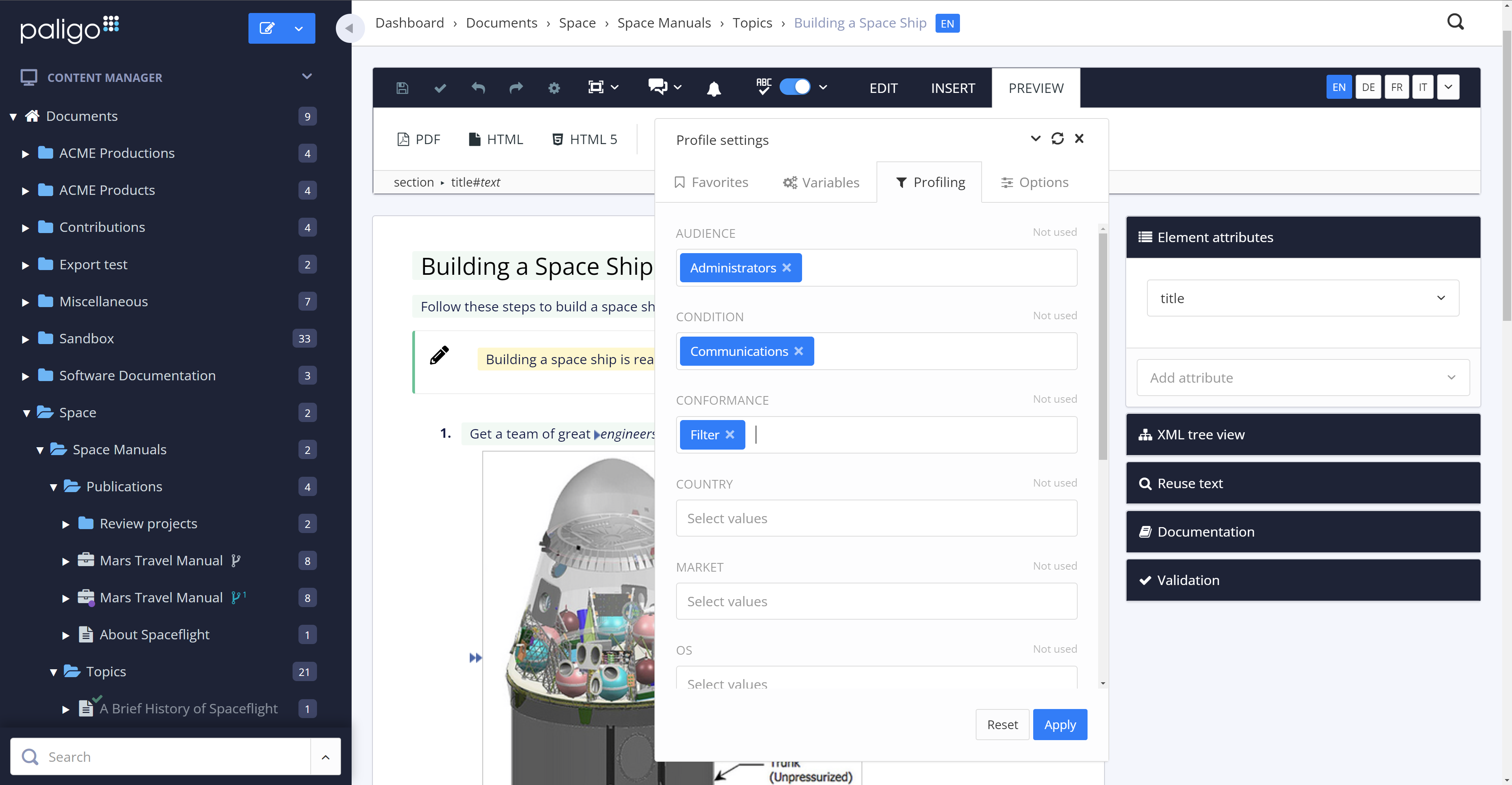
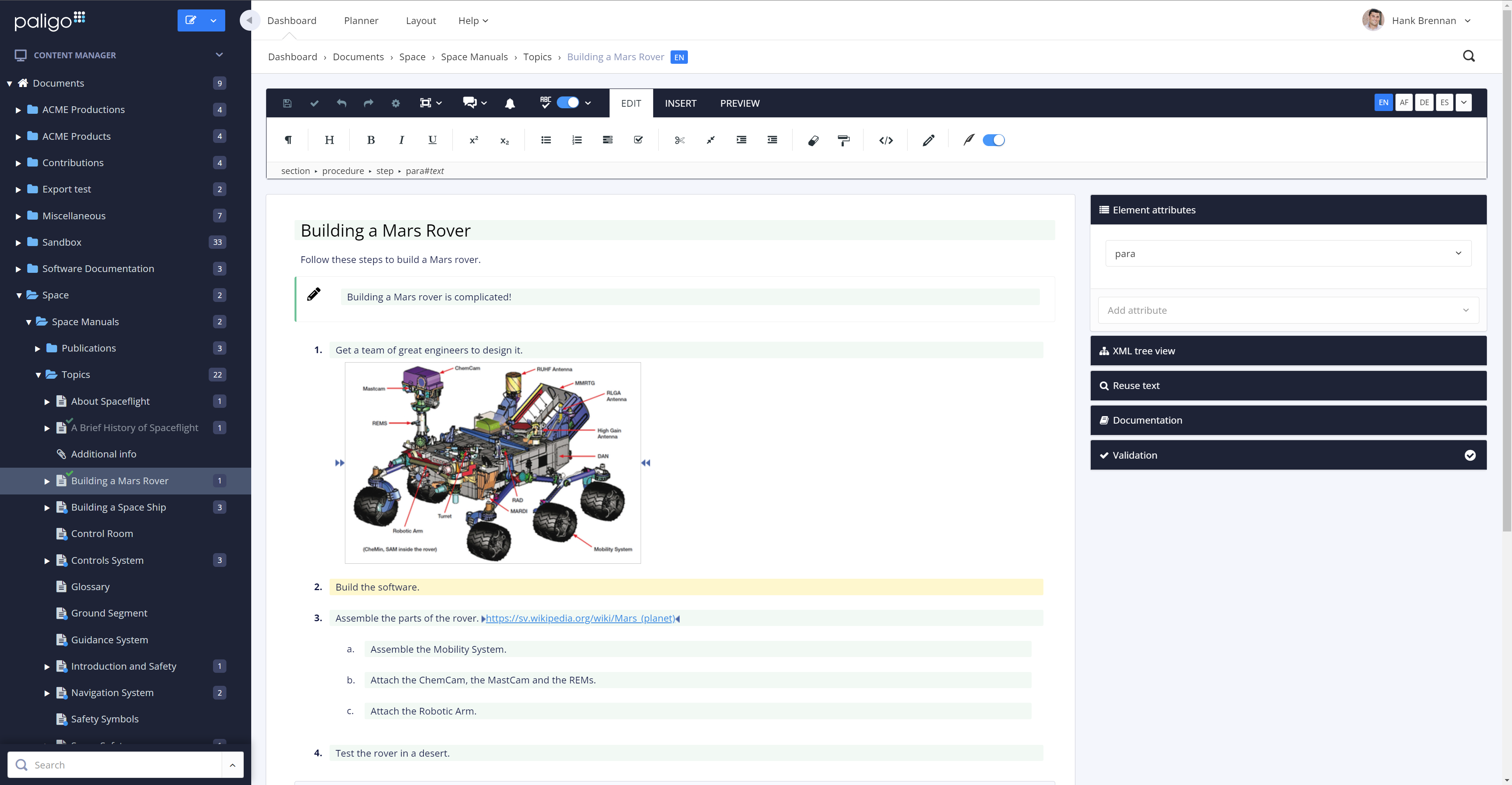
Paligo is a component content management system (CCMS) that helps teams manage complex technical documentation through structured authoring, content reuse, and controlled publishing.
I'll answer the second one because I mean, the first one I don't have an issue with. The second scenario is we oftentimes have the need to spin off very small campaign style sites or sites that generate leads but are unbranded and that sort of thing. So that's hard to do in AEM because you have to then create another organization within AEM to do that. And we're talking about sites that are maybe five to 10 pages in size. So we've been investigating Edge, but then that's a different workflow, so we'd have to train people on that. So it would be nice if there was something within the AEM structure that could allow you to do something very similar to Edge, where you make some small micro sites that are not necessarily branded, that you could still host within the platform and not have to retrain everybody on a completely different platform.
I love Paligo. Paligo has reduced document development and publishing time by 98%! While eliminating content inconsistency issues. Easy to use software with mistake proof design. There is excellent documentation on product features. From on-boarding to creating file structure to adding content and publishing the first 100 documents took less than 3 months, which in our product complexity is exceptional!
It allows us to scale so that we can make a change on a global footer. And it applies to all of the different property websites. It allows us to set up components and compartmentalize things in a way. The big thing is that it's scalable. And then it also ties into Adobe Analytics and other Adobe products. So we are a complete Adobe shop. Every Adobe product that we can use, we use. I don't think we do it for marketing so much, but for doing target testing and analytics, data scientists are using the same product and so it all speaks.
The review mode is super convenient. Comparing a snapshot of the previous versions with the current one clearly outlines the respective changes and reduces the necessary content to review tremendously.
The option to reuse text fragments is another handy feature. Text fragments will be updated whenever the original text fragment is altered is also extremely helpful.
Managing a content's structure was never easier. An intuitive drag & drop functionality allows you to design your document's structure however you like.
You can also fork content, in addition to reuse text fragments. This is another helpful option that no longer requires you to create repetetive chapters over and over.
There are some glitches in permissions inheritance that require us to toggle a save on permissions in groups that inherit from a group that was recently updated.
Large packages require stopping the workflow launcher OSGi components or many workflows will slow down the server.
Locked pages are hard to find unless I use /siteadmin... I often hear that the CQ tools will go away, but if we lose that, some small things might be harder to do, like finding locked pages.
The amount of CSS/JS required to customize a site's appearance can be cumbersome
Product documentation can be lacking, specifically with integrations; in some cases, support offered no real help when trying to solve a problem with an integrated service
Some features require extensive development experience to use, which can sometimes be an obstacle to less-experienced team members
We had and still have a fantastic experience using Adobe CQ. Lots of flexibility, great integration with other Adobe products we already use and a powerful technology make it a great fit for our corporate environment. Also as the community grows, it makes it easier to network with other developers and users to get new ideas on how to continue to get the best out of the software.
Adobe Experience Manager overall is fairly easy to use and caters to a wide range of users when it comes to their technical abilities. It has the flexibility to enable UI/UX designers to pop in and easily design new content with drop in components. It also has sufficient capabilities for those who are more technically inclined and want to dig more into custom code or solutions
Generally, I'm very happy with Paligo and the productivity gains that I get from using it. There are a few arbitrary limitations on structure, and when applying conditional formatting, that I don't really understand. Unlinking / editing reused text uses this broadly inscrutible colour-coding that I just hate. It would be nice to double-click a component, make edits, then respond to a popup asking if I want to confirm the edit for all linked content, or unlink this instance. Likewise converting from an informal topic insertion to duplicates of its raw contents.
Being part of Adobe Suite means you are already notified when the tool has any outages. However, I have never faced unplanned outages. Whenever you face any issue with the site, it is clearly stated if there were any planned outages and how quickly you will be back to normal. So, I will say that even the outages are planned and managed in a great way like their other services.
With respect to performance, Adobe experience manager is one of the best in the CMS space. We didn't observe frequent slowness on platform, however the systems which are accessing experience manager should be of good specifications without which slowness would be observed. Adobe experience manager works well in integration with other solutions, unless the destination application is designed to trigger frequent calls to AEM.
Adobe Experience Manager, in all its capacity, is a great alternative to any other CMS you are using. It helps in rapid development and makes life easier for maintaining the website for multi-language sites. Technical know-how is eliminated at content authoring. Better documentation in terms of live examples with videos would be appreciated.
All the support requests I've submitted have been resolved in one way or another. Sometimes it takes some back and forth, which is to be expected. This is where being on a different continent becomes a drawback. Since we became Enterprise users, we've also had an additional level of help and support from a dedicated account manager in the US, and the resolutions seem to come more quickly
Depending on your individual needs, It is really quite simple to create an authoring experience for a website that looks really good. I have been part of many implementations and many teams and have seen many projects that were super successful and others that were not implemented well. AEM has room for a lot of flexibility in the implementation process compared to other CMS like SharePoint
SSO is one fits all, so we don't have to have a separate SSO for each application of Adobe The integration with Analytics works perfectly and bring directly value really quickly Target remains more complicated to set up, but can also bring a lot of value once integrated with the rest of the Adobe platform The fact that the solution is Cloud services is also a big advantage for maintenance
We moved from Flare to Paligo. One of the main reasons was the fact that Paligo is a cloud product. Collaboration with anyone outside of our team was more difficult with Flare. Also, maintaining a server for Flare content was going to become an issue, and overall I felt the Flare desktop product was prone to errors and issues. The flexibility of assigning Paligo licenses was a huge factor, as was the stability of the cloud platform.
Instead of being directly involved in the tool purchase, I am involved in analysis or what we can use to maximize the tool. Small organizations may find it expensive. However, if the team or organization focuses more on your ROI or the features you will get, then it will definitely be worth it. Pricing is based on a number of factors, including team size or the use of the tool. The user can select the pricing option that best fits their needs based on the number of form submissions they make or the number of pages they wish to publish on their global/multisite sites.
The professional services team within adobe is one of the best in terms of technical and solutioning knowledge. However, considering the billing charges of adobe professional services team, it is always recommended to involve them during platform initial setup or when a complex solution is to be built with platform customizations.
too soon to tell on increased conversion rates based on external marketing factors in play but having increased visibility into customer engagement trends will most likely lead to improvement of our conversion rates.
There have been productivity gains from the perspective of actually migrating all of our externally managed sites to the same in-house Adobe Experience Manager platform and then being able to utilize those universal components.
I am not involved in the financial decisions for my company regarding Paligo; the decision to migrate our content to this environment predates my hiring. However, I know that the migration effort from WordPress to Paligo was an initially heavy lift, but any content migration effort would be. I believe that ultimately, getting our content out of WordPress was a positive move, and I look forward to seeing what Paligo will help us accomplish in the future. Sorry, no hard numbers from me. :)