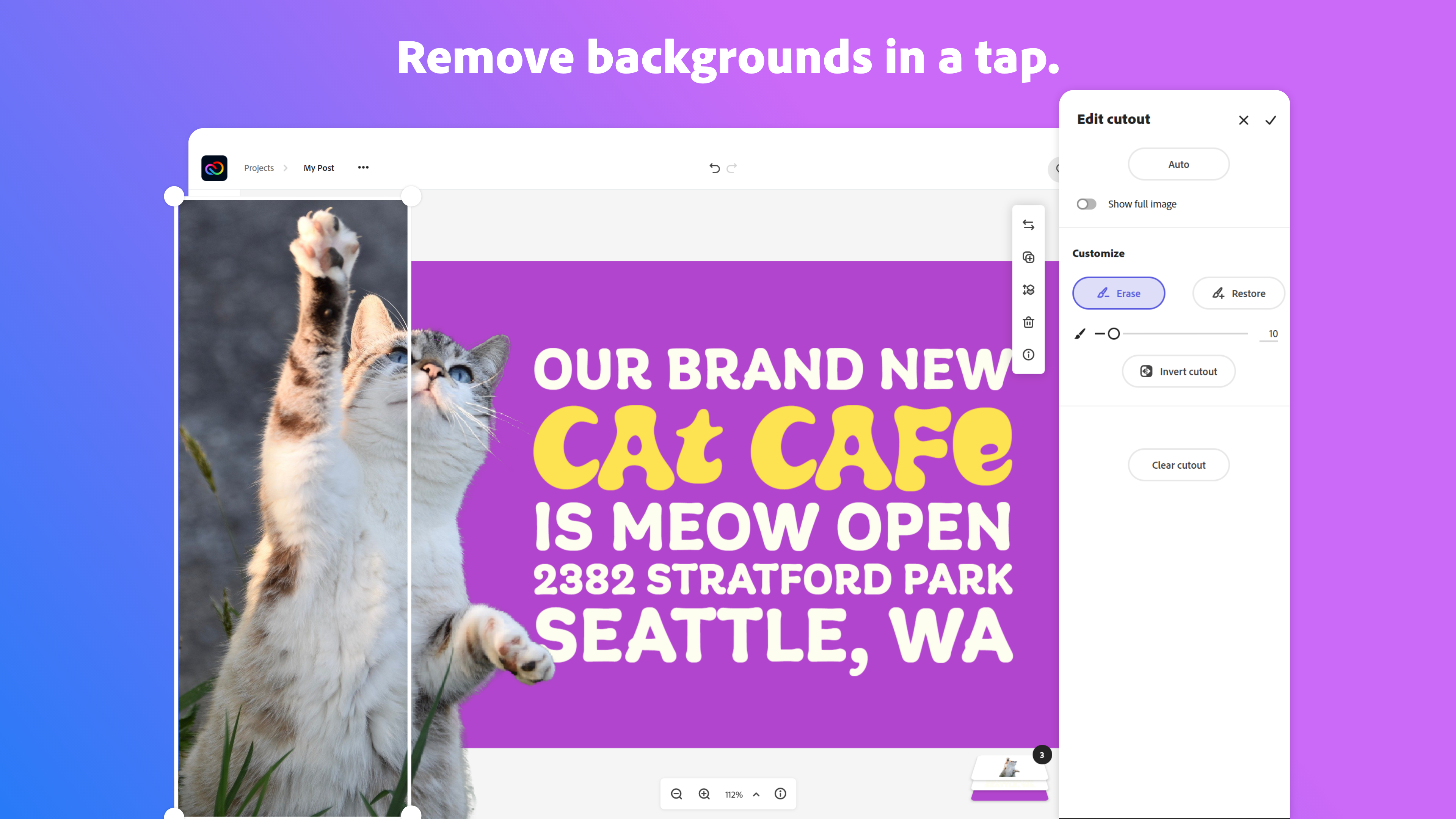
Adobe Creative Cloud Express (formerly Adobe Spark) is a task-based, web and mobile product used to create and share rich multimedia content – from social media posts and stories to invitations to marketing materials like logos, flyers and banners.
$0
Figma
Score 8.9 out of 10
N/A
Figma, headquartered in San Francisco, offers their collaborative design and prototyping application to support digital product and UI development.
$144
per year
Pricing
Adobe Express
Figma
Editions & Modules
Free
$0.00
Premium
$9.99 / $99.99
per month
Teams
$9.99
per month per user
Professional
$144
per year
Organization
$540
per year
Starter
Free
Offerings
Pricing Offerings
Adobe Express
Figma
Free Trial
Yes
No
Free/Freemium Version
Yes
Yes
Premium Consulting/Integration Services
No
No
Entry-level Setup Fee
No setup fee
No setup fee
Additional Details
Contact Adobe directly for Enterprise pricing plan details.
I think they all have a different target audience and a different use for them. I love crafting posts with Figma but i think the "figma look" is a bit cold and super recognizable for my taste. I think creating something with Illustrator still gives me the most options in terms …
Associate Manager- Visual Communications Men's and Licensee
Chose Adobe Express
I can input creative content and files I've made in other Adobe programs directly into Adobe Express, which helps me create more authentic, original content.
Express is very similar to Canva. I like to express more, except that Canva makes it easier to ensure that text/images are centered and aligned, and that the spacing is correct.
Express has put all the tools a design agency will need for day-to-day operations, production, and creation. And with the addition of the Calendar, scheduling these posts is a breeze and very important in a designer's tool belt. We used other products before and found ourselves …
The feature of using the library in Adobe Express helps me to manage my content easily, and the content can be used across all other Adobe apps. Which can be benificial than using Canva.
Adobe Express integrates very well with other products like Adobe Photoshop or Adobe Firefly. The Images from the other Tools can be integrated in new projects or edited out of Adobe Express into those Adobe Tools. Also the Files can be managed and rearranged in the Creative …
In addition to Adobe Express, I have also used Canva because both platforms are quite similar. Basically, the application that I use is typically based on the clients needs, however my personal preference is Adobe Express because I find it too intuitive to my creative persona.
I use Adobe Express for designing social media content, appreciating its ready-made templates which save time and effort. It solves creative blocks by providing design ideas, and I love its voice character feature for making animations. However, the layering feature feels basic …
I think Adobe Express is a bit behind Canva, but as an Adobe Community Expert, I try to provide as much feedback as I can to help improve Adobe Express. ADobe Express does a better job than InShot and a few other apps, but isn't quite there against Canva, I'm sorry to say!
In my opinion, Adobe Express blows it away. Canva is great and all and gets the job done. But it lacks the additional value offered by Adobe Express and Adobe. Canva's stock asset library doesn't come close to Adobe's stock asset library, and the Creative Cloud makes using …
Software like Illustrator, Photoshop, and After Effects are indispensable for my needs. I used Canva to streamline the process of creating carousels, mainly, and Express effectively replaces Canva. The advantage of having everything under a single subscription was crucial for …
It's very easy to generate images or graphics and find them on Adobe Express.In the application, in "Your stuff" > Files section, you'll find all the creations you've made with Adobe Photoshop and Adobe Illustrator, and you can use them directly in Adobe Express. No need to …
Maybe because I use other Adobe products, but I find that Adobe Express is more intuitive than Canva, especially when trying to format text. As for Adobe Express versus other Adobe products, well I think there is a place for them all. There are just certain things that you …
Adobe Express is incredibly similar to Canva. Both tools are something that makes design easy for anyone to do as well as provide templates and pre-made graphics to assist in the design process. However, Express still feels limited compared to Canva and Illustrator. Illustrator …
Overall Adobe Express offers a more polished finished product but does take a little time to learn. But worth the time spent to have more unique content
I would use Figma for sure for any product design you need, for any marketing or visual illustrations related to a product or business. Even if the navigation between files/folders and within the design is not the best, the capabilities and focus on designing are the best in …
Figma is far superior to Canva in my opinion. Canva is a great tool for novice designers who need to rely on templates and a limited number of options to complete their tasks. Figma is much closer to Photoshop in its features and application, but separate from Photoshop in that …
It’s doing well in the canvas editing, whiteboarding with Figjam and commenting for feedback. It’s a better choice for collaboration and design fidelity so it won’t fully replace the AI tools we’ll keep using both and agree on the workflow between tools
It's up there - but needs tweaking to ensure. We were forced to move to Figma, but it's a great tool nevertheless. Miro offers usability functions for novice users that Figma is still not fully up to speed on. Miro's overall templates are more appealing, and AI usage in Miro is …
Figma was a huge turning point compared to its competitors, especially Adobe XD, a tool designed for the same purpose as Figma. I would say that it and all the other tools I mentioned, including those that do not have the same focus on UX design (Photoshop and Illustrator), …
Adobe XD is an absurd copycat that never got to have even 10% of Figma's features. It's hyper fast because it's native, but that's the only good thing it has.
Axure RP is an excellent prototyping software, with Local Variables and complex interactions. But it's also extremely …
Compared to Adobe XD, the Figma tool is much easier to use, offers more features, and has a much lower cost. Its features are less complex, making it very easy to teach beginners how to use it. The navigable prototype is also easier and more efficient to share in Figma compared …
Figma easily wins against adobe XD. Asset sharing on XD was a pain. Figma makes it really easy by allowing you to export any layer as an asset. XD had no comments making it incredibly hard to communicate with the designer in remote settings. XD's prototyping system was not good …
I learned UX Design using Sketch and my team was using Sketch when I joined. We no longer use Sketch, and therefore I cannot compare its current functionality to Figma, but at the time of our switch, Figma just had more advanced capabilities- better collaboration, auto-layout …
Miro is more user-friendly than Figma, but is less robust in terms of web prototyping and graphic design. While Figma isn't made to be used as a design tool, our team has taken to using it as such because it's richer in functions and personalizations compared to Miro and Figma.
Better auto layouts, components and prototyping capabilities. Variables in Figma are also a fantastic addition to create a robust, and scalable design system. I use these features all the time. Love them!
Figma compared to other tools has user friendly UI which is very easy for all levels of designers. Compared to Adobe XD and Sketch Figma is stable, while in other tools I have faced software crashing in the middle of the work which resulted in loss of data/design. Compared to …
I prefer to use it comparing to Adobe Xd. It surely is more intuitive and still develops itself providing new features (e.g. variables; however, I had to get used to the new interface). Now, if I had to compare it to Axure it'd depend on the project I'm working on. In case of …
Figma is the only tool that was build from the ground up for enterprise level distributed teams. If I were a one man shop or even a small team, I would consider sketch or other cheaper alternatives. For a large enterprise team, the only winner is Figma.
Figma is the go-to design tool that can be pushed to production very easily with developer tools. In my opinion it's the most complete design tool that considers the entire design process including the creation of solid design systems, high-fidelity prototyping, user testing, …
I think Figma is better because it's easier to create more visually appealing work. I would say that Figma is better for people who are used to using this sort of visual design software/platform. Whereas I think Miro is better for first time users, it doesn't offer as many …
Basically, I truly find that Adobe Express is pretty much great for all professional scenarios because it offers many creative options and comes with an extremely robust collection of assets (stock photos, videos, music, and graphics) all of which can be edited and enhanced within Adobe Express if needed. One project that it was quite helpful with utilizing was creating a logo for one of our clients. I was able to create the prototype and then offer several iterations of said logo to help the client quickly decide on its official branding. By having all of my assets neatly stored right on my Adobe Express project folder it was very easy for me to remain organized when creating various outputs.
Figma allows us to create assets across multiple teams, such as email templates, website assets like site banners, product pictures, and Amazon/retail digital content. Outside of Figma, our design team still needs to rely on some other features to create all of our assets. This could include things like Adobe Illustrator, Photoshop, and GIF makers. It would be nice if Figma included some of the basic features of these other platforms so that we could create everything in one platform.
Prototyping in Figma is pretty much nothing more than a glorified slide show. Sure, variables, etc are available but it takes way to long to set them up and even more time when there are revisions needed.
It would be helpful if there were a contextual help system for various functionality. For example, advanced autolayout (like space between) can become very tricky to implement sometimes. I often wish there were an AI assistant to ask for help. I often use ChatGTP to help me through these times.
Searching layers needs to be much easier and more intuitive.
I would like to be able to make groups like the layers palette in Photoshop. That would help with organization and speed a lot.
i love express!!! i use it every day and will continue to use it even if my job doesn't pay for it, although i hope i never have to pay for it haha. even though the updates are sometimes frustrating, i think for the most part i get used to/like the updates. it's easy to use and i like the change to projects instead of sharing a brand with collaborators
Figma is a pretty cool tool in many areas. My team almost uses it on daily basis, such as, brainstorming on product/design topics, discussing prototypes created by designers. We even use it for retrospectives, which is super convenient and naturally keeps records of what the team discusses every month. Furthermore, I do see the potential of the product - currently we mainly use it for design topics, but it seems it is also a good fit for tech diagrams, which we probably will explore further in the future.
The user interface is pretty straightforward to use. It has easy to navigate navigations, and the canvas UX is also pretty good. One thing i would like to add it to use shortcuts to add elements on canvas. Like if I am on canvas and I press 'T' on my keyboard the text box should be added automatically
It's easy to use for designers who are familiar with design terms and functions from Photoshop and Illustrator. However, non-tech and non-designer collaborators have a hard time figuring out how to leave comments and apply changes, compared to other online design tools like Canva and Squarespace. Even simple drag-and-drops and rearrangement of certain blocks become too complicated due to uncommon functions like Hug and Lock.
Overall, the Adobe Creative Cloud Express is worth a try and may be a good fit for many organizations and businesses. At a monthly rate, the cost is not prohibitive, but the tools are somewhat limited and not necessarily worthwhile when compared to standard applications and software that are often available free or through a package of services commonly found on workplace computers.
I haven't used their support lately but in the past, they had a chat that I used often. They often responded in a few hours and were able to give a satisfactory solution. I would imagine it's less personal now but the community has expanded drastically so there are more resources out there to self serve with a bit of Google magic.
In-person training has its own benefits - 1. It helps in resolving queries then and there during the training. 2. I find classroom or in-person training more interactive. 3. Classroom or in-person training could be more practical in nature where participants can have an hands on experience with tools and clarify their doubts with the trainer.
Online training has its own merits and demerits - 1. Sometimes we may face issues with connectivity or the training content 2. The way training is being delivered becomes very important because not everyone is comfortable taking online training and learning by themselves. 3. With the advancement of technology online training has become popular but there is a segment of people who still prefer class-room training over online one.
Express has put all the tools a design agency will need for day-to-day operations, production, and creation. And with the addition of the Calendar, scheduling these posts is a breeze and very important in a designer's tool belt. We used other products before and found ourselves importing, exporting, editing and then exporting again a bit tiresome. We only need one app: Adobe Express.
I would use Figma for sure for any product design you need, for any marketing or visual illustrations related to a product or business. Even if the navigation between files/folders and within the design is not the best, the capabilities and focus on designing are the best in the market, vs other tools like Miro.
We have the Figma Org Plan subscription on the annual renewal basis, and we use Figma exclusively for all of our digital product design initiatives/projects. As we are still a very small & lean In-house UX/Product Design team, we see the value in using Figma to curate our Design System libraries which allow us to collaborate and partner with our PMs and Engineers quite well on multiple product design & development initiatives.