Adobe Workfront, acquired by Adobe in late 2020, is a web-based project-management tool. It is designed for both IT and marketing teams, but can be implemented for any kind of project. Workfront offers all the features standard to project management platforms, as well as resource allocation, automation, and agile workflow.
N/A
Kanban Tool
Score 8.5 out of 10
N/A
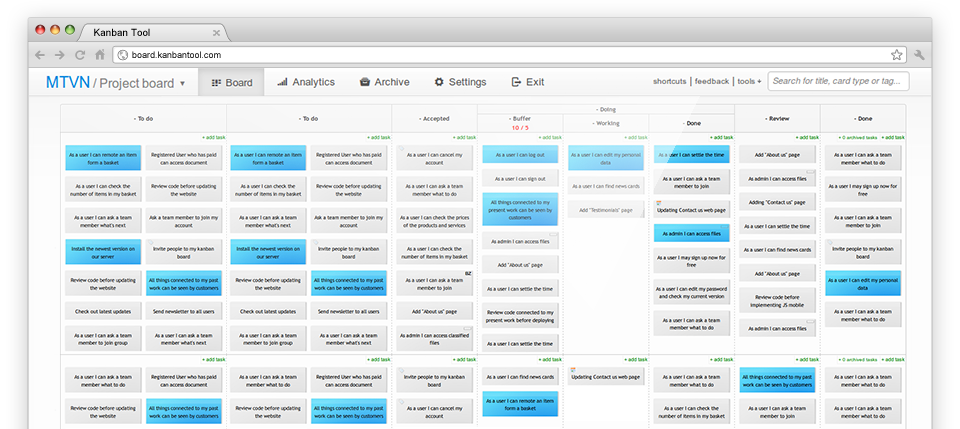
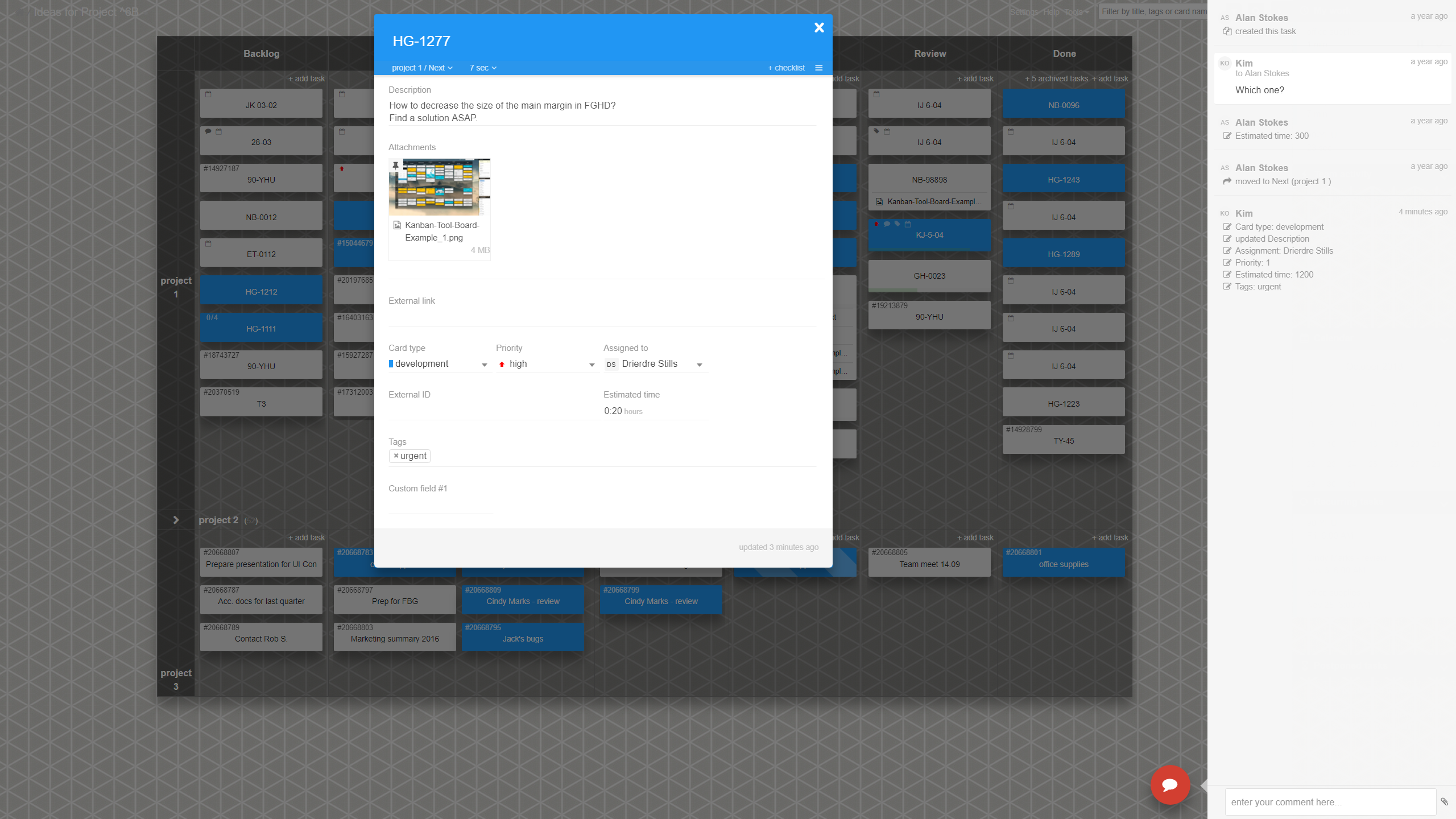
Kanban Tool is a visual project management application based on Kanban that helps companies visualize workflow, track project progress, analyze and improve business processes. Some key features include: time tracking and time reports, real-time collaboration and Kaban analytics.
$6
per month per user
KanbanFlow
Score 7.3 out of 10
N/A
CodeKick AB headquartered in Swedenoffers KanbanFlow, a kanban organized project management and collaboration workspace.
To manage the organization's work from project to project, the organization uses multiple project management solutions. In comparison to Jira, however, the only useful feature I found is the Gantt chart, which helps give a clear overview for multiple projects at once. Moreover, …
I wasn't with this company when the buying decision was made. However, Workfront replaced Mavenlink, and what I could gather is Mavenlink was liked by users, but the owners and administrators wanted more reporting and more automation. For me, Workfront is far superior to MS …
I really like the simplicity and the subtasks found in KanbanFlow. It seems to be the easiest tool to get clients not using another method to use this without any challenges on their part.
Trello has card dependencies, which is a nice touch. Trello also has a lot of add-ons, but …
It works super well for creative brief intake and brand reviews. It took us more time than I'm willing to admit to get it all set up, but for our limited use case, it's working very well now. I'm not sure where it wouldn't be a good fit, honestly. As a newer user, it's still something I'm getting to know and learn.
Kanban is well suited for a fast-paced working environment for larger teams who want continuous communication with users. Kanban is good for rapid development and daily meetings for updates and statuses. Kanban is less suited for smaller teams or groups who don't require collaboration and constant communication with involved users. Kanban is time-consuming and it takes additional effort outside of your regular work to maintain and manage the tool.
Most of the project management software in existence today is focused on agile/sprint based processes. If your team happens to use Kanban instead, KanbanFlow is one of the best options for tracking work. It's quick to get started and learn and has a manageable feature set that won't overwhelm anyone.
Allow nonusers to add requests, our organization has no need to add all 10,000+ team members to Adobe Workfront, but would like them to be able to send requests to our team
Kanban does not show the task or story clearly. You have to open the project separately to view the details of the project.
Kanban gives a higher level project management view but it lacks customization and personal settings features.
I would like to see Kanban provide mobile access to their tool, data, and board. This would be very useful for all companies and provide an increase in efficiency and productivity.
I'm not sure if it has this or not because I've only been using it for about 6 months but we haven't quite figured out how to archive things. We have lots of data on that main page from Q3 and Q4 of last year but we need to figure out how to get it away from our main page so we can focus on new things this quarter
I know when I was first added there were a few things the admin had to do in order to do that. All I remember is that it wasn't simple for them to get me hooked up. They had to do a few steps and then I was granted access. I don't know what exactly but I had to wait.
Workfront is sometimes a bit clunky to use, but overall it works well for our teams when it comes to project management and collaboration across multiple, involved teams. It also has flexibility that allows us to adapt it to diverse use cases, some of which aren't necessarily always the first things that one would think of using workfront for.
Workfront is overly complex, but it is functional as a tool to keep track of projects. It is a shame that sometimes it takes a lot of clicks to find anything. Workfront is slowly modernizing its interface but at the same time, hides certain information away thus making the experience feels worse.
The integration with Teams is well suited. This works wonderful for my company. Our team can easily prioritize tasks based on their importance. It help our team identify and reduce inefficiencies in workflow. With great visibility in data our team can make informed decisions. Ensuring clear accountability and responsibility of team members
Maintenance is required, but usually after work hours, Some days the proofing tool function is not operational, but this is a new function of the tool that WF is working out. the kinks on. Chrome is the best browser to use the system in and we find Firefox and Explorer lose some view functionality - Gantt Chart, Resource Grid
I think overall, Adobe Workfront performs well. There have been some times when it doesn't load or run as quickly as our team would like. This is frustrating when it is such a crucial tool that our team utilizes on a daily basis. It can show our workflow when it lags.
I know that this particular company has it's own Adobe Workfront employee that builds out things they need from the software, and meets with them regularly to troubleshoot. I'm not part of this process, but it's refreshing to see Adobe provide this level of customer service to people, and they're expedient.
The training is very easy to use and you can simply choose the topics included in the course(s) that are most important to your training needs. After each training course, you are tested on what you have learned. If you need a refresher course, they provide Course Catalogs as well as instructor-led courses & workshops.
Most people learn as you go, a lot of this stuff requires trial and error throughout so my suggestion is to provide as much information in the upfront and keep it as simple as possible. You can add other tools and features as you go but everyone should have the basics down so no bad habits can start to develop. Be persistent with everyone, and don't be afraid to correct and talk through steps again so everyone is on the same page
Adobe Workfront blows the other systems out of the water. It just delivers more - out of the gate, and at every quarterly update. Innovation is top of mind, and meeting customers' needs is key. We have been extremely satisfied with Workfront and look forward to all the new features on the horizon, especially AI.
We've only tried JIRA Agile and KanbanFlow before. Kanban Tool was the one that our team actually liked and enjoyed working with. Also - it's been much easier to get started with and to understand than some of the other two (JIRA in particular). Although JIRA has many more features that we would have possibly used, the user feedback on it was so poor we were afraid that the negativity would create time wasted and less "job satisfaction" amongst the team.
I really like the simplicity and the subtasks found in KanbanFlow. It seems to be the easiest tool to get clients not using another method to use this without any challenges on their part. Trello has card dependencies, which is a nice touch. Trello also has a lot of add-ons, but I find them to be a little glitchy. Kanban Tool has really nice reporting and analytics.
As I stated earlier, I didn't have to pay for Workfront myself- I'm a user under a large organization. I know it's not cheap to implement, I don't know how the price scales for a small-business, but I do like the product enough that I'm going to look into it in the future for my own company.
Our organization has thousands of users that use Workfront and it seems to hold up very well. I have not encountered any issues using it and I think it makes it very easy for multiple people to be involved in a project and keep things organized and clear for everyone involved.
Resource Management - Year over year, we were able to validate time and money saved by the implementation of Workfront by more than 2%, saving in non-working dollars and 9% savings in working media dollars.
Organization Restructuring and Automation- We also restructured our teams and implemented automation based on our analysis of how and what we spend our time on and the ROI for our respective business units.