Aha! Roadmaps is used to set strategy, prioritize features, and share visual plans. It includes Aha! Ideas Essentials for crowdsourcing feedback. For an integrated product development approach, Aha! Roadmaps and Aha! Develop can be used together. The software is available with a 30-day trial.
$59
per month per user
Asana
Score 8.5 out of 10
N/A
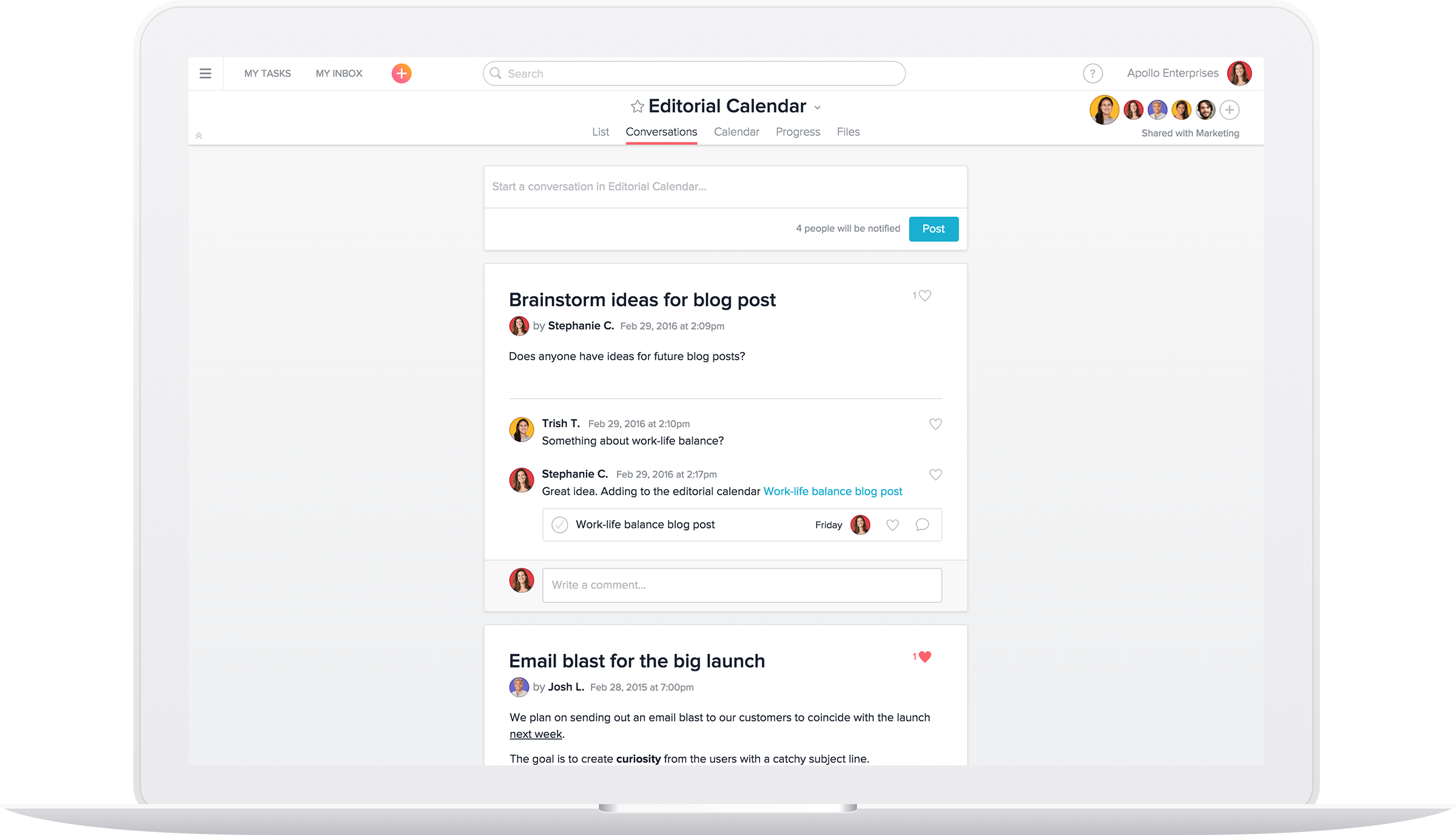
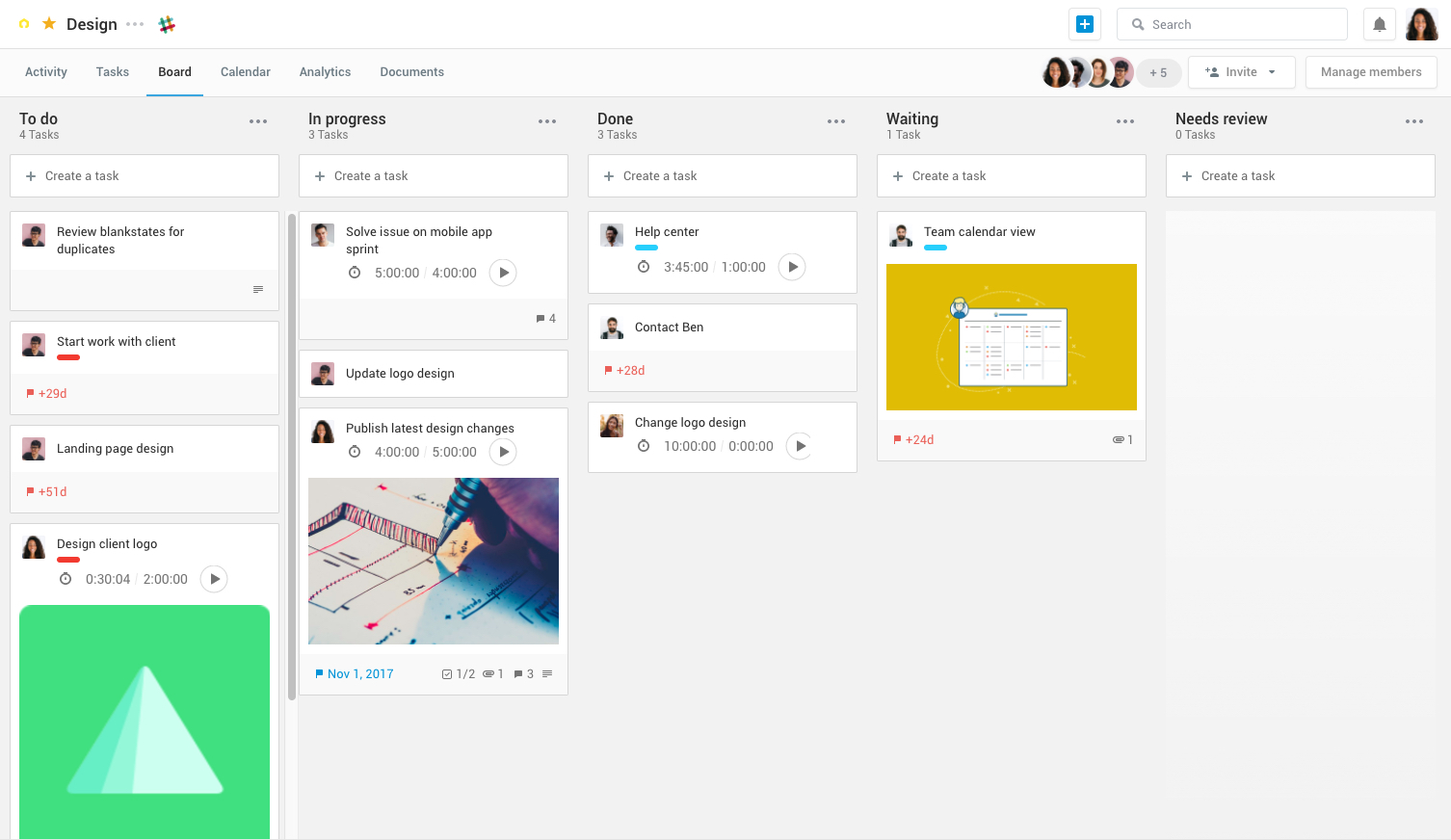
Asana is a web and mobile project management app. With tasks, projects, conversations, and dashboards, Asana lets an entire team know who's doing what by when, enabling workload balancing. Users can also add integrations for GANTT charts, time tracking and more.
$13.49
per month per user
azendoo
Score 3.1 out of 10
Mid-Size Companies (51-1,000 employees)
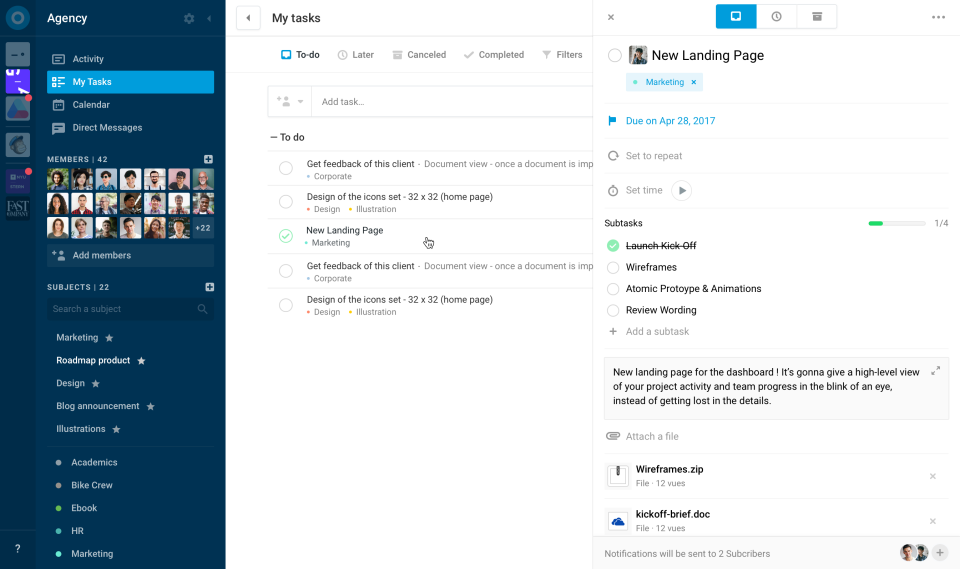
Azendoo is a work management application to help teams work more effectively by giving them the tools to communicate, plan and execute together. Azendoo is designed to make teams collaborate in a more transparent and positive way while making work more enjoyable. Conversations are held in threads shared on projects to see through every piece of information and eventually take action by creating a task based on a conversation. Tasks allow team members to see all of their work in one…
$7.50
per user
Pricing
Aha! Roadmaps
Asana
azendoo
Editions & Modules
Premium
$59
per month per user
Enterprise
$99
per month workspace owner or contributor
Enterprise+
$149
per month workspace owner or contributor
Starter
$13.49
per month per user
Advanced
$30.49
per month per user
Enterprise
Contact Sales
Personal
Free
Team plan
$7.50
per user
Business plan
$14.00
per user
Enterprise plan
custom pricing
per user
Offerings
Pricing Offerings
Aha! Roadmaps
Asana
azendoo
Free Trial
Yes
Yes
Yes
Free/Freemium Version
No
Yes
No
Premium Consulting/Integration Services
No
No
No
Entry-level Setup Fee
Optional
Optional
$7.50 per user
Additional Details
Startup pack available for early stage companies.
A discount is offered for annual billing.
Add some time tracking: +$5.00 user/month
Scheduled and accumulated time per task
More Pricing Information
Community Pulse
Aha! Roadmaps
Asana
azendoo
Considered Multiple Products
Aha! Roadmaps
Verified User
Anonymous
Chose Aha! Roadmaps
ProductBoard was used in the organization when I arrived, but after assessing ProductBoard, I felt it was too lightweight for our ambitious product goals. It's also critical, especially in a startup, that we focus our limited capacity on the work that matters most. Aha! far and …
Compared to some other types of software we've tested or use in other areas of the company Aha! has a better user interface, has more customization ability and grows with the company and the work we're doing.
I initially tried to do this using Notion but without an API to integrate it is all very manually driven when any updates are made in ADO, I would have to hunt it out.
I've worked with other homemade tools and Jira, Confluence as well. They are more tailored for the developers' community than Product and Program managers.
In terms of outright features, a lot of roadmapping tools have the same feature set. We chose Aha! based on look-and-feel, the easy learning curve, and the reviews it has. Between collaboration, milestone tracking, comment threads, and content importing and exporting, we had …
Jira is centered around product development, whereas Aha! is centered around product management and road-mapping. Both allow for planning and tracking, but Aha! is more user-friendly.
Aha has more features continually being released as a Product Management tool. In comparison to ProductPlan, Aha has more complex features and increased support for getting organizations up and running on the platform. They also provide migration tools to determine what data …
Jira has a lot more bells and whistles. It was easier to see how different teams across the (larger) company were prioritizing their own work against all of the incoming requests, and to see how those ideas mapped across the current and next springs. However, it was necessary …
In terms of product road-mapping, Aha! beats its competitors upfront. Aha! is one of the best tool to visualize your product strategy. However, JIRA in terms of PRDs, gives a complete environment in its own. Aha! is for product managers only. If Tech needs to be involved, JIRA …
Aha! definitely does more than either Pivotal Tracker or JIRA. We still use JIRA to track tasks by department, but for strategy everything is in Aha! and aligns all of our other project/task trackers including integrating with Salesforce so we're able to work within every …
We selected Aha over the other options as our specific goal and need was to align as a Product Management team across all our lines of business. While other products did well, the customized abilities of Aha, price points, and Atlassian integration tools made it a clear choice.
Aha! is a better fit for the specific type of strategic planning that I do. The other tools are more intended for other grains of planning and/or execution.
Aha! is completely different compared to the other products I've evaluated. I would compare Aha! to Atlassian/Jira. It's great for agile teams to do weekly sprints and breakdown large features/product upgrades into individual tasks.
Aha! is slightly more complex and nuanced than Trello, which is nice. Trello feels like a digital sticky note system sometimes. It's more straightforward in UI and collaboration than Workfront or Workamajig without all the extra (seemingly unnecessary) features, like scoping …
Wizeline is an up-and-comer in this space. At the time we considered them, the solution was not robust enough to manage a large backlog or multiple products with a Jira integration. They are adding features rapidly, though, and every release is very robust.
Asana is a highly effective instrument for managing teams and projects. The paid edition provides a multitude of features that can be tailored and used in accordance with the organisation's specific requirements.
Email integration facilitates notifications that remind team …
Overall for the money Asana brings a lot of value for organizations who want to do more with less and need a task and project management solution as a small company is growing and scaling to get to the next level. In the space when we evaluated didn't find a lot of other …
Against Jira it offers a more modern experience with less complex user interfaces. The admin and setup experience is also way faster with less (or no) legacy complexity.
Against other modern players like Linear and Basecamp it offers way more integrations so we can pull in data …
Asana is a top-tier project management software that helps us organize and track projects from start to finish. It allows us to apply tasks/to-dos to multiple projects without duplication, divide complex projects into smaller tasks, and track project progress. It also helps us …
Asana provides a mix of features between notion and Jira. Unlike Notion, it helps ease up the collaboration on vast projects and between multiple teams. Jira proved to be a little expensive with similar set of features if not more and which is why we thought of going with Asana.
I believe that Asana is more professional than Trello. I used Trello a long time ago, but it looked more suitable for a student project rather than for a professional team or business environment. I believe it has great features to help companies in different stages and of …
Since I have tried the two applications and saw their advantages and disadvantages, I see that Asana is much better in terms of dealing with files, ease of use, and the many features and characteristics that it has. Also, I noticed that it does not consume much space on my …
Side by side with the other two Asana by far beats Monday.com and is comparable and slightly better than ClickUp. Monday is completely browser-based and is hard to navigate and figure out how to set up. Asana and ClickUp are the exact opposite. Both are easy to set up and …
I like how extensive the capabilities are for Asana. With other softwares it seems there are many things lacking. I feel like Asana is also a very user friendly platform and aesthetically pleasing which is important in a modern office. We have many young people entering our …
Asana compared to Jira is certainly better in terms of user experience, since most of the people can start using it basically without having any kind of training or previous explanation, which makes it really useful not only for people already used to project management but …
Asana is amazing for a remote team, that we are currently as its accessible seamlessly to all our team member no matter where they are in the world. Its very easy to onboard new members to this platform as its very intuitive and easy for new people to get a hang of it. It has …
Basecamp was a great tool, but it was paid and things like recurring tasks and opening new projects was a pain. Asana, as a free tool, has been better for our organization as it serves the basic functions very well and is not complicated otherwise. I really like the …
Azendoo, unlike Trello, is a tool that provides a much more organized interface and features that provide more effective project management and direct communication. Trello is based on a slightly older interface and still requires different tools to be ideal for carrying out …
azendoo has a very easy-to-understand interface, allows for scaling in a way that Basecamp doesn't, and is constantly reinventing the platform (and appears to take customer feedback very seriously). Overall, while many project management platforms seem very similar, and I've …
azendoo is a different tool, meant for a different project type. While it's a good program on its own, Evernote ultimately had all I needed as a single employee/student is the only person within my workspaces. I did not need to network and as such, I did not find it applicable. …
Aha! is the all around product management tool. You need something once you build out a product management role and grow beyond a small scrum team with one or two products. JIRA, Pivotal, and project management tools don't cut it for aligning [engineering] with product initiatives once the backlog starts to scale.
On the other hand, there are several unfinished features that my peers all admit to having to work around: Capacity Planning, Salesforce Integration, Roadmap Display Flexibility, User Feedback, etc. This year has been all about reporting in terms of feature releases. As Aha! grows, they will fill in these other areas, so stay tuned.
The usability of Asana is broad since it's available in a variety of platforms that are widely used nowadays. I think that it would be great for people who are constantly on the move and switching devices, since it has allowed me to work from my phone, too. I also think that Asana has proven itself to handle a large quantity of work
Large organizations can really benefit from azendoo due to its ability to segment into teams. The various levels of organization are helpful for organizations with many coexisting initiatives, and I find that it has been instrumental in our success building out large campaigns or product launches. In general, azendoo is just an excellent project management tool, with little-to-no learning curve.
Notes - There's not a great place to leave lots of notes or instructions, almost like a Confluence page. Although not required, it would be nice to have this built in.
Learning curve - As with most new tools, there's a bit of a learning curve to become proficient.
Search Function - I consistently find it difficult to find old tasks where I don't immediately know the subject to which it belongs. I would appreciate more advanced search capabilities and a stronger search function in general.
Message Feature - We just don't use this feature at our organization, because it's not very robust. We'd prefer more of a "chat" like function, with a pop-up window (something similar to Slack).
I just can't see us getting it off of Asana any time soon, despite the many headaches it has caused us. We have too much data in there, too much time & training invested into it, too much at stake to move. If we were just starting out today, fresh, I don't know for certain that I would absolutely go the same direction, but I *think* I still would. I just haven't seen anything better yet. Maybe if Podio's support staff hadn't treated me like a worthless nuisance to them, I might feel differently, but the fact is that their task management is simply inferior to Asana's. That can't be denied, and in fact Podio said it themselves: "Tasks are a simple function. They cannot be customized. Tasks in Podio can be used for quick to-do's for you and your team members." In our operation, however, prompt task completion is a big deal; one task can't be completed until another one is done first, and closing the gaps between those tasks is critical in meeting deadlines and servicing our customers. Asana gets us there, the others don't.
I think Aha! works really in general, it offers a very comprehensive and well-structured platform that supports strategic product management at scale. Although there is a learning curve for new users and a few areas to be improved. Overall, it is highly usable for experienced product teams who need a robust roadmap tool.
It is very user-friendly. Takes a new employee an hour to start figuring out how the system works. That's an important factor. You don't want to encounter the issue where employees need a week to understand how the system works. For example, JIRA, I tried using it for a week and I still don't understand the complicated layout. Asana has a simple interface. Once you see it, you get it type of program.
We've always had excellent support whenever we need help from the company or need questions answered regarding the setup and installation of the product. Tickets are answered in a timely fashion and there's minimal back and forth to get issues resolved, which are rare.
I haven't had to use their support so I can't rate it. The fact that I haven't needed them reflects the ease of use of the product. I would recommend that any new users schedule a complete demo of the product to ensure that they are using it to it's fullest (there's a lot of useful features).
productboard was used in the organization when I arrived, but after assessing productboard, I felt it was too lightweight for our ambitious product goals. It's also critical, especially in a startup, that we focus our limited capacity on the work that matters most. Aha! far and away had superior capabilities in defining strategy directly in the product and associating all of our work to the strategy. Aha! is a serious product management tool and I found productboard to be more of a simple backlog management tool.
Asana is a top-tier project management software that helps us organize and track projects from start to finish. It allows us to apply tasks/to-dos to multiple projects without duplication, divide complex projects into smaller tasks, and track project progress. It also helps us organize work on Kanban boards or linear lists. It stands out from the crowd in a big way compared to the competition.
azendoo is a different tool, meant for a different project type. While it's a good program on its own, Evernote ultimately had all I needed as a single employee/student is the only person within my workspaces. I did not need to network and as such, I did not find it applicable. Later down the road in a shared office, I might feel differently.
Azendoo has really been an advantage to our company because, thanks to its features that make communication much more feasible and direct, business productivity has increased.
The support team is really very attentive so we have not had any problems left unsolved. That has prevented us from delays in project deliveries.