Aha! Roadmaps is used to set strategy, prioritize features, and share visual plans. It includes Aha! Ideas Essentials for crowdsourcing feedback. For an integrated product development approach, Aha! Roadmaps and Aha! Develop can be used together. The software is available with a 30-day trial.
$59
per month per user
Pivotal Tracker
Score 5.0 out of 10
N/A
Pivotal Tracker is a project management program primarily for software developers. It is built from the ground up to facilitate the agile development cycle, and is optimized for structuring projects in sprints, or “stories.”
The solution is now owned and supported by VMware, and is part of the Pivotal / Tanzu product line up.
N/A
Roadmunk
Score 6.1 out of 10
N/A
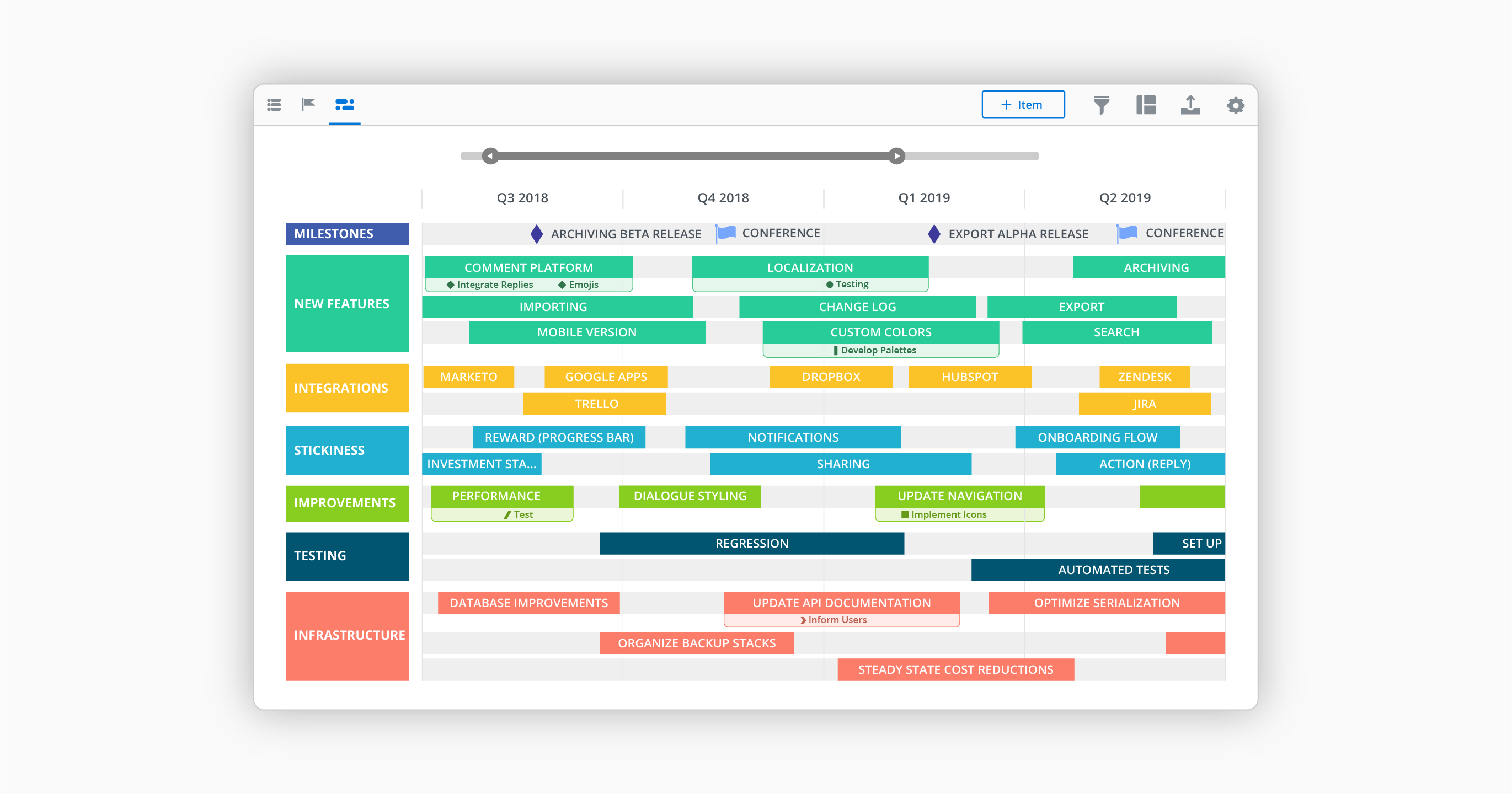
Roadmunk is a roadmap visualization platform that is designed to enable product managers and their teams to communicate the strategic roadmap throughout their organization. The vendor says product leaders can easily input milestones, roadmap data and create unlimited pivots in real time. The vendor says it has differentiated itself through intuitive user-centric design, seamless manipulation of roadmap views and enterprise data security. Since late 2021, Roadmunk is part of Tempo.
$19
per seat
Pricing
Aha! Roadmaps
Pivotal Tracker
Roadmunk
Editions & Modules
Premium
$59
per month per user
Enterprise
$99
per month workspace owner or contributor
Enterprise+
$149
per month workspace owner or contributor
No answers on this topic
Starter
$19
per seat
Business
$49
per seat
Professional
$99
per seat
Enterprise
Custom
per seat
Offerings
Pricing Offerings
Aha! Roadmaps
Pivotal Tracker
Roadmunk
Free Trial
Yes
Yes
Yes
Free/Freemium Version
No
No
No
Premium Consulting/Integration Services
No
No
No
Entry-level Setup Fee
Optional
No setup fee
No setup fee
Additional Details
Startup pack available for early stage companies.
—
Ready to roadmap? All our plans start with a free 14-day trial.
More Pricing Information
Community Pulse
Aha! Roadmaps
Pivotal Tracker
Roadmunk
Considered Multiple Products
Aha! Roadmaps
Verified User
Employee
Chose Aha! Roadmaps
Aha! definitely does more than either Pivotal Tracker or JIRA. We still use JIRA to track tasks by department, but for strategy everything is in Aha! and aligns all of our other project/task trackers including integrating with Salesforce so we're able to work within every …
Roadmunk beats Aha! through visualization and Gantt connections between work items. We originally turned to Lucid (Spark and Chart) and Miro to get away from Aha's difficulties, but those platforms presented significant challenges in terms of relationships and dependencies.
Sr. Director, Emerging Products at Swagbucks, a Prodege Company
Chose Roadmunk
To be quite transparent, Roadmunk was the cheaper option. However, it also provided a ready-to-use solution for the team that required little to no training to get up and running. It provided the needed results almost from Day 1. Aha! had the more robust feature set and the …
In my opinon Roadmunk has the best UX and very friendly interface. The decision to purchase Roadmunk was based also on the great customer service and help provided by the team. Roadmunk team is open to suggestions and is constantly working on their product. It's great to see …
It is great for organizations that want to ensure that the work they focus on is the work that will have the most impact on value and drive them toward their strategic objectives. I consider it to be a real Product Management tool. If all you are looking for is a tool to hold your product backlog or collect customer feedback, then Aha! is probably going to be overkill for your needs
The UI of the Pivotal tracker is really beautiful and amazing, which looks trivial, but we have it open all the time, so it's nice for us. In Pivotal tracker for me its very Easy to create tasks or stories anytime without facing any problems. Pivotal tracker provides us a ton of features to track the tasks and manage a team and the projects. Pivotal tracker allows for a entire team to be on the same page of the tool in regards to where is the project right now, right status of every task, what is being worked on and by whom.
We replaced Trello with Roadmunk for our Roadmapping purposes. For the poor Product Manager and Product Team that is incessantly asked "where is the product roadmap" by Sales and Management, this is the tool for you! Easy, simple, and makes pretty pictures for those constituents. It is less useful for full Requirements documentation. "Ideas" is OK, but too hard to get submissions from non-Roadmunk users, and clunky integration back to the primary road mapping function. Needs an improved editing environment to fully express Reqs using this tool, but it's not that far off!
Aha! is an all around product management suite. It is great for breaking product plans into initiatives, features, and user stories. This helps the organization understand the product plan and what is driving individual work items. Unlike Jira and project management tools, it helps you prioritize by major themes, features, and releases. Once you start to use it, you can't go back to a project management tool because the views for organizing and prioritizing features just isn't there.
Aha! also excels at idea management. You can create a portal for users to submit ideas and manage them through a workflow. Users can submit ideas through a variety of channels, including email, ZenDesk, and SalesForce. You can even attach account values to an idea submitted through SalesForce, though the UI in SalesForce is a little kludgy. This is a great feature for those that have the capacity to manage feedback this way, but be aware that it takes time to manage.
Aha! works pretty well with Jira so that project managers can have their backlog that is understandable to the business and engineering can break down those work items however they want.
Aha! also has a lot of useful integrations: Slack, ZenDesk, Zapier, etc. It also integrates with every major software project management tool on the market: Jira, Pivotal, Rally, Redmine, and TFS.
In-story task management is still a weak point. The ability to @mention users in tasks and mark tasks as 'in-progress' would go a long way.
Epics do not span projects. This becomes troublesome when scaling Pivotal Tracker's agile methodology to multiple teams.
Splitting stories is often confusing for team members as there is no concept of a 'parent' story with child stories that have split off of it. There are only two levels: Epic & Story.
I think Aha! works really in general, it offers a very comprehensive and well-structured platform that supports strategic product management at scale. Although there is a learning curve for new users and a few areas to be improved. Overall, it is highly usable for experienced product teams who need a robust roadmap tool.
It was generally easy to use once you got the hang of it. The searching and tagging of tickets was fine, commenting worked well, and release planning was good. However, it wasn't the most intuitive tool in the beginning. The UI is pretty outdated and could have used upgrades over time.
Performance has improved meaningfully over the last 12 months or so, especially in our views that contain many roadmap items. Some challenges remain, however, particularly when changing the timeline and in scenarios of multiple users interacting with the roadmap simultaneously.
We've always had excellent support whenever we need help from the company or need questions answered regarding the setup and installation of the product. Tickets are answered in a timely fashion and there's minimal back and forth to get issues resolved, which are rare.
We've never had to request support in the 5 years I have been using it. A solid solution! Everything I have had questions about is on the website. New features are in their newsletter with more details on their website. Often I am using the new features within a few minutes of reading the article.
We never really had to go back to Roadmunk for support, but they do provide a wealth of informative updates that can be consumed at the individual user's own pace.
In terms of outright features, a lot of roadmapping tools have the same feature set. We chose Aha! based on look-and-feel, the easy learning curve, and the reviews it has. Between collaboration, milestone tracking, comment threads, and content importing and exporting, we had every feature in Aha! that we were looking for.
We have had employees in the past look at Drupal, and other open source project management tools to assist in our needs. Unfortunately each solution took too much time to implement, design and configure that we could not stop the work we were doing for clients to complete a full set up of a project tracker. Thankfully Pivotal is a predefined solution with no configuration needed. Simply input your projects, design your Stories with Tasks and begin your tracking.
We've used Google Calendar, Microsoft Office products, Trello, and others. Roadmunk seems to combine the best of all of those, and then offers a little more.
It has helped us improve our product lifecycle communication. We have less wasted time spent figuring out where the project is and what it's waiting on. This has helped departments further down the project better use their time so they're already aligned with what's happening rather than waiting for a handoff.
Aha! has helped include our customers more in our product planning and especially in our bug fixes and new feature roadmaps.
Aha! has improved our strategy meetings or roundup discussions by storing everything in one place. They're shorter and more focused.
Time is money with development and a lot of things can fall through the cracks. Having a good system for making sure you're building the most relevant product for customers is really important so it was well worth it for us.
The process we used worked for us and it helped us streamline our development which reduced a lot of things falling through the cracks and headaches. I'm sure there are other products that can do the same job just as effectively but Pivotal Tracker worked well for us.
Def saves us HOURS per quarter probably 50 man-hours per year re: automated visualizations vs. yoga poses trying to use Excel, JIRA, PowerPoint, Visio, etc.