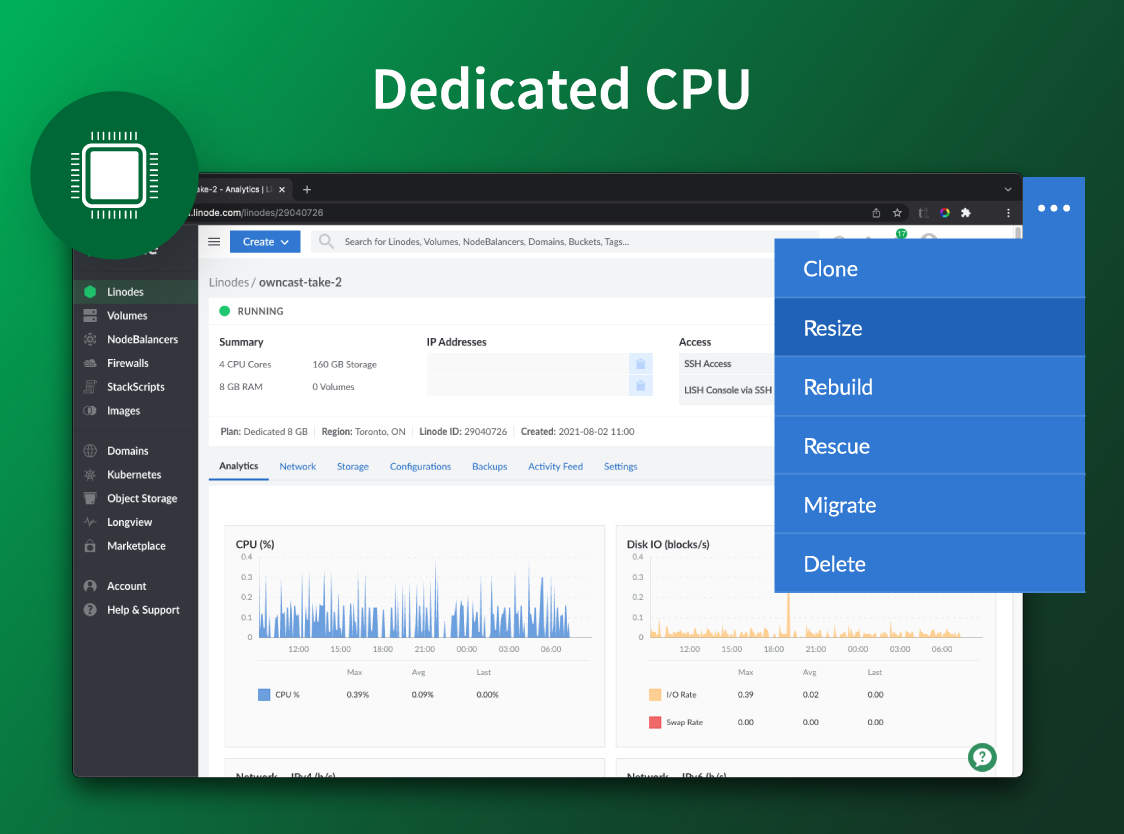
Akamai Cloud Computing (formerly Linode) include scalable and accessible Linux cloud solutions and services. These products and services support developers and enterprises as they build, deploy, secure, and scale applications.
$5
per month
Amazon Web Services
Score 8.6 out of 10
N/A
Amazon Web Services (AWS) is a subsidiary of Amazon that provides on-demand cloud computing services. With over 165 services offered, AWS services can provide users with a comprehensive suite of infrastructure and computing building blocks and tools.
$100
per month
Pricing
Akamai Cloud Computing
Amazon Web Services
Editions & Modules
No answers on this topic
Free Tier
$0
per month
Basic Environment
$100 - $200
per month
Intermediate Environment
$250 - $600
per month
Advanced Environment
$600-$2500
per month
Offerings
Pricing Offerings
Akamai Cloud Computing
Amazon Web Services
Free Trial
Yes
Yes
Free/Freemium Version
No
Yes
Premium Consulting/Integration Services
Yes
No
Entry-level Setup Fee
Optional
No setup fee
Additional Details
CPU, transfer, storage, and RAM are bundled into one price. Storage capacity can be increased with additional Block Storage or S3-compatible Object Storage. Instant Backups can be added with complete independence to the stack. Linode NodeBalancers ensure applications are available.
AWS allows a “save when you commit” option that offers lower prices when you sign up for a 1- or 3- year term that includes an AWS service or category of services.
More Pricing Information
Community Pulse
Akamai Cloud Computing
Amazon Web Services
Considered Both Products
Akamai Cloud Computing
Verified User
Employee
Chose Akamai Cloud Computing
I have used both Linode and Amazon Web Services (AWS), in similar roles. The ease of use and barrier to entry is like night and day between the two. With AWS, I was facing a steep learning curve, hidden costs buried in [small print,] and a feeling that managing AWS was going to …
Google Computer Engine: it is too expensive. You have to pay for computing resources (CPU, memory), storage, network traffic individually. While the quality of service is good, it's still with the same level of Linode.
I have used Amazon Web Services (AWS) before this and both are reliable. AWS is just as easy to use, but the costs are harder to understand, because they are not fixed, they are dependent on usage. If you have a low usage but an abnormal process the costs can spiral without …
Compared to the big cloud players like Amazon Web Services, Google Cloud Platform, MS Azure, Oracle Cloud, and co., Linode's product is simpler and cheaper. For quick and straightforward client engagements, the power and flexibility afforded by the previously mentioned vendors …
Setup and management of Linode services were just simpler than similar services from Rackspace or Amazon Web Services, both of which are cumbersome and confusing to the point of frustration.
It is more user-friendly than the big three cloud providers like AWS and GCP. The interface blows them out of the water; pricing is so much more competitive—no egregious bandwidth fees like AWS. As a small startup, cutting out the overhead of ultra-complex UI and pricing …
Linode's price for performance is unmatched. The scalability and customizability of their offerings is likewise superlative. Uptime is great and they have servers in all of the places we need them. Security is on par with the rest. Their web interface is useful. Their …
Linode ultimately has better value for money. Not as many features/services as AWS but they do cloud computing very well. Managed databases are something we’d like to see and it’s on Linode’s roadmap. AWS nickels and dimes you for everything. We’ve also considered UpCloud, …
Linode offers a fairly specialized subset of cloud services, which makes the dashboard interface a million times easier to use than both GCP and AWS. In addition, their VPS offerings give you a broader range of control with (thankfully) fewer options. This makes it easier to …
Linode's offering is almost identical to DigitalOcean's, but I find Linode's customer service better AWS, Azure and Google Cloud provide all services Linode does, but provides a much large set of other features and customizations.
Linode delivers higher performance cloud servers, within an easier web interface, simpler API, and better cost-benefit. Amazon has a complex interface that many times make the customers spend much more time in order to finish simple tasks and use "AWS-terms" so even if you need …
While SiteGround, GoDaddy, and DreamHost all offer ease of use and work OK when they're working, their performance is not consistent. All three can become very slow for even very low traffic sites. Linode, in comparison, offers much more consistent performance and any issues …
I don't have extensive experience with VPS services, but I steered away from Amazon and toward Linode specifically because the latter was easier to use. Amazon offered a lot of flexibility, but it was geared to meet the needs of experienced developers. Linode's package deals …
For other jobs I worked with both AWS and GCP and they both are mind-boggling complex in comparison. You have a running machine on Linode by the time you just started reading what services you need to activate for your project in AWS / GCP. This also makes the pricing of Linode …
Linode is far simpler to use than AWS. Digital Ocean is roughly comparable but the simplicity and customer support of Linode along with roughly equivalent cost kept me with Linode vs. going to Digital Ocean.
There are giants in the cloud industry like AWS and GCP, which most businesses and corporations prefer. They offer a wide range of services. Hence they are preferred. And they offer enterprise support. They offer full control over user management, security and permissions. They …
Compared to the "big three" cloud providers, Linode does not have the enormous range of service offerings that they do. I would not attempt to build the next Instagram on Linode. But for companies that simply want a straight-forward cloud provider, they're definitely our …
Linode's cost is a fraction compared to Azure and Amazon. Additionally, the bandwidth and throughput of the machines on the Linode network is also better.
I also used AWS, they are good but their interface is very complex. You need a person to manage on AWS due to its complexity but on Linode, its interface is very clear and simple. You don't need any person to look up for it as you can easily manage the things on Linode. That's …
I use AWS at my day job, and I find their admin tools to be a lot more cumbersome and difficult to use as compared to the Linode management interface. I also find the AWS pricing models to be complicated and harder to understand. Linode is just easier to work with.
I chose Linode because of its simpler and easy-to-understand pricing structure. Deployment of nodes seemed easier as well. Another thing I may add is that Linode just seems more professional. Linode gives you a lot more flexibility and control compared to GoDaddy. DigitalOce…
Linode is most cost effective among all services reviewed and particularly well suited for cases in which loads are predictable and not continually expanding.
Amazon Web Services is much more mature than all of the cloud service providers out in the market. It has 300+ services that solve almost all of your cloud problems.
Akamai Connected Cloud Linode would be a good service to host a content delivery network (CDN) because of its edge network but I'd prefer not to use Akamai Connected Cloud Linode for tasks that need GPU power such as Machine Learning or Artificial Intelligence (AI) because Akamai Connected Cloud Linode lacks deep GPU compute compared to AWS or Google Cloud or Microsoft Azure
This is something that is actually common across most cloud providers. A comprehensive understanding of one's use cases, constraints and future directions is key to determining if you even need a cloud solution. If you are a 2-person startup developing something with a best-scenario audience of 1k DAU in a year, you would very likely best served by a dirt-cheap dedicated Linux server somewhere (and your options to graduate to a cloud solution will still be open). If, however, you are a bigger fish, and/or you are actively considering build-vs-buy decisions for complicated, highly-loaded, six-figure requests per minute systems, global loadbalancing, extreme growth projections - then MAYBE you solve all or part of it with a cloud provider. And depending on your taste for risk, reliability, flexibility, track record - it might be AWS.
I've been with them a long time. They provide me with the capabilities I need coupled with knowledgeable support that's not pay-for-extra. However, if I move to a non-Linux OS, the level of support by necessity will drop off. I can still ask questions about the infrastructure but I my ability to ask about OS features will decrease.
We are almost entirely satisfied with the service. In order to move off it, we'd have to build for ourselves many of the services that AWS provides and the cost would be prohibitive. Although there are cost savings and security benefits to returning to the colo facility, we could never afford to do it, and we'd hate to give up the innovation and constant cycle of new features that AWS gives us.
Simple and clear, no BS interface. From a design perspective it's no Apple or Stripe, but it does what it needs without making me want to stick a fork in my eyes, like when being forced to use Azure, AWS or GCP.
AWS offers a wide range of powerful services that cater to various business needs which is significant strength. The ability to scale resources on-demand is a major advantage making it suitable for businesses of all sizes. The sheer volume of options and configurations can be overwhelming for new users leading to a steep learning curve. While functional the AWS management console can feel cluttered and less intuitive compared to some competitors which can hinder navigation. Although some documentation lacks clarity and practical examples which can frustrate users trying to implement specific solutions.
There is very little planned downtime. Whenever planned downtime is necessary I'm always given lots of advanced notice and an explanation that I can pass along to my users that they'll understand. I really appreciate that Linode appreciates my commitment to reliable service to my users. It shows that they believe they've been successful when I'm successful.
Servers are well dimensioned and price performant. Of course one always wants more, so if they were to upgrade their hardware for the same price I'd consider moving more workloads. Networking - never had an issue. Hardware speeds - disks are fast and can grow to great size.
AWS does not provide the raw performance that you can get by building your own custom infrastructure. However, it is often the case that the benefits of specialized, high-performance hardware do not necessarily outweigh the significant extra cost and risk. Performance as perceived by the user is very different from raw throughput.
Support was excellent and fast. The documentation is extensive and helpful. I learned many things from their online documentation. I did not contact them by phone, but email took a day or less. Complex problems would probably need a service contract. I liked the friendly and polite tone of the support.
The customer support of Amazon Web Services are quick in their responses. I appreciate its entire team, which works amazingly, and provides professional support. AWS is a great tool, indeed, to provide customers a suitable way to immediately search for their compatible software's and also to guide them in a good direction. Moreover, this product is a good suggestion for every type of company because of its affordability and ease of use.
We got kick started with an initial walkthrough along with some free credits. The initial walkthrough helped us to understand Linode's ecosystem and start our hands on with Linode. We tried out some apps from Marketplace initially with the free credits, which not only helped us understand Linode better, but also those apps. We had implemented many such apps to our customers with Linode
We're a small organization. The implementation of our Linode solution was trivial. Once I justified a cloud server to my bosses over a co-location -- the co-lo wasn't as fast as our linode server in load tests -- it was a matter of moving one Linux implementation to another. Trivial.
We switched to Linode from Namecheap due to poor uptime, and never had any issues with stability ever again after switching. We also cut our costs in half by switching. We compared Linode to DigitalOcean and Vultr, with the primary factor that caused us to go with Linode initially being their documentation. After using Linode for 3 years, their amazing support is another reason why we wouldn't consider anyone else at this point.
Amazon Web Services fits best for all levels of organisations like startup, mid level or enterprise. The services are easy to use and doesn't require a high level of understanding as you can learn via blogs or youtube videos. AWS is Reasonable in cost as the plan is pay as you use.
Although I use only a fraction of their product offerings, the total set makes scalability an easy goal to shoot for. As I said, I have a few customers that use the services my Linode provides...and I like it that way. However, should I need to scale up, I can...without incurring any more cost than I need to.
Using Amazon Web Services has allowed us to develop and deploy new SAAS solutions quicker than we did when we used traditional web hosting. This has allowed us to grow our service offerings to clients and also add more value to our existing services.
Having AWS deployed has also allowed our development team to focus on delivering high-quality software without worrying about whether our servers will be able to handle the demand. Since AWS allows you to adjust your server needs based on demand, we can easily assign a faster server instance to ease and improve service without the client even knowing what we did.