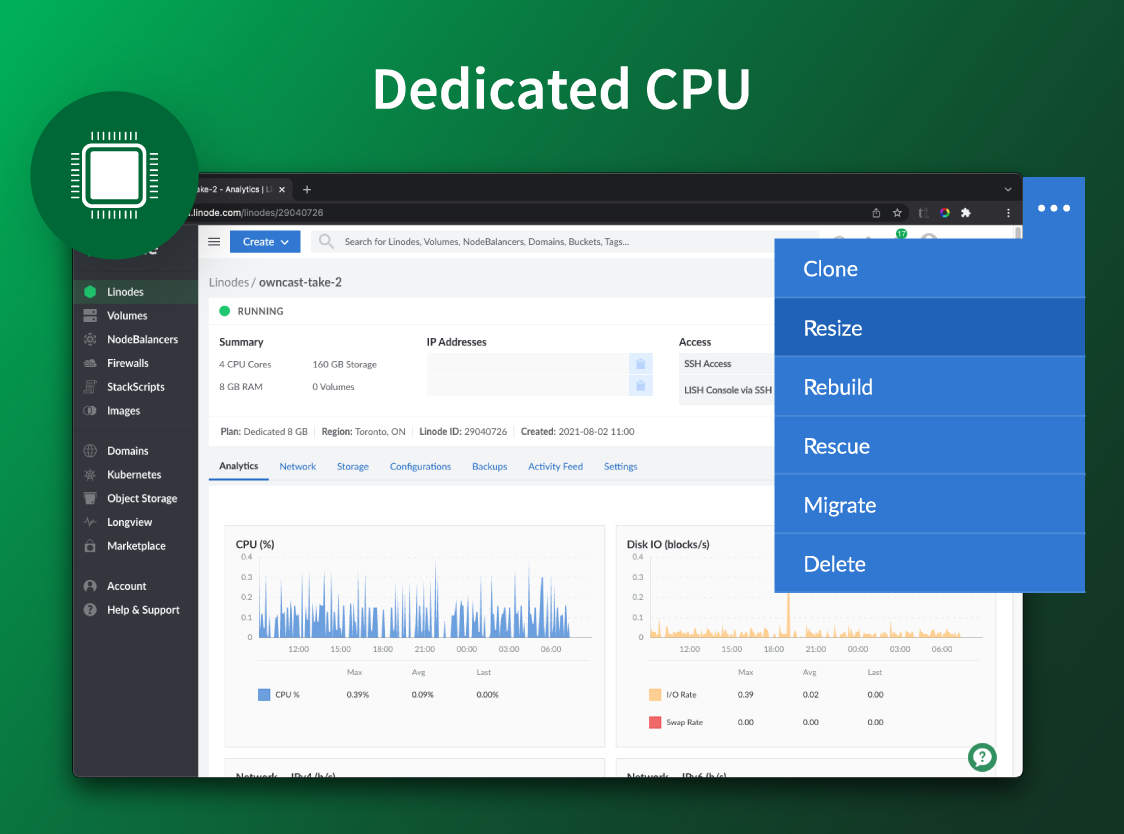
Akamai Cloud Computing (formerly Linode) include scalable and accessible Linux cloud solutions and services. These products and services support developers and enterprises as they build, deploy, secure, and scale applications.
$5
per month
Google Cloud Storage
Score 9.0 out of 10
N/A
Google Cloud Storage is unified object storage for developers and enterprises.
N/A
Google Compute Engine
Score 8.8 out of 10
N/A
Google Compute Engine is an infrastructure-as-a-service (IaaS) product from Google Cloud. It provides virtual machines with carbon-neutral infrastructure which run on the same data centers that Google itself uses.
$0
per month GB
Pricing
Akamai Cloud Computing
Google Cloud Storage
Google Compute Engine
Editions & Modules
No answers on this topic
No answers on this topic
Preemptible Price - Predefined Memory
0.000892 / GB
Hour
Three-year commitment price - Predefined Memory
$0.001907 / GB
Hour
One-year commitment price - Predefined Memory
$0.002669 / GB
Hour
On-demand price - Predefined Memory
$0.004237 / GB
Hour
Preemptible Price - Predefined vCPUs
0.006655 / vCPU
Hour
Three-year commitment price - Predefined vCPUS
$0.014225 / CPU
Hour
One-year commitment price - Predefined vCPUS
$0.019915 / vCPU
Hour
On-demand price - Predefined vCPUS
$0.031611 / vCPU
Hour
Offerings
Pricing Offerings
Akamai Cloud Computing
Google Cloud Storage
Google Compute Engine
Free Trial
Yes
No
Yes
Free/Freemium Version
No
No
Yes
Premium Consulting/Integration Services
Yes
No
No
Entry-level Setup Fee
Optional
No setup fee
No setup fee
Additional Details
CPU, transfer, storage, and RAM are bundled into one price. Storage capacity can be increased with additional Block Storage or S3-compatible Object Storage. Instant Backups can be added with complete independence to the stack. Linode NodeBalancers ensure applications are available.
—
Prices vary according to region (i.e US central, east, & west time zones). Google Compute Engine also offers a discounted rate for a 1 & 3 year commitment.
Information Technology Specialist, Digital Strategist
Chose Akamai Cloud Computing
There are a lot of very good cloud operations. Linode, for us represents a good offering. It offers a simple way to control infrastructure, without being overly simplified. For us, it was a good median giving us the flexibility to explore, experiment and still build for scale. …
Linode's price for performance is unmatched. The scalability and customizability of their offerings is likewise superlative. Uptime is great and they have servers in all of the places we need them. Security is on par with the rest. Their web interface is useful. Their …
Linode offers a fairly specialized subset of cloud services, which makes the dashboard interface a million times easier to use than both GCP and AWS. In addition, their VPS offerings give you a broader range of control with (thankfully) fewer options. This makes it easier to …
I am still evaluating DigitalOcean Droplets as their pricepoint has moved more towards Linode, but so far I am leaning back towards Linode. They also don't have the GPU machines. But they do have a wider range of options for CPU. At present if you do lscpu on Linode it lists …
All the companies [and] service providers [have] some [unique] features. They [work well] but we are having [a good experience] with Linode. As compare to AWS and Google Cloud, Linode is very cheap and if we compare it with DigitalOcean then they both have similar …
For other jobs I worked with both AWS and GCP and they both are mind-boggling complex in comparison. You have a running machine on Linode by the time you just started reading what services you need to activate for your project in AWS / GCP. This also makes the pricing of Linode …
Linode provides easier and more understandable pricing and value. I never have to wonder or estimate the month's costs or have any surprises. Linode also is more logically laid out and easy to get things set up and running quickly.
Digital Ocean, AWS are used by some of our clients. Linode is good and I'm very comfortable using it for the last 2-3 years, so love to refer it to clients too.
DigitalOcean had very bad communication both internally and externally. Vultr had good features but could not answer questions about Spectre/Meltdown with any specificity. EC2 and GCE's unpredictable costs and higher bandwidth fees make them annoying or expensive for most of my …
Google Computer Engine: it is too expensive. You have to pay for computing resources (CPU, memory), storage, network traffic individually. While the quality of service is good, it's still with the same level of Linode.
For simple VMs or Kubernetes, Linode is cheaper and it also has consistently good performance. As long as this is what you need, you get all you'd want. AWS and GCP shine when you need their other services. Oracle Cloud was bare bone and expensive. Droplets are easy to start …
Red Hat OpenShift was the first product I used and it was fantastic--until they changed to a container model and kicked everyone of the previous model. From there I moved to Linode and haven't looked back. You have much more control but it does mean you need to keep on top of a …
Compared to the "big three" cloud providers, Linode does not have the enormous range of service offerings that they do. I would not attempt to build the next Instagram on Linode. But for companies that simply want a straight-forward cloud provider, they're definitely our …
One of our clients was previously hosted on Rackspace, then Google Cloud Services. Their Rackspace services were very expensive and provided little in the way of migration or management. After re-engineering their deployment, we migrated them to Google Cloud Services (GCS) …
Google cloud provides serverless scalable services that protect key business pipelines from falling over during unexpected high volumes. Linode clusters require management and provisional scaling, which is acceptable in most cases but still requires monitoring. That said, GCP …
The two services are very comparable, but we have many different services that all run on the Google Cloud Platform and therefore Google Cloud Storage made more sense as our storage solution rather than looking to an outside service like S3. Either one of these options would …
The perfect blend of setup flexibility, costing and trust of Google could be my answer to the comparison. This being a server backed service so, ruling out the functions. The Setup flexibility and speed set the GCE apart from Kubernetes. Compliance, regulation and the security …
Google Compute Engine provides on-demand computing resources that are easy to scale up or down according to my organization needs. This allows our business to quickly adapt to changes in demand without having to invest in additional hardware. It also offers a very competitive …
Verified User
Engineer
Chose Google Compute Engine
We decided to use GCE mainly for its price and good looking UI.
We have used a few other cloud providers of similar services and continue to use Google Compute Engine because it fits well within our technology stack and is cost-effective while providing the service we need. It has allowed us to use and experiment with many more …
App Engine is somewhat similar, but we use it together with Compute Engine. App Engine is good for serving end requests to users -- it can scale automatically to any number of requests, but has it's own limitations. Compute Engine does not have any limitations. but you have to …
Google App Engine is slower in comparison, and costs more than Google Compute Engine. We chose Google Compute Engine because Google App Engine was way too slow (mainly due to having to use Google Cloud Storage).
Akamai Connected Cloud Linode would be a good service to host a content delivery network (CDN) because of its edge network but I'd prefer not to use Akamai Connected Cloud Linode for tasks that need GPU power such as Machine Learning or Artificial Intelligence (AI) because Akamai Connected Cloud Linode lacks deep GPU compute compared to AWS or Google Cloud or Microsoft Azure
[Google Cloud Storage is] great for storing and playing large video files, and even sharing them securely with others, whether or not they are part of your organization. No need to download video files before watching, and can also be used to store any other kinds of files.
You can use Google Cloud Compute Engine as an option to configure your Gitlab, GitHub, and Azure DevOps self-hosted runners. This allows full control and management of your runners rather than using the default runners, which you cannot manage. Additionally, they can be used as a workspace, which you can provide to the employees, where they can test their workloads or use them as a local host and then deploy to the actual production-grade instance.
Really great, easy to use interface helps us manage files easily. Storage is fast and inexpensive, so we don't have to spin up storage instances locally
Great set of command-line tools to manage data and storage options via scripts and apps, as well as an SDK means we can build GCS into our orchestration and operations tools
Robust integration with other Google cloud tools means that we don't have to think too hard about using GCS for a variety of storage tasks as we interact with other Google services.
Scaling - whether it's traffic spikes or just steady growth, Google Compute Engine's auto-scaling makes sure we've got the compute power we need without any manual juggling acts
Load balancing - Keeping things smooth with that load balancing across multiple VMs, so our users don't have to deal with slow load times or downtime even when things get crazy busy
Customizability - Mix and match configs for CPU, RAM, storage and whatnot to suit our specific app needs
I've been with them a long time. They provide me with the capabilities I need coupled with knowledgeable support that's not pay-for-extra. However, if I move to a non-Linux OS, the level of support by necessity will drop off. I can still ask questions about the infrastructure but I my ability to ask about OS features will decrease.
after all of the investment made in the tool and considering how many teams use it I think we would not be likely to move away from this tool. A lot of our information including historical is already here and we are happy with the capabilities of the tool currently
Its pretty good, easy and good performance. Also, interface is very good for starters compared to competitors. Infra as Code (IaC) using Terraform even added easiness for creation, management and deletion of compute Virtual Machines (VM). Overall, very good and very easy cloud based compute platform which simplified infrastructure, very much recommend.
Simple and clear, no BS interface. From a design perspective it's no Apple or Stripe, but it does what it needs without making me want to stick a fork in my eyes, like when being forced to use Azure, AWS or GCP.
Very easy to use. I love having my data backed up. I love that Google Cloud Storage provides me with the peace of mind that I no longer need to worry about my data being lost. I can now sleep better at night. Google Cloud Storage is very easy to use. Overall, you save time and have less stress by using Google Cloud Storage.
Having interacted with several cloud services, GCE stands out to me as more usable than most. The naming and locating of features is a little more intuitive than most I've interacted with, and hinting is also quite helpful. Getting staff up to speed has proven to be overall less painful than others.
There is very little planned downtime. Whenever planned downtime is necessary I'm always given lots of advanced notice and an explanation that I can pass along to my users that they'll understand. I really appreciate that Linode appreciates my commitment to reliable service to my users. It shows that they believe they've been successful when I'm successful.
Google Compute Engine works well for cloud project with lesser geographical audience. It sometimes gives error while everything is set up perfectly. We also keep on check any updates available because that's one reason of site getting down. Google Compute Engine is ultimately a top solution to build an app and publish it online within a few minutes
Servers are well dimensioned and price performant. Of course one always wants more, so if they were to upgrade their hardware for the same price I'd consider moving more workloads. Networking - never had an issue. Hardware speeds - disks are fast and can grow to great size.
For performance i give Google Cloud Storage 10 of 10 on performance because even though there are other softwares that do exactly the same thing as Google Drive, it still works exceptionally well. It is very fast, and and far as integration, the only software I have used with it that integrated was Google Docs, and of course it integrates perfectly.
It works great all the time except for occasional issues, but overall, I am very happy with the performance. It delivers on the promise it makes and as per the SLAs provided. Networking is great with a premium network, and AZs are also widespread across geographies. Overall, it is a great infra item to have, which you can scale as you want.
Support was excellent and fast. The documentation is extensive and helpful. I learned many things from their online documentation. I did not contact them by phone, but email took a day or less. Complex problems would probably need a service contract. I liked the friendly and polite tone of the support.
We have never used official support from Google for our Google Cloud Storage, but there is plenty of documentation in place already. With a small amount of work, anybody should be able to get started. Once needs get more complicated, there is still documentation from Google, but also plenty of community support for common use cases around the internet.
The documentation needs to be better for intermediate users - There are first steps that one can easily follow, but after that, the documentation is often spotty or not in a form where one can follow the steps and accomplish the task. Also, the documentation and the product often go out of sync, where the commands from the documentation do not work with the current version of the product.
Google support was great and their presence on site was very helpful in dealing with various issues.
We got kick started with an initial walkthrough along with some free credits. The initial walkthrough helped us to understand Linode's ecosystem and start our hands on with Linode. We tried out some apps from Marketplace initially with the free credits, which not only helped us understand Linode better, but also those apps. We had implemented many such apps to our customers with Linode
We're a small organization. The implementation of our Linode solution was trivial. Once I justified a cloud server to my bosses over a co-location -- the co-lo wasn't as fast as our linode server in load tests -- it was a matter of moving one Linux implementation to another. Trivial.
overall I was not directly involved but hears the teams were satisfied with the implementation. the teams that used the tool did not encounter major issues, it was as expected with minor issues and bugs that were resolved later. The more significant learning curve was actually starting to use the tool
We switched to Linode from Namecheap due to poor uptime, and never had any issues with stability ever again after switching. We also cut our costs in half by switching. We compared Linode to DigitalOcean and Vultr, with the primary factor that caused us to go with Linode initially being their documentation. After using Linode for 3 years, their amazing support is another reason why we wouldn't consider anyone else at this point.
We prefer Google Cloud Storage over Amazon Web Services because of the tools and code integration offered by Google Cloud Storage. We found the Google Cloud Storage toolset to be highly usable and give us the fine-grained control we need for managing digital assets. Ultimately, we chose Google Cloud Storage because we found the API and suitability for code integration with our Java codebase to be impeccable and because we had excellent direct support from the Google Cloud Storage team
Google Compute Engine provides a one stop solution for all the complex features and the UI is better than Amazon's EC2 and Azure Machine Learning for ease of usability. It's always good to have an eco-system of products from Google as it's one of the most used search engine and IoT services provider, which helps with ease of integration and updates in the future.
Although I use only a fraction of their product offerings, the total set makes scalability an easy goal to shoot for. As I said, I have a few customers that use the services my Linode provides...and I like it that way. However, should I need to scale up, I can...without incurring any more cost than I need to.
It has assisted greatly with our ability to share documents/information cross functionally. Especially within our advertising team, we store a large amount of information to assist new hires and refresh current employees.
Something that could improve is employees' understanding of how to best utilize Google Cloud Storage. This could improve by implementing a potential training video or tutorial.
Overall, Google Storage has been great. I have not used a similar storage product that had the same enterprise level capabilities.