Appcues is online software for creating in-product experiences such as user onboarding, feature announcements, etc. without writing any code. (The vendor believes it's the non-technical people who oftentimes have the best information about a software user's needs and desires.) The goal of using Appcues is to improve product engagement within the user's own customer base.
$299
per month/billed monthly
MindTouch
Score 7.0 out of 10
N/A
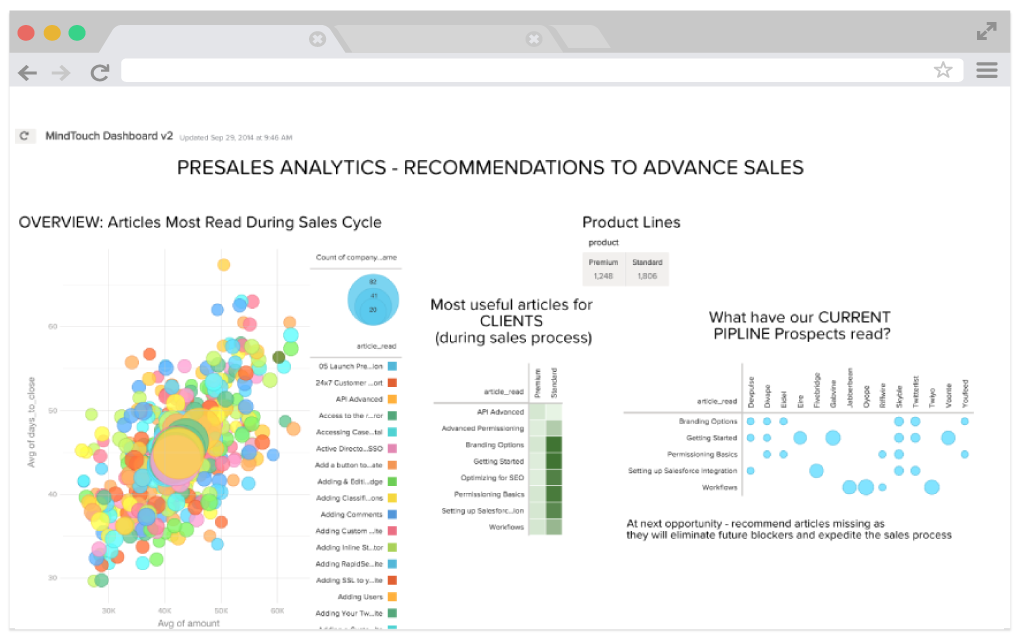
MindTouch is a customer experience management platform with content management and help authoring capabilities. Formerly known as MediaWiki, it is optimized for building knowledge bases for customer self-service and agent assistance purposes.
N/A
Whatfix
Score 9.9 out of 10
N/A
Whatfix is advancing the "userization" of application technology, by empowering companies to maximize the ROI of digital investments across the application lifecycle. Powered by GenAI, Whatfix’s product suite includes a digital adoption platform, simulated application environments for hands-on training, and no-code application analytics. Whatfix enables organizations to drive user productivity, ensure process compliance, and improve user experience of internal and customer-facing…
N/A
Pricing
Appcues
MindTouch
Whatfix
Editions & Modules
Essentials
$299
per month/billed monthly
Growth
$879
per month/billed annually
Enterprise
Contact sales team
No answers on this topic
No answers on this topic
Offerings
Pricing Offerings
Appcues
MindTouch
Whatfix
Free Trial
No
Yes
Yes
Free/Freemium Version
No
No
Yes
Premium Consulting/Integration Services
No
Yes
Yes
Entry-level Setup Fee
No setup fee
No setup fee
Optional
Additional Details
—
—
All Pricing models are customized and tailor-made according to the customer's requirement.
We took a demo for Whatfix but thought them nowhere to be close to Appcue's functionalities. Even though I want more theming options in Appcues, it still has more variety than Whatfix. Also, to make changes to flows, Appcues is more nimble, and you can preview the resultant …
It has a much, much better user interface, better customer care, and of course better pricing. This along with the fact that they were very accommodating for our use case ensured we went ahead with Appcues.
We used Userlane briefly but unfortunately, it didn't meet our technical requirements. When we moved away from Userlane we investigated Appcues, however, the range of capabilities in Whatfix was much higher so we saw more value in Whatfix.
The support from Whatfix is very good. It has better features than others. It has very few bugs. Whatfix is very user friendly. It meets all the requirements. They will quickly respond to all the queries and questions of users or your clients if they face any issues. Their …
Great quality of support provided by Whatfix as I already mentioned. Looking at all the features it’s headed to the right direction. Very delightful in terms of the ease of use and setup. Meets all the requirements. Quick to respond to all the queries and questions whenever …
It is well suited for SaaS products or services that have a highly complex user interface. Through Appcues, you can ensure that people discover all the existing and new features and make them understand the value of your product as soon as possible to address the evergreen issue of churn. But if your user interface is really messed up, you should change the product itself instead of using a tool like Appcues to explain everything on the screen.
If a company doesn't want to make their knowledge base public-facing, you lose a lot of the value of using MindTouch in a closed environment. MindTouch is not ideal for extremely structured content management scenarios that are strong DITA advocates. Companies that require localization might not be good fits either.
Currently, we are only using Whatfix with Salesforce but are in the process of implementing on other systems. It is an excellent tool to organize and provide in-app access to training materials already created. It excels at providing guidance about tasks users don't complete often and, therefore, forget what they were trained about the process. The only sort of system it might not work well is one that provides its own robust in-app assistance. More than one type of tip icon being displayed, for instance, could be confusing.
We were extremely surprised that there are not any Appcues used in Appcues. The app is pretty easy to use, once you figure out how to use it. There were not any type of tutorials when we logged in that quickly walked through how to setup a flow.
Appcues has lots of support articles, however they are almost so numerous that it was hard to find simple onboarding documentation that we found useful.
The different tooltips and product actions are great, but being able to customize the different cues a little bit more by changing sizes and aspect ratios could be an improvement.
When we do have a support issue, we frequently need to go through multiple people, contacts, ways of explaining things, etc,. before someone on their end actually understands our problem. It's rare that the first person we talk to understands the big picture or appreciates our use case.
The draft functionality is a promising start but lacks some key features that cause us regular frustration. For example, you can only create one draft of a page at a time. This is fine if changes come to you in perfect sequential order, but it makes it impossible for us to update a live page while a draft exists. More specifically, if we're working on updating content on a page for a new feature being released next month, but then we notice a typo today, we can't fix the typo in production without first deleting the draft or doing some hacky workaround of temporarily copying/pasting the source HTML of the draft page and saving it someplace else.
Existence of, or integration with, true source control would be a huge win, but it's something currently lacking in the product. MindTouch's content reuse feature is helpful in the right situations, but it's not robust enough to scale well for lots of content.
Version history of page changes is not 100% reliable. Sometimes items don't show up at all or there is a delay before the diff is visible. Also, creating a draft does not register at all in the page version history.
In-site search is poor, unless you know the *exact* title of what you're looking for. We tell our customers to use Google, not the MindTouch search. Google is excellent at searching our MindTouch site.
The possibility to select content/widgets at the time for "push to production" (some we would like to p2p for one single content, that is not possible at the moment).
I wish the filters in the dashboard would stay when you choose a content, currently you have to filter again and again.
In the analytics area, I would like the system to remember this for a certain time window after selecting the start date.
We've put lots and lots of content into the MindTouch system, of course, so that makes it harder to opt out, but we're also very pleased with their rate of development and weekly pushing of improvements, as well as their response and solutions to our questions and input All in all, a winning combination.
[We feel like] even though Whatfix has its flaws, we are impressed by the speed of development [and] their openness about their future improvements, [but] most important their proactive customer service and customer success team. Whatfix acts more like a partner than a supplier of a 3rd party tool, and we welcome that experience.
The site is responsive across multiple devices and screens. It has a clear path to contact support. The articles are searchable. Site users do have trouble navigating the site and finding what they need. That may be due to the architecture of the site, but it'd be nice if MindTouch offered more solutions are this. Our content is organized by product line. And many of those product lines have overlapping training content, so we have extensive duplicate content.
While they've made a lot of improvements in the last year, there are still challenges with walkthroughs and how beacons can be created. They are aware of these limitations and are actively soliciting customer feedback to help them remedy these shortcomings.
MindTouch is a hosted site, so as a heavy user there are times when I notice that pages are slow to load, or something happens like Amazon Web Services crashing the entire east coast for a few hours, that you do notice even if it isn't actually the fault of the MT tool itself. It's the risk of using a hosted tool, but the benefits are pretty amazing and outweigh these performance issues.
It's good. Pretty solid. We got a lot of input to get up and running, but did a lot of the setup and customization work ourselves, because of our high standards. We've gotten good response and results on specific projects related to customization and our CSM is also pretty responsive. Overall, I think that the jobs of CSMs and support folks would be easier if the product weren't wonky in some ways. They seem to have to do more "workarounds" for basic functionality that should just work out of the box
Whatfix is THE best vendor I've ever worked with when it comes to supporting their customers. The support team is friendly, helpful and always willing to listen to your suggestions and ideas. This also applies to the Engineering team who I've spent several hours on calls with debugging a few of the more challenging scenarios we have in place. Nothing is ever too much trouble for Whatfix and they are truly best-in-class when it comes to their support model.
Written documentation and videos are very good and have helped on numerous occasions when I've had to look up how to accomplish a certain task. The reason I have not given a full score is mainly because there have been some inaccuracies in the documentation because updates to the MindTouch framework have slightly changed the way things work. But this is usually the same type of challenges I face when making documentation for the software solution we develop. So all in all I'm very satisfied with both the personal webinars and the online documentation MindTouch provides for their service.
While helpful, the feedback from our employee was, that [they felt] the training was very high-level - sometimes confusing. It would be great to have some kind of sandbox environment for new users to train certain scenarios.
Just know that there is so much more involved than adding your content. There are so many pieces to launching your site -- especially if you are moving from another platform. If you are not a person who typically works in the "website" realm, do your homework, ask your web people, engineers, etc., because there's a lot to do that you won't know about until you are unexpectedly smacked in the face with it. Learn from my mistakes! We are very happy now, but it was a long road getting to launch day for us
Although Whatfix make the process relatively straightforward (they will provide Group Policy Scripts to install a Google Chrome extension specific to your organisation) its important to ensure your network deployment teams (if you have more than one) understand their role and what they need to do to test deployment once they undertaken the work.
It has a much, much better user interface, better customer care, and of course better pricing. This along with the fact that they were very accommodating for our use case ensured we went ahead with Appcues.
I will be brief. DealerTeam is built upon Salesforce and we try to support native apps. We used Desk.com first for basic Help Ticket management. The product did not satisfy how our customers were looking for information. We upgraded to Service Cloud with Knowledge Base and spent one year writing content and developing our support agency. Again, our customers were upset about submitting help tickets and waiting for answers. They wanted access to self-help while working with a customer. Today we continue to use Service Cloud with MindTouch integration and have found complete success. There is simply no other solution I know of that is a flexible and easy to use as MindTouch when it come to providing customer success and product support
There is no comparison - Whatfix is the clear winner with us from the very beginning. As Whatfix continues to grow and innovate their product, engage with it's customers on a level beyond any I have every seen. They work as Partners with us, their teams from bottom to top are incredible - Customer Service, Collaboration Teams, Innovation, Sales, Success Mangers and everyone I missed are incredible. One team in particular I want to call out for there outstanding service, care and innovation to help us launch one of our systems is the Professional Services Team. Ganish, Joel, and everyone else who has been on our calls and worked behind the scenes to hit our incredible tight deadline in August - KUDOs for a job well done, You ROCK, THANK YOU words cannot describe how great you guys have been with us on this project, but on all of them. Whatfix's team definitely understands, the customer is first, they align with our values and we will continue to grow with them
Our operational efficiently has improved significantly. Prior to Mindtouch, we managing duplicate content in two separate authoring solutions. Delivering content predictably and consistently was difficult and stressful for writers. In Mindtouch, we were able to optimize our content (remove redundancies) giving us more time to test, review, and improve content quality.
Traffic to our knowledge center is increasing monthly.
Internally, SMEs and customer-facing teams are recognizing the value Mindtouch brings through self-service knowledge. These SMEs want to contribute more to content, either as contributing writers or collaborators with tech writers.
Reduced Training Costs: By cutting traditional training time by 40%, Whatfix has saved significant resources while increasing learning efficiency.
Improved User Productivity: Faster onboarding and fewer errors have led to a 25% improvement in user performance metrics, directly contributing to operational efficiency.
Decreased Support Requests: Self-service guidance has reduced support tickets by 30%, freeing up teams to focus on strategic initiatives and cutting support costs.