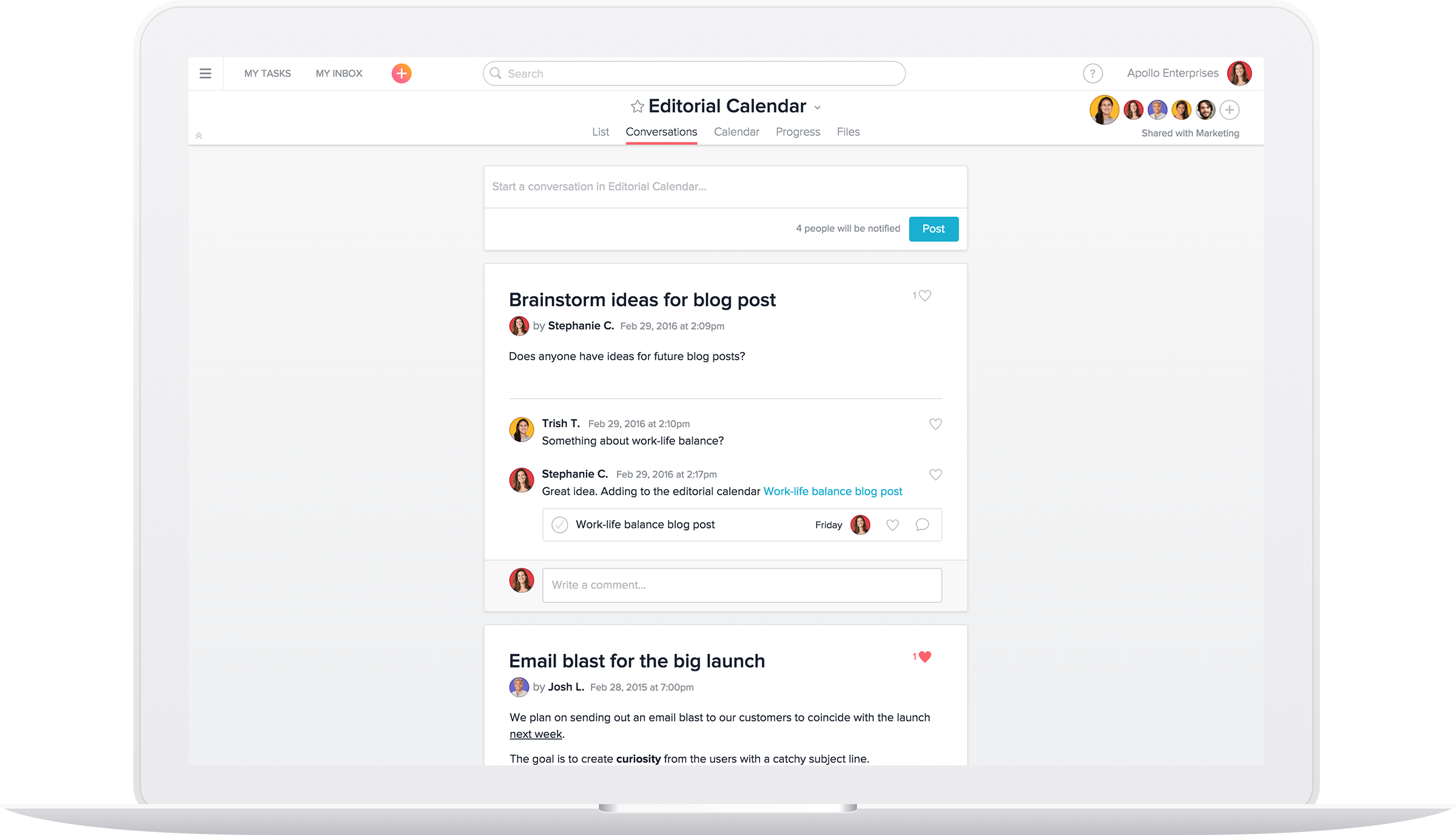
Asana is a web and mobile project management app. With tasks, projects, conversations, and dashboards, Asana lets an entire team know who's doing what by when, enabling workload balancing. Users can also add integrations for GANTT charts, time tracking and more.
$13.49
per month per user
Bugzilla
Score 8.5 out of 10
N/A
N/A
N/A
Redmine
Score 7.1 out of 10
N/A
Redmine is a project management web application written using the Ruby on Rails framework. It is cross-platform and cross-database, and free to download and use as an open source project available on the GNU 2.0 license.
$0
per month
Pricing
Asana
Bugzilla
Redmine
Editions & Modules
Starter
$13.49
per month per user
Advanced
$30.49
per month per user
Enterprise
Contact Sales
Personal
Free
No answers on this topic
No answers on this topic
Offerings
Pricing Offerings
Asana
Bugzilla
Redmine
Free Trial
Yes
No
No
Free/Freemium Version
Yes
No
Yes
Premium Consulting/Integration Services
Yes
No
No
Entry-level Setup Fee
Optional
No setup fee
No setup fee
Additional Details
A discount is offered for annual billing.
—
—
More Pricing Information
Community Pulse
Asana
Bugzilla
Redmine
Considered Multiple Products
Asana
Verified User
Analyst
Chose Asana
Asana is very quick in terms of creating and assigning tasks. None of the above software does it with that efficiency. Redmine and JIRA both have a boring interface while Asana is modern and hip. The only major difference between them is the integration for Agile development …
I think that although they are tools for managing equipment and tools for bugs tracking, Redmine has a great advantage since it can be integrated with many third-party tools and that is the only tool of this type with which I have been able to integrate and integrate systems. …
The usability of Asana is broad since it's available in a variety of platforms that are widely used nowadays. I think that it would be great for people who are constantly on the move and switching devices, since it has allowed me to work from my phone, too. I also think that Asana has proven itself to handle a large quantity of work
Buzilla is easy to use and provides basic functionality to use as a bug tracking tool. If big size attachments are allowed it would have been great. Also with Bugzilla home->Test management area is improved by allowing multiple sections it would be awesome!
Redmine is a perfect solution for businesses that are looking for a FREE and open source solution for project management. It is great for teams that are managing numerous tasks or projects at one time. Redmine is easy to set up and is fairly self-explanatory for anyone who is semi tech-savvy.
Through it, we were able to communicate and cooperate with the rest of the team to complete the work in the required manner and at the appropriate time.
Open source! No license fee involved, no limit to the number of licenses.
Easy to install and maintain. Installation is very easy and hardly needs any maintenance efforts, except when migrating from one version to other. Each project can have its own group of users.
Includes all the core features/fields that are needed to log a software bug/issue.
Multiple attachments are possible, supports various formats.
Good for reporting. Filtering mechanism lets you query bugs by various parameters.
Cloud Based. I'd like to see bugzilla be cloud based. The company I currently work with made a final decision to change db's for this specific reason. Due to the frequency of travel in this company, they need access to bugzilla from differing national / international locations.
Larger File Attachments. I believe the limit of a bugzilla content upload is 4 megabytes. For many of our video'd issues, this file size is simply impractical without the additional effort exertion on video compressor applications.
The design and user-interface are a little outdated. It looks like a product that was designed ten years ago and doesn't have a polished look and feel like newer apps have.
It's not particularly designed to support agile-based project management methodologies such as Scrum.
For future projects I will look at something that is hosted in the cloud that I don't have to manage. I would also like something that has a more modern feel to allow my customers to use it as well as my employees.
It is very user-friendly. Takes a new employee an hour to start figuring out how the system works. That's an important factor. You don't want to encounter the issue where employees need a week to understand how the system works. For example, JIRA, I tried using it for a week and I still don't understand the complicated layout. Asana has a simple interface. Once you see it, you get it type of program.
This is a pretty straightforward system. You put in the bug details, a ticket is created, the team is notified. The user interface reflects this very simple and straightforward flow. It's certainly much easier than trying to track bugs with using Excel and email.
Redmine is a great product to have in an organization. It's extremely flexible, costs much less to maintain than other alternatives, and as a tool, it is relatively fast to get experienced with. The primary advantages of working with Redmine are: flexible platform, API, open-source and highly configurable, stability.
I haven't had to use their support so I can't rate it. The fact that I haven't needed them reflects the ease of use of the product. I would recommend that any new users schedule a complete demo of the product to ensure that they are using it to it's fullest (there's a lot of useful features).
Since it is open source, it doesn't have customer service. However, the amount of information on forums is vast. If you can wade through it, you'll get what you need
Redmine is free, easy to use and it's everything you could want in a free project management program. The fact that it has wiki integration and that it can track on such a granular level is amazing. Assigning tasks to other users, such as our development team, is fantastic and ensures we are always up-to-date on where we are what - on what projects.
Implementation was pretty simple. Particularly because the product cannot be customized so there is not much to do apart from getting it up and running.
Asana is a top-tier project management software that helps us organize and track projects from start to finish. It allows us to apply tasks/to-dos to multiple projects without duplication, divide complex projects into smaller tasks, and track project progress. It also helps us organize work on Kanban boards or linear lists. It stands out from the crowd in a big way compared to the competition.
We migrated away from the whole suite of Rational tools because of their massive complexity around administration and inflexibility regarding workflows. In addition, the suite was insanely expensive, and users hated the usability of the tools. We evaluated, and liked JIRA, but because the organization was looking for cost savings, we ended up going with Bugzilla and it's FOSS model so as to avoid ongoing costs.
Jira is a great project management tool for software product life cycle management for an agile environment based on agile methodologies. Jira is an intuitive and modernized user interface design compared with Redmine but Redmine is a lightweight and affordable project management and task tracking solution with its essential features and functionalities.
It has made the SDLC process more efficient. Bugs were logged and tracked in emails or in Excel sheets leading to slow communication and at time version issues with multiple files. Being an online tool, Bugzilla solved those issues, improved communication, instant status updates and improved efficiency.
We have used Bugzilla with a lot of federal goverment agencies (DHS, CMS, SAMHSA, CDC, HHS etc). Project Directors adn Principle Investigators were at times given access to Bugzilla which provided a snapshot of open vs closed issues.
Some groups would resist using Bugzilla with the email reminders being the main reason. Turning off or reminding them of features where we can 'control' email notification helped a lot.
Customers receive updates on all progress made for their issues -- this results in an informed customer who is being given transparency on all steps of our process.
Customers have responded well from being able to not have to track down emails and instead come to a central place for requests.