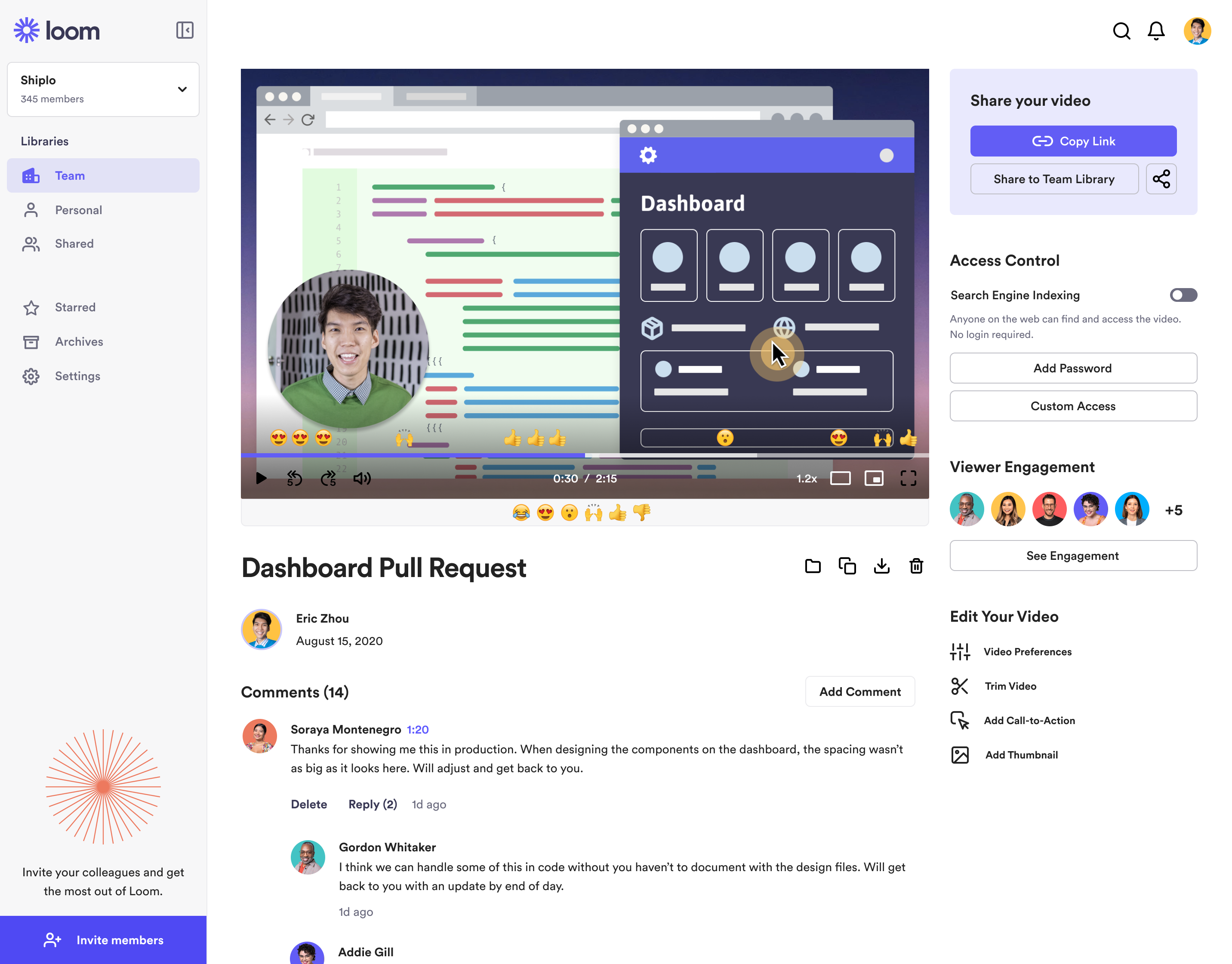
Loom is a screen recorder for Chrome, Mac, Windows, and iOS from Atlassian, presented as quick to install, easy to use, and boasting a functional free edition.
$10
per creator/per month
Munch
Score 0.0 out of 10
N/A
For content professionals, Munch provides automatic content repurposing, intelligent distribution, and AI-driven content creation.
N/A
Vimeo
Score 8.8 out of 10
N/A
Vimeo is a video experience platform. They enable anyone to create high-quality video experiences to connect and bring ideas to life. They proudly serve their growing community of nearly 300 million users — from creative storytellers to globally distributed teams at the world's largest companies.
We have used zoom, google meet or youtube to manage our videos in the past. But both did not seem to be as seamless for everyone to use it. Loom came in to provide an easy way for everyone to use video and share screens or communicate in general. Loom integrates with slack and …
Loom: Loom offers both free and paid plans. The free plan includes basic features and limitations, while the paid plans unlock additional functionalities such as longer video recordings, HD quality, and more advanced sharing options. Either way, quite affordable Vidyard: …
I tried other solutions for video feedback and none of them could match how quick and easy the video recording and sharing is on Loom. Also the consistency of the recordings and reliability is crucial.
When we evaluated the alternatives, Loom was by far the most advanced tool, with multiple types of integrations. Additionally, Loom also provided a Free plan, which made it easy to consider as an alternative. Vidyard and similar tools integrated better with certain other tools …
Honestly, before using Loom, I was recording videos from my cell phone and sending them through Whatsapp or Telegram to try to send large file sizes! I know there are other screen recording tools, but Loom's web interface with all the settings just knocks it out of the park for …
I selected Loom because of product superiority and intuitiveness. Loom has high quality videos compared to others, the Freemium tier is very exciting in Loom. Loom is a multipurpose tool that comes to our help in many areas- whereas other tools are more focused on a specific …
I didn't use any other product like Loom. Skype or Viber just won't work for what I needed. I talked with people who used other products but didn't try one myself. Loom was the first to try and I stayed with it. I was satisfied enough with Loom that I didn't feel like exploring …
I prefer loom to droplr because of its easy interface. I had to take extra time to learn how to become effective with Droplr, while Loom felt self explanatory.
Zoom's recording feature has been helpful before Loom, but I appreciate that with Loom I can go back and re-record something if I made a mistake. It's much easier.
Simplified version of ScreenFlow, not as comprehensive as ScreenFlow in terms of features, but it does the trick for making short training videos. If you just want to capture something on-screen and not do a lot of editing, then Loom is perfect for that. Great for generating …
I tried lots of different screen recording software but ultimately chose Loom because it had the simplest and most user-friendly UI. There are certainly more advanced apps, like ScreenFlow, but my use case is fairly simple—I just want to be able to record video/screen-shares as …
I've used Camstasia and Screen-o-Matic to record screen capture videos in the past. These 2 options at the time didn't have an online platform to upload the videos, so I uploaded it to Youtube or Google Drive so my collaborators could watch them. Loom is easier than them, as it …
Loom solves something that no one else is even trying to solve. Quick visualization of your online experience. Every other solution that records your screen takes time to render the video before it can be shared. Loom is taking the magic of sharing a screenshot of your computer …
Loom is the best video screen sharer that we have come across. Its ease of use and relative value in its free product make it an easy stand out when we went looking for a platform to use. Though there are different video recording platforms out there that can do similar things …
I used to use Zoom to do screen capture video - even I don't have someone else in a video conference - just because it does a good job of creating screen captures. But that's not really what Zoom is designed to do. Now, when I need to do a fast, low-production-value, …
I also have used eCamm and Quicktime for screen-share/screen recordings. All of the tools here require some patch working of a screen recording, uploading the video to a hosting site, and then eventually sending it to the client. Huge time suck!
There are plenty of screengrab / screen recording tools out there. I like loom based on it's simplicity for acheiving regularly occuring challenges. I don't typically need anything heavier, so having this as a quick tool is great!
For desktop recordings, I've only used Quicktime. Loom is overall a nicer looking and functioning tool for recording videos, although there are a couple tools that Quicktime has (like splicing videos and selecting a specific recording size) that I wish Loom had.
Vimeo has a more secure hosting environment than Facebook Live. We can push to Facebook from Vimeo, so that eliminated the need for Facebook alone. YouTube has too many ad interactions, and too many suggested videos on the sidebar, so the Vimeo site has a cleaner and more …
It is a similar alternative to Vimeo. It is a cloud-based video platform that offers a suite of tools for businesses to manage, deliver, and monetize their video content.
Vimeo is more reasonably priced and a little more user-friendly. Plus, I like the look of it and that I can use it at a price that doesn't break the bank for a small business like mine. It seems to have more features than these other platforms, so you don't have to have so many …
We have used You Tube, but do not like that an add for ANYTHING may pop up before your video plays. In a setting where there are parents/families or members of our leadership group this can and has led to some very awkward moments that we have had to try and laugh off.
Cinesend is a MUCH slicker platform. It integrates well with our website, and provides a much better branded experience. It costs slightly less, and provides much better access to information and user control.
If you have a reasonable level of website knowledge in your company, …
Youtube does not have the ability to livestream from anything other than your computer unless you have more than 1,000 subscribers. Vimeo on the other hand allow you to livestream from mobile, camera etc, you just have to subscribe.
We are currently looking at Dacast as an alternative option to Vimeo for many obvious reasons. However, we have not tried Dacast yet, we will be doing a free trial next week. While they offer a lower storage that Vimeo, and cost about 400 more per year than Vimeo, they offer …
Vimeo leaves ClickMeeting in the dust when comparing compatibility on social media and other platforms. Vimeo has also been proven to be much more customizable. In ClickMeeting for example, video formatting may be changed if a certain font is not recognized by ClickMeeting. It …
We publish our films to Vimeo and YouTube, but our films come first to Vimeo by way of Frame.Io, which is our client editing platform. The videos move over from Frame.Io to Vimeo effortlessly, with longer films moving slowly and shorter films moving quickly. After the films are …
For our business applications, the primary competitor to Vimeo is YouTube, although Dailymotion is arguably a competitor for some of our business applications, though not others. The most complete full-featured competitor for our business use cases is YouTube, and I think Vimeo …
We also use YouTube to publish our films, but that is more for SEO sake than for everyday use. Vimeo is the primary way we share films whether via the direct URL or by sharing the video link on our social media.
We also use Youtube to host our videos, but rely principally on Vimeo for hosting them to our site and sharing them with others. Vimeo has a great feature where it allows you to update a video if you ever make changes to it. While the video file changes, the URL and all embeds …
Vimeo is best suited for internal video sharing and proofing as well as video storage for creatives, such as video editors and marketers. I think most organizations who need a simple, lightweight access-controlled video sharing platform should use Vimeo since it is easy enough …
We've tried YouTube in the past, and it's just not as good as Vimeo. Vimeo is a software that's built for professionals. And while it doesn't have the "marketability" of Youtube, it looks and FEELS better than a traditional YouTube setting, which is quickly becoming a platform …
YouTube was the platform we primarily used previously, after having restrictions and having locked out of a couple of accounts we needed a better platform. We also lost some of our videos. We also have an internal app to track client videos and Vimeo supported it better. With …
The only competitor we've used to Vimeo is YouTube. Both offer embedded players, basic view counts, etc... but Vimeo has (in my opinion) easier customization for embed options, security features, and thumbnail selection. Youtube has a better recommendation system and the …
In higher ed we have a couple of options that integrate directly with our LMS (Blackboard/Canvas) that are comparable. Kaltura is outstanding but it's very expensive whereas I've found Viddler(and YouTube) to be much more simplistic. I've worked with other tools that want to …
I recall that we looked at YouTube and Wistia. We were looking for a solid, no-frills solution to host and embed videos within our application, and Vimeo just seemed to do that the best, and at the best price.
We use Zoom for a lot of recordings (webinars, videos, etc.) but it doesn't stack up to Vimeo Pro in terms of features and functionality. So we just use Zoom for recording purposes now.
In my opinion, Vimeo Pro beats these competing products hands down because it has customizable features and just for video. The other services treat your videos only as files (indistinguishable from other file types except by their extension and preview). The ability to offer …
Loom is literally the best free (or depending on your team size) tool that I have found in recent years honestly. I have a consulting practice on the side where we work in multiple timezones. Im not the best with words or explaining things over email, and im a much more visual person. being able to show somehow how to do something rather than explain it via email is HUGE. Its literall creating the office culture vibe over video, and its exactly what i need to help scale my consulting while also help provide training at my current job.
If you're a small company with one or two employees, I'm sure that Vimeo is great. When it comes to larger organizations and teams, they clearly are treating such customers stepmotherly. You need a basic account in order to be an admin on a Pro-plan team, but you only get basic support (3 days wait). The teams function is riddled with bugs and affects the whole experience. In this case, I would not recommend Vimeo at all.
Image and Branding - Vimeo has always had an edge on design and branding versus its competitors like YouTube. Using Vimeo as a content delivery platform gives the appearance of being luxurious and having a high-end product.
Video Configuration - I've used YouTube through multiple iterations of their video management and configuration options, and Vimeo has continued to beat it hands down, both in ease of use and robustness. I can easily organize my Vimeo videos into tags and playlists while I still struggle with YouTube, where it is quite laborious.
User Interaction - Vimeo allows you to capture user email addresses for email lists with ease, something its competitors have not figured out yet. You can easily split your video into chapters and hyperlink from within the video to other areas, features which competitors like YouTube have in some form but not nearly as easy to use or well-implemented as Vimeo.
Video Analytics - Vimeo has a full-featured analytics suite that helps content creators understand user interaction and engagement with their videos.
Versioning and Collaboration - Vimeo has workflows for video history and for collaboration where you can have a content creator upload a video which enters a pipeline for an editor to approve. I have not used these workflows, but it's pretty cool that they have implemented features like this.
Custom Micro-Sites - I have only ever embedded Vimeo videos in websites that I've created, or sent them as links to clients, but I have seen well-designed micro-sites for content creators built using Vimeo. Overall, Vimeo does design and branding very well. Their micro-sites look much better, visually speaking, than competitors like YouTube whose equivalent feature, the YouTube Channel, just seems dry in comparison.
The video trim feature has improved a lot recently, but it's still not perfect. Sometimes when I trim a video clip, it distorts other parts of the video.
It would be nice if they had a referral/affiliate program. I would get all my friends to sign up!
I usually extract the links of all lectures from the embed code, but now Vimeo is not allowing that feature. Instead, I have to copy the whole embed code and then extract the URL from the embed code separately. This process has become cumbersome and a bit of hassle since I don't need the whole embed code.
It's dirt easy for the one thing it does exceptionally well. If you think, "hmmm, I should make a quick screen capture of this thing on screen, you can start recording in seconds with almost no additional effort." Once you're done, the recording is automatically uploaded to your account site, and automatically creates a URL you can copy and share with your target audience. From IDEA to EXECUTION to DISTRIBUTION is literally seconds.
The design is clean and intuitive for the most part, which allows for ease of use by both novice and experience users. We are grateful for the ways that the front-end video player is easy to navigate and intuitive to use, and the backend is generally designed the same way. Tools and options are where you expect to find them, and it was easy to navigate the storage on the backend through folders and content filters
Loom is one of my favorite solutions and I've been a raving fan since they first launched. The value of quickly sharing videos in seconds is amazing. Our customers love it so much that they have even downloaded the Loom Chrome extension for their own use with their clients! It's so simple, and nothing else compares or competes.
Vimeo does well in performance with systems with ease. I have not encountered any issues with loading pages or slowing down in other software or systems.
I use Loom for simple tasks. Never used customer support really. It's so simple to use. I haven't had any real issue with Loom which would require customer support to help me out. So I just put 5 because I don't know if the customer support is good or bad since I never used, so I'm kind of neutral.
Terrible support. When I subscribed to Premium we were guaranteed support. However, after the first e-mail I received from them, I never heard from them again. I sent several emails over the course of a couple of weeks acknowledging that due to covid, I did not expect a miracle overnight and that I was keen to work on the issue with them. I have not heard from customer service at all. This is very disappointing. We lost customers due to the poor quality of the livestreams and were left to sort the issue out without their help.
Vimeo does provide the legwork of content curation and management of sources. The quality of content is not bad from a viewer's point of view. I think the analytics could use a little bit of improvement, only because my department has a lot of users.
We have used zoom, Google Meet or youtube to manage our videos in the past. But both did not seem to be as seamless for everyone to use it. Loom came in to provide an easy way for everyone to use video and share screens or communicate in general. Loom integrates with Slack and that is another cool feature
Vimeo is more reasonably priced and a little more user-friendly. Plus, I like the look of it and that I can use it at a price that doesn't break the bank for a small business like mine. It seems to have more features than these other platforms, so you don't have to have so many different platforms just for your video needs.
It gives me back 2-3 hours per week in time saved fussing with typing out long emails.
Our team and vendors understand us faster and better when we offer revisions and training using Looms vs. trying to type it out - causing better client satisfaction.
We still have to use Snagit, though, until Loom gives us still screenshot edit/markup abilities!
General membership engagement has increased significantly. We are accustomed to 20-35% of users viewing content and that has increased to about 40-60% within the past 5 months.
We have found that linking a Vimeo video where the video can be viewed in-app or on the website is when we see most views, rather than redirecting users to the Vimeo account.