Basecamp is a web-based project-management tool. Basecamp offers features standard to project management platforms, as well as mobile accessibility, unlimited users, and 3rd party integrations. Basecamp is priced by space requirements and concurrent projects.
$15
per month per user
Notion
Score 8.8 out of 10
N/A
Notion aims to present users with an all-in-one workspace — for notes, tasks, wikis, and databases, from Notion Labs in San Francisco.
$5
per month per user
TimeCamp
Score 7.0 out of 10
Small Businesses (1-50 employees)
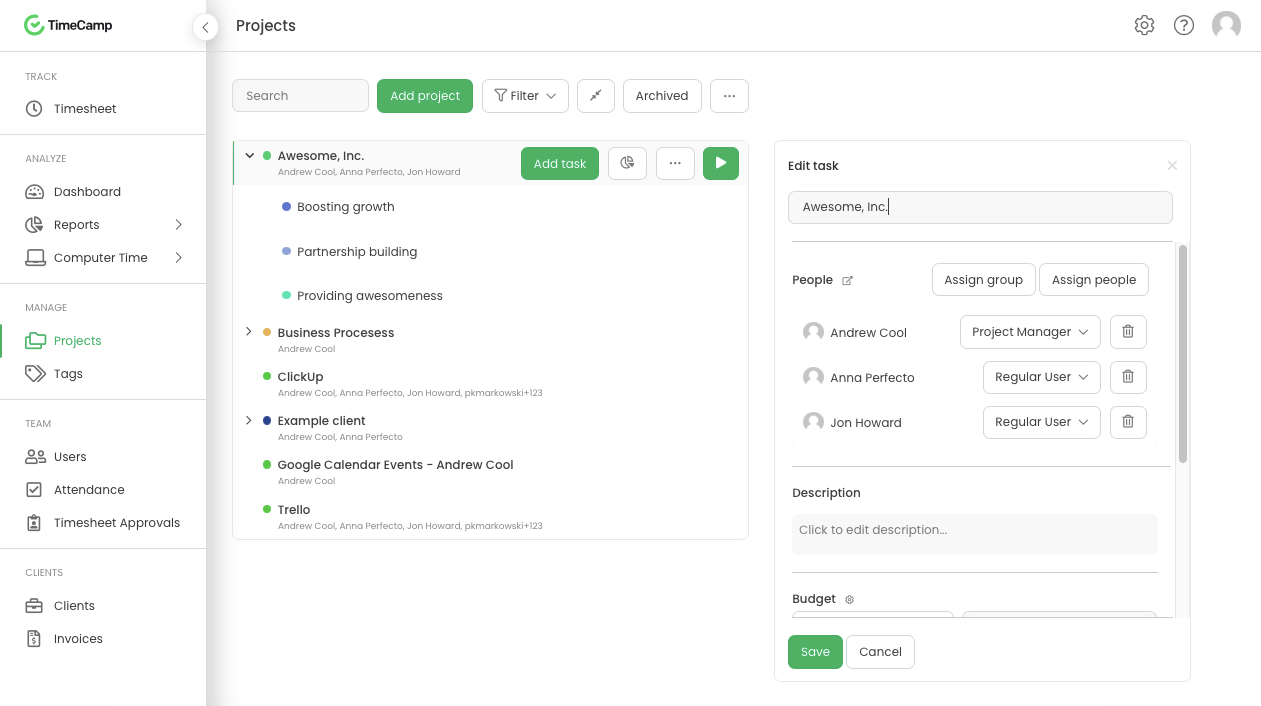
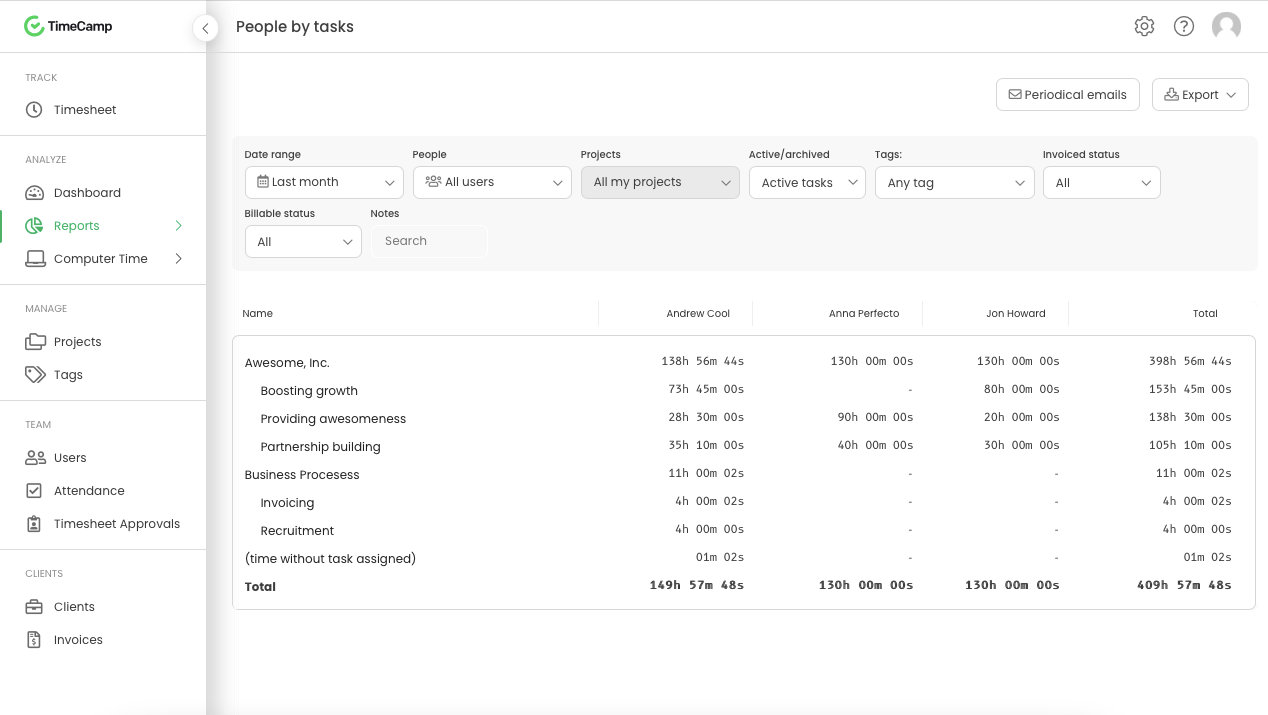
TimeCamp is cloud based, multi-platform (Windows, Mac, Linux, iOS, Android) time tracking and invoicing software.
$2.99
per month per user
Pricing
Basecamp
Notion
TimeCamp
Editions & Modules
Basecamp Plus
$15
per month per user
Basecamp Pro Unlimited
$299
per month (billed annually)
Basecamp Free
Free
Limited Capabilities
Free
$0
Plus
$12
per month per user
Business
$24
per month per user
Enterprise
Custom Pricing
Free
$0
For unlimited users
Starter
$2.99
per month per user
Premium
$4.99
per month per user
Ultimate
$7.99
per month per user
Enterprise
Custom
Offerings
Pricing Offerings
Basecamp
Notion
TimeCamp
Free Trial
Yes
Yes
Yes
Free/Freemium Version
Yes
Yes
Yes
Premium Consulting/Integration Services
No
No
Yes
Entry-level Setup Fee
No setup fee
No setup fee
No setup fee
Additional Details
—
A discount is offered for annual billing.
Free plan includes: unlimited users, unlimited rojects & tasks, project templates, bulk edit, desktop & mobile app, one integration, tags, PDF export
There is a simplicity that basecamp offers where most other project management systems seem to miss. They've worked hard at keeping the right things in place and not adding so many of the extra features that just get in the way of getting work done. The thing I liked most …
Firstly, we chose Basecamp to our main project managing tool and it does its job perfectly. It's too simple, there is no any meaningless and useless tools or something else, every single tool is useful, it has a small learning curve, working well. You can organize your topics …
Firstly, in my view the main difference among these project management softwares is designing. Basecamp has excellent design, it is very cost effective, trustworthy and the quickest way to work with your projects and events. If you are a beginner, almost 4-5 minutes is enough …
Basecamp's interface is graphically organized very differently from Notion so it's difficult to completely compare. I think overall Notion feels more appropriate for higher, c-level positions, whereas Basecamp feels more relevant for a leader to help organize their team.
As I mentioned before, time is the most necessary thing and you have to use it more wisely, if you don't you will be lost in deadlines. That's why I choose Timecamp and bring it to my company. Timecamp is kinda most important program that every company must have it for their …
Features
Basecamp
Notion
TimeCamp
Project Management
Comparison of Project Management features of Product A and Product B
Basecamp
8.9
124 Ratings
14% above category average
Notion
7.3
79 Ratings
6% below category average
TimeCamp
-
Ratings
Task Management
9.3123 Ratings
8.174 Ratings
00 Ratings
Resource Management
9.1103 Ratings
00 Ratings
00 Ratings
Gantt Charts
6.843 Ratings
6.846 Ratings
00 Ratings
Scheduling
8.599 Ratings
6.957 Ratings
00 Ratings
Workflow Automation
8.672 Ratings
6.455 Ratings
00 Ratings
Team Collaboration
9.7123 Ratings
00 Ratings
00 Ratings
Support for Agile Methodology
9.451 Ratings
00 Ratings
00 Ratings
Support for Waterfall Methodology
8.748 Ratings
00 Ratings
00 Ratings
Document Management
9.6115 Ratings
00 Ratings
00 Ratings
Email integration
8.4101 Ratings
00 Ratings
00 Ratings
Mobile Access
8.8100 Ratings
7.372 Ratings
00 Ratings
Timesheet Tracking
9.248 Ratings
00 Ratings
00 Ratings
Change request and Case Management
9.458 Ratings
00 Ratings
00 Ratings
Budget and Expense Management
8.342 Ratings
00 Ratings
00 Ratings
Search
00 Ratings
8.075 Ratings
00 Ratings
Visual planning tools
00 Ratings
7.968 Ratings
00 Ratings
Professional Services Automation
Comparison of Professional Services Automation features of Product A and Product B
Basecamp
8.0
42 Ratings
3% above category average
Notion
-
Ratings
TimeCamp
-
Ratings
Quotes/estimates
10.030 Ratings
00 Ratings
00 Ratings
Invoicing
10.026 Ratings
00 Ratings
00 Ratings
Project & financial reporting
8.034 Ratings
00 Ratings
00 Ratings
Integration with accounting software
4.028 Ratings
00 Ratings
00 Ratings
Communication
Comparison of Communication features of Product A and Product B
Basecamp
-
Ratings
Notion
7.8
76 Ratings
3% below category average
TimeCamp
-
Ratings
Chat
00 Ratings
6.229 Ratings
00 Ratings
Notifications
00 Ratings
7.568 Ratings
00 Ratings
Discussions
00 Ratings
7.349 Ratings
00 Ratings
Surveys
00 Ratings
6.720 Ratings
00 Ratings
Internal knowledgebase
00 Ratings
8.869 Ratings
00 Ratings
Integrates with Gmail and Google Hangouts
00 Ratings
8.98 Ratings
00 Ratings
Integrates with Outlook
00 Ratings
9.02 Ratings
00 Ratings
File Sharing & Management
Comparison of File Sharing & Management features of Product A and Product B
Basecamp is a wonderful tool for teams of varying degrees of technical knowledge, teams managing lots of different types of "agifall" and waterfall projects, and teams that are remotely distributed. It's probably less useful for more strictly agile-focused development teams, compared to other more flexible software applications like Jira and Asana.
If you want a customizable solution that can be adapted for just about any scenario, I recommend using Notion. If you need a solution that's easy to share with people outside your organization, Notion is great and allows individual or team permission-setting. If you want a turnkey solution, Notion might not be the best since it requires a fair bit of set-up. There are templates that can be purchased to handle this, but I haven't found them very helpful.
TimeCamp is comparable to all other time tracking apps. It predominantly depends on your specific use case and if the UX works for you if TimeCamp will be a good fit. Personally, I found the software not super intuitive and I think that was a big turn off.
Task management - It is very easy to add, organize and discuss tasks within Basecamp's interface.
The "Campfire" function is great for communicating when you just have a quick question for someone on the team.
Notifications - Basecamp lets you decide how often and about what you'd like to be notified. The ability to respond to messages in Basecamp directly via email saves a lot of time.
TimeCamp does what it is made to do and it does it very well. It allows multiple levels of billing rates and does a great job tracking.
TImeCamp does take a little bit of time to set up, but that is no different than any other tool. The interface is easily understandable so the configuration goes pretty quickly.
High Learning Curve. It's true that it can be easy to use, but to use well and effectively takes some time to learn. It's recommended to have an agreed-upon system in your team of what tools to use and when.
Notification Overload. If people aren't careful they could send a notification to everyone when only a couple people were meant to be prompted. And since emails are sent by default, you could have your mailbox overloaded with unnecessary updates. This is where it takes a bit of training in your team to have an agreed-upon system.
Lack of organization with Archived Projects. I will often need to reference an archived project to make a new one, but there is only a list of archived projects in alphabetical order, with no way to organize by archive date, or even search.
I use Notion on my personal tablet, and unlike on the computer, I have a lot of difficulty editing backgrounds, GIFs, and page dividers. It's not as user-friendly, and often the elements end up cut off or misaligned, which is frustrating.
While the current calendar feature is helpful, I'd love to see more customization options. The Google Calendar style isn't always ideal, especially for tasks without specific times or for ongoing projects that require daily maintenance.
It would be fantastic to have more flexibility in customizing Notion pages. For example, I'd love to create planners with the freedom to add illustration boxes, stickers, or GIFs without being restricted to a fixed layout.
TimeCamp is a little bit expensive. It needs overall improvement in all tools. Moreover, the mobile version is not as useful as the web version of TimeCamp.
Other than that, customer service needs more attention and requires more improvement.
Also, I feel like that if there are more features of TimeCamp then it would be better.
When I bring new people onto a project, it's immediately obvious how to use Basecamp. I don't have to worry about teaching them the features or walking them through it, it's just incredibly user-friendly. For this reason, I'll continue to renew my subscription even as new people are brought onto production jobs or the client changes.
It is easy to use, even for clients who have no experience with the platform. It can only get a little cumbersome to ensure that a client can't see certain documents you might want to keep in the Docs & Files folders. And sometimes, getting a client to actually use an unfamiliar platform can be a challenge.
Very easy to use (I learned how to use everything on my own) and I was able to set up an entire ecosystem without any courses or other tools. I often say that Notion is like Lego for adults, because there we can use all the available tools to create a multitude of things, from funnels to projects with calculated deadlines and tags.
I've never experienced downtime while using Basecamp, or been unable to access it when I needed it. That's not to say they've never had downtime, but I've been lucky enough not to encounter any, and I work odd hours, including late nights when maintenance is often undertaken.
For the many reasons I've given, Basecamp is a very strong program. There are a few features I can imagine that might make it even better, but I don't have a basis for comparison to be able to say that there is definitely a better one out there. I've noticed that Basecamp has evolved a bit from the time I started using it until now, so that makes me think that the producer of this program values it and believes in continuous improvement. If you could use the features offered by Basecamp, I would think you could use it with confidence.
I am giving support a rating of 8 but that is quite arbitrary. Honestly, we have never had the need to contact support for any reason. There has not been a situation where we became stuck and could not figure out how to work through it. Sign up was easy and billing is like clockwork so there has been no need to contact billing support. I think this is a testament to the ease of use of TimeCamp.
Decide the process before implementation - i.e. when it's due 8/9 does that mean 8am, noon, 5pm, 11:59pm? Check your to-do list frequently Set-up templates - just not with the dates (they can be funky)
Pretty good, but [Basecamp] has its drawbacks. Honestly I find the interface non-intuitive and sometimes have trouble figuring out how to change the status of a task. Perhaps it has something to do with the way it was originally set up by the admin, but I'm not sure. I liked Jira's drag and drop obvious functionality, but the project management side of the software was lacking. Smartsheet has excellent project management functionality, but the task management isn't as good.
The company uses both Notion and Trello within the company. Notion is more for North America employees while Trello is used between Operation team overseas and in North America. Sometimes it's a preference of how the tools look like for project management. I would say both Notion and Trello are nice tools and serves our needs.
TimeCamp is distinctive and virtuous because it provides a flexible payment system with a free plan to make it even more attractive, it simply provides the essential alternatives in our work processes, and the customer service team executes its work very effectively and with a positive attitude positive.
It has saved me time when having to get the same message out to multiple restaurants
It has helped us make smarter operational decisions because we can all collaborate on an answer in a shorter amount of time (instead of calling a meeting!!!)
The calendar function allows us to plot out our marketing agenda for the month and add/change it together as needed. The chef will post his recipe, the managers will cost it out, the social media manager will post pictures on it, and ultimately we will get that information out on an info sheet to the staff by printing the page.