Birdeye is a reputation management and digital customer experience platform for local brands and multi-location businesses. Birdeye’s AI-powered platform is used by brands to engage with customers, drive loyalty, and excel in local markets.
$299
per month
Metadata.io
Score 9.0 out of 10
N/A
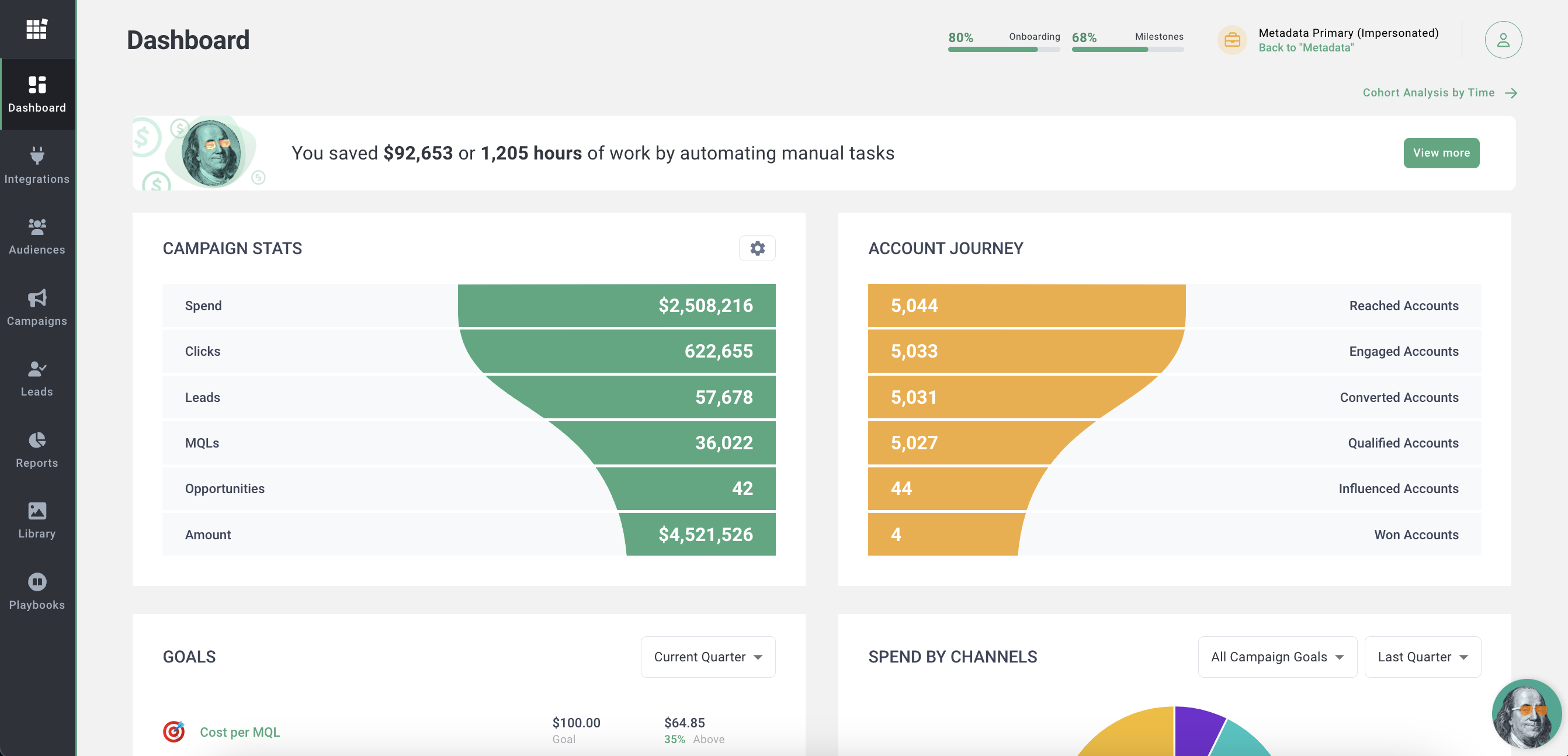
Based in San Francisco, Metadata.io is a Demand Generation and ABM platform designed to execute thousands of B2B campaigns in a matter of hours, automatically optimizing campaigns for pipeline impact at a high velocity.
For businesses that have customers or clients or patients with several different locations, Birdeye is essential to help with the reviews and messages received through Google and other platforms. For businesses with only 1 single location, Birdeye could still be useful but wouldn't be as essential as it would be for other businesses.
Metadata is well suited when you have a really large ad budget (>50k per month at least). This is because the power of metadata lies in the ability to quickly set up and run a large number of experiments (combinations of channel, audience, creative, and conversion assets). To evaluate these variations, all of them need a large number of impressions, clicks, and conversions to be statistically relevant. If your budget is smaller, you will either have a very small number of experiments (not fully utilizing the power of metadata), or your experiments will not have enough clicks to make informed decisions. We had expected a better explanation of this from metadata before signing up.
The sentiment feature is just okay. It requires custom adjustments and time to understand where it is working well and where it is not in order to get the most out of it, while other features require very little user input.
Social listening needs work. I often receive notifications for unrelated terms because of their similarity in spelling to my organization's name, so I don't use this feature.
Birdeye could have more built-in features to create digital content from the reviews.
Birdeye could also have additional reputation tools to strengthen GMB listings and to combat negative press. Review listings and rich snippets in search are great, but having a tool that measures and helps to improve overall brand health/search results would be amazing. My CEO isn’t looking at what is going right. He looks at what is going wrong. We may have thousands of positive reviews on Google, but the bad article with false information is still showing up on page one of search results. That makes for an unhappy CEO.
If you don't have a large budget and audience it's hard to meaningfully optimize. If I have 4 ad creatives, to 2 audience groups on FB and LinkedIn, that creates 16 experiments, each of which needs an ample enough budget, say $40/day, that's now $640 per day or $19K per month.
Limited ability to edit ads after they've been launched. You usually have to stop the ad, clone it, and launch a new campaign.
Can't add new ads to existing campaigns which limits the ability to optimize. If I start an MD campaign with 4 ads, and in a few weeks we see that one is working well and the other 2 are not performing, I can pause those (or it can autopause by rules), but I can't add 2 more new creatives to the mix against the high performer. I'd have to either stop the high performer, and recreate it in a new campaign (losing likes and comments), OR - leave the high performer in the first campaign, and create. a second campaign with the new ones, which will only optimize against each other.
Limited to a single conversion event on a landing page. I'm not able to choose either a Demo Request OR a Sign-Up conversion, I can only choose one.
Google search ads are doable but aren't necessarily more feature-rich or easy-to use than native, so there's no value added to doing it through Metadata in my opinion aside from unifying ad reporting.
I think it is a good tool overall, there are some hiccups but what program doesn't have them. I think we should be notified of more things, specifically broken integrations. There have been instances where I don't notice for MONTHS a client it's having requests sent out because they are organically still getting reviews.
I think it is very easy to figure out very quickly by just playing around in the dashboard. If you have a question you can reach out to our contacts and they do a very good job of figuring out if or what is the problem and getting back to us fast.
Support is really responsive for the most part. I don't feel like they explain it the best for people who aren't as tech-savvy. I have recently had trouble with a more difficult integration and it is hard to pinpoint who I need to reach out to.
Our choice of reputation management platform came down to two contenders, Birdeye and Listen360. Ultimately we chose Birdeye because of their ethical review gathering process. Listen360 had review-gating built in as part of their process, which is against Google's terms of service. We wanted to be very careful to gather reviews in an ethical way, and Birdeye was better for our needs.
We chose [Metadata.io] because it was a smaller company and could get more personalized attention. The price was better and they seemed more eager to support us. The feature set was what we were looking for and not more - it was exactly as robust as we needed it to be. Didn't want to pay for features we weren't going to use.
Huge decrease in CPLs, CPMQL and Cost Per Opportunity
Big improvement in MQL to SQL rates
90%+ of our leads from paid social now have valid business emails, before it was like 30%
Saving us hundreds of hours over the course of the next year doing daily manual optimization and budget management tasks for us so we can focus on strategy and testing new things