
Chose IBM Cloudant
IBM Cloudant vs. MongoDB vs. PostgreSQL
IBM Cloudant vs. MongoDB vs. PostgreSQL
| Product | Rating | Most Used By | Product Summary | Starting Price |
|---|---|---|---|---|
 IBM Cloudant | N/A | Cloudant is an open source non-relational, distributed database service that requires zero-configuration. It's based on the Apache-backed CouchDB project and the creator of the open source BigCouch project. Cloudant's service provides integrated data management, search, and analytics engine designed for web applications. Cloudant scales your database on the CouchDB framework and provides hosting, administrative tools, analytics and commercial support for CouchDB and BigCouch. Cloudant is often… | $1 per month per GB of storage above the included 20 GB | |
 MongoDB | N/A | MongoDB is an open source document-oriented database system. It is part of the NoSQL family of database systems. Instead of storing data in tables as is done in a "classical" relational database, MongoDB stores structured data as JSON-like documents with dynamic schemas (MongoDB calls the format BSON), making the integration of data in certain types of applications easier and faster. | $0.10 million reads | |
 PostgreSQL | N/A | PostgreSQL (alternately Postgres) is a free and open source object-relational database system boasting over 30 years of active development, reliability, feature robustness, and performance. It supports SQL and is designed to support various workloads flexibly. | N/A |
| IBM Cloudant | MongoDB | PostgreSQL | ||||||||||||||||||||||
|---|---|---|---|---|---|---|---|---|---|---|---|---|---|---|---|---|---|---|---|---|---|---|---|---|
| Editions & Modules |
|
| No answers on this topic | |||||||||||||||||||||
| Offerings |
| |||||||||||||||||||||||
| Entry-level Setup Fee | No setup fee | No setup fee | No setup fee | |||||||||||||||||||||
| Additional Details | — | Fully managed, global cloud database on AWS, Azure, and GCP | — | |||||||||||||||||||||
| More Pricing Information | ||||||||||||||||||||||||
| IBM Cloudant | MongoDB | PostgreSQL | |
|---|---|---|---|
| Considered Multiple Products | IBM Cloudant  Denis Voloshko platform manager Chose IBM Cloudant Cloudant extends features of CouchDB, but you don't have to host it for yourself. IBM does this for you. Also Cloudant is free if you are under $50 per month. And there is integration with other IBM products, like dashDB (for analytics).Cloudant has CouchApps and it's a feature …  Pankaj Choudhary Sr. Android Developer Chose IBM Cloudant IBM cloudant documentation is very easy to understand and because of that the implementation is also very easy. We found some difficulties in case of aws documents implementation. Performance of the cloudant database is also high as compare to the other databases. Indexing and …  Jagmeet singh Software Developer Chose IBM Cloudant IBM Cloudant is great for quick deployment and configs of a database service, especially when it comes to rapid prototyping. In a research capacity, we need to spin up web services and run experiments quickly. IBM Cloudant is a fuss-free database service [that] aids in this …  Saket Nalegaonkar Senior Application Developer -IoT Chose IBM Cloudant As its documentation and help are always available, it's easier to manage than any other database mentioned.  Deepak Kaul CTO Chose IBM Cloudant In our case it was a no-brainer since we were using IBM Cloud. In comparison to DB2 the ease of use and JSON support was the key.  Naresh Jasotani Director - Data and Analytics Services (Presales) Chose IBM Cloudant IBM Cloudant DB is backed by CouchDB and that too hosted on IBM Cloud is the key. Concurrency and durability is the key here. In-memory capabilities are non-existent on the IBM Cloudant DB.  Wes Wilson CTO (Chief Technical Officer) Chose IBM Cloudant It's easier to use than Dynamo, more open than Firebase, and has better documentation that CouchDB... it might not be fair to compare Modulus, Modulus obviously suffers from some scalability issues and might not be in the same class... but its a hosted DB service we had some …  Romualdo Gobbo Owner Chose IBM Cloudant All other NoSQL document-centric DB must be installed on premise on in the cloud as complicated clusters. The "as a service" formula and the open source origin were the same reasons for Cloudant choice, freeing us of all system and administration tasks!  Justin Saul Senior Director - SeniorAdvisor.com Chose IBM Cloudant Cloudant is a database as a service with a strong support team. The feature set is comparable to other solutions but not all are managed services, or have easy scalability, or can demonstrate production level reliability and performance.  Bryan Redeagle Developer Chose IBM Cloudant The technology behind Cloudant (BigCouch) is no better or worse than any of these. They are all good for different reasons. What makes Cloudant my choice against them is the hosted portion. These are all just databases that I would have to manage. Cloudant is managed for me, …  Don Burks CTO Chose IBM Cloudant Cloudant blows all of the other competitors out of the water. The robust UI, the scalability, the management console, these are all reasons why Cloudant is a superior product to any of these "competitors". Cloudant is head and shoulders above the rest. It was a pleasure to … |  MongoDB  Brett Knighton Development Team Lead Chose MongoDB Looking into PostgreSQL happened post move to Mongo. Had we considered both options at the time we likely would have went with PostgreSQL. We may migrate at some point in the future but currently it doesn't make sense.  Gaurav Pandey - PMP,ITIL,CSM SAP Application Manager Chose MongoDB We wanted to try something which is not a relation DB and has more of distributed architecture. MongoDB turned out to be a great choice.  Oleg Chumin Java Software Engineer Chose MongoDB  Balázs Kiss Software Developer Chose MongoDB MongoDB is the most reliable and fastest for storing document-based data. It has a place among the most popular DB's these days.  Sagiv Frankel Senior Software Engineer Chose MongoDB Your default choice should not be MongoDB in my opinion. Most user-facing systems are relational by nature so a well known and reliable SQL database would be easier to maintain and simpler to develop long term. If you highly value speed of development go with Firebase. If you …  Gabriel Samaroo Senior Software Engineer Chose MongoDB MongoDB is the best NoSQL database out there. There are others, but Mongo has the largest community, is very easy to set up, and is extremely performant. Compared to a relational DB (like MySQL or Postgres) is like comparing apples and oranges. One isn't better or worse than …  Joshua Weaver Developer Chose MongoDB I recently tried out Firestore from the Google firebase family of development products. While it allows structuring of data similar to MongoDB, it handles things a little differently. MongoDB documents are incredibly flexible and can be structured really any way you can …  Eddy Wong Cofounder and CTO Chose MongoDB - Mongo had a query language - Mongo could be run easily on my laptop  Kamesh Ganesan, FLMI, PMP Lead Database Administrator Chose MongoDB We find MongoDB is an easily adoptable NoSQL database.  Joshua Austill Application Developer Chose MongoDB I selected MongoDB because it works for well with web interfaces. All of the RDBMS alternatives would have required a lot more time writing schemas and working around retrieving data and mapping it. That could have been somewhat mitigated with Entity Framework, but that again … | PostgreSQL  Carlos Alberto Pedron Espinett Lider de Proyecto Chose PostgreSQL Despite being all open source options, what ended up making us choose PostgreSQL was the robustness of its core, which allows the great workflow that can support timely and efficient response to the demand and demand for resources. In the case of MongoDB, it is a non-relational …  vijay bhopalwani Software Engineer L3 Chose PostgreSQL First It's open source and it's cost-effective compared to other databases.PostgreSQL can be easily integrated with numerous platforms. It is well known and appreciated so relying on it as our system database can be easily accepted by our customers. And if your developing a …  Anson Abraham Data Czar Chose PostgreSQL  Valeri Karpov Principal Engineer Chose PostgreSQL When we were originally evaluating Redshift we ran into some issue with dates. Either way, Postgres is a better choice than Redshift because it avoids vendor lockin. We ended up choosing Postgres over MySQL because it was easier at the time to get a hosted Postgres cluster up …  Mark Mitchell Vice President of Information Technology Chose PostgreSQL  Paul De Audney Senior Staff Engineer Chose PostgreSQL We selected PostgreSQL due to the number of employees who have used it in the past. The data consistency guarantees. The multiple transaction isolation levels support. Don Burks Technical Lead Chose PostgreSQL PostgreSQL outperforms every other option. It is faster, more flexible, more reliable, easier to maintain, and more consistent in behaviour than any of the other offerings. Balázs Kiss Software Developer Chose PostgreSQL It's a viable alternative, with a rich feature set and a reliable system. PostgreSQL is one of the best RDBMS's currently on the market in 2020, it serves just as well as a starter, PoC DB for any software idea as a final, highly valuable database solution for big systems.  Nitin Pasumarthy Research Assistant Chose PostgreSQL |
| IBM Cloudant | MongoDB | PostgreSQL | |||||||||||||||||||||||||||||||
|---|---|---|---|---|---|---|---|---|---|---|---|---|---|---|---|---|---|---|---|---|---|---|---|---|---|---|---|---|---|---|---|---|---|
| NoSQL Databases |
|
| IBM Cloudant | MongoDB | PostgreSQL | |
|---|---|---|---|
| Small Businesses |  Redis Software Score 8.9 out of 10 | IBM Cloudant Score 7.4 out of 10 |  InfluxDB Score 8.8 out of 10 |
| Medium-sized Companies | Redis Software Score 8.9 out of 10 | IBM Cloudant Score 7.4 out of 10 |  SQLite Score 8.0 out of 10 |
| Enterprises | Redis Software Score 8.9 out of 10 | IBM Cloudant Score 7.4 out of 10 | SQLite Score 8.0 out of 10 |
| All Alternatives | View all alternatives | View all alternatives | View all alternatives |
| IBM Cloudant | MongoDB | PostgreSQL | |
|---|---|---|---|
| Likelihood to Recommend | 7.0 (45 ratings) | 10.0 (79 ratings) | 8.0 (55 ratings) |
| Likelihood to Renew | 7.3 (1 ratings) | 10.0 (67 ratings) | 9.0 (1 ratings) |
| Usability | 7.7 (5 ratings) | 10.0 (15 ratings) | 8.3 (9 ratings) |
| Availability | 8.2 (1 ratings) | 9.0 (1 ratings) | 9.0 (1 ratings) |
| Performance | 8.2 (1 ratings) | - (0 ratings) | 7.0 (1 ratings) |
| Support Rating | 8.6 (4 ratings) | 9.6 (13 ratings) | 9.3 (7 ratings) |
| Online Training | 7.3 (2 ratings) | - (0 ratings) | - (0 ratings) |
| Implementation Rating | 8.2 (4 ratings) | 8.4 (2 ratings) | 9.0 (1 ratings) |
| Configurability | 8.5 (3 ratings) | - (0 ratings) | - (0 ratings) |
| Product Scalability | 9.6 (23 ratings) | - (0 ratings) | 8.0 (1 ratings) |
| Vendor pre-sale | 9.1 (1 ratings) | - (0 ratings) | - (0 ratings) |
| IBM Cloudant | MongoDB | PostgreSQL | |
|---|---|---|---|
| Likelihood to Recommend | IBM
| MongoDB
 Kendal Droddy Senior System Engineer | PostgreSQL Global Development Group
 Ron Ballard Consultant and author |
| Pros | IBM
Naresh Jasotani Director - Data and Analytics Services (Presales) | MongoDB
 Ronald Melendez Desarrollador de software | PostgreSQL Global Development Group
 Aurpa Fiza Software Application Developer |
| Cons | IBM
| MongoDB
Joshua Weaver Developer | PostgreSQL Global Development Group
|
| Likelihood to Renew | IBM
 victor pease solano General Manager | MongoDB
 Jon Kern Manager Strategic Products | PostgreSQL Global Development Group
 Ojoswi Basu Sr. Tableau Solution Consultant |
| Usability | IBM
Bryan Redeagle Developer | MongoDB
 Jose Manuel Ortega Software Engineer && Security researcher | PostgreSQL Global Development Group
|
| Reliability and Availability | IBM
| MongoDB No answers on this topic | PostgreSQL Global Development Group
Ojoswi Basu Sr. Tableau Solution Consultant |
| Performance | IBM
| MongoDB No answers on this topic | PostgreSQL Global Development Group
Ojoswi Basu Sr. Tableau Solution Consultant |
| Support Rating | IBM
 Nicolas Peeters VP of Engineering | MongoDB
 Mehmet Fatih Onal Technical Architect | PostgreSQL Global Development Group
 Javier Blanque Technology Risk and Information Assets Manager |
| Online Training | IBM
victor pease solano General Manager | MongoDB No answers on this topic | PostgreSQL Global Development Group
Ojoswi Basu Sr. Tableau Solution Consultant |
| Implementation Rating | IBM
Nicolas Peeters VP of Engineering | MongoDB
 Tom Maiaroto Sr. Platform Developer / UX Designer / Optimization Engineer | PostgreSQL Global Development Group
Ojoswi Basu Sr. Tableau Solution Consultant |
| Alternatives Considered | IBM
| MongoDB
Oleg Chumin Java Software Engineer | PostgreSQL Global Development Group
 Moris Mendez Ing. de Sistemas Informaticos |
| Scalability | IBM
Wes Wilson CTO (Chief Technical Officer) | MongoDB No answers on this topic | PostgreSQL Global Development Group
Ojoswi Basu Sr. Tableau Solution Consultant |
| Return on Investment | IBM
| MongoDB
 Jeff Sherard Senior Leader | PostgreSQL Global Development Group
Don Burks Technical Lead |
| ScreenShots | MongoDB Screenshots     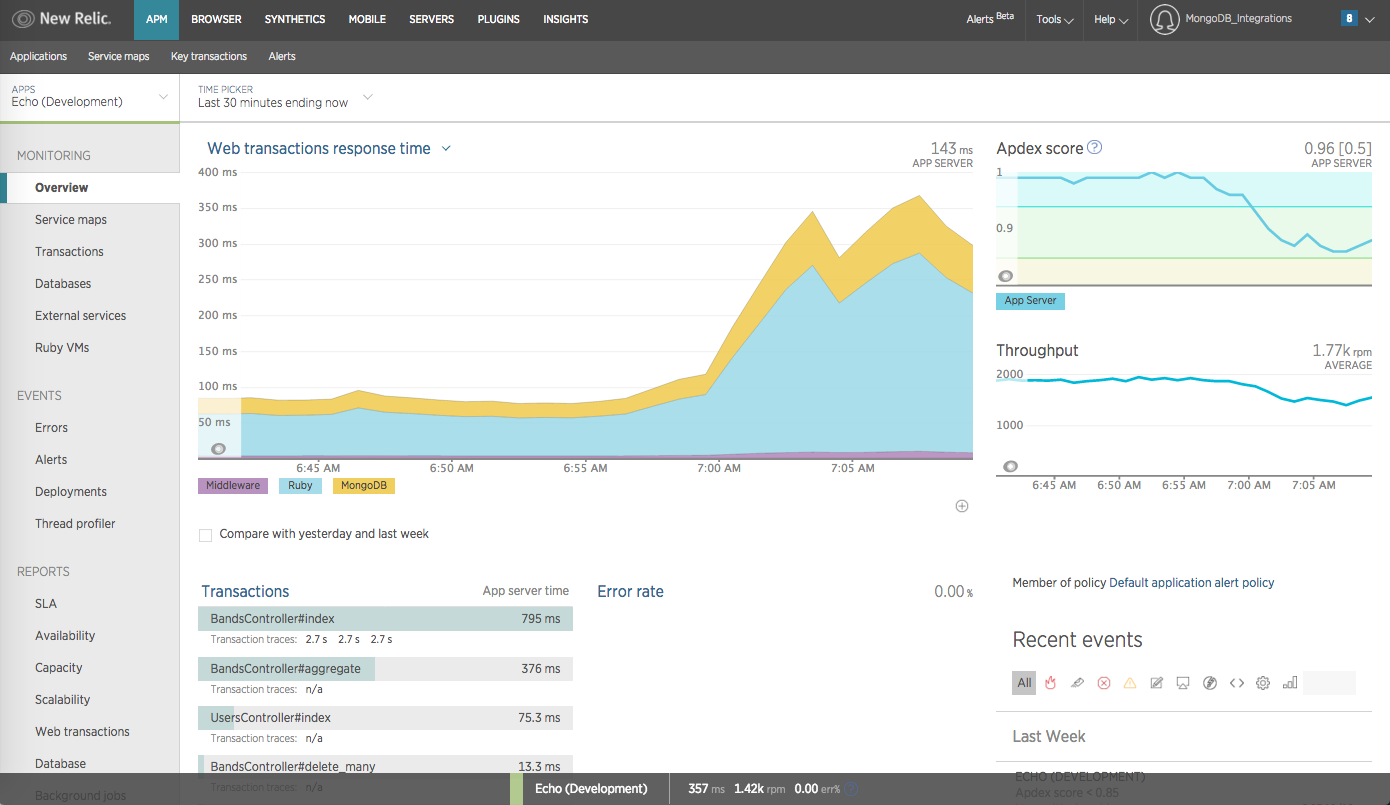 |