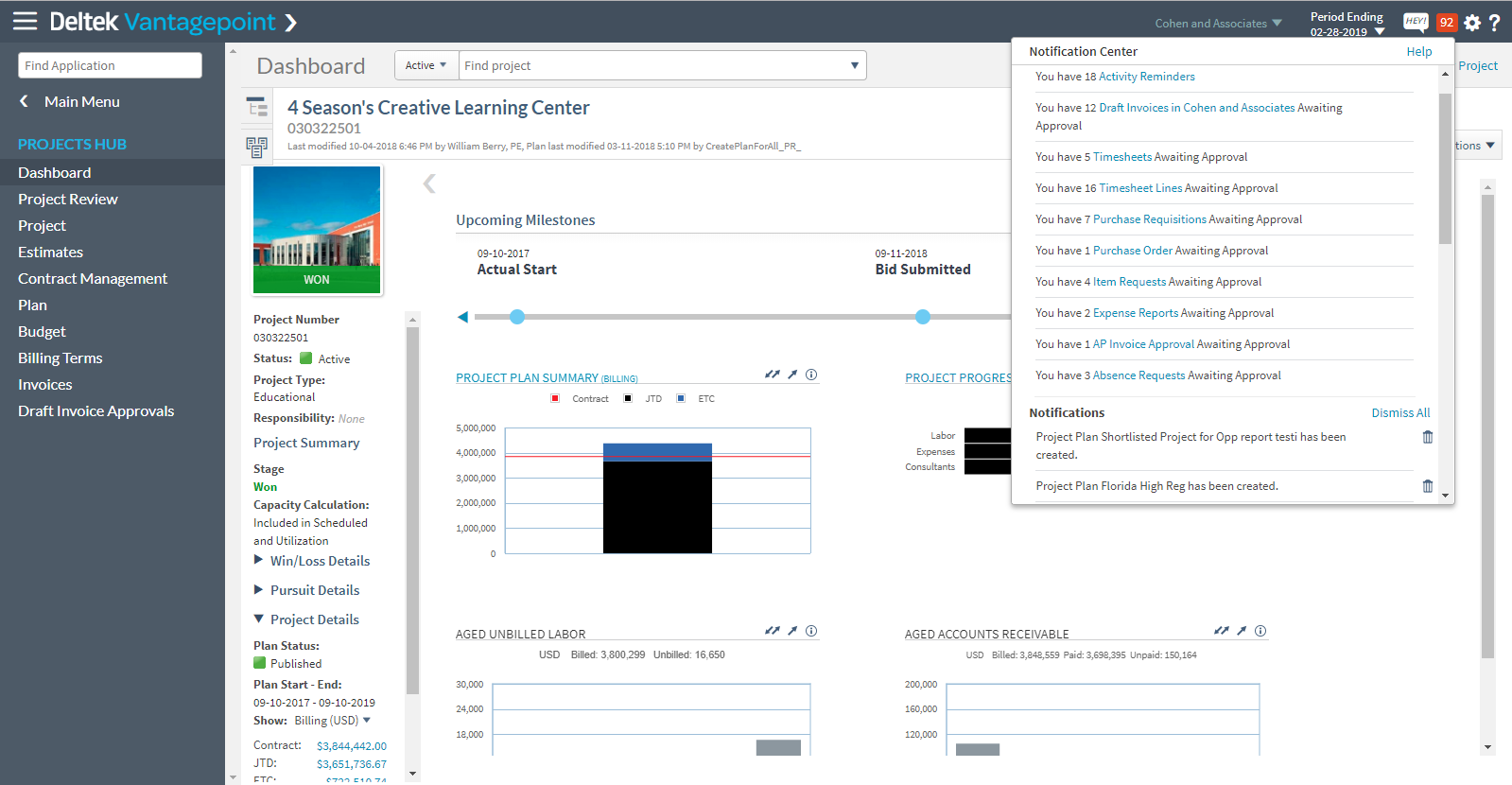
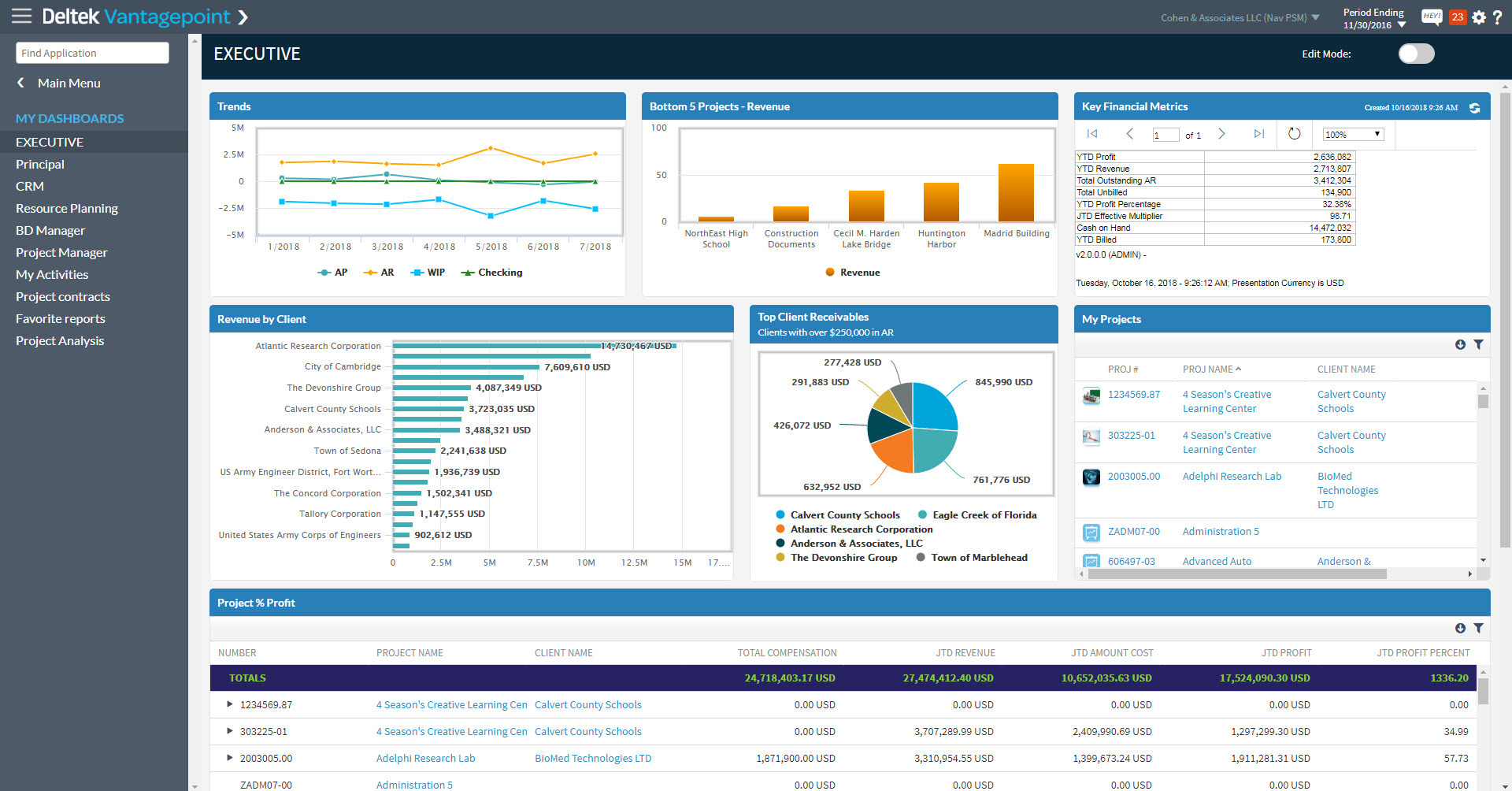
People and projects are the heart and soul of a business. So Deltek created Vantagepoint, which they present as a powerful, intuitive solution that helps users manage projects from start to finish. Deltek Vantagepoint’s 360-degree view of projects puts client, project and financial details in a single location. The vendor states this adds up to making well-informed tactical and strategic business decisions and a more efficient, productive and profitable company.
N/A
HaloPSA
Score 8.1 out of 10
Enterprise companies (1,001+ employees)
HaloPSA is a solution designed for MSP's and service providers. With HaloPSA out-of-the-box functionality, the solution aims to provide businesses a Cloud platform that enables users to modernise customer experience and automate service. An integrated PSA platform, it includes features such as time-tracking and billing, advanced reporting, asset management, remote access, integrations, and automation tools. Aligned to the user's requirements and boasting an intuitive UI, users…
$35
per month per user
Agentforce Sales
Score 8.8 out of 10
N/A
Salesforce' Agentforce Sales (formerly Salesforce Sales Cloud) is the company's flagship CRM platform. The AI CRM for Sales features data built right in.
$25
per month per user
Pricing
Deltek Vantagepoint
HaloPSA
Salesforce Agentforce Sales
Editions & Modules
No answers on this topic
All-inclusive PSA Software
$35
per month per user
All-inclusive PSA Software
$35
per month per user
Starter
$25.00
per month per user
Professional
$80.00
per month per user
Enterprise
$165.00
per month per user
Unlimited
$330.00
per month per user
Agentforce 1 Sales
$550
per month per user
Offerings
Pricing Offerings
Deltek Vantagepoint
HaloPSA
Agentforce Sales
Free Trial
No
Yes
Yes
Free/Freemium Version
No
No
No
Premium Consulting/Integration Services
No
No
No
Entry-level Setup Fee
No setup fee
Optional
Optional
Additional Details
—
15% discount for all charities, educational institutions and non-profit organisations.
The one-stop-shop of CRM, accounting, reporting, and planning is the biggest appeal for Vantagepoint. When you set up your system to provide a "single source of truth" it makes use of other systems impractical and obsolete. Other systems can provide a portion (CRM, accounting, …
BQE Core. I think that BQE core is definitely harder to use, and has a lot of features atleast from the users perspective that dont seem entirely neccesary. Deltek is very straight forward and easy to use.
Deltek stands up against the competition by being the most robust and the most powerful. It is more expensive so that is a negative. It does not have the best user interface but it works well enough. Others were missing key data or functions that we could not do without them.
Against the other platforms used, HaloPSA is faster, simpler, and easier to use. It might not yet have all of the features of the other platforms, but they are coming fast. The support is second to none.
We have used and tried several other PSA vendors and HaloPSA was our favorite by far. Many others were either much too overly complicated, clunky, slow to respond to issues, incomplete, or they simply failed to deliver on promises made, especially in terms of integrations.
Based on my experience, I’ve used Odoo — it’s an open-source ERP system. It’s not exactly the same as Salesforce or Sales Cloud, but it serves a similar purpose. And I feel that Sales Cloud is better. Personally, I find it easier to use and better than what Odoo offers, …
Over the years, I’ve helped many people move from different sales solutions — like Dynamics, HubSpot, and Act, which was one of the first ones. I’ve supported a lot of organizations in moving from those platforms to Salesforce.
So I've evaluated, implemented Microsoft Dynamics in the past. I've used Oracle CRM solutions. I've used Daylight, which is a very niche CRM system the last couple of years. And I've evaluated a variety from Legacy Microsoft Ones to Zoho and Sugar when making implementation …
Actually, we have not. By the time I joined my company, we already had Sales Cloud. It was already there and the decision was made. I'm sure that there were other small companies that the upper management team evaluated very quickly, but they came to a decision very quickly. I …
Raiser's Edge, CSING. Those are the primary ones. There's no competition at all. I mean, in terms of tracking duplicate contact, I mean contacts ability to be secure and provide the right access for different levels. Salesforce was able to do that. Oh yeah. Yes. Whereas the …
We have used HubSpot and we have used jojo CRM. So the customer who cannot afford the licensing model of Salesforce, jojo CRM is a very good platform and another for assembly level, hub Spot does the work as well.
Salesforce is magnificently more robust and functions much better when managing complex sales cycles with multiple individuals and products. With simple sales cycles and few products, Excel is a strong contender.
Salesforce CMS stacks up as a Customer management system because it has a more user friendly snd intuitive interface. The UX is better and more modern. It can be customised and extended. There are always learning opportunities and updates for the system so it keeps on …
Salesforce more so compliments these products, rather than stacks against them. We don't have any products similar to Salesforce CMS, so in lieu of that, these are the products we were using that mesh the easiest with Salesforce CMS in terms of proceeding through the …
In my opinion, Salesforce CMS is the most complex of these offerings, and probably the most complex platform of its kind. It was selected by another stakeholder - I would likely have chosen something less expensive and more intuitive to use. The robust feature set is amazing, …
We used the Catalyst product of Totango. It was not great as it was hard to navigate, and it did not offer any reporting capabilities at all, nor did it speed up our day-to-day tasks.
It is well suited to connecting customer relationship databases and a project lifecycle. Business development people and other personnel should be able to get good use out of it in their daily jobs and functions. It is helpful to keep a record of ongoing projects and new pursuits among the team.
Quote to cash. Workflows throughout the entire process are simple and easy to amend/change if needed. Reporting is easy and can be scheduled to our needs.
In the end, I think we can always make it fit — and that’s one of the powers of Salesforce. Because of its flexibility and wide range of possibilities, you can really make it work for almost any need. The key, though, is to make thoughtful decisions upfront and plan carefully how you set it up. If you do that, you’ll end up with a truly flexible and effective system.
Reporting is very clunky and anything but intuitive.
Compared to Vision, Vantagepoint layouts are very cookie-cutter. The latest release allows you to create up to 5 columns, still, it is so much less customizable than Vision in look and feel.
Customer service is poor. If you have a question or issue you can expect it to be addressed in 2-4 weeks, minimum.
Software testing has been poor in the past. Too many bugs have made it through to release on things that should have easily been caught, such as certain workflows not working, etc.
I’d say the only thing that can be a bit tricky — and I know Tableau helps address this — is that sometimes we’re limited in how deep we can go with the data in terms of reporting. It would be great to have a bit more robustness within the app itself. However, we’ve figured out our workarounds, and overall, I think it’s a fantastic product — which is why I’ve been working with it for 23 years.
There are days when I wish we hadn't switched, but I know that if we put in the time, we will get to where we want to be with the software and that it has many more capabilities than anything else we looked at. However, the amount of time and onboarding we need to do is also far greater than we realized/were told when we originally bought the product. They told us we should hire onboarding support, but at the end, after we had already reached our budget maximum for this, so it's been slower than we had hoped.
It is ok to use; it is not the easiest to use in terms of usability and user-friendliness but it is not the worst. It still feels somewhat outdated. Many cloud options are cleaner or look more modern. But it is good enough and you should be able to get the hang of it.
All in all, it's a great product that use all day, every day. It's aesthetically pleasing overall and specifically provides information in a clean, concise way. It's easy to manipulate and seems to play well with the other products I use such as Pardot, Gmelius, and our company's proprietary data system. It increases my efficieny in my admin tasks so I have more time to focus on revenue-generation and account management. It's also easy to use from everywhere where it be on a university campus, in a hotel room, one of a million Starbucks, or at home
All Force.com apps run on world-class data centers with backup, failover, and disaster-recovery facilities. Force.com has had a proven 99.9 percent uptime record for years. Accordingly, I only recall our instance of Salesforce having one unscheduled, brief down time over 6 years. I can't remember for sure, but it may have been due to our Internet Service Provider (ISP) versus Salesforce itself. Also, Salesforce does it's best to keep customers in the loop:
Trust.salesforce.com is the salesforce.com community's home for real-time information on system performance and security. On this site you'll find:
Live and historical data on system performance Up-to-the minute information on planned maintenance Phishing, malicious software and social engineering threats Best security practices for your organization Information on how we safeguard your data
For a SaaS provider, I'd rate their performance to be one of the best. At times, reporting tends to slow down if the data set is very large, which is the case in any system. But, that's a very rare phenomenon
I would rate Deltek VantagePoint highly in terms of the overall support. You can receive support any time you need it and there is a representative from Deltek assigned to your account so that you can always get the help when you need it. Sometimes, they want to go more in-depth than I would like, however.
The overall support has been good. More and more features are being released quite frequently. Very small features are also making big difference in how the tool can be adapted and used better. If there is anything we need or are stuck, the support team sets up a call and helps in resolving the issue/provides workarounds.
I attended two training sessions. I would rate them a 4 as an advanced user. It was very basic – great for someone new – would give 8+ for new person.
I had 3 years of experience at the time. I skipped basic and went onto advanced and still not helpful. A lot of it was best practices that didn’t feel relevant for our business
I have gone through multiple. The content that’s delivered is quite basic – I wish they had more advanced training.
We are grandfathered into premium support plus training. We get unlimited access to instructor led and online training for free. We have taken advantage of this
Just from an organizational standpoint - we standardized our data prior to moving to Salesforce. But we essentially standardized it wrong. That's created a big disgusting mess for us know that I'll have to deal with as the Admin. Be sure you think through use cases prior to doing something like that - seek outside opinions on how the data will work best, especially depending on what else you're going to integrate with Salesforce.
The one-stop-shop of CRM, accounting, reporting, and planning is the biggest appeal for Vantagepoint. When you set up your system to provide a "single source of truth" it makes use of other systems impractical and obsolete. Other systems can provide a portion (CRM, accounting, planning, etc.) of what Vantagepoint offers in a single package, but very few provide the one-stop-shop Vantagepoint provides.
Against the other platforms used, HaloPSA is faster, simpler, and easier to use. It might not yet have all of the features of the other platforms, but they are coming fast. The support is second to none.
Based on my experience, I’ve used Odoo — it’s an open-source ERP system. It’s not exactly the same as Salesforce or Sales Cloud, but it serves a similar purpose. And I feel that Sales Cloud is better. Personally, I find it easier to use and better than what Odoo offers, especially in terms of customization and achieving business objectives. That’s where Salesforce Sales Cloud really stands out in comparison to Odoo.
It's very scalable as it has a ton of features (but you do need an admin who understands how to leverage these features). Because of the various features, we've also needed to host onboarding sessions with our users so that they can familiarize themselves with the platform, which isn't always super user-friendly or intuitive.
It helps us achieve our objectives, especially now with Agentforce — we can get more insights to help our sellers sell more. It’s really nice because it’s almost like you can use the standard part of Salesforce to train your agents and teach your sellers how to improve their sales. So that’s really nice.