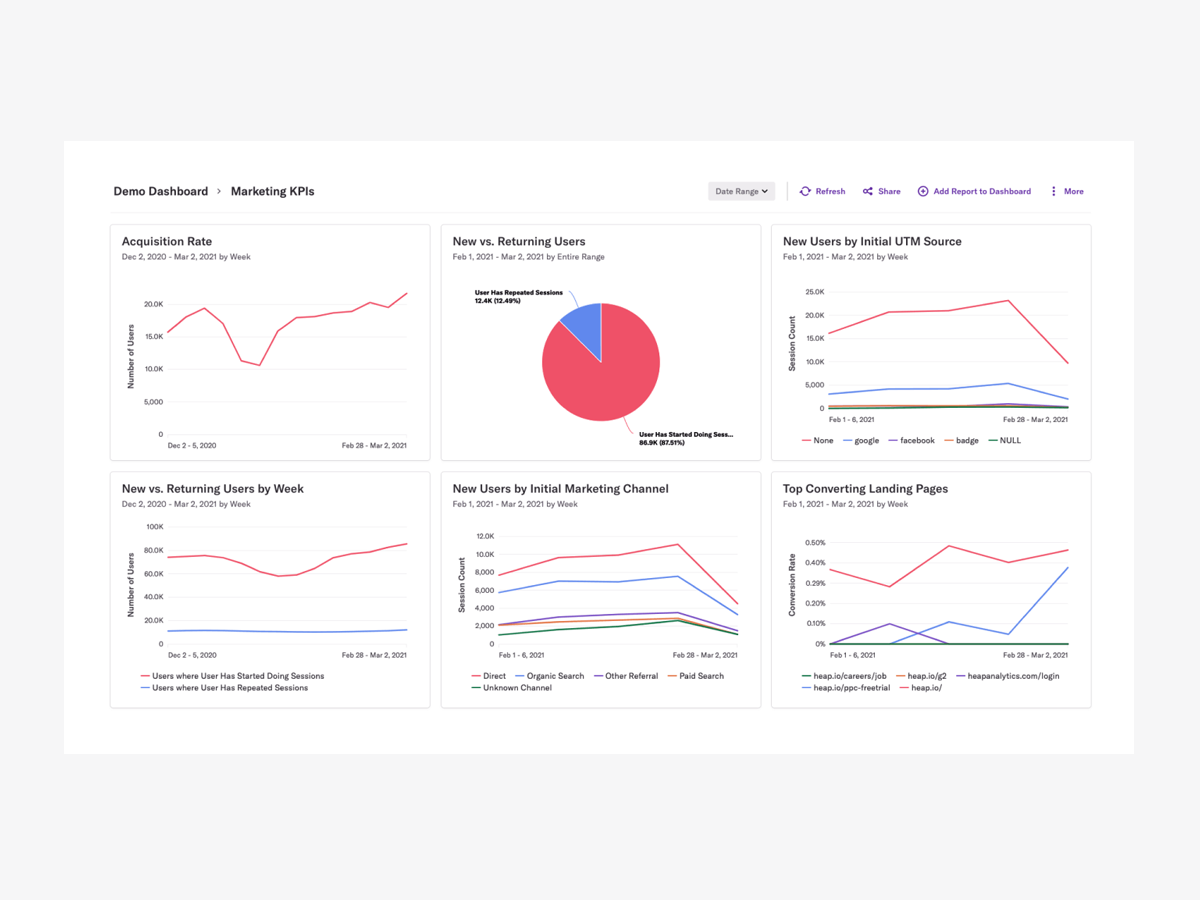
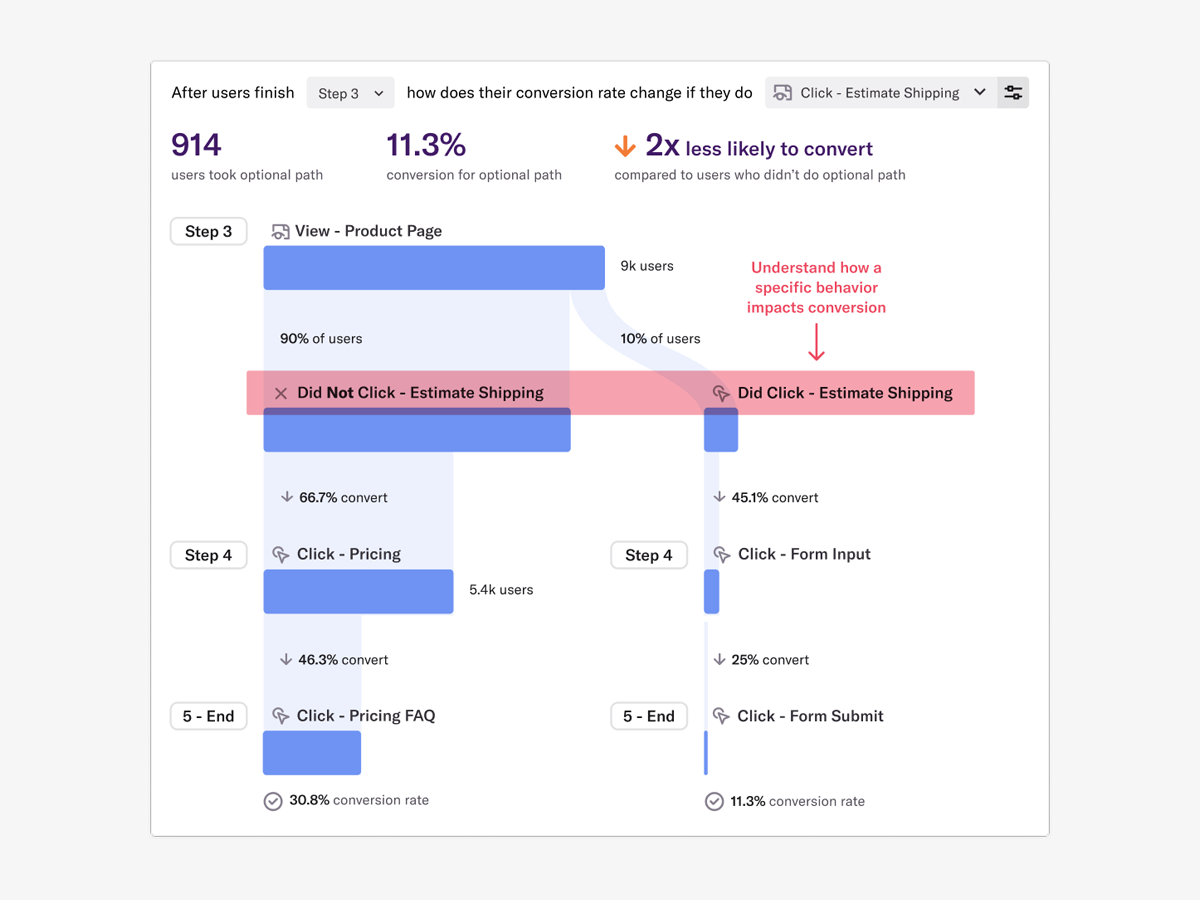
Heap is a web analytics platform captures every user interaction on web iOS with no extra code. The tool allows you to track events and set up funnels to understand user flow and dropoff. It also provides visualization tools to track trends over time.
$0
per month
Heroku Platform
Score 7.8 out of 10
N/A
The Heroku Platform, now from Salesforce, is a platform-as-a-service based on
a managed container system, with integrated data services and ecosystem for deploying modern apps. It takes an app-centric
approach for software delivery, integrated with developer tools and
workflows. It’s three main tool are: Heroku Developer Experience (DX), Heroku
Operational Experience (OpEx), and Heroku Runtime.
Heroku Developer Experience (DX)
Developers deploy directly from tools like…
$85
per month
Pricing
Heap
Heroku Platform
Editions & Modules
Free
$0
Up to 10k sessions/month
Growth
Starting at $3,600 annually
Up to 300k sessions/year
Pro
Contact Heap Sales
Custom sessions per month and unlimited projects
Premier
Contact Heap Sales
Custom sessions per month
Production
$25.00
per month
Advanced
$250.00
per month
Offerings
Pricing Offerings
Heap
Heroku Platform
Free Trial
Yes
No
Free/Freemium Version
Yes
No
Premium Consulting/Integration Services
Yes
No
Entry-level Setup Fee
Optional
No setup fee
Additional Details
Heap pricing is based on session volume. A session is a period of activity from a single user on your app or website. It can include many pageviews or events.
—
More Pricing Information
Community Pulse
Heap
Heroku Platform
Features
Heap
Heroku Platform
Platform-as-a-Service
Comparison of Platform-as-a-Service features of Product A and Product B
Scenarios when Heap was well suited: It is when a user claims that he encountered a bug without giving us the details of the error message. Scenarios where it is less appropriate: Its when we try to capture user interaction in our mobile app
Heroku is very well suited for startups looking to get a server stack up and running quickly. There is little to no overhead when managing your instances. However, you'll need a background in basic DevOps or system management to make sure everything is set up correctly. In addition, it's easy to accidentally go crazy on pricing. Make sure you're only creating the server instances you need to run the base application and set up an auto-scaler plugin to handle peaks.
Heroku has a very simple deployment model, making it easy to get your application up-and-running with minimal effort. We can focus on our efforts the unique aspects of our application.
The robust add-on marketplace makes it easy to try out new approaches with minimal effort and investment -- and when we settle on a solution, we can easily scale it.
Heroku's support is quite good -- their staff is quite technical and willing to get into the weeds to diagnose even complicated problems.
Large price jumps between certain resource tiers (2x Dyno for $50 per month versus Performance Dyno for $250). Free Postgres next jumps to $50 per month.
Marketing/Branding to non-technical stakeholders. As the years pass, I've had to fight more to convince stakeholders on the value of Heroku over AWS.
Improve Buildpack documentation. This is one area where Heroku's documentation is fairly confusing.
It's a great platform. I'm glad that one of our product managers introduced it because it has allowed us to create all kinds of new functionality. We're not only able to create a better product experience from our communications because of Heap, but we're also able to generate all kinds of helpful analysis.
Heroku is easy to use, services a ton of functions for you out of the box, and provides a means to get a software product off the ground and managed quickly and easily. The tools provide allows a small to medium size org to move very quickly. The CLI tools provided make managing an entire technical infrastructure simple.
On a scale from 1-10, I find Heap to be incredibly user-friendly and easy to use. I enjoyed the training videos available and was quickly able to pick up how to create events and reports to track user interactions on our product. I would recommend Heap for its usability first and foremost.
Easy to use web based console and easy to use command line tools; deployment is done directly from a GIT repository. What more could you ask for? The one thing that keeps me from giving it a 10 is that custom build packs are almost incomprehensible. We used one for a while because we needed cairo graphics processing. Fortunately, I was able to figure out a different way to do what we needed so that we could get off the custom build pack.
I've never run into any issues with Heap's availability, Heap is always there when I need it. I haven't run into any issues like application errors or unplanned outages during my 2+ years of using Heap. Each and every time I log in to Heap I have a completely functional experience
Heroku availability correlates pretty strongly to AWS US EAST availability. We had a couple of times where there was a Heroku-specific issue but not for the last 7-8 months.
Heap doesn't affect page load times considerably nor has a large impact [on] our overall score, as far as page loading times inside of the tool its pretty reliable to retrieve data as much as "instant" that it can be the delay seems to be on data getting tracked into the servers to be read but it's not significant.
Heap support has allowed us to troubleshoot and test a lot of different items. Their support team is always helpful and friendly, even when we come to them with the most complicated questions. I think this greatly improves the value proposition of the product because their support team is knowledgable and friendly.
I've used it for many years without facing any major problem. It's not hard at all to get used to it, it's documentation is outstanding and simple. We are close to 2020 and I don't think most of the existing companies or startups should still face old problems such as wasting time deploying code and calculate computing resources.
The implementation was smooth and easy. The Heap team helped us with implementation and it went great! Within a few weeks, we were fully up and running and utilizing the platform to its full capability. This is an additional thing that has made this platform so great and we couldn't recommend it enough.
Be ready to pay a bit more than expected in the beginning if you're migrating from a big server. The application is probably not ready for the change and you have to keep improving it with time.
It's also important to consider that you can't save anything to the disc as it will be lost when your application restarts, so you have to think about using something like S3.
Heap offers a ton of functionality on a single platform.It also has an smart data science layer to offers suggestions for next steps in the analysis, allowing us to explore alternative paths we may not think to take. The low-code option for updating data is appealing, and there is a lot of automation with minimal engineering effort.
Heroku is the more expensive option for hosting compared to some of the cloud platforms we investigated, but it's worth it for us because of the plug-and-play nature of Heroku deployment. We can be up and running in a few minutes and know with precision how much it will cost us each month to run the application, unlike Amazon Web Services where you have to go to great pains to configure it correctly or else you might end up with a shocking monthly bill. Overall, spending the time to configure Amazon Web Services or one of its competitors is likely the more affordable and powerful choice, because you have control over so many specifics of the configuration. But it also requires the burden of continuing to maintain and update your AWS instance, whereas with Heroku they take care of security fixes and platform upgrades. It's a great service and we are happy to pay the extra cost for the value-adds Heroku provides.
The most challenging part of using Heap in a growing organization is the naming and structure in which reports and dashboards are organized. I work within the marketing department and our Heap leader internally works within the IT/Product department, which makes it challenging because we often don't speak the same language, so the learning curve has been steep without any specific use-case examples to leverage online.