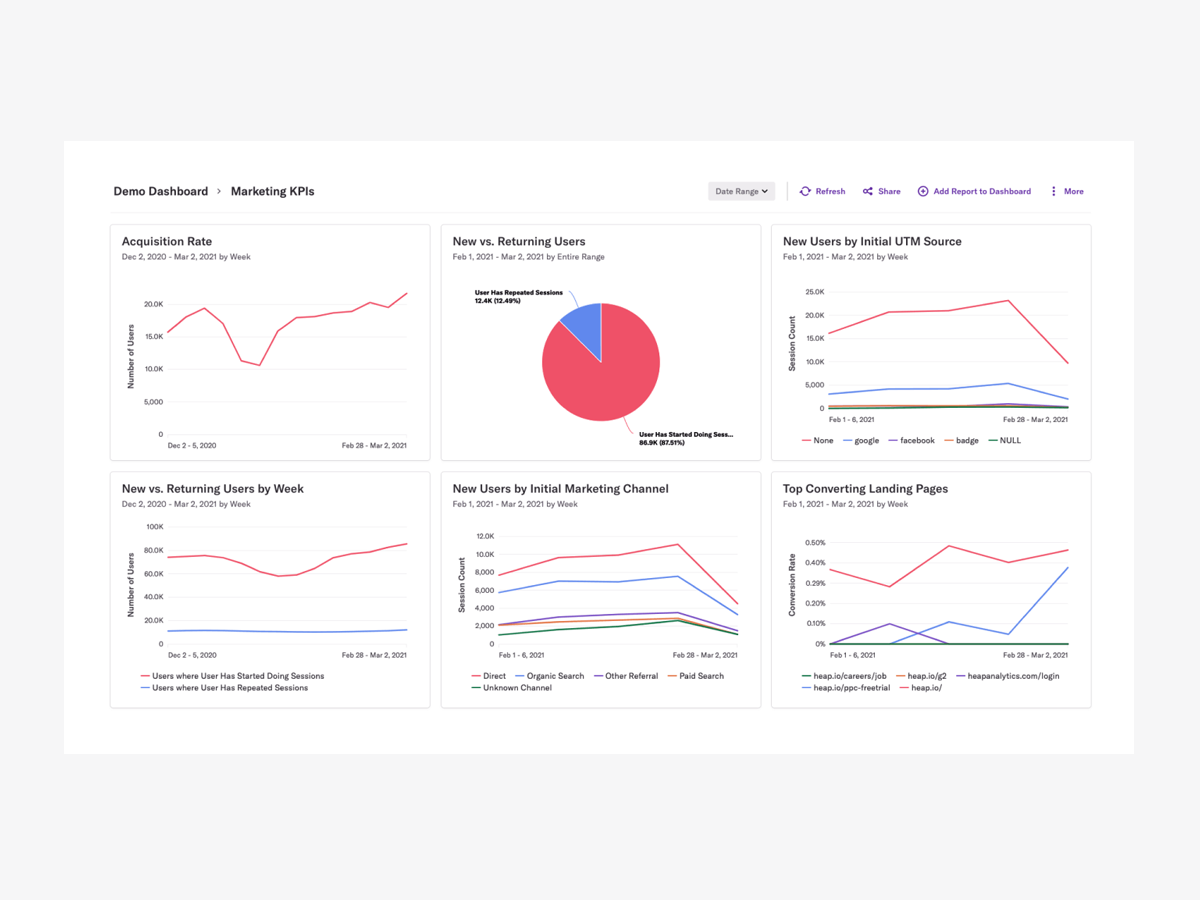
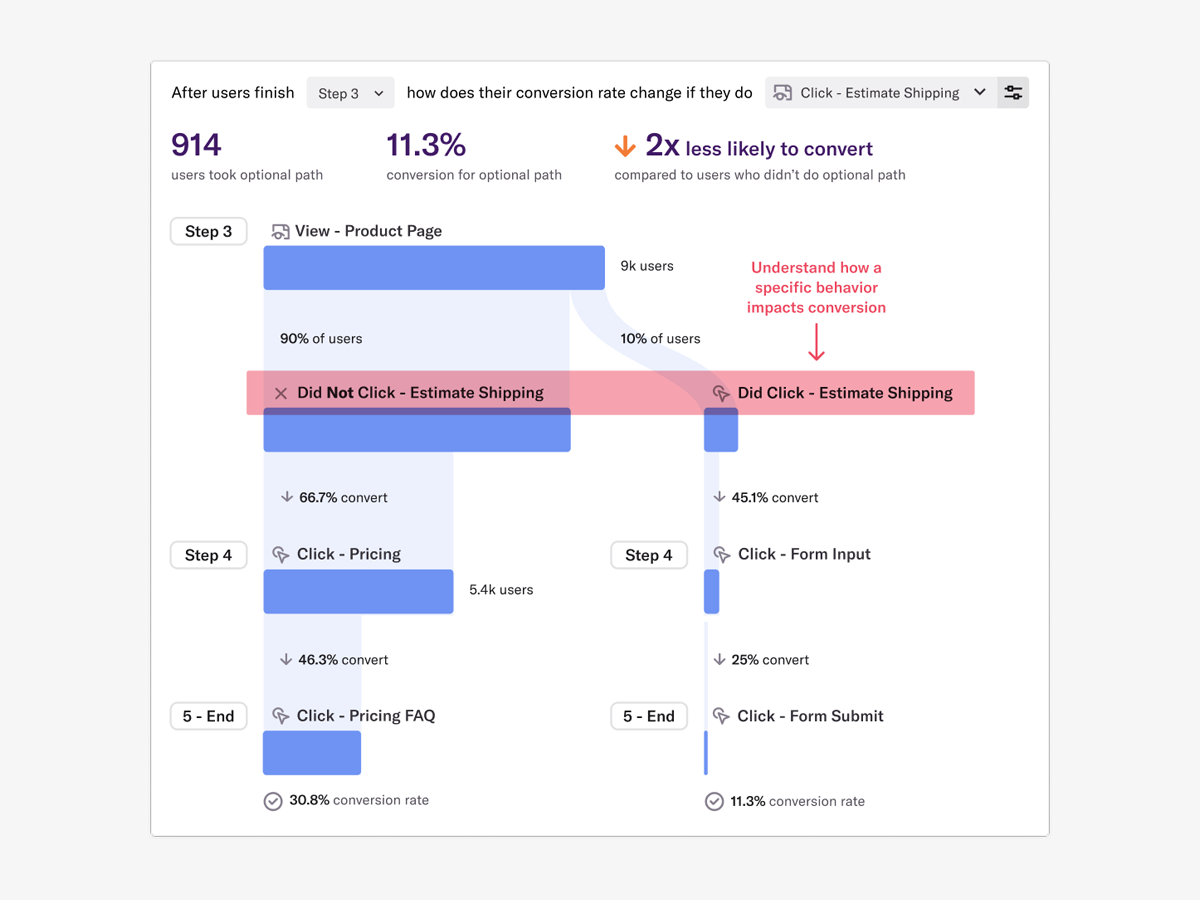
Heap is a web analytics platform captures every user interaction on web iOS with no extra code. The tool allows you to track events and set up funnels to understand user flow and dropoff. It also provides visualization tools to track trends over time.
$0
Up to 10k sessions/month
Spekit
Score 9.1 out of 10
N/A
Spekit is a just-in-time enablement engine that embeds answers, coaching, and sales content directly in the tools revenue teams use. From drafting prospect emails to updating deal stages in Salesforce or reviewing Gong calls, Spekit’s AI Sidekick understands what sellers need in the moment and surfaces the precise message, content asset, or process guidance to keep momentum moving. Built for Sales Enablement & Product Marketing Teams Spekit supports various use…
N/A
Pricing
Heap
Spekit
Editions & Modules
Free
$0
Up to 10k sessions/month
Growth
Starting at $3,600 annually
Up to 300k sessions/year
Pro
Contact Heap Sales
Custom sessions per month and unlimited projects
Premier
Contact Heap Sales
Custom sessions per month
No answers on this topic
Offerings
Pricing Offerings
Heap
Spekit
Free Trial
Yes
No
Free/Freemium Version
Yes
No
Premium Consulting/Integration Services
No
No
Entry-level Setup Fee
Optional
Optional
Additional Details
Heap pricing is based on session volume. A session is a period of activity from a single user on your app or website. It can include many pageviews or events.
Google Analytics stacks up for high level traffic and marketing data but not ideal for enterprises looking user level product interactions in detail. On the other hand Heap stood out for its automatic data capturing, faster onboarding, easy to use dashboards, Highly integrable …
For me, Heap is much simpler to utilize. I've previously used Google and Adobe Analytics but switched to Heap because it provide better features and is easy to integrate. Without a specialist's assistance, I am able to construct dashboards and am convinced that they are useable …
Heap is better because its easy to use, easy to install. With Heap you just add a snippet of tracking code to your header, instead of having to instrument each event like you do with other tools.
all of them may have their own strong suits but Heap is backed by best in class ML and AI algorithms. not only that all this powerful and robust backends are well handles also from the frontend. no matter how good your software is, if it is somewhat hard to navigate or to get …
Heap is better then Pendo and Amplitude. Compared to Amplitude, Heap is cheaper and easier to analyze and use. Configurations might be cumbersome but in the long run, users find it very seamless and easy. Compared to Pendo, Heap offers much superior analytics, event …
The ability to view events in real time as they occur, restrict them to just show mine, and then create dashboards using those events is the finest feature for me. It eliminates the requirement for constant 100% accuracy in documentation maintenance and guessing. I can monitor …
Heap had an edge over Google analytics in many ways. Few points to consider Heap over GA. 1. Low code implementation and less involvement of engineering team. 2. Great reporting dashboard with additional feature of of showing user journey, that helps understand user behaviour
Other applications help to achive the requirements using the current data, but Heap has two driven model one is dependent on past data which is also known as predictive framework and also one dependent upon fly which is adaptive framework. And integration is other tools is …
Heap offers a ton of functionality on a single platform.It also has an smart data science layer to offers suggestions for next steps in the analysis, allowing us to explore alternative paths we may not think to take. The low-code option for updating data is appealing, and there …
Heap blows away the competition in this space in my opinion. Amplitude was the closest competitor but did not have the ease of instrumentation that Heap offers out of the box. Google Analytics has gotten worse year after year and was borderline worthless for our business, as …
Tableau offers more advanced features, but at a much higher cost across all dimensions: price, difficulty of implementation and integration, onboarding effort, prior knowledge required, etc.
Compared to GA, Heap provides a much better UI, and its a much better product analytics tool (considering GA's main functionality is not for Product analytics) Overall, of you, are searching for Product analytics I would choose Heap instead of GA.
Heap is much easier to use versus Google Analytics. Previously, I was using Segment to get channel level data. However, Segment is not a customizable tool to understand top of funnel/web performance in the same way Heap does. Heap Connect is excellent when it comes to creating …
Heap is much easier for me to use. With Adobe Analytics, I needed to work exclusively with a product analyst whose whole job is working in Adobe Analytics. I can create dashboards without help from a specialist and feel confident that they are functional, actionable, and usable …
I didn't select heap. Someone else did. I wasn't consulted during the process either, it was there before I arrived and we recently renewed, but I wasn't part of that process. Hotjar was alright, the heapmap is a neat way to quickly show non-experts where we might have an …
We selected Spekit because of its superior customer service and ability to handle our use case to have our Salesforce Stage Gates fully populated. The ability to have a definition "on-page" for Salesforce fields was critical for us.
Spekit may not be as robust as Confluence or organized as SharePoint, but its use of embedded tooltips (Speks) and browser extension put it in the S Tier for "just-in-time learning" platforms - particularly for customer-facing teams.
Spekit is fine, I just feel like it doesn't have the world's best upfront organizational tool. I like Atlassian Confluence due to the ability to have pages and have an organized thought. That does take significantly more effort to keep it organized and up to date which everyone …
Heap is well suited for 1. Capture customer journey with session replay 2. Identify customer behaviour and improve overall customer experience 3. Frequent and quick implementations and modifications 4. Comparative analysis for historical marketing insights Heap is not so well suited, if the aim is to capture only analytics data without any goals to improve upon customer experience / targeting appropriate users based on data tracking.
Good situation: when you have way too many tools hosting content, Spekit is great at bringing everything together so I don't need to remember where things are hosted. I just need to know ish how to search. Bad: I feel like it still doesn't help people discover content nearly as much. The nice thing about a Confluence or other systems like that is that there are resources right in front of you, VS having to know what to search for. Also, I hate the extension, stop cluttering up Gmail.
The Auto Capture function does indeed save quite a bit of time, and being able to build new reports off historical data is really valuable.
Interface is really intuitive and user-friendly. Much easier to pick up and use than GA.
Building reports out on the fly is really quick and easy, allowing you to give right into all kinds of analyses.
The Event Definition screen is really useful, giving a quick glance at the most used events, which you then decide to turn into conversions or goals if you want.
Heap helps me understand key data points without fussing with the formatting of a dashboard. It gives me the benefit of data analyzation without the fuss of the formatting - as well as the ease of sharing data collected with my colleagues
Sometimes, Heap has issues reconciling similar selectors, and I have not found the manual tagging system to be the most intuitive, especially when best practices are not used when designing the front-end infrastructure. Even so, it helps that the data is unmodified, and all analytics are done through an interfaced layer, so damage and confusion [are] not permanent.
As an administrator, it is very easy to navigate. I can easily see which content is performing well, which content has not been touched. It's simple to teach new team members how to create content. We have added new authors easily in multiple groups in the business.
I've never run into any issues with Heap's availability, Heap is always there when I need it. I haven't run into any issues like application errors or unplanned outages during my 2+ years of using Heap. Each and every time I log in to Heap I have a completely functional experience
On a scale from 1-10, Heap loads pages fairly quickly. The only time I experience delays is when I am loading a graph with perhaps too many events or filters on the page. But in terms of creating or searching for events or viewing reports, I don't ever experience a lag.
Heap support has allowed us to troubleshoot and test a lot of different items. Their support team is always helpful and friendly, even when we come to them with the most complicated questions. I think this greatly improves the value proposition of the product because their support team is knowledgable and friendly.
The implementation was smooth and easy. The Heap team helped us with implementation and it went great! Within a few weeks, we were fully up and running and utilizing the platform to its full capability. This is an additional thing that has made this platform so great and we couldn't recommend it enough.
Heap is better because its easy to use, easy to install. With Heap you just add a snippet of tracking code to your header, instead of having to instrument each event like you do with other tools.
Spekit may not be as robust as Confluence or organized as SharePoint, but its use of embedded tooltips (Speks) and browser extension put it in the S Tier for "just-in-time learning" platforms - particularly for customer-facing teams.
The most challenging part of using Heap in a growing organization is the naming and structure in which reports and dashboards are organized. I work within the marketing department and our Heap leader internally works within the IT/Product department, which makes it challenging because we often don't speak the same language, so the learning curve has been steep without any specific use-case examples to leverage online.
The time saved from using Spekit is incredible. No more calls/emails asking "what's this field for?" or "How do I do ?" It's all right there, thanks to Spekit.
Using Spekit has provided an unexpected morale boost because it's not only easy to use, but it's making work more enjoyable too.