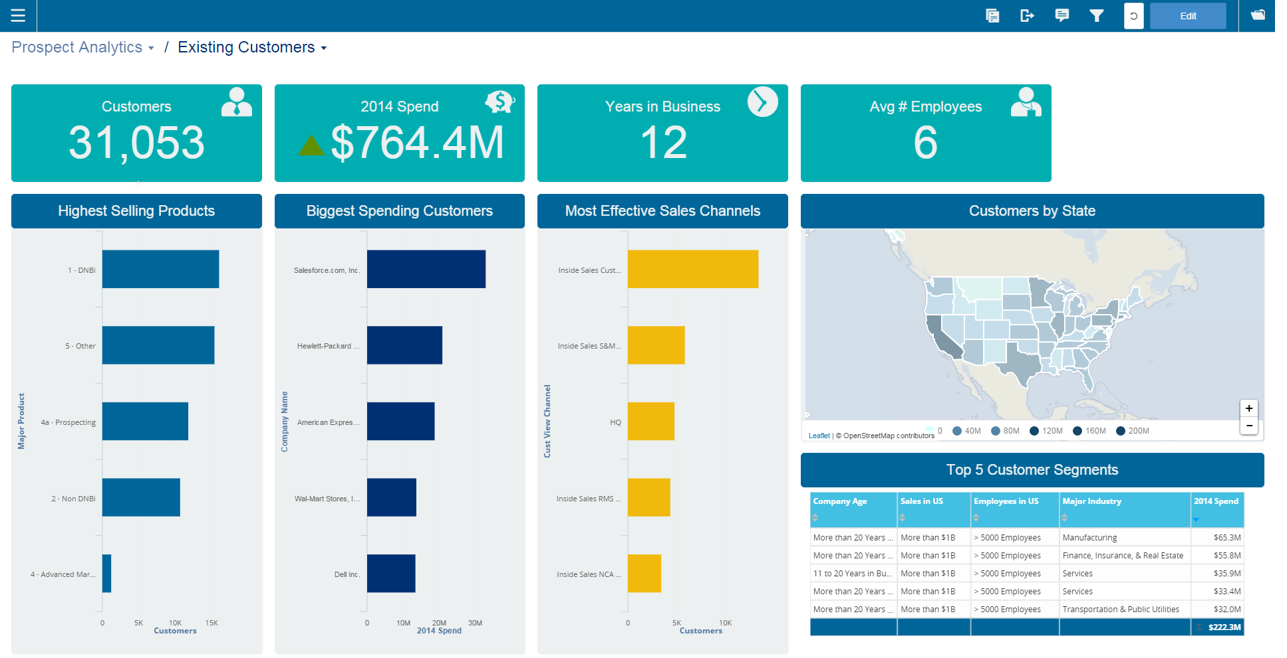
Infor Birst offers multi-tenant cloud BI for deployment in a public or private cloud, or on-premises. It provides an in-memory columnar data store and a BI layer comprising a reporting engine, predictive analytics tools, mobile native apps, dashboards, discovery tools, and an open client interface.
N/A
ZoomInfo Operations
Score 8.5 out of 10
N/A
ZoomInfo OperationsOS/RingLead is a comprehensive data quality management platform for sales and marketing operations teams to clean, enrich, and route their go-to-market data.
Infor Birst OEM and embedded analytics are well suited for advanced analytics and business intelligence. It has flexible deployment features and a lot of configuration ability with low code - no coding ability. Ability to ingest data from multiple live data sources. Source data from multiple sources can be segregated into multiple sections based on business criteria. Easily searchable business terms (metadata) across all enterprise analytic content.
ZoomInfo Operations is very well suited for bulk record updates, list imports, and record ownership assignments and reassignments. The intuitive user interface makes it easy to explore as many scenarios as possible to use the platform. The platform is extremely powerful as well - the volume of scheduled/automated bulk updates that we have running hourly and daily has never seemed to cause any issues with the system. All expected tasks are completed every time, and if any records couldn't be updated, the system does a great job of highlighting those errors for you. Based on my experience, scenarios that would be less appropriate include automated enrichment, specifically for contacts who may have moved to another company. Also, they need to keep up with Salesforce capabilities regarding what objects can be added as Campaign Members - we have to come up with a workaround when we want to add Accounts to campaigns.
End-to-end solution, from raw source data, ETL, warehousing and reporting, Birst is able to do everything we need in one package instead of needing to develop and maintain multiple technologies
Intuitive report development. The drag and drop creation of reports is simple. More complicated queries are easy to generate.
Very user-friendly and interactive. A lot of nice features are available both for developers and end users to streamline the process of preparing and consuming data
Rich API which allows us to programmatically interact with Birst
EverString allows us to build account lists based off in-depth firmographic or technographic data. It's far more accurate than trying to build these lists any other way.
EverString is fast. Where it might've previously taken us weeks to build lists of this quality, we now can build them in a matter of minutes (and have them ready to be published in a couple of hours).
We have been able to overcome any of the drawbacks we've found with Birst easily and it has fulfilled almost all of our analytic needs to date. Having seen their roadmap it would be highly unlikely we would move away from this platform any time soon. You simply can't beat the functionality that Birst provides for the price and the things I see coming out of the company solidify that our decision to choose Birst was the best possible choice. We have never regretted the decision.
I give this rating because I feel that ZoomInfo Operations has made our work easier and smoother than before. Like now we manage our sales leads, new engagements, easily, and the data we get from ZoomInfo Operations helps us a lot to move in the right direction. our customer success rate is higher than before after implementing it.
I would like to see additional usability put into the ETL scripting. Recently, Birst added a nice function reference inline to formula creation which has kept me from having to return to documentation so much. The same in ETL would be very beneficial. The interface problems related to the Flex framework are being addressed in a rewrite to HTML 5, but for now they are still a hindrance to a higher usability rating.
ZommInfo OPerations is pretty intuitive once you get the hang of it. I like that the current integrations make it easier to work within our existing flows and processes. Some of the more advanced features take a bit more training to fully understand and use correctly. And the interface could maybe be updated.
We frequently experience -103 errors due to us using the Live Connect functionality, which does not seem to handle even minor interruptions in connectivity, and treats all future connection attempts or data requests as errors, even if the issue does not exist any longer
If I talk about the operation's availibility, it is always available whenever I need it. Yeah, once in a while, I have seen an outage, but that was quickly resolved, so I would say they have a strong team that keeps the tool running, no matter if it is updating itself.
Everything runs very fast and smoothly. The only process that I wish was faster would be processing the data after uploading new data or making changes to the existing data model. It can take 15-20 minutes (roughly) to upload and process new data once you start getting into 10's of millions of rows. Given my experience with how long it takes me to pull the same data using SQL Server Management Studio, I don't think Birst is unreasonably slow - but for me to give a higher rating, I would want it to be unreasonably fast
I would rate its performance 9. I do not doubt its performance, the pages load quickly withour laging or error. It gives a report within the time frame without errors, no matter how complex the report is. We integrated it with our CRM; at first, it tended to slow a little, but later it was fixed and ran smoothly.
When we have an issue that is stopping our business from proceeding, I want answers sooner than later. While Birst does have a published response time for each case level, we always wish it could be quicker. What response improvement could there be with a larger support team? In response to first question: Blackhole of issues - Birst needs to improve upon closing issues that resolution was dependent upon code fixes or enhancements, perhaps someone to add a comment on all case tickets at least every 60 days. Escalation - I always have the ability to electronically or via phone escalate a ticket. I also have my Customer Success Manager through whom I can escalate topics.
I give this rating because I never feel they deserve less than it. Their commitment towards the customer is outstanding, whenever I need to reach out to the supprot, I feel like I am just talking to a person who is sitting beside me. They respond quickly and solve the problems easily, even guiding us on how not to get into the same problem again and again, so we can avoid going back to support.
I have attended two different training sessions. The first one was my initial training on the system. It was well paced, clear and concise. If there were questions that were not able to be answered by the instructor, he took down the question and actually followed up and provided us a response quickly. The second session was specific to the dashboard and report design components. This training was very good though there were some attendants who had little or no experience and their questions slowed the class.
Although I found the online resources helpful, a lack of appropriate examples for certain tasks key to report creation and advanced modeling make the online training/documentation less than perfect. For an inexperienced BI professional, the online training would not enable a streamlined launch of the product.
Have clean data! Birst flexibility allows - Start small, then introduce functionality and complexity along the way. If you try to present all the functionality [bells and whistles] and wow them, but bad data is uncovered, the end user blames the new application and turns away.
Have a plan on how you're going to evaluate. We had a two-month trial period, but a six-month average lead cycle time, making it impossible to evaluate on a purely new-business ROI basis within the trial. We applied the model to our prior data, which demonstrated how much time and effort was devoted to accounts that weren't going to close
Birst was better than Domo for our needs because we could get in and tinker with it. Our impression of Domo was that it had a lot of connectors and ready to go reports, but it made too many assumptions about applications we use. We customize too much to use a "ready to go" solution like that. When we looked at Tableau, we liked its visualization capabilities, but it wasn't going to help us do the extractions, ETL, and warehousing of data. It may have come some distance since then.
I haven't tried stacking it against any competition as I feel no need to. ZoomInfo blows me away like it first did in 2018, and I don't want something different. I hear Clay is good, but I just haven't felt the need to try it out or replace ZoomInfo at all.
we can see that loading a lot of data can cause a noticable slow down in performance. Birst support indicated that they don't really consider anything less than 30 seconds to be an issue, but that is not the case for our customers, so we have had to change some of implementation to address this
This is the most important and beautiful thing about this tool: it has strong scalability across teams and use cases. It allows us to expand from a single thing to multiple things, like sales to multiple departments, e.g., marketing, Data Accuracy, and Customer Success, without needing complex changes in the setup.
Being a manufacturing company we tend to lag behind technologically. But having all the data for different ERP systems in one place has been an eye opener for the executives. It has lessened the need to convert some legacy ERP systems.
Having such a simple reporting tool is a great asset to some of our sites that have traditionally had trouble gathering data from AS400 systems.
Generate more pipeline - indirectly. Data from anywhere still needs to be transformed and used for a business objective.
Saved time in doing research and data population.
Assuming a business will purchase a data vendor, the comparison between other vendors is a factor of cost, functionality, and data quality. ZoomInfo has higher costs typically - which would lower the ROI - but with proper incentives or discounts, the comparative ROI grows.