A de minimis incentive was given to thank the reviewer for their time. The incentive was not used to bias or drive a particular response, nor was the incentive contingent on a positive endorsement. More Info
Verified User
Chose ManageEngine Endpoint Central
Having the two integrate together as you can have a history of each piece of equipment is wonderful. You can easily see what has been done or if it is a reoccurring issue that might be the symptoms of a bigger issue.
A de minimis incentive was given to thank the reviewer for their time. The incentive was not used to bias or drive a particular response, nor was the incentive contingent on a positive endorsement. More Info
Verified User
Chose ManageEngine Endpoint Central
In terms of feather and usability ManageEngine Endpoint Central far surpasses both. Although spiceworks is free, you are limited to support and new feature updates. Intune does well what it is built for, but does not provide all the features that are needed for day to day …
A de minimis incentive was given to thank the reviewer for their time. The incentive was not used to bias or drive a particular response, nor was the incentive contingent on a positive endorsement. More Info
Systems Administrator in Information Technology at City of Frederick (Government Administration, 501-1000 employees)
Chose ManageEngine Endpoint Central
Endpoint Central provides a more robust unified Endpoint Management product. Other products would need separate add-ons or third party products to manage what we would require from an asset management product.
A de minimis incentive was given to thank the reviewer for their time. The incentive was not used to bias or drive a particular response, nor was the incentive contingent on a positive endorsement. More Info
Verified User
Chose ManageEngine Endpoint Central
both are great. i like to finish the ticket reports on what i did for the solution
A de minimis incentive was given to thank the reviewer for their time. The incentive was not used to bias or drive a particular response, nor was the incentive contingent on a positive endorsement. More Info
Verified User
Chose ManageEngine Endpoint Central
My opinion is its night and day. We are saving so much time since we switched products
A de minimis incentive was given to thank the reviewer for their time. The incentive was not used to bias or drive a particular response, nor was the incentive contingent on a positive endorsement. More Info
Verified User
Chose ManageEngine Endpoint Central
From the few that I have used, and the ones I researched, I like the fact that there are many other ManageEngine products that all link together to build a fantastic tool kit for IT. Also, I have found that the few times I have had problems, their support has been very …
A de minimis incentive was given to thank the reviewer for their time. The incentive was not used to bias or drive a particular response, nor was the incentive contingent on a positive endorsement. TR verified that a representative sample of customers was invited. More Info
System Administrator in Information Technology at Countybank (Financial Services, 201-500 employees)
Chose ManageEngine Endpoint Central
Intune doesn't offer 3rd party patching and the reporting isn't on the same level for some of the offerings in this application. Nessus is very expensive, and we have used both at the same time to compare and they pull the same results with the ManageEngine Endpoint Central …
A de minimis incentive was given to thank the reviewer for their time. The incentive was not used to bias or drive a particular response, nor was the incentive contingent on a positive endorsement. More Info
It analyst in Information Technology at Mired (Financial Services, 51-200 employees)
Chose ManageEngine Endpoint Central
I had already used SCCM in other companies, but when I joined the company I'm currently in, I started using Endpoint Central and I've been incredibly satisfied with the service and support.
A de minimis incentive was given to thank the reviewer for their time. The incentive was not used to bias or drive a particular response, nor was the incentive contingent on a positive endorsement. More Info
Verified User
Chose ManageEngine Endpoint Central
Its can always be integrated with ManageEngine other products, which is very useful.
A de minimis incentive was given to thank the reviewer for their time. The incentive was not used to bias or drive a particular response, nor was the incentive contingent on a positive endorsement. More Info
Verified User
Chose ManageEngine Endpoint Central
ManageEngine Endpoint Central has more modules- like MDM and OS deployer, I am not aware if either of the solutions I have used before have this functionality
A de minimis incentive was given to thank the reviewer for their time. The incentive was not used to bias or drive a particular response, nor was the incentive contingent on a positive endorsement. More Info
Verified User
Chose ManageEngine Endpoint Central
We didn't try any other products - we went straight for ManageEngine Endpoint Central due to the value for money on the features you get.
A de minimis incentive was given to thank the reviewer for their time. The incentive was not used to bias or drive a particular response, nor was the incentive contingent on a positive endorsement. More Info
Asesor Comercial in Sales at Synergy Ecuador (Information Technology & Services, 11-50 employees)
Chose ManageEngine Endpoint Central
ManageEngine Endpoint Central is the best option if the cost-benefit obtained is evaluated.With ManageEngine Endpoint Central it is possible to perform vulnerability analysis and patching of operating systems and applications other than Microsoft such as: Linux and Mac. This …
A de minimis incentive was given to thank the reviewer for their time. The incentive was not used to bias or drive a particular response, nor was the incentive contingent on a positive endorsement. More Info
A de minimis incentive was given to thank the reviewer for their time. The incentive was not used to bias or drive a particular response, nor was the incentive contingent on a positive endorsement. More Info
Verified User
Chose ManageEngine Endpoint Central
TeamViewer is a good solution for remote control, but I haven't found it as useful for patch management, software deployment and inventory reporting However, the file transfer and chat functions of TeamViewer are better to use than Endpoint central
A de minimis incentive was given to thank the reviewer for their time. The incentive was not used to bias or drive a particular response, nor was the incentive contingent on a positive endorsement. More Info
Product Manager in Information Technology at iDric Soluciones de TI y Seguridad Informática (Information Technology & Services, 11-50 employees)
Chose ManageEngine Endpoint Central
The principal reason was that ManageEngine's Desktop Central supports multi-platform (Windows, Mac and Linux) while SCCM obviously only supports Windows systems. We have Windows and Mac computers in the company. Besides also the Mobile Device Management module, supports Chrome …
A de minimis incentive was given to thank the reviewer for their time. The incentive was not used to bias or drive a particular response, nor was the incentive contingent on a positive endorsement. More Info
IT LAN Administrator in Information Technology at Information Services Firm (Information Services, 51-200 employees)
Chose ManageEngine Endpoint Central
I've used RDP for remote control. I've used WSUS to deploy patches. I've used various methods to achieve nearly silent install of software. The great thing about ManageEngine Desktop Central is that it is all under one umbrella with one interface.
A de minimis incentive was given to thank the reviewer for their time. The incentive was not used to bias or drive a particular response, nor was the incentive contingent on a positive endorsement. More Info
For small businesses, it is also free, which, for what it offers, is really helpful. It works better than similar products, such as SCCM, both within and outside the internal network. I do not see scenarios in which it could be less appropriate.
We use the free version, it allows up to 10 technicians to be added to the system, but that has never been an issue, as we are a small team. The functionality and usability of MESDP are great and can work with larger teams too. It is well suited to be used as a main Ticketing system, and this is not limited to IT only, I am sure other teams that need to keep track and log issues will be able to utilize MESDP without any issues. There is a self-service portal as an option, however, we do not use it as of yet, as there has not been the need for it. If you would need to use the same instance within multiple departments, this may be a bit tricky to achieve, as there is no easy way to limit visibility to tickets from other departments, however, I am sure there is a way around it.
A de minimis incentive was given to thank the reviewer for their time. The incentive was not used to bias or drive a particular response, nor was the incentive contingent on a positive endorsement. More Info
We set alerts when a devices gets low on disk space. That is automatic and creates a ticket in ME SDP. We are then able to Add space to a VM Desktop, and then go thru ManageEngine Endpoint Central to extend the drives so the entire process can be done without interruption to the end user.
Using the patch scans we can easily see what patches have been installed for all manufacturers not just Microsoft, without having to physically go to the device. It also allows us to choose which patches we want to push out and automate the process so we can be hands off, freeing up out time for other things.
Remote access to devices. This allows us to remotely make changes, not just via remote control but also make registry changes and clean up space without going to the device and without interruption to the end user.
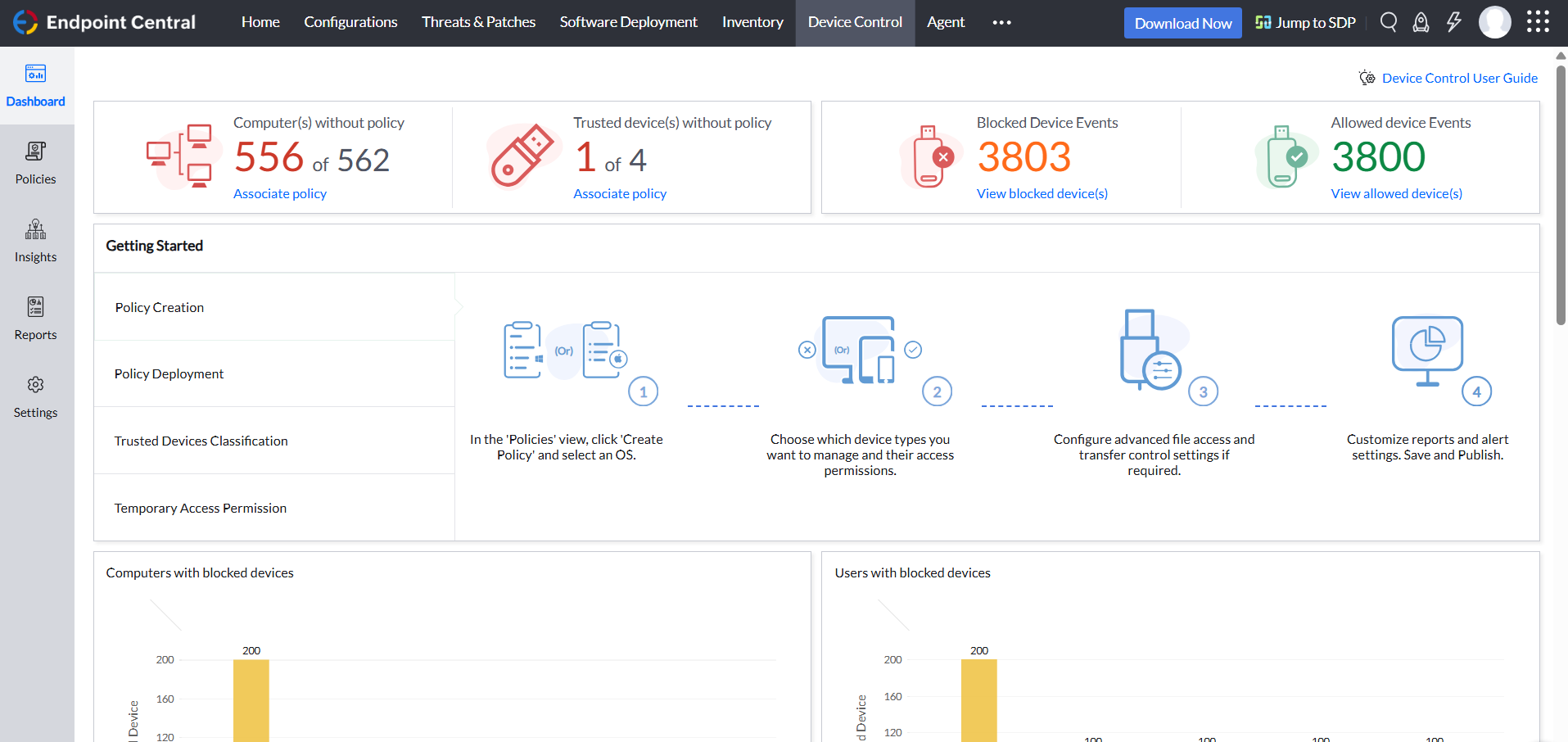
Alerts. We have set up to get email alerts when new hardware is plugged into any computers. This lets us know if someone is bringing in un-authorized equipment (thumb drives, hubs, etc) to better manage what is/is not on our network.
A de minimis incentive was given to thank the reviewer for their time. The incentive was not used to bias or drive a particular response, nor was the incentive contingent on a positive endorsement. TR verified that a representative sample of customers was invited. More Info
It is very easy to create business rules that automatically route email tickets to the correct department and apply templates to correctly categorize the incident.
The technician auto-assign function allows email tickets to be fairly apportioned using a round robin technique. We do not cuurently use the load balancing technique which is also available.
It is very easy to bulk edit requests to correct miscatergorization by Analysts. (i.e. Incidents vs. Service Requests)
Coordinating communications and notifying ticket holders when a network or application event is resolved is very simple.
A de minimis incentive was given to thank the reviewer for their time. The incentive was not used to bias or drive a particular response, nor was the incentive contingent on a positive endorsement. More Info
A de minimis incentive was given to thank the reviewer for their time. The incentive was not used to bias or drive a particular response, nor was the incentive contingent on a positive endorsement. More Info
Reporting tools; the report features can be a little limited, it can be quite tricky to get the information you want displayed in detail
You can set required fields within the ticket template, which should mean the user has to complete them before they can submit the ticket, however this often doesn't enforce correctly
A de minimis incentive was given to thank the reviewer for their time. The incentive was not used to bias or drive a particular response, nor was the incentive contingent on a positive endorsement. More Info
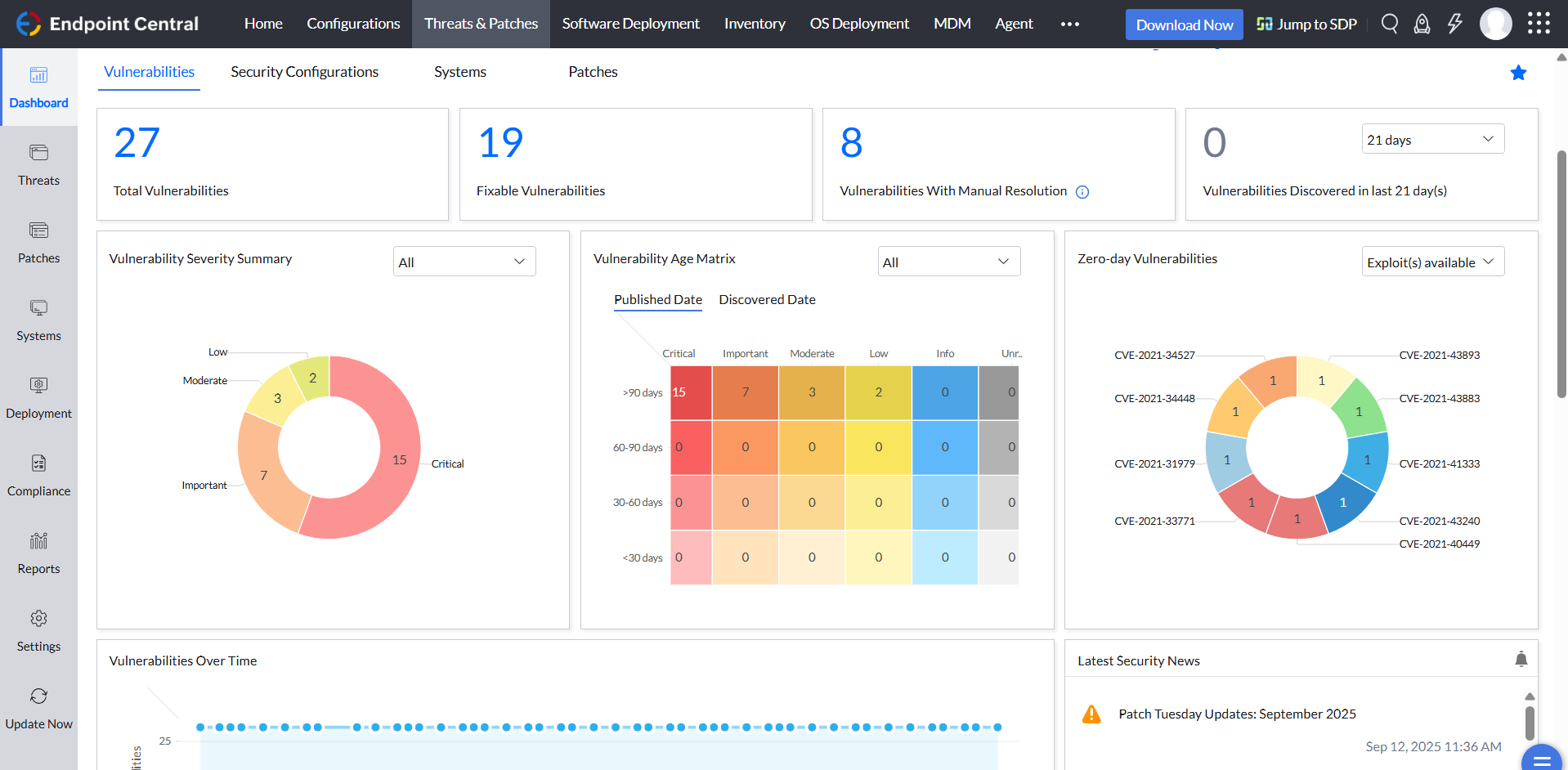
ManageEngine is considered an excellent product due to its comprehensive suite of solutions for IT management, with ManageEngine Endpoint Central specifically excelling in endpoint management. The platform stands out for its user-friendly interface, robust features, and versatility in addressing diverse IT needs. It offers organizations a centralized solution for endpoint security, patch management, software deployment, and asset management
Because this is the best tool, we have given ManageEngine ServiceDesk Plus a rating of 9 out of 10 because it provides a good overall IT service management experience, especially for ticketing, asset management, automation, and reporting. It has helped us organize IT support processes and improve visibility. For ticketing.
A de minimis incentive was given to thank the reviewer for their time. The incentive was not used to bias or drive a particular response, nor was the incentive contingent on a positive endorsement. TR verified that a representative sample of customers was invited. More Info
Not using WNS to communicate with the endpoint console is a big plus. We now use Workspace One, and WNS can be really annoying at times. After deployment, it cleans itself, which is important for us because our current solution leaves the package on the computer and requires maintenance. The remotely script command is a lifesaver.
A de minimis incentive was given to thank the reviewer for their time. The incentive was not used to bias or drive a particular response, nor was the incentive contingent on a positive endorsement. More Info
As any other feature-rich software package, starting out with ManageEngine ServiceDesk Plus has a little bit of a learning curve, but it usually doesn't take very long until you can use the basic features. Training new technicians on the use of the software does not take very long, and for users to submit tickets it is as easy as sending an email.
A de minimis incentive was given to thank the reviewer for their time. The incentive was not used to bias or drive a particular response, nor was the incentive contingent on a positive endorsement. More Info
The immediate chat support is great and very helpful. However, if you need escalated support or have a deeper need that the chat tool can't help with, you will experience significant wait times and slow responses. The time zone difference becomes painful to the point of often just giving up.
I have a few issues with MESDP and even though we use the free version, the support staff was very quick to respond and extremely competent and helpful. Luckily, I have only had to use them a couple of times over the 2.5 years I have been using their product, but they strike me as very competent, friendly and helpful, regardless of the version of their product you use.
A de minimis incentive was given to thank the reviewer for their time. The incentive was not used to bias or drive a particular response, nor was the incentive contingent on a positive endorsement. More Info
It seems that the services offered with the purchase change from what is covered to what is an additional cost. Somethings I thought we had ended up requiring an additional purchase if we wanted to continue using the feature.
A de minimis incentive was given to thank the reviewer for their time. The incentive was not used to bias or drive a particular response, nor was the incentive contingent on a positive endorsement. More Info
I was not a part of the initial selection process, but I understand the issue was related to cost per endpoint. As a user of the other solutions I would say that the other solutions do have other strengths that ManageEngine is missing. The remote access tools are superior but at the end of the day you get what you pay for.
A de minimis incentive was given to thank the reviewer for their time. The incentive was not used to bias or drive a particular response, nor was the incentive contingent on a positive endorsement. More Info
Spiceworks was free, which obviously had both benefits and limitations - I will say that the community around Spiceworks has always been great. If we could replicate that experience with the ME user base, it would be terrific.
A de minimis incentive was given to thank the reviewer for their time. The incentive was not used to bias or drive a particular response, nor was the incentive contingent on a positive endorsement. More Info
A de minimis incentive was given to thank the reviewer for their time. The incentive was not used to bias or drive a particular response, nor was the incentive contingent on a positive endorsement. TR verified that a representative sample of customers was invited. More Info
The tool does not scale well from an ROI perspective. As you add a customer, you must add a new instance, hence a new license.
The tool is probably on the expensive side (34,000 USD per 130 technicians per year).
There is no usage beyond incident, change, and problem management. The CMDB feature is extremely limited and cannot generate additional ROI. There is no knowledge-base or integration with other software (other than ME Desktop Central).
A de minimis incentive was given to thank the reviewer for their time. The incentive was not used to bias or drive a particular response, nor was the incentive contingent on a positive endorsement. More Info