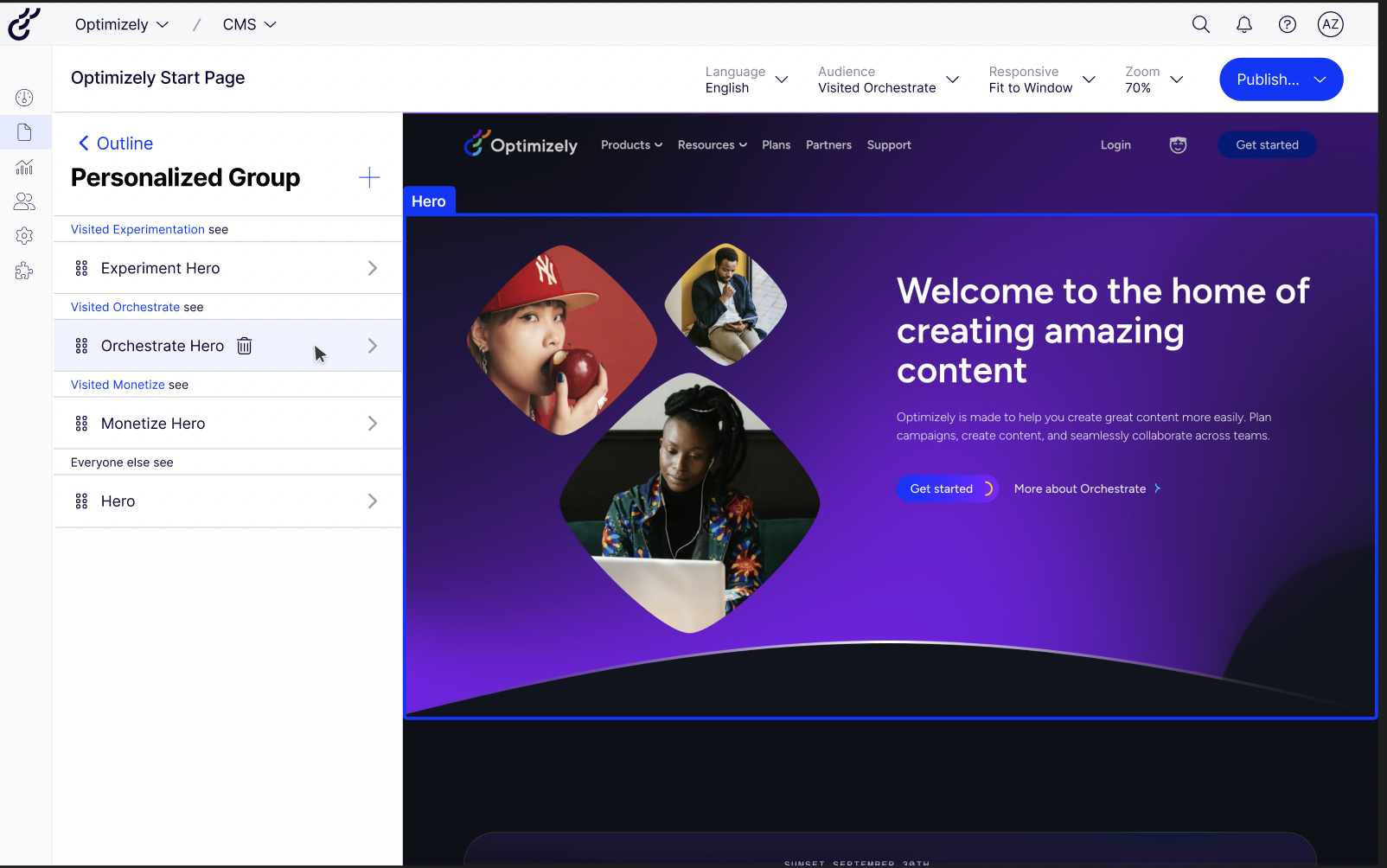
Optimizely Content Management System (CMS) is purpose-built for marketers, and fully composable for developers. The CMS supports the end-to-end content lifecycle, helping users to deliver on-brand, high-impact digital experiences that 'wow' audiences.
N/A
Optimizely One
Score 7.4 out of 10
N/A
Optimizely One is a digital experience platform, helping marketing and product teams accelerate digital growth, powering the marketing and digital lifecycle from planning to analysis through a unified workflow. Optimizely One accelerates every step of the process with embedded AI.
N/A
Umbraco CMS
Score 6.7 out of 10
N/A
Umbraco is an open-source .NET Core CMS with over 700,000 active installs worldwide and with more than 200,000 active community members. It was first released on February 16th, 2005, and is still to this day an open-source project backed by a commercial company. To ensure Umbraco is always running the latest technology, the company has aligned with Microsoft's .NET release schedule to always have the Umbraco CMS…
$0
Pricing
Optimizely Content Management System
Optimizely One
Umbraco CMS
Editions & Modules
No answers on this topic
No answers on this topic
Umbraco Free
$0
Umbraco Starter
$53
per month
Umbraco Standard
$320
per month
Umbraco Professional
$860
per month
Umbraco Cloud Enterprise
Custom Pricing
per month
Offerings
Pricing Offerings
Optimizely Content Management System
Optimizely One
Umbraco CMS
Free Trial
No
No
No
Free/Freemium Version
No
No
Yes
Premium Consulting/Integration Services
Yes
Yes
Yes
Entry-level Setup Fee
Required
Optional
No setup fee
Additional Details
—
—
The Umbraco CMS and all of its core features are the same across all plans.
Episerver outranks these products in most cases. There are some functions in each product that you would love in Episerver but when you sum it up Episerver is the greatest :)
Umbraco is quite close to my heart. I've done lots of CMS implementations in Umbraco, done a little bit of Sitecore, done some WordPress. Well, it's a more refined commercial product that's more mature. So Umbraco for example, that's an open source free content management …
Both Umbraco and Optimizely have a lot of common denominators, but the main difference from a development perspective is how content types are implemented in code in Optimizely vs. defining content types in the Admin UI in Umbraco, where Optimizely has the upper hand, making it …
Optimizely Content Management System is better supported, but more expensive. The support is what we needed and the possibility of having direct access to the company that develops the product.
Out of those listed, only Umbraco is applicable as it can be directly compared to Optimizely CMS (with the other 3 being Headless solutions, which should instead be compared with Optimizely Headless, which I haven't worked with)
Umbraco offers a really visual experience and far …
Umbraco is a similar product that does a lot of the same things well and has a big community behind it when you need help with something. However Optimizely Content Cloud feels more refined to work with, plus the official support is sometimes a godsend when you can't find the …
Among all the CMS products that I've tested, Episerver had a stronger coupling with an e-commerce product (Episerver Commerce), and that was the main reason we went with it. Besides that, the main reasons why I wouldn't go with each, would be mainly:
Ultimately it depends on needs. Price point for Episerver can be similar to Sitecore and is definitely less than Adobe. I think Episerver is strong because the product isn't looking to replace powerful systems (email, etc.) which is why their add-ons are so successful. Sitecore …
EPiServer had the right mix of features and cost for what we were looking for. We especially liked the robust translation and localization options since we needed to support multiple languages in many different locations. The support options have gotten better and better over …
EpiServer competes with both Drupal and WordPress, hands-down, in terms of both efficiency as well as usability. I would say EpiServer is actually a lot easier to use than Drupal was for me personally. EpiServer wasn't confusing like Drupal, and had an easier learning curve.
The performance of Umbraco is as good as Episerver. The back office in Umbraco is cleaner and more intuitive than Episerver. Sitecore is a good CMS for large projects, but the learning curve for developers and editors is steep.
Features
Optimizely Content Management System
Optimizely One
Umbraco CMS
Security
Comparison of Security features of Product A and Product B
Optimizely Content Management System
8.4
168 Ratings
2% above category average
Optimizely One
-
Ratings
Umbraco CMS
9.0
12 Ratings
9% above category average
Role-based user permissions
8.4168 Ratings
00 Ratings
9.012 Ratings
Platform & Infrastructure
Comparison of Platform & Infrastructure features of Product A and Product B
Optimizely Content Management System
7.9
165 Ratings
2% above category average
Optimizely One
-
Ratings
Umbraco CMS
8.5
11 Ratings
9% above category average
API
7.9158 Ratings
00 Ratings
8.010 Ratings
Internationalization / multi-language
7.8126 Ratings
00 Ratings
9.010 Ratings
Web Content Creation
Comparison of Web Content Creation features of Product A and Product B
Optimizely Content Management System
7.8
193 Ratings
0% above category average
Optimizely One
-
Ratings
Umbraco CMS
8.0
12 Ratings
3% above category average
WYSIWYG editor
7.7177 Ratings
00 Ratings
10.012 Ratings
Code quality / cleanliness
8.1165 Ratings
00 Ratings
10.012 Ratings
Admin section
8.1177 Ratings
00 Ratings
7.012 Ratings
Page templates
8.2171 Ratings
00 Ratings
8.012 Ratings
Library of website themes
7.596 Ratings
00 Ratings
6.011 Ratings
Mobile optimization / responsive design
7.9175 Ratings
00 Ratings
6.011 Ratings
Publishing workflow
8.1171 Ratings
00 Ratings
10.012 Ratings
Form generator
6.6130 Ratings
00 Ratings
7.010 Ratings
Web Content Management
Comparison of Web Content Management features of Product A and Product B
Optimizely Content Management System
7.5
179 Ratings
1% above category average
Optimizely One
-
Ratings
Umbraco CMS
7.2
12 Ratings
3% below category average
Content taxonomy
8.1164 Ratings
00 Ratings
6.012 Ratings
SEO support
7.1163 Ratings
00 Ratings
10.011 Ratings
Bulk management
7.0136 Ratings
00 Ratings
7.09 Ratings
Availability / breadth of extensions
7.5141 Ratings
00 Ratings
7.011 Ratings
Community / comment management
8.0116 Ratings
00 Ratings
6.011 Ratings
Best Alternatives
Optimizely Content Management System
Optimizely One
Umbraco CMS
Small Businesses
ManageWP
Score 10.0 out of 10
Bloomreach - The Agentic Platform for Personalization
If you want to build a website quickly there are plenty of ways to do so with some great examples and plenty of support both from the company and in the forums. if you want to build a more complex structure you can but be ready to spend the time to build exactly what you need as a solid foundation goes a massive way before building out content and making those choices early and sticking with them helps
It is well suited for heavy-duty A/B testing where management would like to see and quantitatively determine the effect of a change. It is not so efficient to try for a single page simple form, except when the form is part of a larger workflow. The security model is not very well understood, including RBAC and protection against injection attacks.
Umbraco CMS is the perfect tool for a company that is looking to keep their website updated. The simple to use tools and templates means updating and creating new pages is easy. The WYSIWYG editor is a nice feature, however, for accessibility, there should be some more guidance on what is suitable to be used on the CMS.
I think the user interface for content admins is very good and very competitive. And compared to other providers, the technology that CMS in particular has. So the way it integrated the net ecosystem is very well because it follows the MBC pattern. So basically it just allows really simple implementations for what would normally be complex components on any other sort of vendor that's out there.
Magento did have some nice tools for creating product groups or carousels for promotion. Opti seems to be lacking in that.
A blog - maybe this is available and we don't have it installed, but a searchable blog would be very appreciated.
Structured Data/MicroData - maybe it's our install, but this seems to be missing
Meta data: we have access to limited types and need to make a request from IT, it would be nice to be able to access more to adjust for SEO needs.
When in a folder on the BLOCKS tab, it would be wonderful to hit the MEDIA tab and stay in that same folder.
I have some less technical people that will make folders with spaces - which Opti handles, but it would be great if it wouldn't accept a space or gave an error message not to use them.
I think I know why the extra code is added to urls and image links, but it causes issues when taking things from our testing site to the live site. For example, I need to copy the Navigation from Inspect Element on testing to put it in production. I have learned to work around it, but it's not my favorite.
Speed for older sites - Umbraco content can load slowly if you have thousands of pages of content. Of course, this would not be a problem for simpler websites
Complexity - since the product is free out-of-the-box, it will take technical expertise to get Umbraco setup properly
Since I work on the implementation side of things, and do not directly own licensing for Ektron CMS, I have to base this rating off of how I think it will be received or presented to customers looking to start a new site deployment. I try to remain CMS agnostic, though my specialty is with the .NET and Microsoft stack. Because of the experience I have working with Ektron, I tend to be more forgiving with the shortcomings as I am familiar with how to work around them or past them from experience. Being familiar with the community available also helps, as you become familiar with the best approaches to find solutions to your issues. Each product has it's ups and downs and all of them are only going to be as good as the company or development team implementing them can make them. This is EXTREMELY important to remember when choosing a CMS, as it can make or break your expensive investment.
From our editors perspective they find the CMS system easy and to clear to use. Our developers find it very easy to design on and appreciate the level of service support available. It's also always evolving and getting better every year. We find this investment reassuring and encourages us to try keep pace and see how we can continue to push the envelope and continue to improve all aspect of our websites and online touch points.
Umbraco CMS effectively addresses enterprise content management needs. It's quite mature .NET based CMS, standing out as a leader among its competitors. Websites built with Umbraco are blazing fast. Extensive customization capabilities, and user-friendly content publishing interface makes it an ideal choice for businesses looking for a mature CMS solution.
Working in the admin panel (adding / reviewing / editing content) is very slow. The public facing site speed is dependent on what the pages are doing and how well the code was written (whether it is optimized for speed).
I attended multiple trainings/tutorials early in the process. The vendor-supplied content about Optimizely was engaging for users/attendees (I often analyze training content, compliance programs, governance plans), which helps our OCM people by having good "word of mouth" about the product long before a rollout ever happens. I actually when the user-focused portion of the Optimizely Academy twice in 2022 to ensure I had a grasp on operability and to be able to support the training and OCM efforts
Ektron is one of the best solution for .Net platform. Over the years have improved the performance issues that the previous versions had. My only complain is right now you can't do Page builder pages if you choose to have a MVC architecture
Spend the time to wireframe the content structure prior to diving in. This helps speed the process of implementation and it serves as documentation for end users.
Optimizely Content Management System is much more feature rich, and less complex that the other CMS platforms we have used. Optimizely Content Management System is more intuitive in how the content is structured and how easy it is to pull blocks of content to create the layout of a page.
There is a big difference between the two: Google Optimize uses Bayesian analysis while Optimizely uses Frequenting. There is a risk of counting multiple visits. Google Optimize data isn't available instantly (if I remember correctly). Optimizely's analyses dashboard is a lot richer and offers a better experience, though it may get intimidating.
Umbraco's templating is far superior than WordPress, Drupal and Joomla, but it's update process is WAY behind those platforms. The release schedule of Umbraco is way to often and most releases are to fix something missed in the previous release and not an improvement or new feature of the CMS