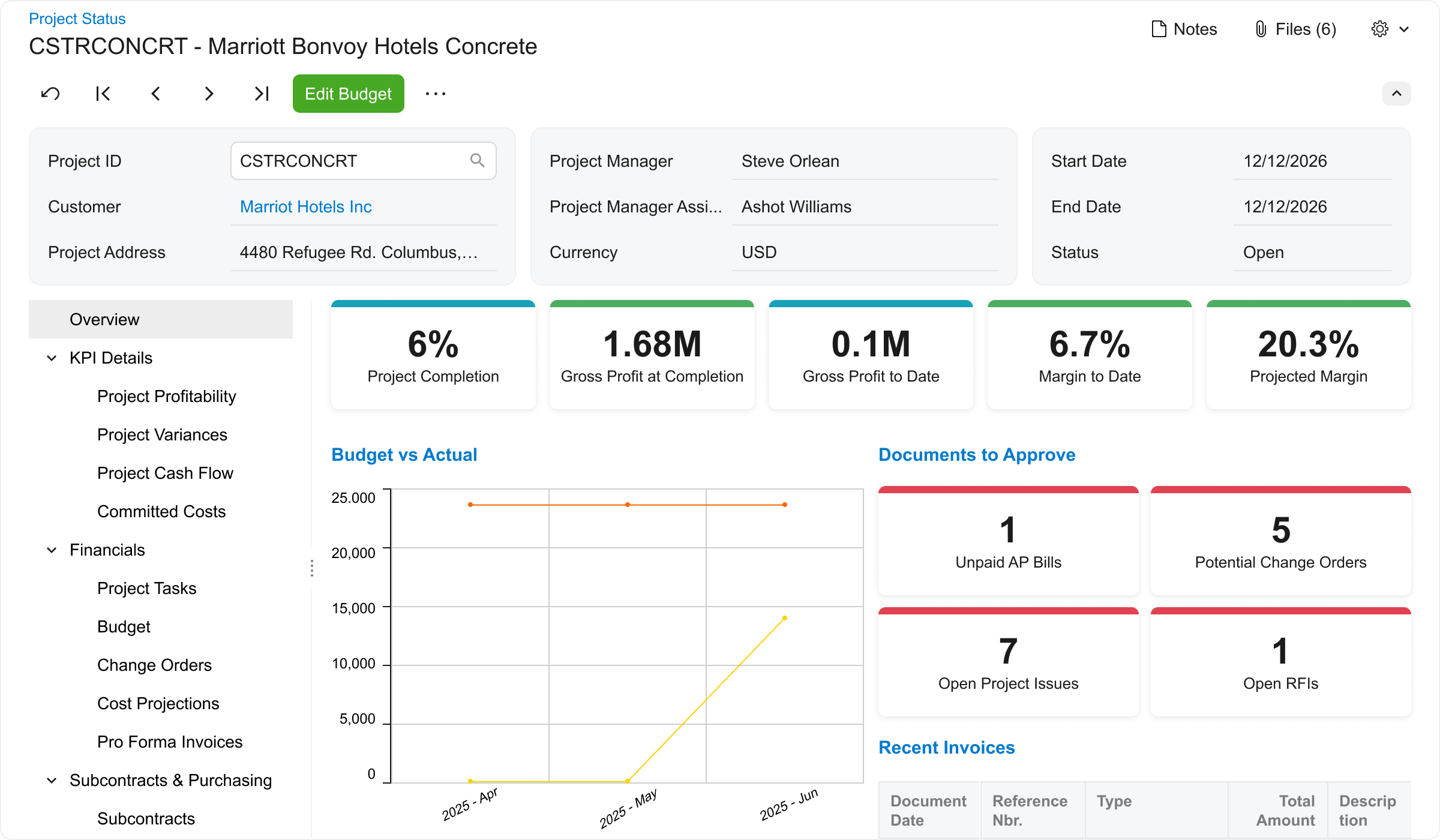
Acumatica delivers a set of cloud-based business software applications with dashboards, reporting tools, integrated document management, centralized security, and customization tools.
$1,000
per year
Oracle Fusion Cloud ERP
Score 7.3 out of 10
N/A
Oracle Cloud Enterprise Resource Planning (ERP) is a core suite of Oracle Cloud software-as-a-service (SaaS) applications. Oracle Expense Management and Oracle Risk Management are part of this solution. Other apps include Financials, Revenue Management, Accounting Hub, PPM, and Procurement. The single cloud platform offers built-in industry standards and modern best practices. ERP software is the backbone of many organizations and Oracle aims to offer a modern, connected…
N/A
Vanta
Score 1.0 out of 10
Small Businesses (1-50 employees)
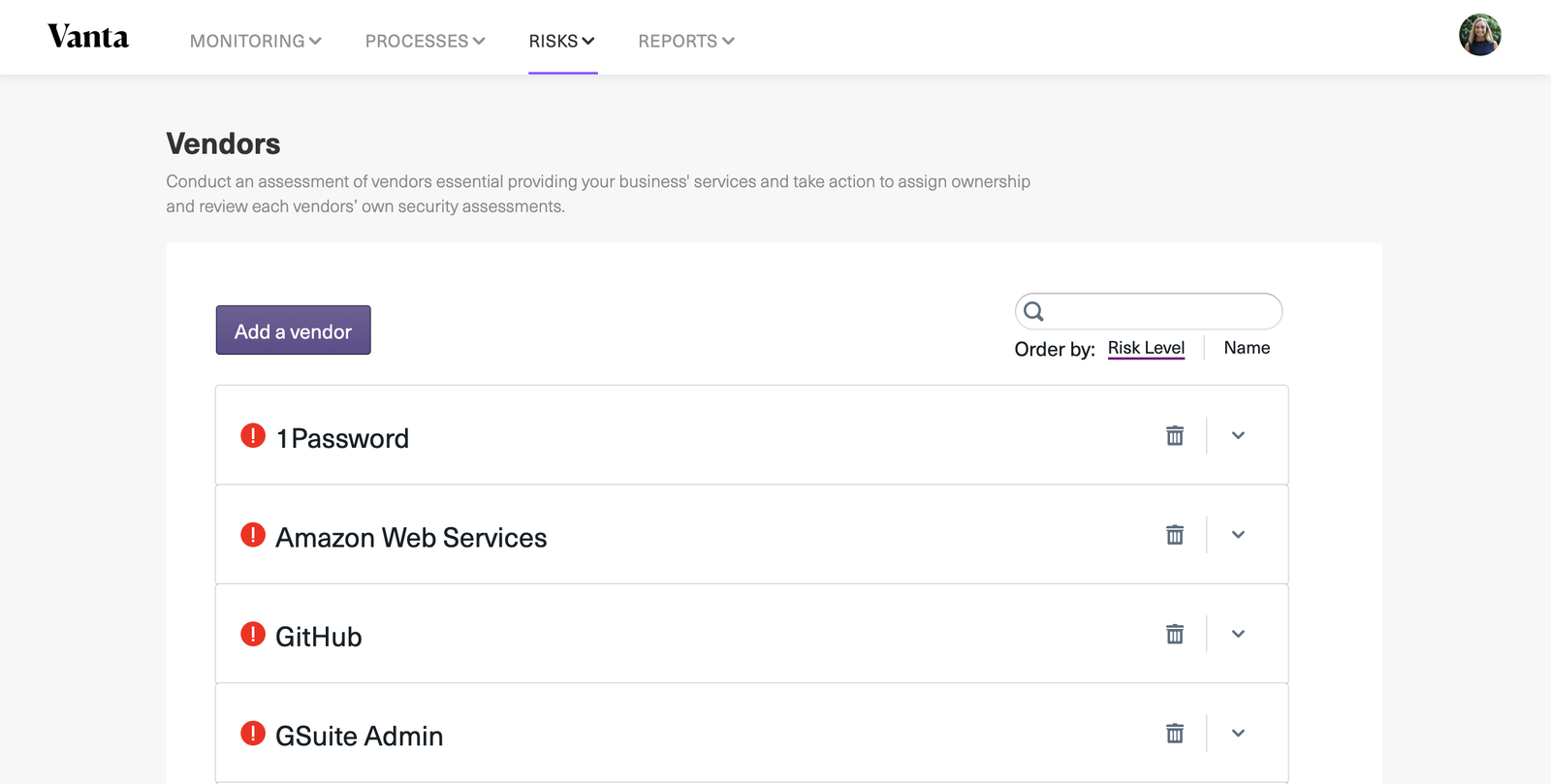
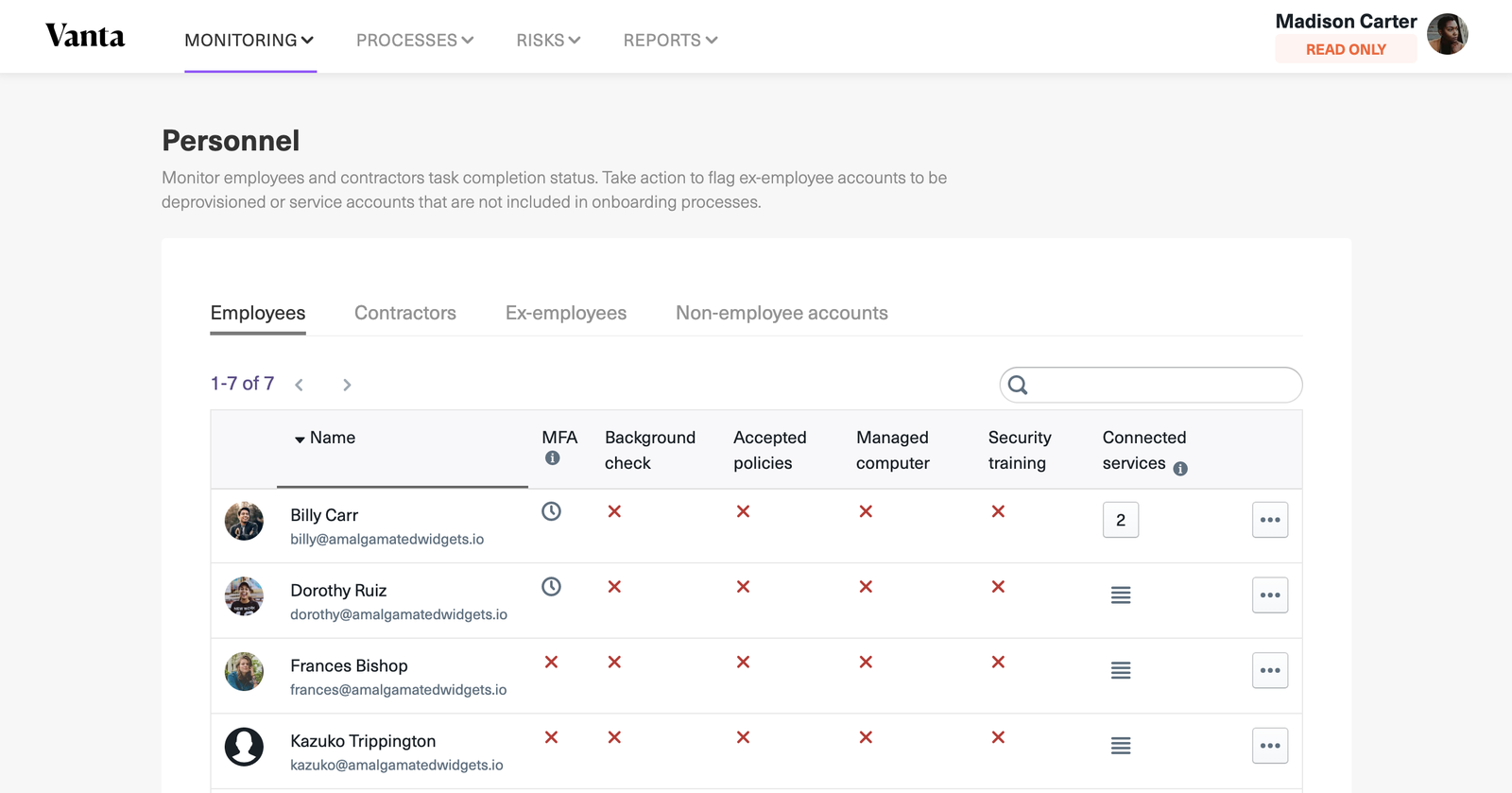
Vanta is an automated security and compliance platform. Vanta helps businesses get and stay compliant by continuously monitoring people, systems and tools to improve security posture.
N/A
Pricing
Acumatica
Oracle Fusion Cloud ERP
Vanta
Editions & Modules
No answers on this topic
No answers on this topic
No answers on this topic
Offerings
Pricing Offerings
Acumatica
Oracle Fusion Cloud ERP
Vanta
Free Trial
No
Yes
No
Free/Freemium Version
No
No
No
Premium Consulting/Integration Services
Yes
Yes
Yes
Entry-level Setup Fee
No setup fee
Required
No setup fee
Additional Details
Pricing is always consumption-based with no five-year lock-ins or termination penalties.
The Acumatica ERP pricing structure allows adding casual users, suppliers, and customers without paying for additional licenses.
The cost is based on the features and resources utilized, not on the number of users who access the system. An Acumatica partner works with users to understand specific requirements, determine the proper resources and modules for the company, and presents a price for the license.
Pricing per user varies by component within the Oracle ERP Cloud solution.
We have many companies which was a sticking feature, and quite costly, with many of the solutions we evaluated. Additionally, we require project accounting which eliminated many of the options we thought we would consider. Acumatica's resource pricing model set it apart in …
We have looked into the other ERP systems and seen that there are pros and cons to going cloud and on-premise. As far as user functionality, the Oracle ERP system has more features, but the customer service is horrible compared to the other system. There is no product support …
I think it’s a great product. I think it’s very customizable, which is a big plus. For manufacturing, it’s excellent because of creating the inventory, turning it into an actual product to sell, and also tracking the status of each process within that system. I can’t think of any areas where it’s not suited, because otherwise we would be looking for something else or making changes, and at this time, we’re just growing with the system.
Oracle Fusion Cloud is best suited if a customer moves from Oracle eBusiness Suite (on-prem) to a SaaS offering. The transition is comparatively manageable to implement. However, the customer must understand that we cannot have too many customizations in the SaaS model, so many heavily customized on-prem applications would need to be incorporated in the Cloud by using Cloud tools like Oracle Integration Cloud, Oracle Cloud Infrastructure Autonomous Database, Oracle APEX provisioned on OCI, etc.
Vanta seems excellent for startups, but I expect that they would be even more useful at bigger companies. I think it really helps people that haven't done SOC2 before. I also think it would help in monitoring compliance across teams with many users. If the budget is extremely tight, I think it would be possible to save money by not using it.
Particularly well is just the ease of it being able to be used. We're coming from Sage, that's the product that we used before. Sage was limited, five people could get into the system at a time. Acumatica is unlimited.
The amount of information that's so easily accessible has made us more efficient, more productive, and it just makes for an easier workday when everybody can see the same information real time.
Acumatica's open API is very powerful but doesn't get integrated cleanly across every external system, challenge arises with integration of legacy systems
Some of the platform feature's requires third-party add-ons or custom developments like advance finance report & BI.
Sometimes it gets glitch in the system leading slower processing speed
We are highly likely to renew because Acumatica has become the foundation of our ERP strategy replacing another ERP system with a more flexible, scalable platform while improving governance, planning, and operational visibility. Ongoing stabilization, roadmap investment in IBP and automation, and strong alignment across Finance and Operations give us long‑term confidence in the platform.
Oracle ERP cloud is a significant investment for our company. It will be an ongoing software cost and there's no looking back on that. Our users have become very accustomed to this tool that it is not practically feasible to rip them off from this system. So yes we will continue to renew the subscription going forward.
The processes are very intuitive and easy to use. Whether you are entering AP bills, timecards for payroll, or AR invoices, the processes are similar and easy to use. The drill-down capability is also a huge plus as you can easily toggle between different modules without having to leave the screen you are in and navigating through a menu to get the information you need. We found that the standard reports out of the box are lacking. Our implementation did not go so well and when we were finally ready to run financial reports, it was both disappointing and frustrating to discover that the P&L was highly summarized and to get a detailed report required having to do a lot of formatting myself. I was able to figure it out on my own, but when our financials were already delayed getting published, I did not really have the time to spend trying to figure out how to build my own P&L.
Depending on the menu, some items are easy to navigate, however other areas seem like have too many menu selections resulting in many clicks to get what needs to get done. The more you use it the easier getting things done becomes; it is not difficult to learn.
The application is used by big banks like HSBC is a testament to its reliability. I did not hear or experience any outages.Oracle is in the hosting business since long. In its previous avatar, it used to be called as Oracle on demand. So oracle has enough experience and expertise in hosting and managing customers applications in their datacenters. Oracle is the only major company which has platform as a service, database as a service and software as a service product offerings on the cloud.Hence customers can rely on Oracle as many major fortune 500 companies do.
Cloud performance is something that they need to improve. Also it is not consistent. Sometimes for some users it is slow while for others it is fast. This is frustrating for users especially when they are in the middle of what they are doing. We communicated this to Oracle and they suggested to submit request for environment re-sizing. But again this we think should be a proactive effort from Oracle rather than relying on customers to reach out. This is something Oracle definitely needs to work on.
I would rate the overall support for Acumatica an 8 out of 10. The support team is generally responsive, knowledgeable, and helpful when resolving issues or answering questions. Documentation and community resources are also useful. However, response times can occasionally vary depending on the complexity of the issue or support queue, which slightly affects the overall experience.
Support is always providing step by step details to resolve any issue we encounter. If the issue is currently not a functionality or feature of the application they are supportive in offering guidance on submitting an enhancement request. Currently there is an enhancement that will be rolled out by Oracle that was designed for our organization.
The inperson trainings from Oracle University are effective. The trainers have vast experience and teached thousands of students. In person training will make people sit in a class and do the exercises. One can also learn from other students, who come with different background, industry etc. In person training will be an immersive experience and helps learn more in a short period of time.
We bought online training subscription from Oracle University. The subscription allowed our team to learn the nuts and bolts of the application.The subscription model helps access to all the modules as opposed to buying training for one module. We also leveraged guided learning subscription from Oracle. Guided learning is a state of the art learning application from Oracle. It resides within the application and guides the users on each and every step. This is learning by doing and is very effective. Once you buy guided learning, oracle keeps updating it with the release of new functionality in the quarterly upgrades.
I'd say the partner selection is critically important. I think the software is very easy to implement. It's very customizable to your business. Finding a partner that will work with you to understand your business and your needs is the critical piece to make sure that the system goes along with it.
Try to use the system as true to generic form as possible and cut over quickly. Parallel implementation is not recommended. If the numbers are accurate and materially similar to prior period - cut over. A small accounting adjustment is much better than millions in project overruns or dual system maintenance.
Having used Pastel for a long time in the business, it lacked certain features, or the system was not probably setup for our business needs and requirements at the time. It was also not 100% cloud based and needed to be used through remote desktop which had its limitations. Zero just had 10% of what our business needed.
Oracle Cloud ERP is more flexible, more negotiable and has better breadth and support worldwide. Their reports are better and speed of implementation is faster. It stacks better since the company is larger, more stable, and has more research and development. There are more references to check with peers too.
Vanta's reporting was far superior, the price was competitive but my engineers running the project said that working with vanta would save them significant amount of time. Secondly vanta had more integrations so they could plug directly into the systems we use!
From my understanding, the P.O. module is not very robust, at least the last time I inquired about it. At the time, it had a one-to-one match, with one invoice for one P.O. and that isn't practical for many businesses. I don't believe it would be an easy system to use for sending out invoices, if we had thousands of retail utility customers. We do a small number of invoices because we sell wholesale power, not retail, so we only Invoice the municipality. Not each utility customer.
Orcle ERP Cloud transformed and stabilized in this past 2 years since it was implemented. We have past the auditor reviews and 24 month end closes and 8 quarter closes and 2 FY closes. Above all we do have SEC reporting with all this data. Having said that our ERP subscription is a worthy investment and highly reliable source of information for our organization's needs
They are very responsive and knowledgeable about the product. If the rep doesn't have the ability to solve the issue, they quickly get someone else involved to assist us.
We are able to send automated notifications through business Events, which ensures that information travels seamlessly and without the possibility of someone forgetting an email.
We save time being able to read our demand and level it against our current inventory qty on hand and our supply to make better strategic decisions when purchasing.
Better our business and see our pitfalls that were once hidden in our factory by establishing an On-Time Delivery system within a generic inquiry that uses data that is readily available in Acumatica.