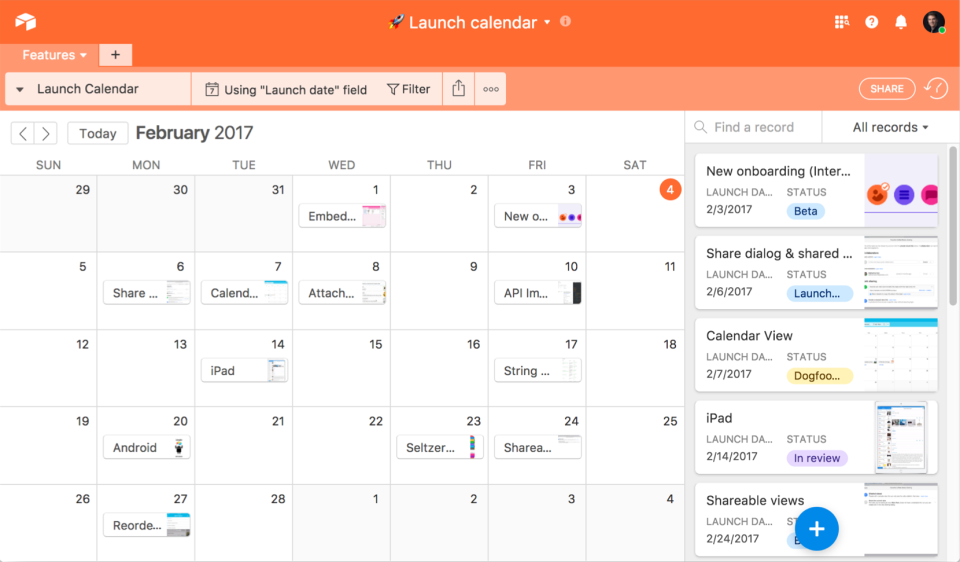
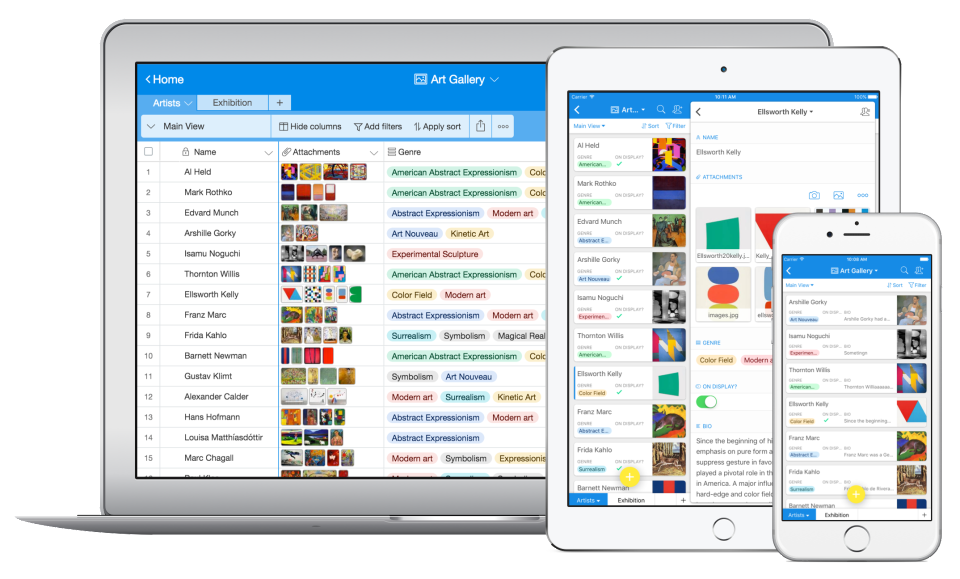
Airtable is a project management and collaboration platform designed to enable content pipelines, product management, events planning, user research, and more. It combines spreadsheet,database, calendar, and kanban functionality within one platform.
$24
per month per seat
Kissmetrics
Score 9.6 out of 10
Mid-Size Companies (51-1,000 employees)
Kissmetrics is a customer engagement automation platform. This solution includes behavioral analytics, segmentation, and email campaign automation.
$150
per month
Pricing
Airtable
Kissmetrics
Editions & Modules
Team
$24
per month per user
Business
$54
per month per user
Enterprise
Custom Pricing
Growth
$500
Monthly Tracked People
Power
$850
Monthly Tracked People
Enterprise
Custom
Monthly Tracked People
Offerings
Pricing Offerings
Airtable
Kissmetrics
Free Trial
Yes
Yes
Free/Freemium Version
Yes
No
Premium Consulting/Integration Services
No
No
Entry-level Setup Fee
No setup fee
$1,500 per installation
Additional Details
—
What are Monthly Tracked People?
Monthly Tracked People are unique visitors that engage in an Event on your website or with your product, that gets tracked by you in Kissmetrics.
Monthly Tracked People can be anonymous or identified.
More Pricing Information
Community Pulse
Airtable
Kissmetrics
Features
Airtable
Kissmetrics
Project Management
Comparison of Project Management features of Product A and Product B
Airtable is an ideal platform for small and growing businesses to keep track of just about EVERYTHING they need to keep things running smoothly. It's a great way to keep tasks organized, and keep everyone on the same page with progress on all things. Our company finds the kanban particularly useful, as products go through a lifecycle from ideation to retirement, it's good to keep a database of what is in production, what's working, and what we've tried before. I can see the platform being challenging with much larger businesses, but for the small to medium businesses I've used the platform with, it is ideal.
[Kissmetrics is well suited for the] abandon cart scenario to re-engage users on the purchase journey. Engaging users to personalized content using the visit metrics derived from the data captured at each digital touch points. [Implementing] website campaign and journey orchestration is easy. You get visitor profile to segment upon using different visit metrics and action.
Airtable has capabilities commonly found in spreadsheet applications, but also has some of the features found in databases.
The ability to filter fields. I set up a filter on the status field, so when a project is marked, complete, on hold, or canceled, that record is hidden from my current projects table view. If it is marked complete, the record is moved to the completed projects table view. In this way I can easily access a record of past projects
Being able to duplicate tables and create alternate views
Collapse and expand records. When I collapse the rows, I can easily scan current projects, next steps, project status, and due dates. When I expand the row, or field, I can see more detailed information about that field or record very easily. I can also expand or open the entire record. This is is helpful, when I am entering a lot of information to multiple fields in that record.
The more events you track and properties you send along, the more you can see how specific users use your product/service. The user based timeline gives you a perfect start point to get in touch with users, because you can see where they get stuck.
Tracking your traffic sources and how they influence conversions is awesome. You can get a perfect view of how much a traffic source contributes to revenue.
Funnel reports give you more insights into micro and macro conversion steps and give you actionable data to work with.
Installing.... yes this is also a negative. While you can install and have the program running in minutes, if you use Unbounce, the form tracking process is quite complicated!
Updates... I feel like the product updates have slowed a lot lately. Thankfully, the product functionality is so amazing that it hasn't impeded the use of it. However, it is still disappointing to see less frequent software updates.
Occasionally clunky UI... there are a few reports that are really easy to mess up and leave you scratching your head on why it isn't showing you any data.
We will 10/10 renew the use of Airtable because it has brought great value to our team. Not only is Airtable affordable, but it's also user-friendly and helps our team be efficient. We no longer need to rely on Excel spreadsheets being passed from person to person via email. Furthermore, we aren't dealing with corrupt Excel spreadsheets and the need to salvage data when a file is accidentally altered.
Price sensitivity and the different choices that now exist in the Analytics industry. I think it makes sense for us sometime this year to rethink our analytics strategy to see how we may leverage the best of GA (which has included lots of new features and updates the past years_, Kiss and other tools as need be
IMO the usability of this product is its greatest asset. The UI is clean and the menus are intuitive to the point where I'd feel confident having a non-spreadsheety colleague take on building an Airtable for the first time with next to no training. I can't say that about every table-like software product that I've used such as Notion.
Right after login, you'll get to a dashboard which shows you a quick view on how your business is doing across the events you are tracking. There is no need to dig deeper than that unless you want to, in which case it's very easy to do so just by clicking on the metric on which you want more information. The interface is very intuitive.
I have rarely experience downtime, compared to other tools, and given how much time we spend on the tool. Even if there were to be, their updates on it are very timely, and our support team are able to provide any questions regarding
The application was very rarely down; during the period we used the application, I can think of only two or three occasions in which the site was down. Notably, at no time was the the performance of our own site compromised as a result.
I never had any issues with load time, even with the integrations that we use today (google sheets) However, I'm curious if adding additional layers of integrations would slow down performance. We do carry quite a bit of data in Airtable, but, again, no impact on overall performance
Speed improved dramatically as the service matured. Early iterations of the publicly-released application would occasionally provide slow processing of results, but those delays became much rarer occurrences during the last year that we used KISSmetrics. One of the more impressive views (which started out feeling more like a toy) is the live view of visits. Knowing that you could see, in real time, what events a user triggered, was gratifying and instructive.
Airtable has great support. They have a variety of support features to answer any questions. They have great self teaching instructions for templates and product tours. They also have support for teams and project management. They also have a fantastic customer help line. They are able and willing to answer customer questions and never have customers waiting long
Our front-line product support person (Mika) is great. She is responsive and great to work with.
However, the data accuracy issue described earlier is the reason for the low score here. This issue was escalated from front-line to support to level 2 technical support and then it disappeared into a black hole. Escalations, in general, do not go well. We get no response for days, or I have to chase things down. This is not acceptable. Marketing metrics are critically important to me and I need answers quickly. I cannot afford to wait around for days / weeks for a response.
Just to be clear, these comments only apply to escalated support issues.
Again, we were fortunate to work with KISSmetrics as they built their application, but Hiten, their CEO and founder, was incredibly helpful to me personally, and to our metrics-driven business as a whole, as we adopted their tool.
Recorded trainings were provided by the Airtable team. Great as an evergreen resources to new team members and for anyone that wants to refresh their Airtable knowledge
I loved this aspect of the product. It wasn't just that the documentation and online tutorials are great - which they are - the on-boarding process though was really stellar. Once you have set everything up, you get a welcome message followed by a step-by-step guide to get you started that is built right into the product interface. For example, the UI asks you to first do X, and then copy this code snippet and send it to your developer who will know what to do with it. When you come back after the first interaction with the product, it continues the process by explaining right in the UI how to track events etc. This kind of step-by-step approach is incredibly efficient. Although there are various forms of supporting documentation (PDFs videos etc) to support every step, you don't really need them. This approach means that you are up and running very quickly with virtually no training time or documentation consultation. Highly efficient process.
Training all users was an important part of the implementation, which did take considerable time and effort. At first glance without training, the content calendar can be overwhelming because of the amount of data. The features within Airtable seem to be endless but our team was able to identify the most important to be successful.
In order to build trackability down to revenue, there was quite a lot of work to integrate Kissmetrics with our software and internal process. We had to build the hooks so that Kissmetrics could call back into our software and billing system, etc.. However, we didn't need additional expertise to do this. Once you understand the API, and you own systems, making it work is not too difficult. We did not require an outside consultant or anything like that
Airtable was a really good fit for this specific use case as it provided a huge number of collaboration features in an intuitive and pleasant-to-use interface. The free tier worked initially with our work, and the upgrade pathway was fair and made sense for us.
Kissmetrics is a next-level step up for people who are used to getting their tracking and reporting from Google Analytics or Shopify's CMS. While HubSpot arguably has a better user interface, Kissmetrics certainly has the power and usability necessary to track important conversion data and help you make better marketing decisions.
There are TONS of opportunity to scale, but I think it's a matter if you have the time and resources to do so because the initial setup can be fairly time consuming and prioritized dedication
Through this platform, I always have the idea bout which of my team member is working on which particular part of the project, I can easily track their progress, and also I can easily correct them where it is required by adding sticky notes, by sending the attachments and URLs.
Unfortunately for this client (small business) the cost of Kissmetrics was just too prohibitive. But it's obvious that for a larger company that can afford it, the data would be invaluable to gain more insight in how to gain more active users and orders for a funnel.
The data provided really increases an understanding of how best to provide the right experience for the users...happy users equals increase in ROI.