Anaplan is a scenario planning and analysis platform designed to optimize decision-making in complex business environments so that enterprises can outpace their competition and the market. By building connections and collaboration across organizational silos, the Anaplan platform surfaces key insights.
N/A
Planful
Score 8.4 out of 10
Enterprise companies (1,001+ employees)
Planful is a cloud-based enterprise performance management (EPM) suite. It includes financial applications for modeling, planning, consolidation, reporting and analytics.
$0
per year per user
Vena
Score 8.1 out of 10
Mid-Size Companies (51-1,000 employees)
Vena Solutions provides a financial process automation solution to automate Corporate Performance Management, accounting and budgeting, Regulatory & Compliance, and other finance-related processes. It is scaled for medium to large-sized organizations.
N/A
Pricing
Anaplan
Planful
Vena
Editions & Modules
No answers on this topic
No answers on this topic
Professional
N/A
Complete
N/A
Offerings
Pricing Offerings
Anaplan
Planful
Vena
Free Trial
No
No
No
Free/Freemium Version
No
No
No
Premium Consulting/Integration Services
Yes
Yes
Yes
Entry-level Setup Fee
Optional
Required
Optional
Additional Details
—
Please visit our website to submit a request for more information on pricing.
The Professional Plan is the most flexible way to get started quickly and can be added onto as a company grows. The plan includes: Vena Platform, Customer Success Manager, Standard Support and Customer Portal.
Complete Plan includes everything in Professional, plus: Vena Insights, Premium Support, Sandbox Environment, and Expert Managed Services.
For a limited time, new customers who use Microsoft Dynamics 365 Business Central (Online) as their primary ERP can get a free year of Vena and 40% off implementation costs.
Vena also offers special pricing for not for profit organizations. To learn more, speak to an expert.
Anaplan is more mature than those other platforms. It is great for larger organizations who have established planning processes with many users. It has a strong calculation engine for large data sets and advanced scenario modeling. Anaplan does come with a steeper learning …
Verified User
Director
Chose Anaplan
We like Anaplan for its flexibility, out-of-the-box starting apps, speed to deploy, and ability to maintain long-term.
Verified User
Consultant
Chose Anaplan
Anaplan provided a much more flexible backend that allows for modeling out any use case.
Compared to OneStream and Venna Anaplan offers a more modern look and feel of the platform. It is better situated and maintained in regards of platform updates as it's a full SaaS software there are never any issues with the system version as it's always automatically up to …
Verified User
Manager
Chose Anaplan
Ease of use, intuitive design, business user friendly, quick implementation time
Verified User
Consultant
Chose Anaplan
Anaplan is much more advanced and robust tool compared to its competitors
Anaplan combines the best of both worlds, the flexibility, ease of use, and freedom of modeling of a spreadsheet and the control, calculation power, and reliability of the best planning, budgeting, and consolidation software vendors.
Verified User
C-Level Executive
Chose Anaplan
Anaplan works well where you have a requirement for complete flexibility, such as in business structure, or in calculation methodology that is bespoke. You can tailor the system to your exact requirements, whereas some products come with pre-built modules that you might …
We selected Anaplan for its intuitive design and our desire to get away from excel. It also enabled us a sandbox of usability to tailor the experience directly to our needs. Other systems compartmentalized areas into one format and did not allow us as much customization.
Planful offers a great solution, however, they have significantly underperformed on their annual growth rate. The solution has a lot to offer, however, it is split across two solutions and is not True connected planning. OneStream is growing on a fast trajectory and has an …
Other platforms offer some scale vs Anaplan by adding great user interfaces and many out of the box functionality (Time filtering, versions, predefined tables (modeled sheet), chart of accounts (debit, credit)). However, very structured architecture makes edge use cases harder …
Verified User
Director
Chose Anaplan
Flexibility in modeling capability sets Anaplan apart from other competitors. You are tied to cookie cutter solution, which needed to be customized for others. Once customized, it does not change as business changes. It requires them to come in and changes. We needed a …
Anaplan is one of the better cloud-based EPM solutions out there. While it doesn't come with a lot of features/modules out of the box, once you get it up and running it's really powerful. There is a steeper learning curve than some other EPM tools out there which are …
I have used all of the above tools in previous companies. I have seen the limitations and what makes each tool shine. I have seen exactly why Anaplan beat the competition, and why the tool is critical for any FP&A team. From the things I mentioned previously, there is no reason …
I've used Anaplan, Host Analytics, and Adaptive Insights. Anaplan is by far the superior tool. Anaplan has much more flexibility, a slicker UI, is light years faster, and is much more user friendly.
Adaptive Planning and Host Analytics. Anaplan was selected due to its flexibility and ability to do multi-dimensional modeling in a simple and straightforward manner.
We had Adaptive before Anaplan and did not like the service at all. Host Analytics was more of a lift and shift from Excel which we didn't want. The look and feel was also too familiar with Adaptive.
Anaplan provided a whiteboard that allowed us to set up our unique business as we saw fit. Other programs had built-in forecasting modules that we needed to adapt to. Our company is retail but also collections so flexibility was the key when making the final decision. Plus, …
Overall better, quicker process. Lack of space in Anaplan is a pain point as compared to Host where we have been able to keep prior years worth of data with no problem.
Host is a lot more user friendly to build out models. We do all of our model building in-house whereas when my company was using Anaplan, we were required to hire outside consultants to build out or even modify various models that we needed built. Host allows for a lot more …
Verified User
Consultant
Chose Planful
I have very very very little experience (approximately 1 hour) with Anaplan.
Planful seems to have the best price to performance option against the tools listed. Some of the more premium options on the market have outdated UIs and dont get updated as frequently and other in the same price category dont seem to have the same level of options and "ease" …
Before my arrival at the company, we attempted to implement Vena but were unsuccessful. We got further with Planful in the first week than in several months with Vena.
Prior to joining the company, we tried to implement Vena but were unsuccessful. There we're a few reasons it didn't work out, but a lot of it related to the implementation team they provided. In just the first week with Planful, we achieved more progress than we did in several …
EPM tools are all pretty close in general functionality in that they are tables of your data with a finance focused UI stacked on top. The last 5% is what the difference. Planful has a very modern UI and does a great job of updating the system over time, including things like …
Planful was great for its price point. Although workday and hyperion are the more popular bunch, our use case is mostly met through Planful's functionality.
Most financial folks user-friendly less technical support needed; most efficient and automated; data host in US; most automated with both the core application and excel spotlight in sync, you can view and sync in web or excel. Process time is fast.
Planful is winning in user experience. More intuitive design and very user friendly. I do expect more flexibility in terms of system confirgurations like higher hierarchy limit
Planful scored high in multiple areas (such planning, reporting, Workforce controlling) and based on our assessment criteria Planful receive the highest value/cost ratio. At the same time, we were confident that Planful was able to scale together with the business and manage …
Ease of use, integrations, price, and excel compatibility were the driving factors behind getting off of Adaptive and selecting Planful over these other competitors
Planful is inherently easier (I know Excel and I don't want to have to learn a new coding language) [and] has more capability and power due to the underlying multi-dimensional architecture (i.e. it can scale much better as you grow). The Dynamic Planning piece is very similar …
We decided on Planful because while all of these products had some of what we need, and maybe a bit more advanced, none had all of the items on our wish list except for Planful. We are very happy with our decision because the importance of having all of the company data …
Planful (formerly Host Analytics) can be quick to implement and does not require an army to administer. It's multi-dimensional technology also allows for a lot more flexibility in it's design and use. It's reporting suite is the most intuitive that I have seen in the industry. …
We selected Host Analytics due to (i) strong out of the box feature set, (ii) best excel integration among cloud tools, (iii) no model size limit, (iv) simple pricing, (v) solid customer references
Vena was a close second in our selection process. We liked the smaller price tag and faster start up time. It s use of Excel was attractive. However, we did not feel that it would be able to grow with us. It was only good for the short run. Adaptive had some good features. …
Being a small company with limited cash flow, my goal was to evaluate what functions that are important and how much that we have to pay for them and last how easy it is to maintain without owning internal IT staff. I have evaluated Hyperion, Adaptive, Vena, and Host. …
Prophix is powerful, and structures data on the back-end in a very similar way with multiple data models, and I have used it before. But the learning curve is steep. Building complex rules, e.g. for a union personnel model, was much harder than designing the same logic in …
DataRails - was the closest to Vena but their product development seemed behind and we were concerned about their ability to continue development as well as supporting us. Cube - poor product for us. Seemed applicable to small businesses. Limited features, inexperienced sales …
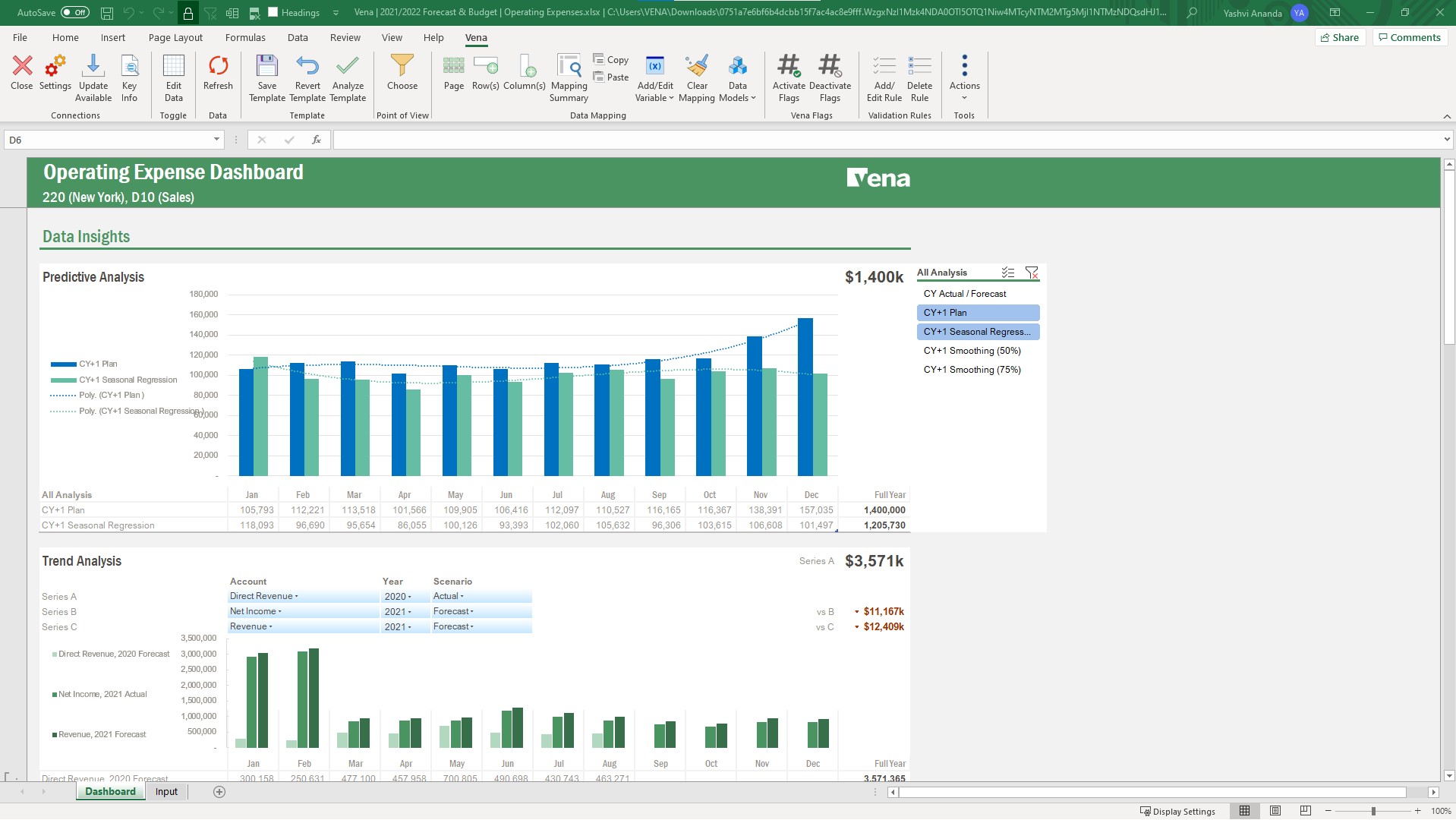
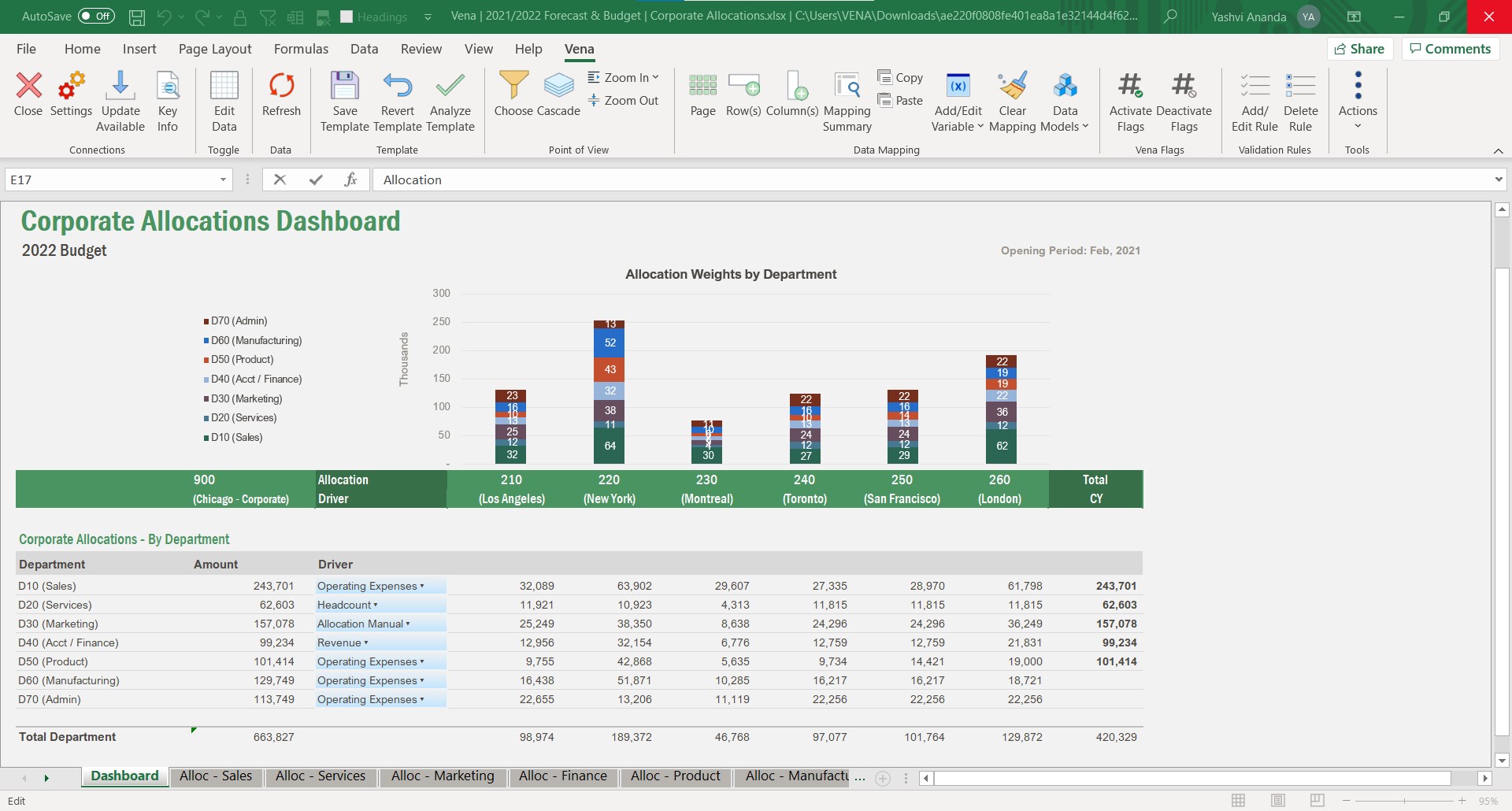
Vena is a strong fit for teams that want to keep working in Excel while adding structure, workflows, and a centralized database. Vena emphasizes its native Excel experience, along with planning templates, workflow automation, and integrations for budgeting/forecasting.
We evaluated Vena alongside DataRails, Planful, and Board during our selection process. Each is a credible platform with real strengths, and the right answer depends heavily on the organization's environment, team composition, and what they're trying to accomplish.
We selected …
Ultimately we decided on Vena because of the Excel interface which we knew would improve adoption. We also like the platform agnostic integration and easy-to-use web interface. The OLAP cube was also appealing to allow for a variety of pivoted reports.
Vena is much faster than other such software which is available in market. If we talking about pricing $$$ so Vena is affordable to smaller companies also. it's help us quicker integrations with other software and User Interface is much better than other software. Vena gives …
We found Vena to be much more intuitive and easy to leverage with our existing models and templates we've built in Excel already. It allowed our finance and ops teams to get traction and value from the solution much faster than we felt the other CPM solutions we looked at.
We went with Vena Solutions because it was able to meet the needs in every way for what we were looking for in a budgeting solution. From an admin perspective, it was very intuitive, but from an end user (contributor) perspective, it was outstanding that we were able to keep …
We chose Vena mainly due to how flexible it is for our business, and that we would be able to own the software inhouse (finance team) rather than relying heavily on external consultants, just like the case with other software we looked at.
We were using Dynamic Budgets before we moved over to Vena and researched many, many, many other products before settling on Vena in the end. One of the things that quickly knocked out other vendors was our unique fiscal calendar. We have 13 periods (4 weeks each) and that …
They have superior database capacity due to the power of the cloud. Usability and user adoption is quick and immediate due to the direct integration with Excel and ease of use for end users and Vena administrators.
We spent about a year and a half in the selection process for our budgeting system. The issue that we kept coming across was speed, flexibility, and a lack of understanding of our process during the sales cycle. Most of these other products wanted us to change our budgeting …
Features
Anaplan
Planful
Vena
BI Standard Reporting
Comparison of BI Standard Reporting features of Product A and Product B
Anaplan
7.3
235 Ratings
3% below category average
Planful
6.1
61 Ratings
21% below category average
Vena
7.9
162 Ratings
5% above category average
Pixel Perfect reports
6.47 Ratings
6.930 Ratings
8.0105 Ratings
Customizable dashboards
7.7235 Ratings
5.153 Ratings
8.2146 Ratings
Report Formatting Templates
7.96 Ratings
6.452 Ratings
7.5153 Ratings
Ad-hoc Reporting
Comparison of Ad-hoc Reporting features of Product A and Product B
Anaplan
9.1
8 Ratings
15% above category average
Planful
7.6
98 Ratings
3% below category average
Vena
8.0
270 Ratings
2% above category average
Drill-down analysis
9.18 Ratings
8.596 Ratings
8.4257 Ratings
Formatting capabilities
9.18 Ratings
7.297 Ratings
8.3257 Ratings
Report sharing and collaboration
9.18 Ratings
7.291 Ratings
8.0230 Ratings
Integration with R or other statistical packages
00 Ratings
00 Ratings
7.2103 Ratings
Report Output and Scheduling
Comparison of Report Output and Scheduling features of Product A and Product B
Anaplan
8.3
240 Ratings
3% above category average
Planful
7.5
80 Ratings
7% below category average
Vena
8.0
216 Ratings
0% below category average
Publish to Web
8.67 Ratings
8.431 Ratings
7.6124 Ratings
Publish to PDF
8.0238 Ratings
6.672 Ratings
8.2161 Ratings
Report Versioning
8.6209 Ratings
6.551 Ratings
8.0181 Ratings
Report Delivery Scheduling
7.98 Ratings
8.560 Ratings
8.1162 Ratings
Data Discovery and Visualization
Comparison of Data Discovery and Visualization features of Product A and Product B
I've implemented a number of projects for Anaplan for Sales Performance Management use cases. It is obviously built for financial planning, but it allows for a lot of flexibility for territory and quota, ICM, sales forecasting, and other important use cases. Territory and Quota is very powerful in the tool as it organize complex assignment structures into hierarchies for easier analysis and reporting.
I think it is a useful tool from a reporting standpoint. It does a good job of data aggregation from different sources, even if slow at times. I think the tools for building forecasting and budgeting templates are straight forward but allow for a level of complexity that make it both easy to use but also allow for complex builds so that our models can take into account many different variables that drive our daily performance.
Vena suited to our environment because we do have so many different budget owners that are in so many different places in our organization and for them to all be able to go onto the software and bring it down in two native Excel where they are all used to work in Excel and putting in the line items and pieces that go with their budget is super helpful a scenario where it might not be as helpful is when we are bringing people on and trying to teach them how to report and map because we struggle with that so much ourselves that it is a difficult situation to try to get people to understand things that we’re you know may be struggling to understand ourselves.
Anaplan removes the time consuming process of integrating the results of individual spreadsheets.
Anaplan facilitates the standardization of assumptions across all sub-processes
Anaplan provides full transparency of the calculations and source inputs
Anaplan allows us to automate certain planning processes that would have been impossible when relying on the computational capabilities of an individual computer.
Creating forecasts for the month, quarter, and year
Creating new variables by using variables pre-defined and that are new in the system
Having a very simple setup in the reports section - not straying away from the old Excel model which most people are used to. I can speak for a lot of people when I say that tools that look new can easily be frightening! 😅
Have another license between power user and contributor that allows building reports that aren't ad hoc, but don't have all the admin rights of a power user.
Have a session on best in class Workforce Planning prior to implementation.
Anaplan is a very strong multi-dimensional modeling tool that provides a calculation engine to empower a complex planning process. It is fairly easy to learn for those with experience in similar tools, or excel. It forces structure and auditability that spread sheets do not have, along with extensive security capabilities
Our new Comptroller understands the value of Planful, and we plan to utilize it further in the organization to enhance external reporting. Strangely enough, Planful had not previously been embraced by the former CFO, who argued that we were running two sets of books (of course, we were not). Fortunately, the before mentioned reconciliation of EBITDA to Net Income demonstrated that to the banks.
Vena has become an integral part of finance and our daily process. Without it we would take longer to prepare results and decisions will be delayed. Vena has given the whole organization more visibility of results and budgets so that all departments participate more actively in managing their budgets rather than it being the sole responsibility of finance.
As a user it is a very simple tool, but at the same time with a very mature and powerful calculation engine. It is very easy to switch from excel or traditional tools with added capabilities of multi dimensionality and real time calculation engine to see quick insights needed to create plans and scenarios
The tool is extremely adaptable, and it enables very quick querying to give us opportunity to gain live insights into the business. Given its adaptability, we are also able to create scenario analyses very quickly in rapidly changing environments. The formatting also enables us to provide this information in a very consumable manner.
I would rate Vena's overall usability as an 8 out of 10. Vena offers a user-friendly interface, especially for those familiar with Excel, making it relatively easy to use. Most features are intuitive. However, some advanced functionalities may require more training or time to master, so it's not a perfect score. Overall, Vena provides a solid user experience that supports efficient financial planning.
There are very few outages. Maintenance is scheduled on two or three Saturdays per month, so as not to affect businesses. When there is an outage, users are kept informed of progress to restore the platform and typically this takes no more than an hour. Anaplan customer support is very responsive if we ever have questions about platform issues
I only give a 9 rating rather than a 10 rating because it seems that every day around 2pm we see a slowdown in the use of Planful. I have requested our internal IT department verify that it is not an internal issue and have been assured it is the tool. We have not yet reached out to Planful to do extensive research to solve this issue.
Vena is seemingly always available. They plan maintenance windows well in advance and always off hours (typically over a weekend) and communicate clearly throughout maintenance about what will be affected. Over 5 years of using the product, I can only remember one time when the platform was unavailable (I believe due to an underlying server hosting issue from their provider), and they resolved the issue and had everything up and running again within 8 hours.
Everything is calculated in memory in the cloud. It's nearly instantaneous updates when you make changes. The only time things get a little slow is when you have a massive model with very intricate calculations...but "slow" for Anaplan is not what I would call "slow" for something like Hyperion. We used to have Hyperion calcs that ran for 60 mins before you could use data. The equivalent would be 60 seconds in Anaplan.
Again, the system is very reliable and, for the most part, runs very quick and smooth. When running larger queries, it does take some time, and during budgeting season our users experienced slower loading times, but nothing that raises concerns outside of normal network issues. Occasionally, as with any software we use, it will crash and you have to restart, but that does not happen very often.
The performance is dependent on how much data and calculations are involved and how complex the security settings are. A simple template or report loads in seconds. A complex template or report can take a while. If there are many users with complex security settings, that will be a factor in the load time.
Support quality has dropped since Thoma Bravo has taken over. I think some serious re-focus needs to happen here -- part of the beauty of being in the Anaplan community was how involved you felt in it before. Before I didn't dread sending a support ticket, now I am starting to.
Sometimes we get great help when using Planful's support team and other times we don't. In particular, there is one person that often responds to our support tickets who is less than helpful, hence the reason for the 5 out of 10 rating. As a result, most of the time we reach out to our Planful consulting group as they provide faster and better support
They are very quick to respond when you submit a ticket and typically fix issues quickly as well. I only didn't give this a 10 because there is still an open issue with our Salesforce connection that we've been waiting on now for a few months.
In my opinion, in-person training is always the best if you have the option to do so. This allows real-time interactions with the instructions, whereas the online training I took required me to write-down questions, email them, and wait for responses. This slows down the process, as you can imagine. That said, in-person training is an extra cost and it likely isn't needed for everyone. I would suggest selecting a small number of people to take in-person training and then having them act as mentors to the rest of your team. That way, as the rest of the team takes the online training, they have a resource to help them in real time.
My team has attended training offered several times before/during the Planful Perform conference. This training has been extremely useful and we always learn something we didn't know prior to the training. The trainers are always very knowledgeable and more than willing to help each and every user after the training with specific questions regarding their environment.
This is the best way to learn and buy-in. The in person effect gives students both a hands on approach but an instruction to be there to customize assistance and understanding. In person also builds greater buy in with your future team on creators. However if your audience is better at on line learning this is another good option.
Anaplan training materials are clear, simple, easy to understand and to follow. Visuals are excellent. The vendor is good at updating training materials in a timely manner and encouraging users and administrators to keep coming back to Academy site for refresher courses or new feature courses. I really like their interactive diagrams
Planful provides a lot of online training support. There's so many options for training. Admin Learning Courses, User Learning Courses. Plus they have several webinars devoted to the tool and the new features they release. New Releases can be practiced in a Sandbox Environment prior to going live in Production
The training was structured as a group training to learn the basics of creating a data model and mapping a template. While we had nearly 10 participants, I was the only actual implementer so we probably didn't actually need the training and could have just learned the initial skills from the implementation consultant. Two years later, when we hired a new team member, they completed several modules in Vena Academy (a self paced learning course) which allowed them to get up to speed on the basics with just a bit of supplemental guidance from me as our existing admin.
One key insight from implementing Anaplan is that success comes from focusing on designing the process, not just building the model. Anaplan is extremely flexible—there are very few planning scenarios it cannot support—but that flexibility means the project needs strong governance, clear ownership of requirements, and a well-defined data model. When those foundations are in place, implementations are fast, iterations are easy, and users can quickly see value. In our projects, both Financial Planning and Integrated Business Planning models were adopted smoothly because we involved business users early, kept the model design intuitive, and leveraged Anaplan’s Excel-like syntax and user-friendly dashboards. The result was more efficient day-to-day work, reduced manual tasks, and increased collaboration across teams. In short: when you combine Anaplan’s flexibility with a structured implementation approach, adoption and value realization happen quickly.
After going through the initial implementation with Host Analytics and a re-implementation with Cervello (due to an ERP change, not due to a poor initial implementation), I've learned that you really must rely on your internal staff to bear most of the implementation burden. Use the vendor or partners for ideas and best-practice suggestions, and some of the easy-but-time-consuming work. Since you will ultimately be using and maintaining the application, you should be able to do most of it yourself.
The Vena consultant had great knowledge of both the Vena solution and Excel and Excel functions. He was able to help suggest ways to build our templates that met our requirements using Excel functions we had not previously considered using. And we have been able to use the Excel information he provided in other ways outside of Vena. He was very patient and flexible as we learned the Vena tool and created templates
Anaplan is more powerful than Pigment considering that it is an Enterprise class system and is able to manage bigger data sets. Anaplan allows for advanced scenario modeling and formula capabilities along with custom reporting functionalities. Anaplan has proven its capabilities and stability across various use cases and across bigger enterprises when compared to Pigment which is still in earlier phases of its development
Prior to joining the company, we tried to implement Vena but were unsuccessful. There we're a few reasons it didn't work out, but a lot of it related to the implementation team they provided. In just the first week with Planful, we achieved more progress than we did in several months with Vena.
Vena is Excel-based, which is what our users wanted. Pigment was web-based, like Adaptive, but our users did not fully trust or adopt it. Adoption drives success for any software. Amy's software, which is not adopted, has a negative ROI by definition. Vena was the right choice for us.
We have managed to leverage Anaplan for financial planning and forecasting across the business. It is now used by almost every department, with more than 50 users (but I know of companies that have hundreds of users) and still the platform is quick and reliable. It is easy to make changes to divisions and departments or add users and apply different user settings - the core part of the model is not affected and end users can continue their work without any disruption
From our experience, Planful is only used in 2 overhead departments in our organization. We easily added another overhead department, but they decided against using Planful for their workforce and financial planning. Removing them from our environment was extremely easy.
Vena solutios is a software that provides robust tools that help different departments in their statistics and we can visualize a lot of promising and visually attractive data. Vena Solutions' level of scalability is high and sustainable over time thanks to the fabulous technical support that is ready to help us at all times
Anaplan's implementation led to a significant reduction in planning cycle errors and bugs, streamlining processes and improving overall accuracy in data inputs
Standardizing the planning process and enabling cross-functional collaboration through Anaplan enhanced our ability to adapt swiftly to changing business needs, resulting in improved agility in decision-making
The platform's capabilities, especially in Demand Planning and Supply Chain, positively impacted our ROI by optimizing resource allocation and solving complex business problems efficiently across multiple functions
Automated monthly financial statements saves us 3 hours a month.
Moving reporting away from IT has begun to save hours of IT involvement, which will only grow as we shift more reports to Vena. This frees up IT to work on more important IT initiatives.
Using budget templates saved hours of copy and paste time when gathering inputs from each department.