Apollo is a sales platform that helps revenue teams find and engage leads, automate outreach, manage deals, and enrich data.
$59
per month per user
Bookafy
Score 9.0 out of 10
Small Businesses (1-50 employees)
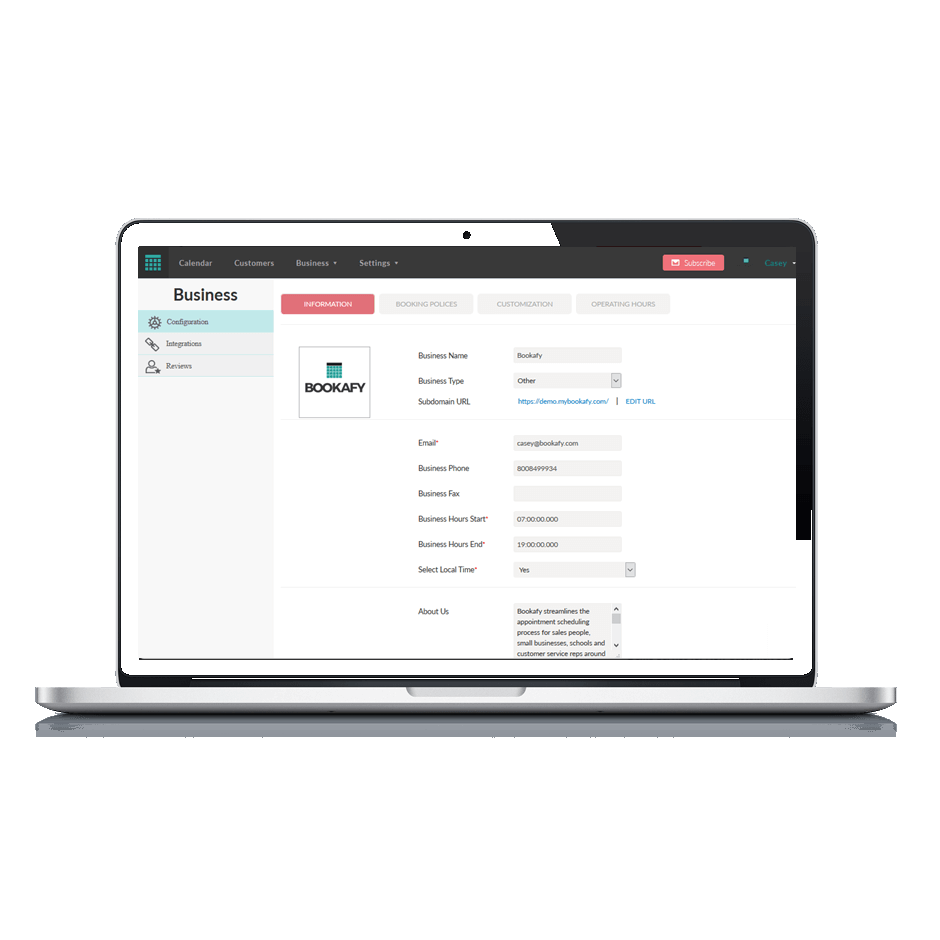
Bookafy is an online appointment scheduling solution targeted at a variety of industries. The vendor’s value proposition is that their solution is simple to use, fully customizable, has an elegant user interface and can be embedded into the business user’s website. Support is available via phone, email or chat.
$9
per month
Calendly
Score 8.8 out of 10
N/A
Calendly helps organizations globally automate the meeting lifecycle by removing the scheduling back and forth, with the goal of enabling companies to close deals, hire candidates faster, and build relationships.
$12
per month per seat
Pricing
Apollo.io
Bookafy
Calendly
Editions & Modules
Basic
$59
per month per user
Professional
$99
per month per user
Organization
$1,188
per year per user
Pro
$9
per month
Pro+
$13
per month
Enterprise
Contact sales team
Standard
$10
per month (billed annually) per seat
Teams
$16
per month (billed annually) per seat
Enterprise
Starts at $15k
per year
Offerings
Pricing Offerings
Apollo.io
Bookafy
Calendly
Free Trial
Yes
Yes
Yes
Free/Freemium Version
Yes
Yes
Yes
Premium Consulting/Integration Services
Yes
Yes
Yes
Entry-level Setup Fee
Optional
No setup fee
No setup fee
Additional Details
20% discount for annual billing on the Basic and Professional plans.
I have mainly utilised ZoomInfo for data sourcing in the past, and I found that Apollo.io was much easier to pick up and use, whilst ZoomInfo took a bit of a learning curve to understand how to set filters and best data within your ICP, I was able to pick up Apollo.io within 5 …
Apollo.io was the best cost-adjusted option given their start up program offering which cut the cost in half. The main competitor consideration was B2B Rocket AI (not listed in the above options)
We had already been using the basic Apollo plan for data enrichment, and agreed to do the professional trial plan for our team. Outreach was too expensive for our current needs, and Salesloft did not have a trial period we could embark on. It was also more expensive than Apollo.
The pricing was better with Apollo.io and the feature set checked all the boxes for us. Gong didn't do everything we needed and then Chorus by ZoomInfo was about 10x the price, so it checked all the boxes for us and was also the best value compared to what we were using before …
After reviewing it the data Apollo.io provides is more accurate than almost all other tools, versus zoominfo who is the main competitor the data might be a little bit better on zoominfo however the automation tools makes it the best choice for a startup like us, we needed a …
Bookafy is more advanced and has more features that I need comparing to these other brands. Calendly is very basic while Bookfy offers more robust features.
If a company is looking to do higher volume email and phone outreach, Apollo.io is a good tool. I would recommend first verifying if this type of outreach works with your offering. If it does, this tool will be very helpful for you.
In my experience, Bookafy has pretty much the same features as the other well-known scheduling apps. In terms of functionality, the two obstacles I experience were setting up a hidden (not shown on the main booking page) meeting for special bonus calls you don't want anyone to have access to. Yes, you can set up a paid meeting and give someone a coupon to access it free but that seems like an extra unnecessary step. The other limitation was how ugly it looks to embed meetings on a website. The scheduler looks fine inside Bookafy, but when embedded, it doesn't flow as well. For everything else, it works well. If you want to sync the scheduler with email marketing systems, most of the integrations work through Zapier so that can be an additional cost. Bookafy focuses on the meeting schedules.
It's well suited for music students' lessons. It's well suited for online coaching, primarily through places like Zoom and more. It helps simplify things for your clients, lets you program your schedule, and allows it all to go automatically! If you are working with a senior population, it may be a little tricky for them to sign up and then really hard for them to cancel lessons. There isn't a way to go to the site and cancel. You have to pull up the confirmed email and cancel from there, but people can lose emails.
Firstly, finding the details of the potential customers that is there name, designation email and phone number since these are the most important cases most of the times I can get this data in Apollo.io
I can pull the bulk data of the targeted organization, or I can pull the emails based on the location and job titles
Apart from the email capture, the thing which helpful is that the email sequence can find emails and send emails in Apollo.io itself and also the report and the dashboard are so clean
Friendly UI and UX Apollo.io was the first tool which I used. Since then I'm still using Apollo.io for easy understanding
Sync with multiple calendar types so my schedule is always current.
Integration with Zoom to schedule meetings, send invites, and populate my Zoom app accordingly.
Automatic email communication to all parties with all relevant details in a clear format.
Allowing team members to do the same in a way that I'm also notified of what meetings are taking place saves a lot of time in terms of coordinating to find out what other people are doing.
Well-designed interface that simplifies everything down to its clearest expression. Language instruction and interaction are wonderfully simple and clear.
After a meeting is booked, having the ability to change the location without canceling the entire booking.
Being able to offer 2 different locked in locations for certain time periods of the day within the same event. So you're not having to create 2 events for the same thing, only different locations.
Giving users permission to create their own routing forms. We run an independent business model where our users like to have control over their subscriptions.
For all reasons like workflows, UI, and the way Calendly keeps all of us engaged through the Collective forum. It's indeed undeniable that no other product covers all business needs like Calendly does. On the other side, this has also reduced the workload by enabling us to focus more on other tasks for the day
I gave it a 7 because it doesn't help you out if you're an organization that's call-heavy, because a lot of times the numbers aren't the best. It's not accurate. If you're somebody who's email and outbound and your goal is to find that, then that's cool. It works well for it. Some of the features, the AI tools, and some additional features they have are just too complex. Sometimes it's easy to use, but at the same time, there are tools that are not efficient, and it's like, "Where is this coming from?"Especially if you're looking for your niche, whatever industry you're in, and the target word, sometimes it can't find it. You can see what people are searching for, and it just doesn't add up. If you're trying to get very, very detailed, it's not the best. Sometimes it's going to depend on your industry, of course.
Calendly is extremely easy to use for selecting times and days for meetings. From my end, it's very easy to indicate the days and times that I am available for meetings. I have used other scheduling products, but Calendly has the smoothest way of operating. I highly recommend it for scheduling meetings
The team wants to solve probelms, but we are finding that they don't know how to solve the more technical issues quickly. I suspect that they don't have a mature process for escalations, and they don't have a usable knowledge base article repository. They seems to push emails around to let us know that people are working on the issues to find solutions, but this takes weeks and oftentimes still leaves us without a resolution.
There is a lot of support for Calendly. Whenever I have had issues navigating through it, especially as a new user, I found multiple support on the web addressing my questions or concerns. There is a lot of in app informative notes accessible to users to navigate through Calendly when needed.
In terms of Apollo.io, the easiest part is its integration and versatility in handling data. LinkedIn NAVIGATOR, on the other hand, is also a decent tool, but it’s significantly more expensive than Apollo.io and Lusha, especially when considering a decent set of data. However, it’s somewhat incomplete when compared to Apollo.io.
Bookafy is more advanced and has more features that I need comparing to these other brands. Calendly is very basic while Bookfy offers more robust features.
When I started using it, there were not many competitors in this space. I've seen some like Mixmax that seem to work well for solopreneurs or where free version might be better than Calendly's free version. I use the paid version of Calendly and it's just kept serving us well so why change?
We sign our new clients based on the list of accounts in the industry that Apollo.io provides. This gives us a clear picture to identify which industry to target.