Appian is a low-code development and business process management platform. It features drag-and-drop design for app building, automated work processes, unified data management, and cloud-based deployment.
$0
Bonita Platform
Score 4.0 out of 10
N/A
Bonita is an open-source business process and workflow management platform created by the French National Institute for Research in Computer Science. It is available as a free community edition or as a commercial subscription product.
N/A
Pega Platform
Score 8.4 out of 10
N/A
Pega Platform is a combined business process management and robotic process automation (RPA) platform with advanced workforce analytics from Pegasystems.
$35
per month per user* (or $0.45 per case**)
Pricing
Appian
Bonita Platform
Pega Platform
Editions & Modules
Appian Community Edition
$0
Application - Input-Only
$2
per month per user
Application - Infrequent
$9
per month per user
Application - Standard
$75
per month per user
Platform
Custom Quote Priced per user with unlimited apps.
minimum 100 users, no maximum
Unlimited
Custom Quote Priced per development with unlimited apps.
unlimited
Platform
Custom Quote Priced per user with unlimited apps.
Minimum 100, no maximum
Unlimited
Custom Quote Priced per development with unlimited apps.
Unlimited
No answers on this topic
Low-code Factory Edition
$35
per month per user* (or $0.45 per case**)
Standard Edition
$90
per month per user* (or $0.80 per case**)
Enterprise Edition
Custom Quote
Offerings
Pricing Offerings
Appian
Bonita Platform
Pega Platform
Free Trial
Yes
No
Yes
Free/Freemium Version
Yes
Yes
No
Premium Consulting/Integration Services
Yes
Yes
No
Entry-level Setup Fee
No setup fee
No setup fee
No setup fee
Additional Details
—
—
*500 named user minimum. Additional users available in blocks of 100. Billed annually. Based on a 3-year term.
**350,000 cases / year minimum. Additional cases available in blocks of 150,000.
More Pricing Information
Community Pulse
Appian
Bonita Platform
Pega Platform
Considered Multiple Products
Appian
Verified User
Manager
Chose Appian
All 3 platforms we looked at met our requirements. The Pega Platform was rejected due to lack of ecosystem partners and consultant availability as well as price. The IBM platform was a very strong offering but a little less open on integration to non-IBM databases and …
Appian compares favorably with other vendors in the space. It is strongest with business workflow automation and to create custom business applications. The tool base for coding is extremely straightforward and allows for faster coding and deployment. Handles very complex …
Appian provided a better IDE for implementation, strategy to upgrade to newer versions, Appian had a simplified model to integrate with APIs and handle their responses as well as providing more robust BMP and RPA capabilities.
Appian has enormously transformed and keeps on updating the product every quarter to meet the latest needs of the world with new innovations & technologies being integrated within the platform. What gives more pleasure than a product that keeps on continuous[ly] improv[ing]?
Perceived as easier to operate and significantly lower cost to implement when originally implemented. I do believe Pega has become more competitive in this regard.
Against programming languages like .NET and Java, Appian is faster to design and develop applications, but it lacks the flexibility in UI and advanced debugging tools. Against Pega, Appian is easier to use and less expensive.
The main advantage of Appian is the cost structure that is more suitable for starting a test-project to see how develop in Appian and most of all how Appian is accepted inside the company. In few weeks you can show the first results and start the journey on digitalization.
We have reviewed Appian against other BPM application/suite such as Pega, Empirica, and so forth. In the end, we found low code with the Appian product to be the most robust and scalable with good performance. Like all evaluation criteria that they have to be balance with cost, …
We liked Bonita's architecture, the open-source framework, and the licensing and support model. Maybe fewer features than other BPM platforms but easier to implement and maintain.
Bonita Platform is very easy to use and more convenient when it comes to data handling. In the poTher Bpm Tools, the processing of the data is very difficult and connections are very confusing. In Bonita Platform, one can even use the customized search for the retrieval of the …
Bonita has a community version, open-source, so it´s easy to test the benefits of process automation for any enterprise. Bonita Platform is also very near to Java architecture, so the learning curve for developers is not difficult, and they only need to understand how processes …
Bonita may be the easiest to start with without a steep learning curve, anyway on the other side it probably is not as powerful in the case you need to handle a very complicated and high volume or mission critical process. If look by the platform cost or license fee, Bonita has …
There is no user license in Bonita. Given the opensource, we have freedom here to extend requirements that might be beyond OOTB concept. If you have to kill [an ant] you don't need a missile. I think, for simple use cases Bonita has a simplified approach to address.
Pega offers a business-friendly toolkit for defining applications. Unlike traditional BPM tools, there is much fewer complications, the technical syntax to handle in modeling processes and hardly any hard-coded programming. A well-trained business user can be trusted to create …
Appian works great for automating manual processes and integrating multiple systems through its toolset. It gives great flexibility for establishing rules for approvals, routings, escalations, and the like. Because of the low code toolset, it's very easy to deploy and make changes as needed as processes evolve and as the organization learns to utilize the system better. Minimal maintenance is required to support the applications build on the platform. Some of the automated testing integration with tools like Jenkins is limited so that may be an issue for some.
Well suited for low code/no code applications centered around approval flows. It has built-in task management for users to see their pending actions, comments, statuses, etc. It has a very nice design for process flows. Less appropriate may be for generic type applications with complex screens and logic within those screens that need a lot of data to process.
Pega Platform has introduced the low code feature, using app studio seasonal and professional developer can develop application easily and quickly. The initial application can be build by Business analyst and product owner who has less knowledge of Pega Platform, further application can be enhanced/extended by professional developer. We can develop end to end application and promote to higher environment. Easily we can perform parallel development using branch.
Allows at a glance workflow documentation which assists in the need we have for information readiation.
Drag and drop interface for workflow development greatly speeds our apps time to market.
Using the advanced features of Appian, we are able to create working sites in a fraction of the time it would take to do so using "traditional" development.
Bonita seems particularly suited for processes requiring a great deal of human interaction. Its user model allows you to control access to business processes in a fine-grained way. This allows for business processes to move smoothly between users and services as the process advances.
The definition and usage of custom forms from the latest version of Bonita seems particularly powerful. It allows for a thorough customization of the look-and-feel and does not require complex developments.
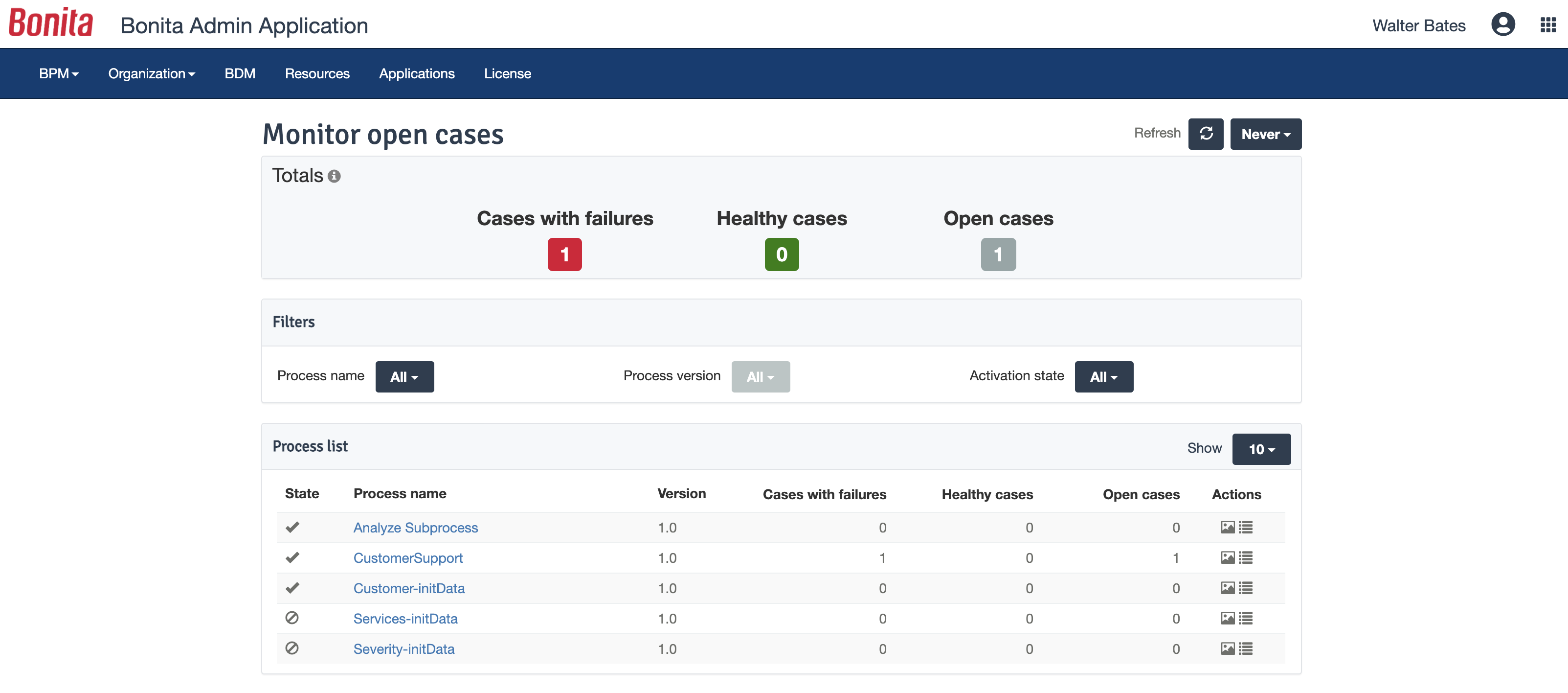
The web interface and administration section have greatly improved in the latest versions. Installation and configuration of processes has become more flexible and more structured. The administration section gives a good view on failed processes, allowing to analyse problems in an efficient way.
Quick development time. Much of the Pega "rules" are easy to configure and implement.
Visually friendly and modern. Much of the UI/UX elements in the system are continuously supported and updated, giving a nice feel to the apps.
Many of the configurations and rules Pega gives to the developers can also be delegated to business users. The organization and structure of the client's business can easily be adapted in the Pega platform.
Search issues when type ahead and database search are used in the same field.
Buttons implementation where user is require[d] to click on the button description - if clicks on the button outside that text - button will not work.
Problems with using certain off-the-shelf performance tools like WebLoad or Neoload. That is because of different dynamic variables being used internally in Appian - which these tools are unable to correlate. We are still investigating using other tools like Jmeter to overcome dynamic correlation problem for performance testing.
There is a learning curve beyond the boot camps that needs to be addressed with more structured curriculum.
The full stack technologies are industry standard, but these [are] challenging to learn and could use a learning path and orientation. There's probably opportunity for third-parties here to help with learning and adoption.
We recently renewed our license with Appian. We are convinced that its flexibility, relative ease of use, the support they provide, there mobile advancements and their general willingness and desire to see us succeed all contributed to our reason to renew our agreement with Appian
Pegasystems has continued to demonstrate a strong partnership with our organization and investment in their product that aligns with our overall vision and need. Pegasystems has engaged us at every level, with the assistance of minor defects to the overall roadmap planning and alignment of our goals
Appian is a low code environment, because of this, a very good visual interface is required. Appian is providing a feature-rich dashboard [that] we can use for building the dashboards and other interfaces. Appian also provides patches and releases to enhance these features. A developer can start off development just by going through a basic course from the Appian learning community.
Bonita Platform has allowed us to develop GUI relatively fast using its UI Designer while being able to seamlessly integrate our business logic in Java in a BPMN2 process diagram. It gives a nice productivity boost but still requires programming know-how to be able to deliver the final solution to your business problems.
Pega Platform is enhancing its product and launching new features day by day which help to achieve customers needs. If I talk about the earlier version of Pega Platform (i.e. pega v5 and 6.3) there were many numbers of limitations in Pega Platform and if we need to do some customization then needed to write custom java and jave scripts to achieve the functionally. Now I can say Pega Platform is running with market trends and demand. Pega Platform is giving all the options which support the current technologies like decisioning capabilities, real time processing, mashup, process fabrics etc..
Engine itself is efficient enough for most cases I dealt with. It can also be extended by clustering. I have done performance tests with JMeter and only managed to induce the crash of... JMeter. If there are efficiency issues they usually concern bad design/implementation of created apps or bottlenecks in integrated systems. Although I have met two cases with efficiency loss.
1. Java 7 related PermGen saturation caused by big number of installed apps (there is no jar dependency reusal between apps option).
2. Big number of waiting event handlers in processes stresses the database.
Appian is one of the leading low code business automation platforms that support RPA, decision rules, case management, workflow automation, and machine learning all in a single bundle. But it is also harder to implement and replace the traditional business process.
It’s very slow sometimes, but that may be our servers. Also the Knowledge Library needs some work - again, not sure if it’s our setup or what- but I’m unable to search the body of an article for content, so I have to be very intentional with tagging, but it’s not ideal.
As analyst I participated in a developer boot camp. At times it was hard to keep up but most of the time it made sense. Trainer took the time to explain and slowed pace down to answer questions etc.
Appian has enormously transformed and keeps on updating the product every quarter to meet the latest needs of the world with new innovations & technologies being integrated within the platform. What gives more pleasure than a product that keeps on continuous[ly] improv[ing]?
We did evaluate multiple products offerings with Pega Platform capabilities and observed that Pega PRPC rules engine and case management capabilities are better over so many BPM Tools. We also conducted a detailed study with developers to identify the best products out of Suite of BPM products. It's observed that Rules engines integration is very streamlined with forms in Pega whereas other tools multiple have powerful data model capabilities but lacks the ease of creating business rules.
Respect of BPMN standard over the long term. Good enhancements by Bonitasoft for new use cases, for example the introduction of a real form editor even if it has been technically difficult to manage. Once done though, we have far greater possibility of human interaction.
I believe it has negatively impacted our release dates. There may have been a misunderstanding as to the learning curve, even though it is "low code."
The look and feel of the applications created using Appian have uniformity and it's easier to have "reuse" between applications.
There is less developer control when it comes to features. I think this mainly has to do with the amount of plugins available. I would think there should be many more available plugins. But again, our use case is probably different than most others.
For one of the applications we worked on, we were able to reduce the processing time on a case from 2 days to 20 minutes by utilizing Pega
We were able to resolve the issue of the routing of cases to users based on a specific algorithm by use of Pega
Pega case management feature was extensively used in one of the application to establish a parent-child relationship which was very helpful for all the business users