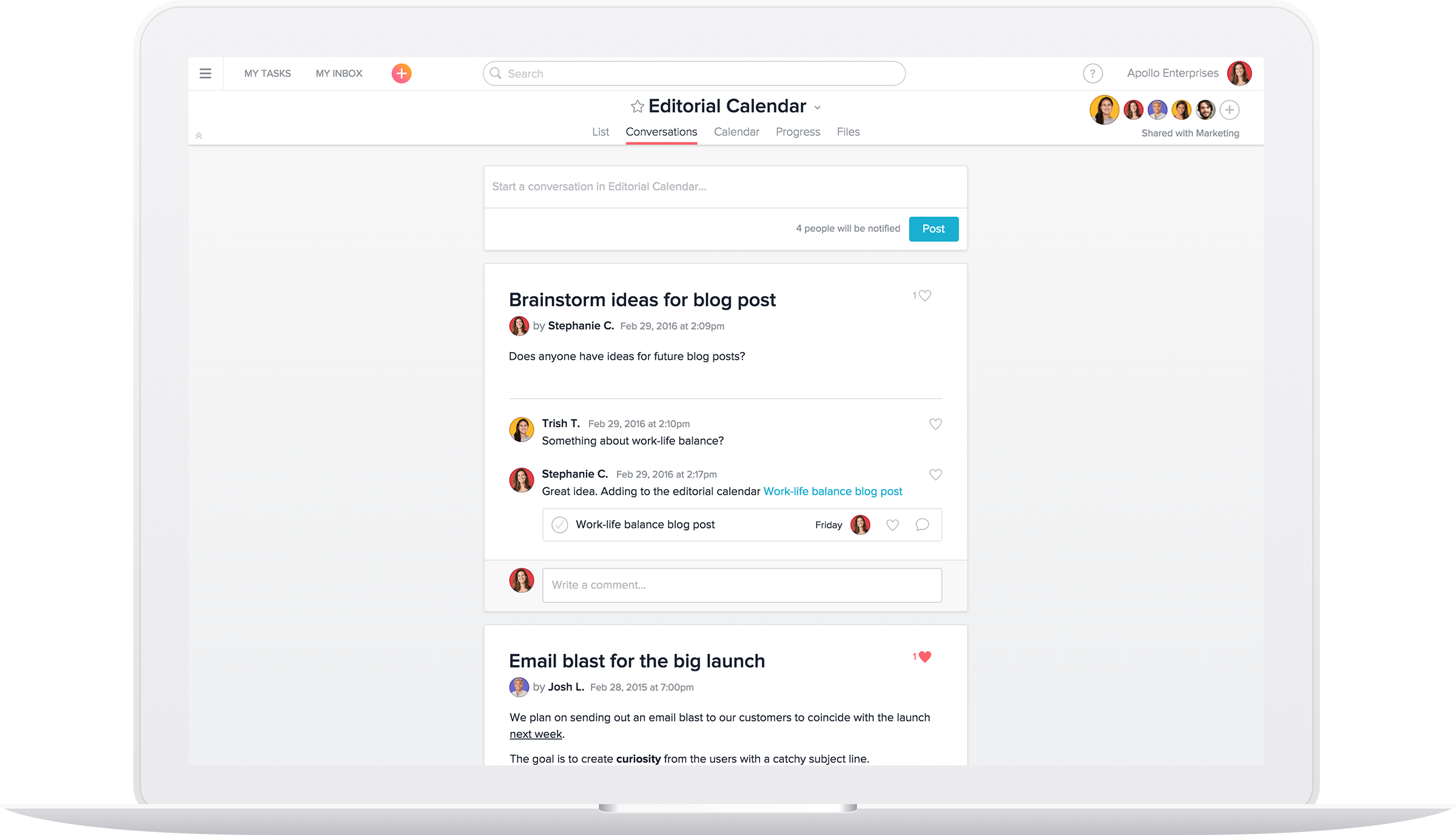
Asana is a web and mobile project management app. With tasks, projects, conversations, and dashboards, Asana lets an entire team know who's doing what by when, enabling workload balancing. Users can also add integrations for GANTT charts, time tracking and more.
$13.49
per month per user
Google Keep
Score 9.1 out of 10
N/A
Google Keep is a note-taking app launched by Google in 2013 and available free, providing a tool to capture text, images, video, etc.
N/A
Microsoft To Do
Score 8.6 out of 10
N/A
Microsoft To Do replaces the former Wunderlist task management tool.
Asana is the best of both worlds because it allows multiple views of your tasks and dashboards for project managers to review. Some of the competitors only allow one way of working, which can be a roadblock for users who are less flexible in their workflow. Getting all users to …
Ease of use and access are what initially put Asana ahead of other options available. We have stuck with Asana because of the flexibility in solving a variety of challenges that would otherwise fall to a spreadsheet or piles of paper, and the load it has taken off of the team …
We tried Trello, Wunderlist, and Producteev, but at the time, none of them had the feature set that Asana offers. The main requirement we had was the ability to create projects and subtasks with individual due dates and assignments. Asana was the only one that allowed us to …
Asana is a great balance of simplicity and robustness. JIRA is simply too robust for my team's needs - it is more appropriate for a software team. We did not need the capabilities to customize automated workflows. Our development process is waterfall, so a PM software centered …
Outlook Outlook can track tasks. However, it's not very collaborative; you can send tasks to other people but you can see what them after that. This feature as part of Outlook was a disaster. The only benefit that currently exists is that it was free; it never really fit in …
I believe Google Keep does a great job stacked up against the other competitors. Evernote has a bit more synchronicity between other software and a very strong OCR technology but Google Keep holds its own as a free, easy-to-use note-taking app. I have used all three of these …
Wunderlist is a good straightforward to-do list that doesn't have anything super extra attached to it. It comes with an app (unlike Trello), and easy to learn (unlike Asana). Trello and Asana are better for complex tasks but take a while to set-up. Wunderlist is the most …
Reason I went with Wunderlist is a simpler build. Applications like Asana or Trello are more large scale for milestones on projects with multiple calibrations across the project. I did not need to overcomplicate things, I needed a simple easy solution that gets the job done, …
Microsoft To-Do simply put just does to-do lists very well. I don't want the visual components of software like Trello or ClickUp, and I had used Asana in previous roles and just found it to have too much going on. I also didn't like the notification system of Asana, constantly …
Verified User
Director
Chose Microsoft To Do
While I have tried a number of other to-do lists, Wunderlist is easy to use and free. Most other to-do lists that I have tried I have used for a day or two and the have deleted and returned to Wunderlist. Part of it is that I am used to this tool, but I think it is also just …
I think each of this products has its pros and its cons, but the only right way to pick the best one is to try them all. This kind of software is used on a daily basis, and you end up interacting a lot more than you would think of, so you really need to use one software that …
Relocated to this task manager after a year of paid subscription on another service. I chose the most suitable for me the functionality of the free version of the service. A great thing.
Wunderlist wins with simplicity. Where other software pile on the features, here we have something that sticks to its mission of being a central location for collaboration on tasks.
The usability of Asana is broad since it's available in a variety of platforms that are widely used nowadays. I think that it would be great for people who are constantly on the move and switching devices, since it has allowed me to work from my phone, too. I also think that Asana has proven itself to handle a large quantity of work
We use it to post photos of a given area or circumstance, so there is never a question about the current appearance or the desired appearance, as the case may be. We also use it a lot for checklists. When items are needed, possibly from different locations, team members can check them off a shared list as they are acquired, so we can see what is still required and what has been acquired, and the person responsible can initial the checked-off entry.
I think Microsoft To Do is helpful for people who don't need a lot of customization in a task manager. I prefer using 3rd party task managers that allow me to create projects with tasks and subtasks. But for a team that already uses Microsoft products and doesn't want to learn or invest capital in another task manager, Microsoft To Do covers the basics and syncs with your calendar.
Through it, we were able to communicate and cooperate with the rest of the team to complete the work in the required manner and at the appropriate time.
Wunderlist is what you need for your to do lists. It's really simple to use.
Allows you to set due date to your lists, share them with your team and/or create a folder to divide and organize all your list set
Also, Wunderlist is compatible with all platform and devices. So you can always be updated on your list or work on them from wherever you are and with all the devices you have.
The iOS app sometimes gets into a state and doesn't update your notes (won't show new notes from other devices / computer), needs to be re-installed to resolve
Your notes take up space in your Google account's quota, though this is not very apparent at first - you have to keep an eye on what you are storing - huge pictures better not go in there
It is very user-friendly. Takes a new employee an hour to start figuring out how the system works. That's an important factor. You don't want to encounter the issue where employees need a week to understand how the system works. For example, JIRA, I tried using it for a week and I still don't understand the complicated layout. Asana has a simple interface. Once you see it, you get it type of program.
They made it simple for anyone to use. There are no complicated steps involved to create a note, edit a note, or search for a specific item located in a note. They also made it simple to share it with others, making it easy to collaborate. Google kept it basic without a thousand "bells and whistles" to overcomplicate it.
User friendly, easy to configure, and VERY simplistic. I particularly use heavily the phone app feature. While others in the room are on social media, I am reviewing my tasks and this triggers other tasks I know I need to get done. I like the sense of accomplishment of moving things to the completed pile as well.
I haven't had to use their support so I can't rate it. The fact that I haven't needed them reflects the ease of use of the product. I would recommend that any new users schedule a complete demo of the product to ensure that they are using it to it's fullest (there's a lot of useful features).
I gave this rating based on the ease of use, the simple functionality and how well it does at keeping my attention and helping me continue to use it and stay on track. The functionality mentioned before alongside the reminder functions and how it utilizes Google's powerful machine learning tech to better its software is remarkable.
I have not had an issue where I needed to reach out to Wunderlist, but I know their contact and online chat is easy to access and feel confident that they would be helpful. My only worry is Wunderlist is becoming Microsoft to-do in May 2020, and I believe the app will become worse after that.
Asana is a top-tier project management software that helps us organize and track projects from start to finish. It allows us to apply tasks/to-dos to multiple projects without duplication, divide complex projects into smaller tasks, and track project progress. It also helps us organize work on Kanban boards or linear lists. It stands out from the crowd in a big way compared to the competition.
The main differential of Google Keep is its simplicity and efficiency for quick notes. I can draw on the card, put a photo, record audio if I can't write at the moment, in short, for everyday tasks, simple things, it is superior.
It's a small tool compared to bigger project management software, but we found that they work perfectly together. It helps you declutter the larger PM tools, keep your smaller tasks in-line and make sure they get completed. When you're working in a creative agency, ideas and tasks are flying around, so having a tool like this that keeps you accountable and reminds you of your tasks is a must!