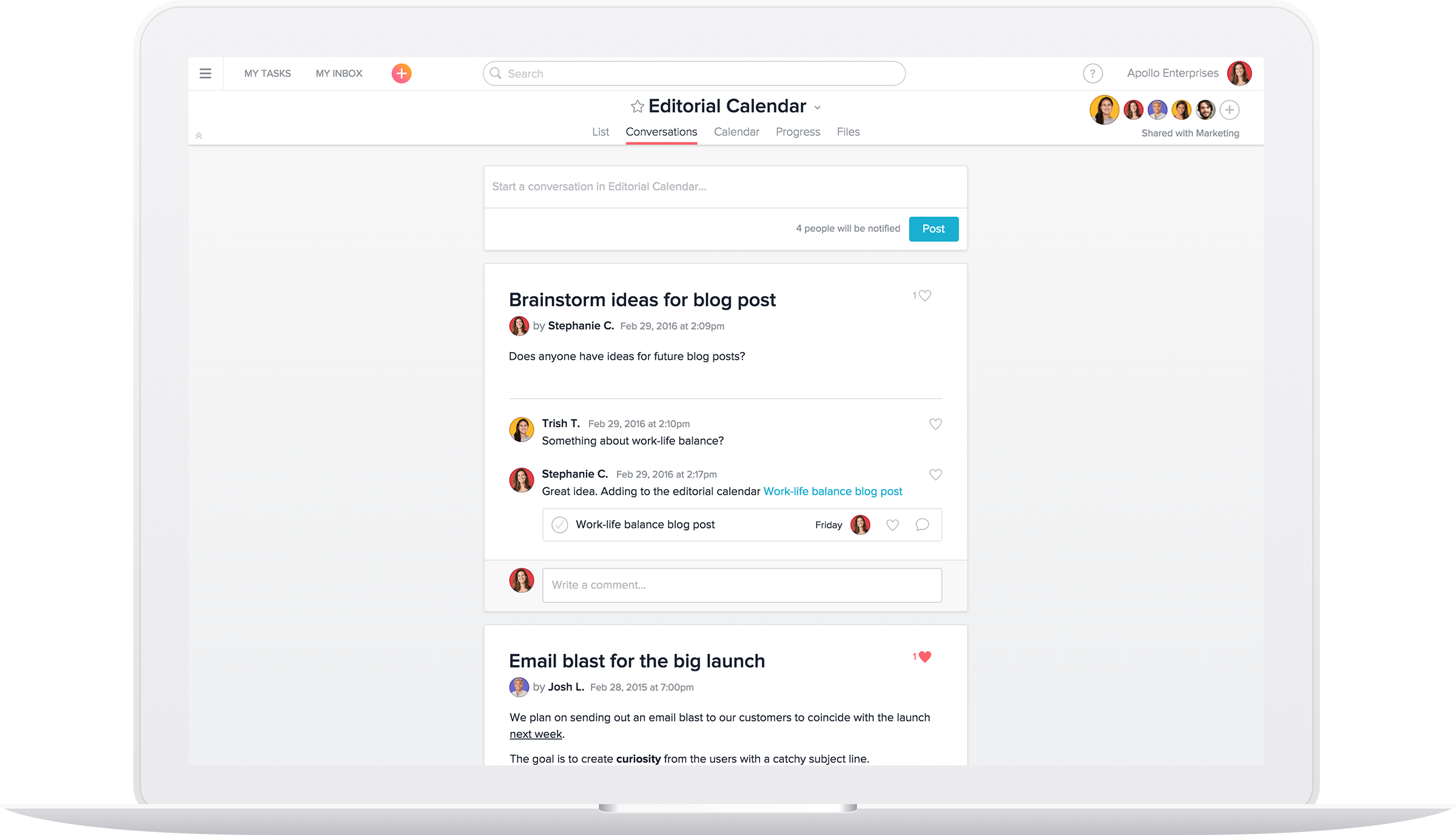
Asana is a web and mobile project management app. With tasks, projects, conversations, and dashboards, Asana lets an entire team know who's doing what by when, enabling workload balancing. Users can also add integrations for GANTT charts, time tracking and more.
$13.49
per month per user
Google Workspace
Score 9.1 out of 10
N/A
Google Workspace enables teams of all sizes to connect, create and collaborate. It includes productivity and collaboration tools for work: Gmail for custom business email, Drive for cloud storage, Docs for word processing, Meet for video and voice conferencing, Chat for team messaging, Slides for presentation building, and shared Calendars.
$6
per user/per month
Miro
Score 9.1 out of 10
N/A
Miro is a web-based Collaborative Whiteboard platform that provides teams with an infinite digital canvas for visual planning, diagramming, and workflow mapping. The platform integrates a spatial user interface with automated drawing tools and natural-language processing (NLP) to structure freeform ideas into defined project workflows and database schemas.
$0
Pricing
Asana
Google Workspace
Miro
Editions & Modules
Starter
$13.49
per month per user
Advanced
$30.49
per month per user
Enterprise
Contact Sales
Personal
Free
Business Starter
$6
per user/per month
Business Standard
$12
per user/per month
Business Plus
$18
per user/per month
Enterprise
Contact sales team
1. Free - To discover what Miro can do. Always free
$0
2. Starter - Unlimited and private boards with essential features
$8
per month (billed annually) per user
3. Business - Scales collaboration with advanced features and security
$16
per month (billed annually) per user
4. Enterprise - For work across the entire organization, with support, security and control, to scale
contact sales
annual billing per user
Offerings
Pricing Offerings
Asana
Google Workspace
Miro
Free Trial
Yes
No
Yes
Free/Freemium Version
Yes
No
Yes
Premium Consulting/Integration Services
No
No
No
Entry-level Setup Fee
Optional
No setup fee
Optional
Additional Details
A discount is offered for annual billing.
—
Monthly billing also available at $10 per month for the Starter plan, or $20 for the Business plan.
Asana is a highly effective instrument for managing teams and projects. The paid edition provides a multitude of features that can be tailored and used in accordance with the organisation's specific requirements.
Email integration facilitates notifications that remind team …
Overall for the money Asana brings a lot of value for organizations who want to do more with less and need a task and project management solution as a small company is growing and scaling to get to the next level. In the space when we evaluated didn't find a lot of other …
Against Jira it offers a more modern experience with less complex user interfaces. The admin and setup experience is also way faster with less (or no) legacy complexity.
Against other modern players like Linear and Basecamp it offers way more integrations so we can pull in data …
Asana is a top-tier project management software that helps us organize and track projects from start to finish. It allows us to apply tasks/to-dos to multiple projects without duplication, divide complex projects into smaller tasks, and track project progress. It also helps us …
Asana provides a mix of features between notion and Jira. Unlike Notion, it helps ease up the collaboration on vast projects and between multiple teams. Jira proved to be a little expensive with similar set of features if not more and which is why we thought of going with Asana.
I believe that Asana is more professional than Trello. I used Trello a long time ago, but it looked more suitable for a student project rather than for a professional team or business environment. I believe it has great features to help companies in different stages and of …
Since I have tried the two applications and saw their advantages and disadvantages, I see that Asana is much better in terms of dealing with files, ease of use, and the many features and characteristics that it has. Also, I noticed that it does not consume much space on my …
Side by side with the other two Asana by far beats Monday.com and is comparable and slightly better than ClickUp. Monday is completely browser-based and is hard to navigate and figure out how to set up. Asana and ClickUp are the exact opposite. Both are easy to set up and …
I like how extensive the capabilities are for Asana. With other softwares it seems there are many things lacking. I feel like Asana is also a very user friendly platform and aesthetically pleasing which is important in a modern office. We have many young people entering our …
Asana compared to Jira is certainly better in terms of user experience, since most of the people can start using it basically without having any kind of training or previous explanation, which makes it really useful not only for people already used to project management but …
Asana is amazing for a remote team, that we are currently as its accessible seamlessly to all our team member no matter where they are in the world. Its very easy to onboard new members to this platform as its very intuitive and easy for new people to get a hang of it. It has …
Basecamp was a great tool, but it was paid and things like recurring tasks and opening new projects was a pain. Asana, as a free tool, has been better for our organization as it serves the basic functions very well and is not complicated otherwise. I really like the …
Google got a good jumpstart on building out a more comprehensive and consolidated platform. Microsoft has been around such a long time that they still have some archaic tech debt in their platform. Dropbox feels like it decided to pursue the more comprehensive suite a little …
Google Workspace is in a good competition with Microsoft 365 and is ahead in many areas. Although MS365 is moving in the 'cloud' direction, Google has always been 'cloud' based and is still ahead in that area. For newer, smaller companies, Workspace is a great choice. For …
Something I highlight is the management of email and G-Drive. Since they are services directly connected to the network and mostly require a browser, emails or files are not lost, since they will always be in a trash can. It has happened to me with Microsoft that files get …
We selected Google Workspace for it's ease of use and clean UI. Microsoft Office granted does have a lot of features and may be more advanced in certain areas (Excel vs sheets), however for the range of functions we need, google workspace provided the necessary features for an …
I've used Microsoft Teams (and sometimes still do for client projects with Teams being the client's workspace), but I find it to be a difficult and cumbersome work environment to manage and navigate.
Google Workspace offers many more collaboration tools then the Microsoft products. Although the Microsoft products are familiar to so many people, picking up The Google suite of tools is easy. Google also allows us to truly be in the cloud and work from any device from …
We used before on my previous role Microsoft teams where you can only casually exchange messages, but Google Workspace allows me to access all the applications that I need in just once access without closing the window that I'm currently working on and it can be used to email …
I find Workspace easier to use and manage, better security, and the gmail interface and features is way better. Plus 3rd party integrations. Support sucks though from my experience. Most other email solutions do not enforce authentication and domain alignment or have MFA, which …
Google Workspace huge advantage is the interface that everyone is familiar with (from using personal Google services). Also, the administration panel is straightforward and easy to use - does not require expert tech knowledge to move around. As a result, it is a perfect tool …
Google Workspace is your all in one go-to tool. No other product offers the versatility and a large selection of tools like Google workspace does. Gmail is incredibly faster than any other email client available out there, and some tools like Google Spreadsheets have replaced …
Though Microsoft offers some great ideas to help you better your work, I believe Google tops Microsoft in the area of office applications. Google mail, Google Sheets, Google forms, Google Docs, Google Calendar, Google Drive, and Google Video Meetings are easy to use to …
Google Drive blows Dropbox out of the water by making its shared assets accessible without requiring app installs and paid subscriptions for outside users. The speed at which it handles all of your stored assets makes it advantageous for demanding projects in the music and film …
Google Workspace's web-based word processing apps are much more robust than Microsoft's equivalent. For example, multiple users working on a single google docs document will very rarely run into issues with synching or continuity, whereas Microsoft's online Word is not as …
Slack has more IT functional integrations that Google Chat/Spaces at this time. It is being used in more of a "shadow IT" configuration currently with a limited set of paid licenses. Facebook for business was missing key integrations and with Google Spaces/Currents, it was …
Google Workspace is a formidable opponent to Microsoft 365. It provides all of the solutions that 365 does, but does it with more finesse. I find it easier to navigate Google Workspace than I do 365, especially when comparing Google Drive to Microsoft OneDrive. Google Drive is …
I've used Office 365 in the past, along with some of Zoho's tools, and none of them have delivered the experience that I get from Google Workspace. Office 365 was slow and cumbersome when I evaluated it, and the interoperability of Google apps far surpasses that which I can get …
Photographer: Commercial, Advertising and Editorial
Chose Google Workspace
There are lots of things that Microsoft 365 does better than Workspace. The problem is that I am stuck in the Google world. It would take way too much time and energy to change platforms. There are lots of other options to choose from but none of them are perfect. Workspace is …
From an ease of use standpoint, Google Workspace is far simpler and easier to use. It offers what we need where Office offers too much of each app/service adding complexity over convenience. Our prior use of Office and even some occasional use of 365 just as a backup is often …
I believe Google tops Microsoft in all areas EXCEPT the office applications. I prefer Gmail, Drive, and Google Video Meetings to Outlook, OneDrive, and Teams meetings, but that could just be me. In my experience, it has been easier to use these applications without much trouble …
We previously used Zoho Suite free tier. Deliverability was good and their spam protection was almost as good as Google's. The one drawback to Zoho was the inability to host more than one domain. Zoho's paid tier is cheaper than Google's, but [I feel] you don't get the same …
There are lots of competitors to various tools in Workspace, like Meet versus Zoom. However, Microsoft is the other big competitor I can think of for Google Workspace as a whole. To me, at least, the strength of Workspace is how easy it is to share and collaborate with others. …
Miro allows for more freedom when facilitating remote lessons and workshops that require lots of participant interaction and drawing diagrams. Other diagramming tools require learning how to use it. Same with design prototyping tools.
We evaluated so many tools before jumping to Miro. Those tools would be Mural, Google Jamboard and Notions. Google Jamboard was easy to use but it was more suitable for basic brainstorming. Notion is excellent for documentation and knowledge management. Mural was a good choice …
Miro is faster to enter as a free tier and good enough for freelancers or very small teams. Also, FigJam does not include a UI library like Miro. Whimsical is the closest competitor.
There are many reasons and its different for each. FigJam provides excellent experience for design focused collaboration and it works particularly well since we are pretty invested in the Figma ecosystem. Jira and Jira product discovery are valuable for tracking execution and …
we had tried draw.io, figjam google whiteboard earlier as well so they work well for basic, but Miro is the easier and more functionality than these apps. in the Miro have the more feature like real time editing and team collaboration and remote team, so Miro is better …
Miro is well-suited to our organization, offering many features not available in the above-mentioned software. The above-mentioned software is not up to the mark compared to Miro, and Miro is better than Draw.io. So, we stopped using Draw.io and shifted to Miro.
I have used Figma and an Excel sheet to brainstorm and create diagrams. Both are useful, but I found Miro to be more flexible when working with large groups and other types of projects. What I like most about Miro is that it brings all our tasks into a single workspace, like …
Miro is far superior to Mural (and I used to be a heavy Mural user a few years ago). The rate of innovation at Miro has helped the product blow Mural out of the water.
Miro stacks below Figma for me. I only selected Miro because that is what my company uses. However, I think they chose Miro over Figma because they are more interested in collaborative features than in the prototyping that Figma prioritizes. They also probably chose Miro …
I selected Miro because it combines all work and user friendly with powerfull functionality and features. It helps to create the perfect planning, meeting with clinet or other teams, creating new disigns and diagrams.
Miro is a more flexible product than the others I've used. I find it's interference to be more flexible and feature rich while simultaneously being easier to use.
I already mentioned this, but Miro is good for non-designers to get onboard easier for team building and collaboration. Designers tend to use tools we are comfortable with and can easily switch tabs in one software
While the Microsoft products are useful, Miro has been easier to collaborate on larger whiteboards. Both MS and Miro are available to me and we don't have a "standard" to use Miro, but in my case for my part of the project, a team member chose Miro and I was happy with the …
We also tried Figma, MS Whiteboard, Google Forms, and Notion. Compared to these platforms, Miro felt more flexible for our team collaboration. We liked how simple it was to organize our ideas, create workflows, and collaborate with our team members. We selected Miro because it …
I think Miro is more comprehensive but has a slightly steeper learning curve. But since it is meant for complex scenarios, the learning curve is worth it. Maybe a simple mode might help new users.
The usability of Asana is broad since it's available in a variety of platforms that are widely used nowadays. I think that it would be great for people who are constantly on the move and switching devices, since it has allowed me to work from my phone, too. I also think that Asana has proven itself to handle a large quantity of work
I find that google workspace covers all the bases that I would need my day to day work solution to offer. Workspace is perfect if you're someone working in sales who regularly sets up and hosts meetings. The meet solution is reliable, the transcription through Gemini is almost always perfect, and the recording function is easy to use. Calendar backs this up well by being simple and easy to use. Although having the ability to share your calendar link for people to book in meetings would elevate this further. You can also never go wrong with Gmail, it is reliable, has strong spam filters and rarely ever goes down. On the flip side, despite Docs, Slides and Sheets covering the basic functionalities that you would need to create a good base level of documents, it does lack some advanced functionalities that other providers offer. Especially in Sheets, I use sheets regularly for importing and exporting data for cold outreach, it works perfectly fine for this, but if you were looking to start creating dashboards etc using sheets as the base for this, it can start to get a bit tricky and limited.
For me, the greatest joy is watching a messy tangle of abstract thoughts instantly click into place. I can quickly drag in colorful sticky notes, connect them with smooth lines, and watch a beautiful, structured workflow come to life right before my eyes. It takes the stress out of alignment by letting everyone see the big picture immediately.
Google Calendar...amazing. I don't need to ask team members when they're busy anymore and play this game of bouncing times back and forth. All I need to do is enter their email address and it shows my calendar and theirs side by side and then select the day and time I find that works best for the both of us.
I actually prefer Google Meet over Zoom. Zoom bogs down my computer and I find their UI overcomplicated for what it actually does. Google Meet is simple and does practically everything Zoom does without needing to pay any extra money.
Sheets integrates with our CRM (Copper) so it's perfect for us. Being able to export information out of our CRM into sheets and then create pivot tables from that data makes our lives a million times better.
Makes internal coordination between admin team and tutors extremely painless. It's like a single place where everyone can drop ideas, get updates and notes without loss of context which usually happens in long email threads.
Versioning and board history are handled very well, which drastically reduces the workload. They help me track how a policy or math guideline has evolved, and also make it easy to revert changes if something doesn't work.
Comments stick exactly where they are meant to, making internal reviews much clearer. Admins don't have to guess which note refers to which rule or section.
Exports are clean, so even non-Miro teammates get it instantly.
I have several Workspace accounts, and it can be kind of annoying to switch between them. For example, if I click in my work email but my Chrome defaults to my personal Workspace, I have to open the file differently or log in and out of the other account.
Meet is my least favorite feature. I find it very subpar to Zoom in both ease and picture resolution. It's harder to tell when you're sharing your screen and you can't see comments if you're presenting.
Google My Business can be difficult to navigate. I frequently forget where features are and have to hunt around for them.
I just can't see us getting it off of Asana any time soon, despite the many headaches it has caused us. We have too much data in there, too much time & training invested into it, too much at stake to move. If we were just starting out today, fresh, I don't know for certain that I would absolutely go the same direction, but I *think* I still would. I just haven't seen anything better yet. Maybe if Podio's support staff hadn't treated me like a worthless nuisance to them, I might feel differently, but the fact is that their task management is simply inferior to Asana's. That can't be denied, and in fact Podio said it themselves: "Tasks are a simple function. They cannot be customized. Tasks in Podio can be used for quick to-do's for you and your team members." In our operation, however, prompt task completion is a big deal; one task can't be completed until another one is done first, and closing the gaps between those tasks is critical in meeting deadlines and servicing our customers. Asana gets us there, the others don't.
There is no better solution for cloud storage and real time collaboration. The amount of features included in G Suite is unmatched and out of other things we’ve tried over the years, nothing comes close to being as great of a tool.
Miro saves my day. I would spend at least 4x more time on documenting my projects and work without this tool. It support my day to day role and helps me be successful while saving my capacity. It is not only very easy to start working on it without additional training required, but also adapts to any use case that I might need to implement
It is very user-friendly. Takes a new employee an hour to start figuring out how the system works. That's an important factor. You don't want to encounter the issue where employees need a week to understand how the system works. For example, JIRA, I tried using it for a week and I still don't understand the complicated layout. Asana has a simple interface. Once you see it, you get it type of program.
On the user end, it's great, probably some of the most user friendly products out there. On the admin side, it can get a little more arcane, but it's still better than a lot of other services. At worst I wrangle some CSVs to perform mass changes, but it's a far cry from the days of Powershell scripts or purely manual entry.
This is a hard one.. and totally subjective.. Initially when i started using Miro, i had trouble scrolling here and there.. the canvas was so vast and zoomed out .. Now i have learnt how this works .. I feel we need some kind of indexing at board level, which will give the topics / headings in a concise way .. Like a birds eye view of the components on the board. That might improve usability a bit.
I have not encountered events where Miro is not available. It is quite nice and reliable to be fair, even on my freemium version (startup) I don't have reliability issues. It does have sometimes where the screen refresh or "freezes" or "consumes a lot of data" and we have to rewind windows and the likes, this instances are very less
I took the loading quickly to be related to availability which I commented on before, so ditto with those comment on load time here. Although to reemphasize, Miro doesn't crash or just refuse to load like some other programs. The weak point of Miro for me is integration of files like Word, Excel, or PowerPoint (especially the later two). When you embed these, it gets slow, and complicated to bring them up while you're in the application.
I haven't had to use their support so I can't rate it. The fact that I haven't needed them reflects the ease of use of the product. I would recommend that any new users schedule a complete demo of the product to ensure that they are using it to it's fullest (there's a lot of useful features).
I have not had to use much support for G Suite, but I imagine it would be a great service, as is everything else that Google provides. I've searched for questions through the help center, and that was easy to use and easy to find. I'm sure I would have no complaints.
We have never reached out to or contacted support because Miro's platform has been incredibly intuitive and user-friendly. The comprehensive resources available, such as tutorials, documentation, and community forums, have provided all the guidance we needed. The seamless integration with our existing tools and the reliability of the platform have ensured that we rarely encounter issues that require external assistance. This self-sufficiency has allowed us to focus more on our projects and collaboration without interruptions. Overall, our experience with Miro has been smooth and efficient, eliminating the need for additional support
There was a series of webinars which Miro hosted with our organization that went over the basics, then progressively became more advanced with additional sections. The instructors were knowledgeable, and provided examples throughout the sessions, as well as answered peoples' questions. There was ample time and experience on the calls to cover a range of topics. The instructors were also very friendly and sociable, as well as honest. Of course Miro isn't a "God-tool" that does absolutely everything, but the instructors were aware and emphasized the strengths where Miro had them and sincerely accepted feedback.
Easy to learn, Miro has a series of videos on YouTube that effectively taught this program to my team members and me. The program is drag-and-drop and works excellently. People pick up on how to use it efficiently, and it's great for organizing ideas more freely. This product is more challenging for some older audiences who are not accustomed to using a touchpad, but for most, it was very easy to use.
Asana is a top-tier project management software that helps us organize and track projects from start to finish. It allows us to apply tasks/to-dos to multiple projects without duplication, divide complex projects into smaller tasks, and track project progress. It also helps us organize work on Kanban boards or linear lists. It stands out from the crowd in a big way compared to the competition.
Google got a good jumpstart on building out a more comprehensive and consolidated platform. Microsoft has been around such a long time that they still have some archaic tech debt in their platform. Dropbox feels like it decided to pursue the more comprehensive suite a little late, and only seems to appeal to smaller businesses instead of being able to scale as big. Google Workspace covers all of the bases well enough with good add-on or enhanced functionality that satisfies the needs of different businesses across the spectrum.
We looked at other tools for the freeform communication and collaboration, as well as for tracking timelines and roadmaps, and Miro was just the best overall tool because we can keep everything in one spot and our team only has to learn and one use tool, as opposed to having to log into multiple spots.
Miro is great for scaling. In every department and subdivision across my entire organization, there is someone using it. From Sales to marketing, to manufacturing and operations; and even in legal and finance, there isn't a process or a department that is not using Miro, and if they aren't, they're missing out! Even at the highest to the lowest levels of the organization, it is essential for virtual collaboration.