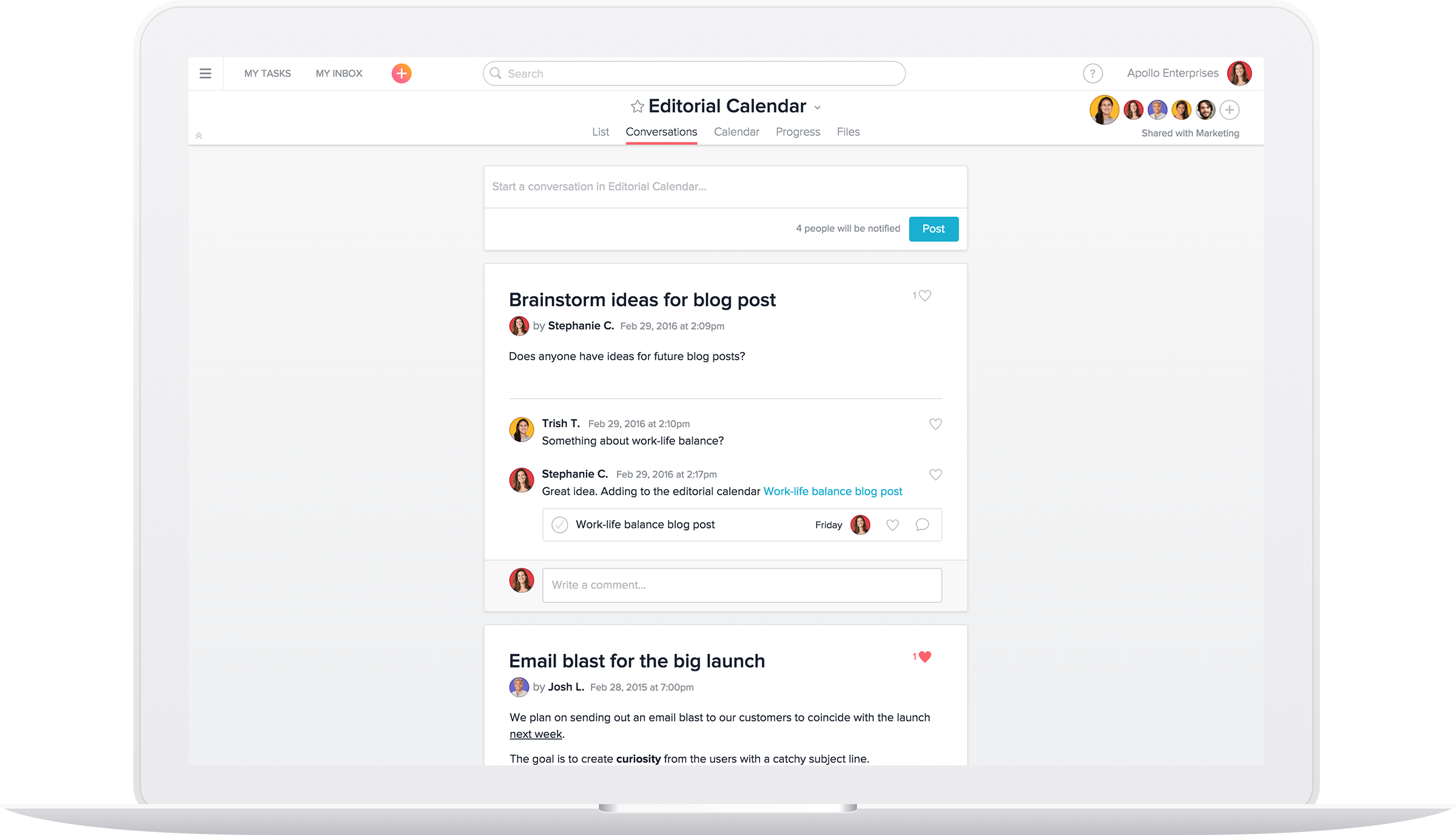
Asana is a web and mobile project management app. With tasks, projects, conversations, and dashboards, Asana lets an entire team know who's doing what by when, enabling workload balancing. Users can also add integrations for GANTT charts, time tracking and more.
$13.49
per month per user
HCL Notes
Score 3.5 out of 10
N/A
Notes from HCL (formerly from IBM, acquired by HCL in late 2018) is a collaboration platform based on the Lotus platform.
N/A
Zoho Projects
Score 9.2 out of 10
N/A
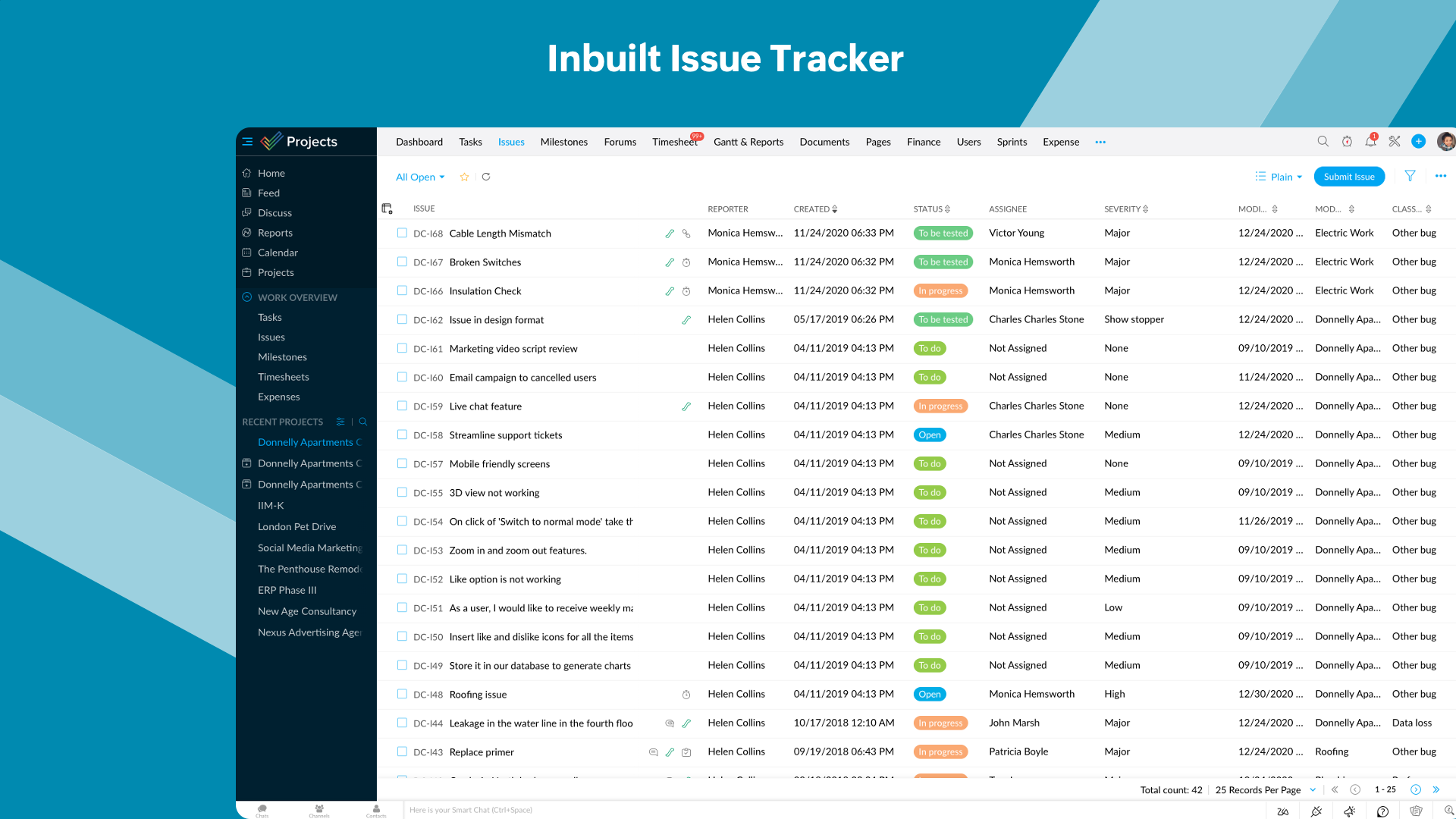
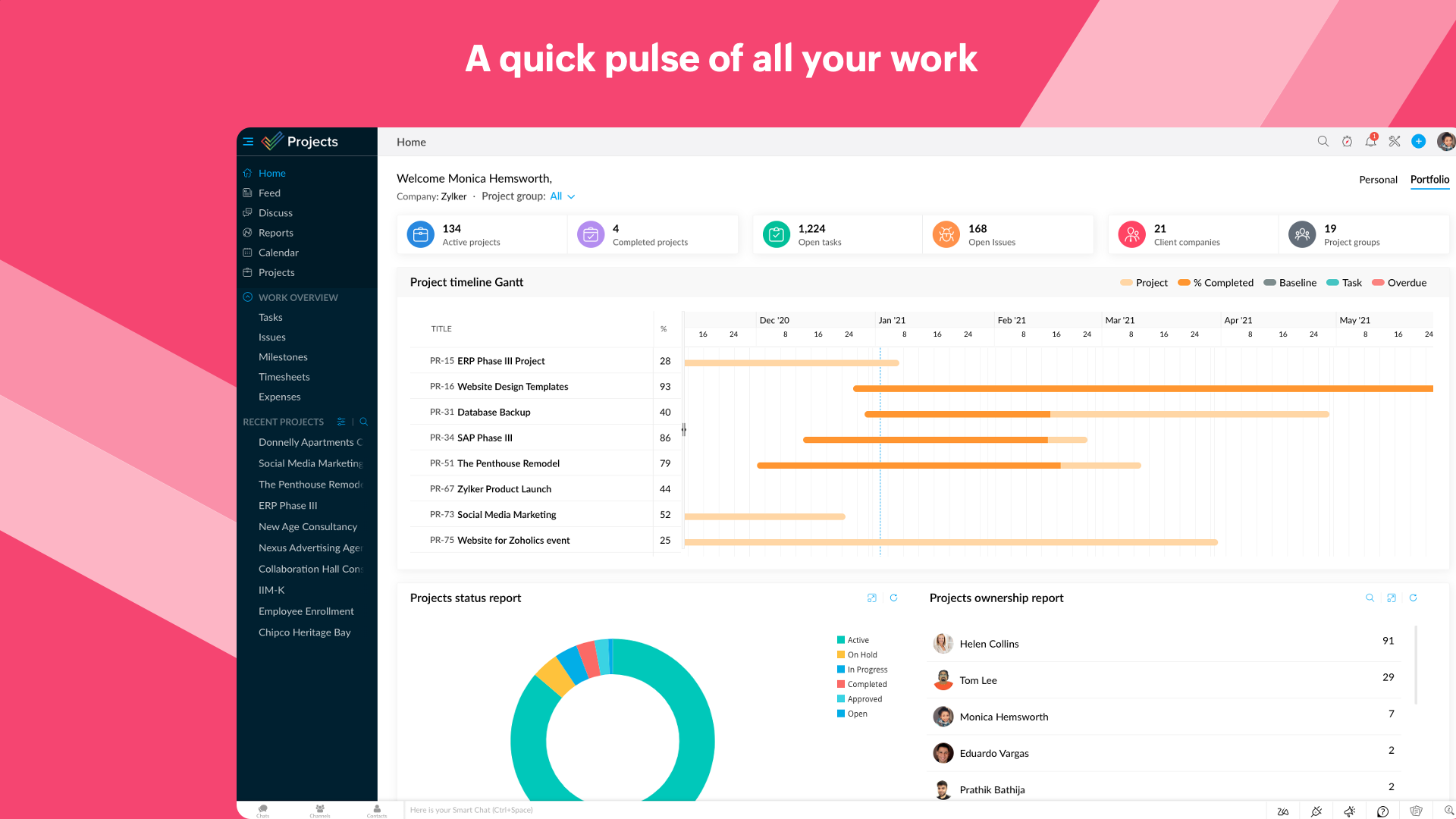
Zoho Project is online project management and planning software that provides project teams with a web-based collaborative environment. Zoho Projects can also include a bug tracking module specifically design to support software development project. It is integrated with other Zoho products including Zoho CRM.
$5
per month per user
Pricing
Asana
HCL Notes
Zoho Projects
Editions & Modules
Starter
$13.49
per month per user
Advanced
$30.49
per month per user
Enterprise
Contact Sales
Personal
Free
No answers on this topic
Free
$0
Premium
$5
per month per user
Enterprise
$10
per month per user
Project Plus
Contact Sales
Offerings
Pricing Offerings
Asana
HCL Notes
Zoho Projects
Free Trial
Yes
No
Yes
Free/Freemium Version
Yes
No
Yes
Premium Consulting/Integration Services
Yes
No
Yes
Entry-level Setup Fee
Optional
No setup fee
Optional
Additional Details
A discount is offered for annual billing.
—
Discount offered for annual billing.
More Pricing Information
Community Pulse
Asana
HCL Notes
Zoho Projects
Considered Multiple Products
Asana
Verified User
Manager
Chose Asana
We selected ASANA based on the feature set, and ease of rollout. monday.com had very good workflow automation but we found that ASANA was quicker and easier for staff to build a task eco-system that worked for them.
Zoho Projects was a very strong contender but was much more …
In comparison to other Project Management software tools that I have used, Asana is the most user friendly platform without compromising any advanced capabilities.
We were testing out Asana at the time we moved on to Zoho. Zoho seemed to have more features that met our needs. Asana was not quite developed to the point of our liking. Zoho has an awesome calendar function that I loved, which Asana did not.
MSP - Windows based. Not collaborative. Complex UI. Cannot be shared with people outside the organization easily. Cannot set security levels for users to access projects based on the rights granted to them. Trello and Asana - Expensive subscription plan. Limited …
I would choose HubSpot & Asana over Zoho because of their intuitive UIs and functionality. I would choose Zoho over Basecamp only when you are managing hundreds of projects.
I used Zoho projects initially because it was easy to setup and gets going for FREE. The best thing you can get out of Zoho projects is that it needs zero setup time. It is also a great tool for manage projects, however not that suitable for product management, I believe. JIRA …
The usability of Asana is broad since it's available in a variety of platforms that are widely used nowadays. I think that it would be great for people who are constantly on the move and switching devices, since it has allowed me to work from my phone, too. I also think that Asana has proven itself to handle a large quantity of work
I often work with teams from other country and regions, hence HCL Notes is a very useful platform for internal company management operations. It standardized organisational work standards in most of the offices worldwide. HCL Notes also enables chat with other team around the world that I find very helpful when initiating conversation or just want to have a quick update rather than sending emails and waiting for replies. However, HCL Notes is not very efficient in web browsing and user still need to use other internet service providers.
My work involves projects of 5-15 people with numerous projects running simultaneously. Prior to Zoho, I did not have a central location from which to view all project statuses at once. Zoho looks to provide this and also looks like it will deliver. I am anxious to see how our organization's use of it develops. At this time, I feel I am likely to recommend Zoho Projects because my organization has made great software decisions in the past so I have a level of trust already that the research has been done that Zoho is the best solution for our line of work.
Through it, we were able to communicate and cooperate with the rest of the team to complete the work in the required manner and at the appropriate time.
We use it to manage our sales orders as there are lots of moving parts which are necessary to get client orders done properly.
I use it anytime I have a new idea I want to put into motion. As I can create a list for brainstorming, feedback, specific actions necessary in order to test and or implement the idea.
Unrelated to business, it's a great way to plan travel in order to make sure you don't forget those important things like passport, flight arrangement, client meeting confirmation, and meeting prep as far as what specific documents or things do you need to bring with you.
And since everyone is on the go and expected to keep up with work, the mobile/tablet app makes it a breeze to keep up, work on, and create new projects.
Notes' backwards compatibility sometimes gets in the way. Menus are cluttered with extraneous, outdated options and features that modern users will never use, and Preferences are often difficult to navigate for those coming from Gmail or Outlook. We have greatly simplified this via Policies, but users still find it daunting to go through all the options that are available.
The IBM Notes client for Windows & Mac is essentially the Eclipse Java development platform...so it is HUGE. Performance initially was very slow but IBM has done a good job of speeding things up. As IBM moves more toward cloud-delivered applications, this will not be as much of a problem.
Notes and Domino can be complex to manage for administrators who are more accustomed to ActiveDirectory, Group Policy, etc. Editing a notes.ini file to add a feature, or working with XML files by hand to create a SmartUpgrade kit can be daunting to those coming from more modern administrative roles.
Some users claim to "hate" Notes mail. While I have heard this less and less over the past 10 years, we have had 3rd party software offer plugins to Outlook and it's rare to see any for Notes.
The client update process should be automated more. I would like to see the Notes client update quietly and quickly more like an Adobe software update. If an update fails it should automatically try again without prompting the user over and over.
Notes multiple language spell checking is a downloaded add-on Java-based resource that has to be deployed in a convoluted way that is difficult for users to grasp. Therefore any foreign language spell check updates must be done individually per Notes client by IT, which is unfortunate. I would prefer to see that be a "live download" update option for users to get directly from IBM (don't make me download it and put it on my network).
I've been in IT business and as a Programmer/Developer for 20+ years with too many programming languages experiences/back ground (C/C++/Visual Basic/Basic Program/Unix/COBOL/Java). Also with 18+ years with Lotus Notes/IBM Domino, I am still and always think Lotus Notes is the best RAD platform available!. When the time where resource is very limited and the expectation is very high and the turn around is too short, IBM Domino/Notes is the platform to use and it's the only choice available.
I've reviewed about 8 other project management solutions and Zoho Projects is the best I've seen without being overly complicated. Zoho Projects keeps getting better! Recent new enhancements makes it even easier to navigate. There are new keyboard shortcuts that cut my time way down. The tools are very easy to use.
It is very user-friendly. Takes a new employee an hour to start figuring out how the system works. That's an important factor. You don't want to encounter the issue where employees need a week to understand how the system works. For example, JIRA, I tried using it for a week and I still don't understand the complicated layout. Asana has a simple interface. Once you see it, you get it type of program.
Easy to use for the user, most of the apps we developed, there is not much need for user training. Most of the times, we just do a demo to the users group and they can pick up from there.
Zoho Project has been very user-friendly. As a small business, we have a diverse group of people with varying skill sets. This platform has been easy for our team to learn, implement, and succeed with. The mobile version is also very handy for our team.
I haven't had to use their support so I can't rate it. The fact that I haven't needed them reflects the ease of use of the product. I would recommend that any new users schedule a complete demo of the product to ensure that they are using it to it's fullest (there's a lot of useful features).
I've been using the production for a very long time and very happy with it. Also, all the online resources and forums for notes is very friendly and easy/quick for getting help. I found out that compared to Microsoft or Oracle or any other platforms, IBM Notes online forum is the best I have seen.
Although it might lack intuitiveness, once you get a hang of how Zoho Projects works, you can do a LOT. The impact good project management has on profitability is huge, and it has helped not only improve communication and coordination when working on a project, but more importantly have adequate tracking of time, due dates and potential bottle necks
Implementation is easy and smooth if the requirement is well gathered/documented. Notes is a RAD platform, all projects in Notes is simple in the implementation step.
Asana is a top-tier project management software that helps us organize and track projects from start to finish. It allows us to apply tasks/to-dos to multiple projects without duplication, divide complex projects into smaller tasks, and track project progress. It also helps us organize work on Kanban boards or linear lists. It stands out from the crowd in a big way compared to the competition.
Outlook has been considered for years as a replacement platform. Pricing and support staff made it prohibitive. Our long-time use of Microsoft Office productivity suite naturally led us to consider the adoption of Office365. A recent investigation told us that Azure Cloud services propel an O365 solution to the forefront. Early adopters in international divisions have paved the way for Azure and O365.
Zoho Projects provides a more limited set of functionality and customization options than other task/bug trackers on the market, but what it lacks in functionality it makes up for in ease of use. It probably has 80-90% of the features of its competitors but takes about a third of the time to get up and running and realizing value.
Over the years, we have lost countless hours of productivity from the thousands of crashes we have experienced.
One benefit of IBM Notes is that it is very simple to train a new user on. Many people prefer and are familiar with Google tools, but those that use IBM Notes have very little trouble acclimating themselves.
We needed a system to organize our growing business, so anything was better than what we had, which was nothing.
Recording time spend is a huge reason for using project software. It has made me aware of the tasks that are taking too long and where we are not being profitable as a company.
It has kept our team accountable for what needs to get completed and when projects are not in motion or completed timely. It's helpful to know in order to get billing out faster.