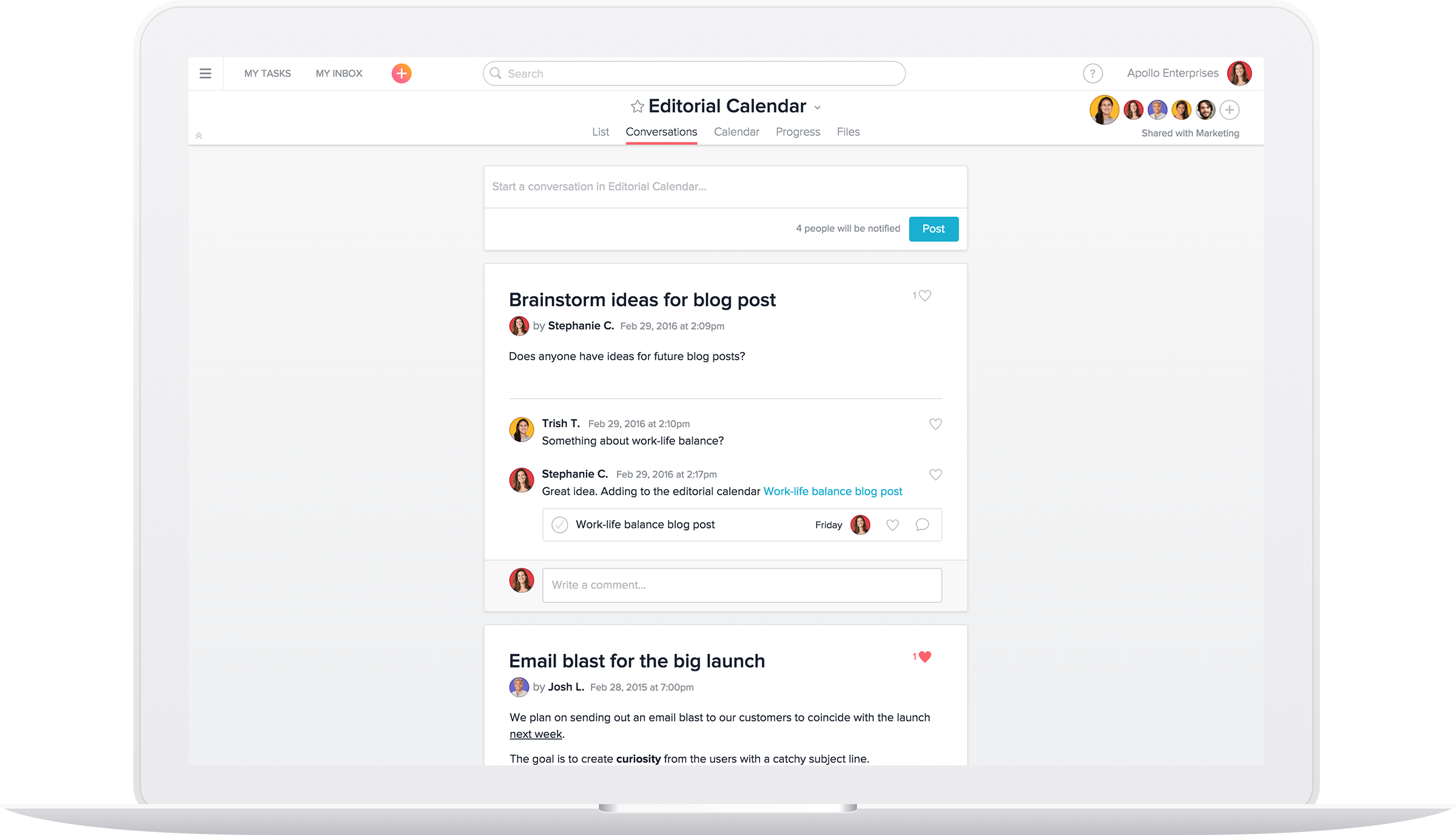
Asana is a web and mobile project management app. With tasks, projects, conversations, and dashboards, Asana lets an entire team know who's doing what by when, enabling workload balancing. Users can also add integrations for GANTT charts, time tracking and more.
$13.49
per month per user
Jira Align
Score 7.8 out of 10
N/A
A solution to bridge the gap between strategy and execution for portfolio, product, and program management teams, used to manage idea intake, prioritize your feature backlog, and track progress with live roadmaps.
$27,000
per year
Microsoft Project
Score 7.9 out of 10
N/A
Microsoft Project is a project management software. It provides core PM functionality, including agile workflow support and resource management. Project can be deployed in the cloud or on-premise.
Asana had more useful features, is a more mature product and a better interface than Microsoft Planner while Microsoft Project was harder for the average person to learn and hit the ground running due to it complexity making Asana that nice middle ground for most persons to …
Comparing to other not so complex project management solutions (which does not include Primavera, for example), Asana is way better due to the experience it provides to users and the alignment with the new trends of project management approaches such as Agile. Therefore, the …
Trello - great but a bit young. Good integration points. I think it could be a good too to integrate with. Some people enjoy the KanBan type view and Asana doesn't have that currently. Basecamp - more project manager focused but also a good integration point. JIRA - Better for …
Verified User
Administrator
Chose Asana
Asana is much simpler to use that Microsoft Project or Zoho Projects. Anyone can jump in and start using the software. There are also tutorial videos available on their website if you need any sort of clarification. You also can't beat free or low cost, depending on how many …
Jira provides a large advantage over some competitors, such as Harvest which is more of simple time tracking software, but without the connectivity provided between team members. Furthermore, Asana is a close competitor, but does not provide the same level of integration with …
MS project stands up over Asana because it is more formal. When you realize that you need to submit a proposal to a huge company or federal organization, you must use the most complete software to do that. In addition, MS Project helps to integrate costs and human resources in …
Verified User
Engineer
Chose Microsoft Project
It has many advantages over Asana. It's cheaper but can still give effective presentations. Sharing information is easy and the support is great.
I can't remember because it was many years ago. But Microsoft Project was very affordable and had a much larger set of features. Also the stability of its technology, as well as the number of existing users, the abundant documentation and the possibility of having well-defined …
Dependency tracking and automated task management helped its raking above other competitors in the usage. Microsoft support and updates are also reliable. Security is also good for this tool. UI is also good and task management is very effective. Integrations are also easy.
Microsoft Project will continue to be my tool of choice for high stakes high complexity projects with over 100 tasks and many requirements to control costs and delivery but the assumption is that a dedicated PM is needed to keep the file updated and manage communication with …
Microsoft Project had the strongest integrations and Gantt chart qualities. As a team that uses Outlook, Skype, DevOps and the Office Suite, it became clear that Project suited our needs best. Additionally, testing found that the user interface and security features pleased …
While many of the above tools are extremely well-versed, Microsoft Project's largest advantage comes from it being related to the largest business productivity company in the world. Project does have its sharing limitations - but regardless, offers one of the most robust tools …
I selected Microsoft project because we use many other Microsoft products. The advantage it has over competitors is the data visualization, which gives it a good return on investment. The project management tools are good, but other platforms have more features and integrations.
The strength it has is that it's the best complete solution for project planning. I would choose Microsoft Project over cloud solutions only if the requirements specify self-hosted solutions or that it allows integration with the AD and other corporate tools. But be prepared to …
The usability of Asana is broad since it's available in a variety of platforms that are widely used nowadays. I think that it would be great for people who are constantly on the move and switching devices, since it has allowed me to work from my phone, too. I also think that Asana has proven itself to handle a large quantity of work
The Atlassian Jira Align (formerly AgileCraft) tools help keep our scrum teams moving in the right direction. It gives Sr. Executives visibility into the progress of our digital transformation efforts. It provides information to our program manager to create the necessary artifacts to justify continued funding of our initiatives. It also supports the SAFe framework, along with some others. And the Atlassian Jira Align (formerly AgileCraft) tools provide integration to other tools that we use in our portfolio.
Microsoft Project Online is suited to Turnkey Projects where more Collaboration is required in Project Progress monitoring, risk assessment and conveying, issue recording and tracking. It is less appropriate when ERP Suites other than MS Dynamics are used, i.e when Enterprises need to integrate Finance / Accounting with It and having straight project management workflow
Through it, we were able to communicate and cooperate with the rest of the team to complete the work in the required manner and at the appropriate time.
Effective Sprint planning : Sprint planning can be done using Planning Poker in AgileCraft by clicking Team > Manage > Other > Estimation Games very effectively for distributed teams.
Team Capacity Allocation Report: After tasks are created at team or program level, the report from AgileCraft cab be pulled and can be verified that no team member is under or over allocated. A report can be generated by navigating to Team > Manage > Assign Tasks.
Effective Requirement trace-ability: To maintain requirements trace-ability follow the steps below:
Upload test cases against the story/requirement. once uploaded test cases will be visible under that story
Execute Test cases in AgileCraft and mark them as Pass/Fail based on the actual outcome
Based on test results, The acceptance criterion's can be marked as “Pass” or “Fail” & if marked failed corresponding defect can be logged & can be attached with the story
So against each story we can easily see whether all test cases been executed or not & which acceptance criterion's are failed & how many defects are in open or close state.
Daily Scrum: In AgileCraft, the option to run a daily stand-up is available from Team > Manage > Daily Standups. Selecting the sprint number opens the daily stand-up meeting window in which each team member's tasks are visible and hours can be burned against them. Conduct Scrum meetings in AgileCraft, and burn each associate hour against the tasks created during the meeting. The burn-down chart can be generated & viewed during the stand-up to check whether the team is on track.
I love the Gantt Chart that Microsoft Project offers me, because it provides me with a view from various aspects, it provides me with exact details about the fulfillment of tasks over a period of time, it also allows me to make comparisons with the necessary data and the fulfilled data. by the employees, in order to know exactly if the project's expectations have been met.
I love the Gantt Chart that Microsoft Project offers me, because it provides me with a view from various aspects, it provides me with exact details about the fulfillment of tasks over a period of time, it also allows me to make comparisons with the necessary data and the fulfilled data by the employees, in order to know exactly if the project's expectations have been met.
The alert system for the fulfillment and delay of assignments is perfect. Microsoft Project allows me to configure the task system, I can assign the necessary tasks to fulfill the project, and the software alerts me immediately if the managers are fulfilling the assignments.
The initial ticket creation screen lacks some important features, such as assigning "point values" (a measure of effort needed for the ticket).
The browser needs to be manually refreshed to see new tickets, which can make things confusing when several people in a meeting are simultaneously creating tickets.
The interface on some smaller portions of the software are sometimes difficult to understand.
It is very user-friendly. Takes a new employee an hour to start figuring out how the system works. That's an important factor. You don't want to encounter the issue where employees need a week to understand how the system works. For example, JIRA, I tried using it for a week and I still don't understand the complicated layout. Asana has a simple interface. Once you see it, you get it type of program.
As I have mentioned, some older, less tech savvy, team members have not found it as intuitive. I found it the same when I started using it although it quickly made sense. I think this is because there are lots of features we do not use so this can get in the way of what we do use
Microsoft Project is easy to operate because data could be inserted, changed and deleted like you are in an Excel timesheet. Besides, it provides a great level of automation beween his fields allowing few data changes. Also, its funcionalities are well defined and grouped in upper menus, so you can find a funcionality quickly
I haven't had to use their support so I can't rate it. The fact that I haven't needed them reflects the ease of use of the product. I would recommend that any new users schedule a complete demo of the product to ensure that they are using it to it's fullest (there's a lot of useful features).
Overall support from Jira team is good. It comes at an additional price but it is very efficient. There are no long wait times, you get a dedicated team to look into your issues. The support is available throughout the year and they keep a record of your issues. Overall we are very satisfied with the support they have provided us over the years, it has been very effective for the price that we pay.
Microsoft in recent years has transformed itself and gives a positive feeling when one interacts with the company. The company is focusing on its customers and willing to go extra mile to make customers happy.The company continues to invest in its products and bringing new features from time to time. Overall it is a positive feeling to be associated with such an iconic company.
Asana is a top-tier project management software that helps us organize and track projects from start to finish. It allows us to apply tasks/to-dos to multiple projects without duplication, divide complex projects into smaller tasks, and track project progress. It also helps us organize work on Kanban boards or linear lists. It stands out from the crowd in a big way compared to the competition.
Microsoft Azure Devops won't have the major functionality of software management like Jira. The customization provided by Jira is having a cutting edge over any project management tool. Adds-on and Plugins feature in the Jira Tool make it as perfect as desired task management tool for any company. One of the best Agile based Project Management Tools.
While many of the above tools are extremely well-versed, Microsoft Project's largest advantage comes from it being related to the largest business productivity company in the world. Project does have its sharing limitations - but regardless, offers one of the most robust tools in the market today. Microsoft Project is built with large-scale projects in mind but is more than up to the task for smaller projects as well. However, there are options available (especially cloud-based options) that may be more fitting for higher-level projects that do not require going into the weeds.
It has positively impacted our tech teams, allowing them to better organize the tasks and items they are working on and has greatly improved their ability to communicate & review these tasks with other teams.
I believe it negatively impacted other departments as lengthy training was required by many associates to attempt using the tool, only to find out it didn't meet our needs, therefore much time was wasted.
Project saved me, as the project manager, countless hours of digging through tickets and schedules to plan everything out. It also saved me time in adjusting the project triangle as needed, since it does so much automatically.
It is costly, and since it requires extensive training to master, it's not just the high licensing cost that you need to take into account.
The reporting features - even just printing out Gantt charts - makes it far easier to communicate with stakeholders. That means less time for PMs doing all of this manually, and it means less follow-up questions and delays moving forward.