With AWS Batch, users package the code for batch jobs, specify dependencies, and submit batch jobs using the AWS Management Console, CLIs, or SDKs. AWS Batch allows users to specify execution parameters and job dependencies, and facilitates integration with a broad range of popular batch computing workflow engines and languages (e.g., Pegasus WMS, Luigi, Nextflow, Metaflow, Apache Airflow, and AWS Step Functions).
N/A
ignio AIOps
Score 8.1 out of 10
N/A
ignio AIOps, from Digitate in Santa Clara, is a solution designed to improve business agility by creating a unified view of the IT estate, connecting business functions to applications and infrastructure. This is combined with behavior profile of systems and applications that is continuously learnt using this blueprint. ignio aims to improve the transparency of complex Enterprise IT landscapes.
N/A
JAMS
Score 9.1 out of 10
N/A
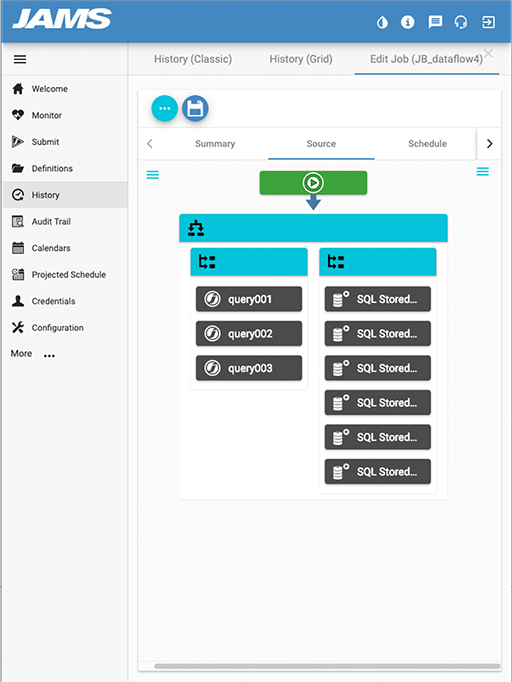
JAMS is a centralized workload automation and job scheduling solution that runs, monitors, and manages jobs and workflows. Reliably orchestrate the critical IT processes that run your business from a single pane of glass.
$9,996
per year
Pricing
AWS Batch
ignio AIOps
JAMS
Editions & Modules
No answers on this topic
No answers on this topic
Core
9,996.00
per year
Advanced
Customized Pricing
per year
Offerings
Pricing Offerings
AWS Batch
ignio AIOps
JAMS
Free Trial
No
No
Yes
Free/Freemium Version
No
No
No
Premium Consulting/Integration Services
No
No
Yes
Entry-level Setup Fee
No setup fee
No setup fee
No setup fee
Additional Details
—
—
- Core: For small teams getting started with automation. Core Integrations: PowerShell, SQL, Azure Data Factory, Python, 20+ others.
- Advanced: Comprehensive solution for large-scale operations. Core Integrations: SAP, JDE, Ellucian Banner, Informatica, Mainframe and Power Systems.
More appropriate if you have a tech group that can use more of the AWS Batch rather than one or 2 things. It works great for me, but there was a huge learning curve the first week of using it. Now, I love it - and I hope to dig deep into other parts not just S3.
It's good for issue resolution, user access request automation, standard report generation, health checks, executing self-healing as configured in the attributes. Currently not good at real-time monitoring to trigger an action. Health checks have to be on a scheduled basis.
There's probably better schedulers out there. JAMS is good for an on-premises/classic IT implementation. JAMS is well-suited for use cases such as collecting a file from a shared location and uploading it to an API, running scripts on servers, and handling middleware tasks that process files or data between handoffs across different locations. JAMS is best suited to environments with IT staff who can develop, test, implement, maintain, and troubleshoot scripts; it does not use natural language processing (so it requires in-depth knowledge of the scripting language in use), and it does not appear to offer native dashboarding or reporting that is easily accessible to all users.
There is a lot more the desktop tool can do. For example, we need to apply an upgrade to get the tool to talk to our infrastructure while employees are working from home. The tool was initially installed with the assumption that the desktops would be in UserLand. Instead after COVID-19 the desktop/laptops have been used for over a year on people's home networks. As of right now, we have to sync when the devices are connected to VPN. Moving forward with the upgrade, we will be getting this data over TLS when they are connected to the untrusted networks.
The concept of ignio AlOps requires OCM efforts within most operational teams. This isn't necessarily the fault of the tool itself, but when implementing ignio, or any AIOps tool, the team will get a lot of pushback as an outside team is centralizing the operational improvements. The tool should have a centralized intake process that will allow the collection, ranking, and management of automation opportunities. ignio AlOps should then simulate the proposed efficiencies from implementing something within the backlog. Right now a lot of local teams are having a hard time getting on the same page as the enterprise teams, and a common methodology for prioritizing (even if overly simplistic) would go a long way to enterprise planning.
These tools are very new and things get added to them all the time. There should be a way for the product's stakeholders and process owners to understand the additional value ignio AlOps is gaining over time.
JAMS is a critical resource free up people to do other things and ensuring that processes and tasks are run consistently. We are also confident that procedures are run consistently and on time or as soon as the necessary data is available. With automated job failure notification, we are not required to check that jobs are running correctly.
Key advantages include cost-effectiveness through dynamic resource provisioning and the use of spot instances. It auto-scales to meet workload demands, allowing easy job submission via the AWS Management Console or SDKs. It integrates seamlessly with other services like S3 and CloudWatch. It features automatic retries for failed jobs. It allows for a custom computing environment tailored to specific needs
ignio AIOps version upgrades were a heavy lift. Having to learn a new language versus an industry standard language took time. More consideration on overall internal long-term support needs to be determined.
JAMS is very user friendly; you hardly need to do coding. The only thing that I would say a challenge is setting it up, but that's because you barely know the product yet and, in every processing, setting up is the difficult part. But once you've set it up and you are going to use it, you will really feel that it is worth to invest in this kind of software solution, it really does it job very well.
We didnt really encounter any downtime, no issues encountered during 2 years of use of JAMs also our client barely raise an issue with JAMS, mostly the issues is on the batch jobs that jams executes. So I would gave it a perfect 10, very reliable hardly encounters any error and bug
JAMS performance is very great, there are no issues raised with the performance, it just like nothing happens on the job after integration it gives you this monitoring capability, no reports and bugs raised on the performance, we didnt do integration with other software only database and with use of JAMS agent to different servers
We have built a healthy relationship with the vendor support team throughout the implementation phase, all incidents raised were resolved within the SLA without a fail
I've never had to wait more than a day for a response to any email queries submitted. We had a very positive experience using support hours during out migration process from v6 to v7. We've also recently had a weeklong group training course where all attendees were positive about the learning outcomes, a shoutout to Jose who did both the migration and the weeklong course!
People that were involved in the POC found the training a lot easier to follow. I think most people would have preferred to just get the training material and run through themselves.
I am happy with the way team has implemented and shared the product for our organization. However, would like to see it get extended to the other line of business too.
I Was not part of the original Implementation, and the persons did that are no longer with the Organization. But I was part of the recent Upgrade process a year ago and I am the JAMS admin and was very pleased
JAMS is WAY more advanced, it isn't a fair comparison. The history is easy to get through. It is easy to get alerts of complete to failed and with a log. Adding jobs is extremely easy that even my teammates who do not manange the software are able to set them up. With the new web component we are very excited for the future of JAMS advancements.
The product is quite flexible. There are a number of features and functions that we use on a daily basis, and there are many features that are available that we have not yet needed or explored (like setting up jobs with the ability to do FTP or Sftp file transfers).
Our company depends on the JAMS Scheduler in executing a large number of SAP Jobs. In never having had a true Enterprise Scheduler such as JAMS before now, we are very happy with the results.
There a number of features in JAMS for setting up schedules and dependencies on other jobs. This helps our company achieve the necessary workflows for Job execution. This optimization saves on system resources and keeps Jobs flowing smoothly.
We are very happy that JAMS is a robust solution with High Availability. This is necessary for Enterprise products, to reduce downtime, which we have not had as a result. This feature definitely saves our company money by reducing or eliminating unexpected downtime.