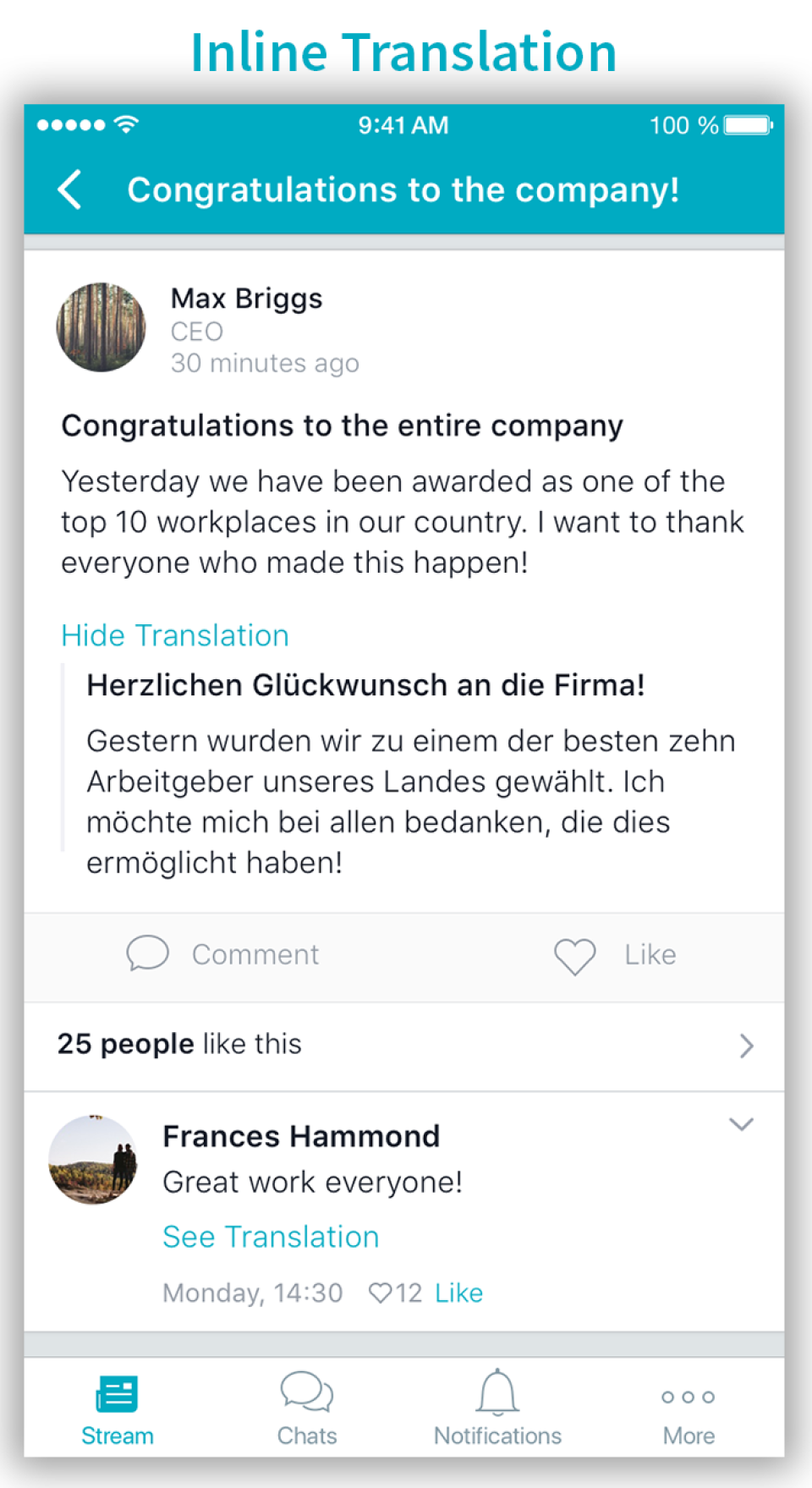
Beekeeper is a social collaboration software solution offered by Beekeeper AG.
N/A
Klaxoon, a Wrike company
Score 9.8 out of 10
N/A
Klaxoon is presented by the vendor as a one-stop shop for collaborative tools that improves teamwork efficiency when working remotely or on-site.
Meetings, workshops, learning sessions, workshops… everyone connects to Klaxoon via a web link, from any digital device (computer, smartphone, tablet…) and without anything to install. With a click, users share ideas through Brainstorm, Word Cloud, Quiz, Votes…
From Fortune500 organisations to small businesses, universities and consultants, Klaxoon…
N/A
Miro
Score 9.1 out of 10
N/A
Miro is the AI Innovation Workspace that brings teams and AI together to plan, co-create, and build the next big thing, faster. With the canvas as the prompt, Miro's collaborative AI workflows keep teams in the flow of work, scale shifts in ways of working, and drive organization-wide transformation.
$10
per month per user
Pricing
Beekeeper
Klaxoon, a Wrike company
Miro
Editions & Modules
No answers on this topic
1. Free - To discover what Miro can do. Always free
$0
2. Starter - Unlimited and private boards with essential features
$8
per month (billed annually) per user
3. Business - Scales collaboration with advanced features and security
$16
per month (billed annually) per user
4. Enterprise - For work across the entire organization, with support, security and control, to scale
contact sales
annual billing per user
Offerings
Pricing Offerings
Beekeeper
Klaxoon, a Wrike company
Miro
Free Trial
Yes
Yes
Yes
Free/Freemium Version
No
No
Yes
Premium Consulting/Integration Services
Yes
Yes
No
Entry-level Setup Fee
Optional
No setup fee
Optional
Additional Details
—
—
Monthly billing also available at $10 per month for the Starter plan, or $20 for the Business plan.
We didn't. After evaluating multiple products over the course of a few quarters, we decided on using Miro actually. Namely, because Miro had more templates and features like voting and clip art searching. The call feature was the only thing unmatched, which we didn't really …
Klaxoon has a highly intuitive visual platform with better collaboration. I still feel Miro has a better user experience though. In terms of pricing, Klaxoon is better priced compared to Miro and many other competitors and delivers betters return through a scalable approach. …
They are pretty similar tools. The problem we had with Miro was that it was pretty blocky outside the company network and Klaxoon was better adapted to share results using the company agility tools. I do not have a favorite between the 2 tools but I believe that price is an …
we are trying many visual collaboration applications. and we will choose the application that will offer us a more interactive environment. Miro is a very similar app and surpasses Klaxoon in terms of interface and simplicity. But Klaxoon is more successful with pre-designed …
Klaxoon helps to facilitate the collaborative environment for decision-making processes to assess a situation, analyze the root causes of problems in a collective manner, improve processes, reach an agreement and define an action plan. We have implemented this tool for …
Miro provides a more fluid and easy on the eye exp. compared to the competition. It has a wider variety of templates too and seems to be adopted by a larger segment of our clients relative to other tools such as Mural or Klaxoon. Miro Academy also stands out to others.
I've used Mural before in training as a guest user, and I've found that the user experience seems to be easier than with Miro. Looking at Klaxoon, I used it a few times as a guest user and I liked it, especially the feature of being able to follow the facilitator of the session …
Mural: at the time (something like five years ago), the Mural was less complete, less intuitive, and easy to use. It also had fewer templates, and it didn't have the community templates feature, which was something that I really liked to inspire me on new methodologies for …
The amount of tools, the accessibility and the overall experience of Miro makes it a go-to compared to the others, especially given the ease of playing around all the different frames, images, etc.
I've tried Klaxoon once and I really didn't like my experience. As for Mural, I …
None of these platforms provide the depth in features and make it easy to use them as Miro does. The only problem with Miro is that the no-on-premise version is a no-go for some corporations. Hence, I have used these other applications, which I hate compared to Miro. Frankly, I …
Miro is a lot more flexible and intuitive to use than Klaxoon, which can be confusing. First time users usually have no issue with Miro but often struggle with Klaxoon.
Microsoft Teams / Microsoft Whiteboard is great for MS integration but really too limited and basic for using …
Miro offers a better user experience and options, in my opinion. While the other tools each had their strong point, it was good to find a great product like Miro that offers to do it all in one centralized location. It's almost plug and play with a very straightforward setup. …
Miro has simplicity and nice navigation - or perjhaps I'm used to it. Client techstack force me to use multiple other platforms but I prefer Miro mainly as i can easily copy existing boards and the new features are often in line with me needs - the other tools always miss …
Miro is easier, especially to make post-its and to lock a frame. It's basic functionality but they are working very well with Miro and it's the most important point in order to involve new people into the tool. Globally, I think Miro is more user-friendly and that's all that …
Integration with Zoom and MS Teams is a plus. It is visually attractive and quite intuitive to work with. My design student picked it up as her preferred way of working so I am learning as we go along.
Miro is easier to use and allows you to have your window where you have your colleagues' faces to be on the side while you use the app. It is fast, reliable, and has many different options.
Miro is much more user-friendly. Multiples users can visualize and contribute to the board in real-time, which allows for smooth brainstorming and workshop sessions. The whiteboard method gives us more creative freedom and creates a visual (and almost tangible) result, where …
We do have several factors that we considered in choosing Miro but the main ones are security and flexibility to our requirements. Miro has been accommodating enough to discuss with us how they will be able to deliver and provide solutions to our needs. Miro has more strong …
Beekeeper is one of those gems which can not get replaced by any other application that easily as it comes in everyday use. Being an SDE I can say that it get used a lot in creating, updating or deleting any data also sharing files is really fast among users. It is suitable if you have a vivid project and need to store huge database and contacts and interaction is daily requirement . It takes sometime to get load but that does not make it any less suitable.
Easy for end-users to experience the workflow and processes (i.e. low entry barrier) and handle the tool. Easy for facilitators to create a digital board and to animate and create a good remote real-time or asynchronous experience. Moreover, it allows building Customer Journey Maps (CJM) for my end-users with very low time invested and a high level of reusability.
I first used Miro in a service design module at university, where we used it for personas, customer journey mapping, and more. I've since used it in marketing for SWOT analysis, RACI models, project planning, and more. I've yet to use it in a wider team setting, but from my experience, some team activities, even a SWOT analysis, for instance, where it is brainstorming-based, are better done in a physical space and then brought onto a digital tool, rather than done purely digitally.
There are many templates available in the library: very useful for organizing a workshop that always requires a method to support collective intelligence.
Klaxoon is great for working collaboratively at the same time. It is really visual and not very difficult to use. It has different kinds of interesting features, but you have to know about them.
Blackboard principle, confidentiality of contributions
Makes internal coordination between admin team and tutors extremely painless. It's like a single place where everyone can drop ideas, get updates and notes without loss of context which usually happens in long email threads.
Versioning and board history are handled very well, which drastically reduces the workload. They help me track how a policy or math guideline has evolved, and also make it easy to revert changes if something doesn't work.
Comments stick exactly where they are meant to, making internal reviews much clearer. Admins don't have to guess which note refers to which rule or section.
Exports are clean, so even non-Miro teammates get it instantly.
As a designer, I miss some more creative features. I can't even get really into designing small things (like paths). Many of my colleagues have already switched to the Figma board because it is possible there.
Things often get lost in the workflow, especially in teams. Working on the same file often leads to misunderstandings and can be frustrating. For example, if text is accidentally deleted and cannot be recovered, or if images become distorted.
The scale on the board is missing, which often leads to size differences.
Miro saves my day. I would spend at least 4x more time on documenting my projects and work without this tool. It support my day to day role and helps me be successful while saving my capacity. It is not only very easy to start working on it without additional training required, but also adapts to any use case that I might need to implement
It's very easy to use, while having endless features. When I start a new board, I know that there's almost nothing that I cannot put on it, whether these are builtin tools, like documents and diagrams, or whether these are 3rd party services that can be imported onto the board. Using Miro is very easy. When I'm onboarding a new user, I focus on what can be done and not on how, as everything is very intuitive.
I have not encountered events where Miro is not available. It is quite nice and reliable to be fair, even on my freemium version (startup) I don't have reliability issues. It does have sometimes where the screen refresh or "freezes" or "consumes a lot of data" and we have to rewind windows and the likes, this instances are very less
I took the loading quickly to be related to availability which I commented on before, so ditto with those comment on load time here. Although to reemphasize, Miro doesn't crash or just refuse to load like some other programs. The weak point of Miro for me is integration of files like Word, Excel, or PowerPoint (especially the later two). When you embed these, it gets slow, and complicated to bring them up while you're in the application.
We have never reached out to or contacted support because Miro's platform has been incredibly intuitive and user-friendly. The comprehensive resources available, such as tutorials, documentation, and community forums, have provided all the guidance we needed. The seamless integration with our existing tools and the reliability of the platform have ensured that we rarely encounter issues that require external assistance. This self-sufficiency has allowed us to focus more on our projects and collaboration without interruptions. Overall, our experience with Miro has been smooth and efficient, eliminating the need for additional support
There was a series of webinars which Miro hosted with our organization that went over the basics, then progressively became more advanced with additional sections. The instructors were knowledgeable, and provided examples throughout the sessions, as well as answered peoples' questions. There was ample time and experience on the calls to cover a range of topics. The instructors were also very friendly and sociable, as well as honest. Of course Miro isn't a "God-tool" that does absolutely everything, but the instructors were aware and emphasized the strengths where Miro had them and sincerely accepted feedback.
Easy to learn, Miro has a series of videos on YouTube that effectively taught this program to my team members and me. The program is drag-and-drop and works excellently. People pick up on how to use it efficiently, and it's great for organizing ideas more freely. This product is more challenging for some older audiences who are not accustomed to using a touchpad, but for most, it was very easy to use.
Beekeeper has been able to bring us considerable advantages in terms of communication and collaboration within our organization. It is a fantastic tool that allows us to communicate with colleagues.
we are trying many visual collaboration applications. and we will choose the application that will offer us a more interactive environment. Miro is a very similar app and surpasses Klaxoon in terms of interface and simplicity. But Klaxoon is more successful with pre-designed boards. MURAL is a different concept and lags behind Klaxoon in terms of workspace.
Both FigJam and ClickUp have similar features where we can do collective brainstorming and idea mapping. We have gone back to Miro from both of those platforms because of the intuitive nature and usability of the Miro interface. Surprisingly, we do still pay for ClickUp and Figma. Miro has not been able to replace either of these for us because we use them for different use cases. Our team expressed the most comfort and ease of use with Miro versus these two platforms, so we gladly have decided to stay.
Maybe is possible now so... Could be useful to manage in some way source code for the projects? not to edit so when we make solutions with different components in MIro, maybe each component could redirect to the source code of this component
Since we need to deploy project and beekeeper makes it easy to store database it has positive impact on ROI.
Beekeeper makes whole task very easy and hassle free making it easier to developers to work and get the tasks done thus having a positive impact on ROI.
Klaxoon allows working in a group easily at the same time for people in different places. So the main benefit is to work collaboratively and to come back to the work anytime we want.
It was especially important during the Covid period when we could not organize on-site sessions with a real post-it. It helps also for online training or digital adoption thanks to the possibility to define the digital training journey with Module/Quiz sessions/Surveys.
we benefited from strong support from the Customer management services of Klaxoon to kick off the solution in a very good way.
Miro allows me to plan work for the future without having to reference tedious spreadsheets. This gives me better insight into workload forecasting.
Just today, I was able to quickly put together a Miro to show a team member who was confused the workflow for a problem. The easy 'on-the-fly' tools let me create something quickly in real time.
Flowcharts often get a bad rap because people think they are too complicated, but Miro lets me get more work done quickly than just using a doc or sheet.