Blogger is a blog-publishing service that allows private or multi-user blogs with time-stamped entries. It was created by Pyra Labs, which was bought by Google in 2003. Generally, the blogs are hosted by Google at a subdomain of blogspot.com.
N/A
Tumblr
Score 8.0 out of 10
N/A
Tumblr is a very easy to use microblogging platform and social networking website, owned and operated by Tumblr, Inc. The service allows users to post multimedia and other content to a short-form blog. Users can follow other users' blogs, as well as make their blogs private.
N/A
Volusion
Score 4.8 out of 10
N/A
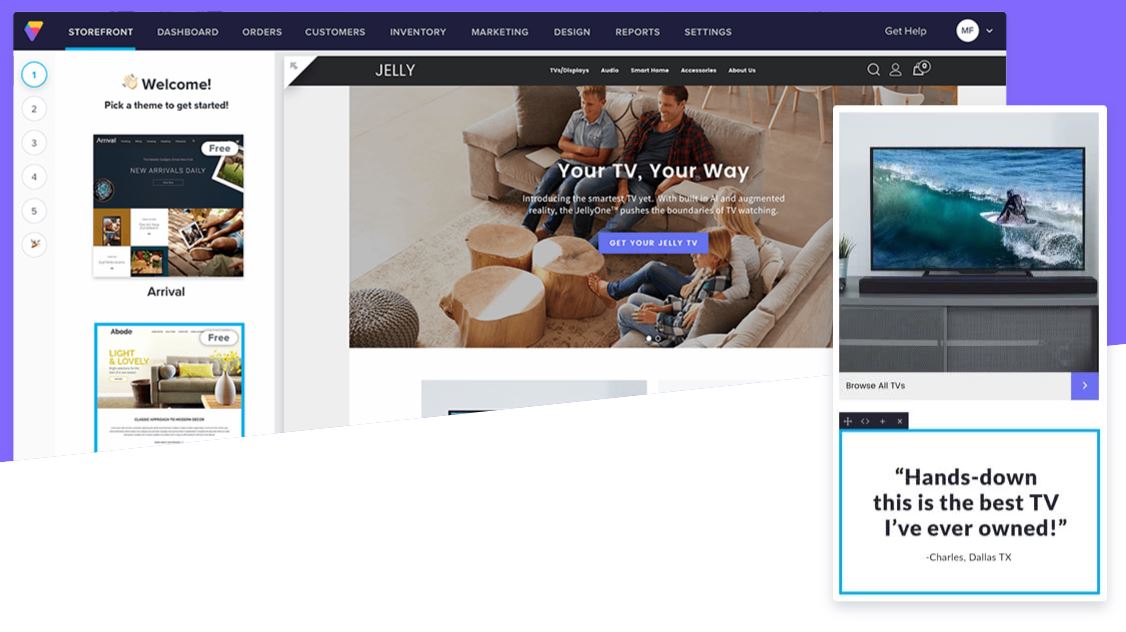
Volusion is a cloud-based ecommerce solution from the company of the same name in Austin, TX. It features an intuitive dashboard, built-in marketing and promos, SEO, templates, and tools to customize look and appearance.
Tumblr is very simple and seems to have more community adoption when compared to Blogger. Blogger gives you a little more control over the site when compared to Tumblr, though. WordPress outperforms Blogger on nearly all fronts. Blogger is free, however. So, if cost savings is …
Tumblr was quick and easy to use and required very little set up time. When setting up the Word Press account to try it out, it was clear it was much more time consuming to get up and running. Blogger just didn't have a look we cared for.
Volusion
No answer on this topic
Features
Blogger
Tumblr
Volusion
Online Storefront
Comparison of Online Storefront features of Product A and Product B
Blogger
-
Ratings
Tumblr
-
Ratings
Volusion
3.6
9 Ratings
73% below category average
Product catalog & listings
00 Ratings
00 Ratings
4.39 Ratings
Product management
00 Ratings
00 Ratings
4.39 Ratings
Bulk product upload
00 Ratings
00 Ratings
4.28 Ratings
Branding
00 Ratings
00 Ratings
3.69 Ratings
Mobile storefront
00 Ratings
00 Ratings
1.28 Ratings
Product variations
00 Ratings
00 Ratings
4.78 Ratings
Website integration
00 Ratings
00 Ratings
3.38 Ratings
Visual customization
00 Ratings
00 Ratings
5.19 Ratings
CMS
00 Ratings
00 Ratings
2.27 Ratings
Online Shopping Cart
Comparison of Online Shopping Cart features of Product A and Product B
Blogger
-
Ratings
Tumblr
-
Ratings
Volusion
3.6
9 Ratings
72% below category average
Abandoned cart recovery
00 Ratings
00 Ratings
3.67 Ratings
Checkout user experience
00 Ratings
00 Ratings
3.79 Ratings
Online Payment System
Comparison of Online Payment System features of Product A and Product B
Blogger
-
Ratings
Tumblr
-
Ratings
Volusion
4.1
8 Ratings
68% below category average
eCommerce security
00 Ratings
00 Ratings
4.18 Ratings
eCommerce Marketing
Comparison of eCommerce Marketing features of Product A and Product B
Blogger
-
Ratings
Tumblr
-
Ratings
Volusion
2.6
9 Ratings
99% below category average
Promotions & discounts
00 Ratings
00 Ratings
4.89 Ratings
Personalized recommendations
00 Ratings
00 Ratings
1.88 Ratings
SEO
00 Ratings
00 Ratings
1.28 Ratings
eCommerce Business Management
Comparison of eCommerce Business Management features of Product A and Product B
It's well-suited for helping you reinforce SEO for another site. It's OK for creating a real quick blog if you or a client needs something fast that does not demand a great visual design or a lot of visual content. If you want to create a super sharp-looking blog with a lot of visual content, WordPress will outperform Blogger by about 16 zillion to 1. Like, it's not even at all close. I would never use Blogger as my company's website. That would almost automatically consign your site to a very lonely existence.
Tumblr can be complicated when it comes to using it in a work setting. With the privacy options being somewhat limited, you will want to make sure that your staff are only sharing information that they are comfortable with in the public realm. You'll need to put some effort into designing an appropriate policy that covers the use of Tumblr and what content can be shared. If you're simply finding a way to engage staff and perhaps show outsiders what it is like to work at your organization, it can be used quite effectively, but you have to be mindful of how involved it gets.
Volusion is a good company if you're starting out. The problem is that, if you want more complexity out of the program, you're kind of stuck. Also the regular time out errors and slow downs can be very frustrating. Packages that miss overnight deadlines because your system stops working can cost you customers. In today's highly competitive market, that's just something that's hard to put up with. If you have a lower volume of business you might be able to work around these issues.
Templates are pre-built for a good end user experience. I've gone through the process of building custom sites as well as tweaking both free and paid templates that Volusion's design team provides.
Their support team didn't use to be as helpful, but in recent years have answered nearly all questions I've had. Their support section within the database provides detailed walkthrus as well.
Order processing is easy once you've been trained on the system. We got to a point where nearly the entire process was automated from initial purchase through shipping.
It can be hard to get followers, similar to Twitter.
Also similar to Twitter, its possible to get followers that are in no way interested in your business and seeking to promote themselves.
If you want to use Tumblr to promote your products online, it can be a trial and error process that can be frustrating for businesses that have little experience with photography.
API calls use the previous call as a reference, even if you weren't the one we made the previous call. Can lead to data gaps, so you often have to set a manual date range to look back to make sure you aren't missing any data.
I love the additional income and how great my blogs have turned out. It's given me ideas for others to build their blogs and has attained new clients for me. I make money using AdSense, how little or how much I want to make is up to me promoting my Blog.
Because of its ease of use - both on desktop and mobile - and the perks of being able to schedule a post for future release, Tumblr is a tool that we plan to continue using in the long term. Despite feeling like a primairly one-sided tool, it can also start conversations online, which is something for which we are always striving.
When you spend so much time with a product like this and not only have you witnessed its growth, but you almost feel like you are next those that make the decisions of building features a certain way, you can't help but want to stay and be a part of their continued growth. It's simply a great product. Can it improve? By all means! But it will only improve because of users and avid resellers like me.
Blogger has a simple layout with descriptive instructions when you first sign up. It can be intimidating at first but is easy to learn through simple navigation and a little trial and error
Tumblr is an easy to use tool. If you're looking for a simple platform that isn't complicated Tumblr works well. There are even ways to embed it to a company website.
Google doesn't support anything that's free. Anything. Seriously, when was the last time you saw a help number for a free Google app where you could pick up a phone and get a credible voice on the other end. Unless you're actually paying Google for a service you don't exist.
You have to wait on hold for at least 45 minutes every call—the tech support person never knows the answer right away so they put you on 10 minute holds only to come back and say they're still looking for answers. The chat function could take days to get a response. Our "Dedicated Account Manager" never checks in or answers, nor are they ever in the office when we call. It's like they try to be as unavailable as possible until you forget why you even called in the first place. Insane.
Have a plan written out for yourself, you can always make changes as you go. It's more difficult to build a Blog if one doesn't even know what the Blog is going to be about. It's best to plan what your Blog is going to be about and what your audience is going to be and what you want to accomplish before you start building.
It is best to use the built-in features and recommended services for the most turn-key experience (ie. Skipjack for payment processing so that it can all be done from the Volusion backend).
I've selected Blogger due to its simple user interface and open source feature. I can make my pages within a few minutes and add them to my website quickly, unlike other software, Iike Wix or WordPress, which is more advanced and requires pre-learning to make efficient use of them. With Blogger, I can start my blog building directly without any prior knowledge and coding.
Tumblr turns out to be better than Facebook Pages as it allows the pages to be in the form of customizable templates. It doesn't conform to specific rules for publications beyond the provided templates. Compared to WordPress, Tumblr is much simpler to use. It doesn't require any page management skills.
While k-eCommerce was very glamorous to us because it integrates with our main workflow, it just didn't have some of the marketing features that are so integral to the way we do business online. The set-up costs were also way too high. Volusion is so affordable and feature heavy, it makes it very difficult for any shopping cart provider to compete. You can find others who are competitively priced and have similar features, but they simply aren't as robust (at least for the way we use it)
Before using Blogger, we were sending out information to agents via email and they would either delete them or just not find them. Now since we keep all the information in one place, it has cut down repetitive questions and has given our agents a voice as to what is working for them and what is not.
We don't have any hard numbers, but we have heard back from our agents that the blog posts help them and not have to rely on contacting support stuff as often to find answers to simple questions.
The only negative impact felt so far is with a few select agents leaving negative feedback to blog due to personal issues they have with policies within the company.
Honestly, when you're in the dashboard, the UX is simply horrendous. I mean, everything that should be 1-2 clicks away is 4-6 clicks away, and each pages takes at least four seconds to load. You just find yourself wasting a lot of time waiting for things to load. This should be more simple.