BMC Helix ITSM replaces Remedy. It is a broad suite of ITSM, tools with strong integrations to other BMC tools and in-built ITAM. The product is used mainly by global brands and is offered in on-premise and SaaS configurations.
N/A
BMC Helix Remedyforce
Score 9.0 out of 10
N/A
BMC Helix Remedyforce is a cloud-delivered SaaS solution for IT Helpdesk and Ticketing Management.
$67.90
per user/per month
Splunk IT Service Intelligence (ITSI)
Score 10.0 out of 10
N/A
Splunk supports IT operations analytics with the Splunk IT Service Intelligence premium offering, a software application available to subscribers to Splunk Cloud or Splunk Enterprise log analytics and SIEM platforms.
BMC Remedy ITSM should be on your short list if you are considering a robust solution in an on-premise model. The implementation community is very strong and mature. BMC still has the broadest suite of complementary IT Operations add-on products which are still currently …
BMC Helix ITSM fits our environment particularly well, where standardized, auditable processes are already in place: Incident and Problem Management can be structured cleanly, with clear ownership, escalations, and fully traceable documentation—crucial in a highly regulated banking context. Through the customer platform/portal, users can log incidents and requests consistently, track their status transparently, and use a single central communication channel across service boundaries. This supports a service-oriented setup spanning multiple business services and locations. It becomes less suitable—or at least more effort-intensive—when core foundation data is not yet stable: an immature CMDB, insufficient ITAM data quality, and an unstructured knowledge base limit the value of automation and self-service. In addition, heterogeneous integrations and strict authorization models can increase implementation and ongoing maintenance efforts, especially when SLAs are not harmonized across different customer environments.
[BMC Helix Remedyforce] is probably best suited for an MSP who needs to keep multiple clients separated. If you were an internal IT department I think the additional features it has would be lost. When dealing with an MSP who needs to know what software and what issues have effected specific clients it is very well suited to do that.
Splunk ITSI is a great tool (and toolbox) for combining together numerous and varied monitoring regimes to bring more holistic analysis and reduce alert fatigue. By leveraging the Splunk ITSI service and KPI modeling regime, ecosystem telemetry can be turned into a more reliable, clearer, high-level perspective on the current state of your components and services.
AI drive incident correlation leading to identifying problems and major incidents quickly.
Digital Workplace gives end-users a modern and personalized UI to submit requests, monitor service health, and receive self-help.
As an enterprise ITSM, it is critical that Request, Incident, Problem, Asset, and Change Management are integrated and flow together. BMC Helix is built on this principle.
An admin user is able to quickly create a request definition with all of its components from one screen. We use to have to go to the 7 or 8 different screens to create each piece of the request definition.
Ability to update multiple Incidents/Service Requests at once with the update button. This allows essentially an inline edit functionality within Remedyforce.
Change management schedule is a great feature as well to be able to see how changes align and what there expected start dates/times are.
Service Level management configs can be lengthy, and when changes are needed to specific SLA, it does take a long time to configure. Templates work but only for certain things, lots of manual work is still required.
The Online product documentation can be confusing or in same cases not correct.
BMC products are sometimes expensive. When partners try to resell licenses or increase their own allotment, it becomes very expensive.
The ability to monitor/regulate the volume of tickets when you integrate with your monitoring software. We have so many items that trigger alerts, creating a ticket for each is somewhat overwhelming. Would like to be able to better control when an incident should be created.
Being able to report on Service requests and tasks together would be nice. Right now I have to do it separately as they are in different buckets, so to speak.
Remedy console is an improvement from where it started but can still be a cleaner interface for a tech to be able to work out of for their day to day work.
The total amount of time spent from installation to configuration for a minimal ticketing system was 2 hours. Maintenance and customization for the application can be completed with a great amount of ease. In addition having a customer portal is an added benefit that pays for itself
We have replaced our monitoring platform with Splunk & ITSI, and with the success, it's seen at our organization thus far we would be hard-pressed to pivot to another tool. Frankly, our business partners and application teams love Splunk & ITSI.
Overall the product enhances the capability of incident management, problem management and change management. The AI based framework helps generated better visibility and reports. The effectiveness of enhanced service desk suuport improves end user experience as the incidents are handled well in time and aged incidents are highlighted at the right time.
Splunk IT Service Intelligence (ITSI) is a platform with extended functionality and provides various functionalities which can be utilized to improve the efficiency and accuracy in analyzing the data and detecting the attacks.
Their tech support is top notch. They respond and get back to us, even on lower level incidents and issues, very quickly. It is rare that we deal with a support technician who does not know what they are doing.
During POC, pre-planning, and implementation, we have had interactions with numerous folks at Splunk. Everyone from sales & engineering to markets analysts to specific IT component SMEs, and a small professional services engagement to get started. They have all been exceptionally helpful and go above and beyond the call of duty. They actively reach out to ensure success is being realized and find ways to help proactively, instead of having to simply open support cases with the vendor.
the trainers dont have so much practical experiences. its mostly follow up and reading existing documentation withou own input. of course experiences people are on shore or have no free time. sad truth
Learning industry best practices or gaining insight on them from either BMC or an implementation partner would have saved some headaches we faced after roll-out.
I believe Remedy's performance and market share exceeds its competitors. But it is worth mentioning that Microsoft's SCCM has excellent integration with Microsoft enterprise solutions and has is less expensive and not efficient. The IBM solution has better analytics but lacks the wide features and capabilities of Remedy. HP & CA are the real competitors for Remedy but lacks the stability, maturity, and effectiveness in Remedy
I previously worked with tools like Service Manager which were difficult to configure, administer and maintain. The support options were very limited. Remedyforce has local US support, dedicated reps, and a more developed infrastructure to work from to support an organization. This runs on the Salesforce platform so worrying about server failures and unscheduled outages was no longer going to be an issue for us. Self service, knowledge base, and change control were just a few highly utilized features that helped employees support themselves and automate very manual processes.
Splunk has raised itself as a platform not just as a tool unlike other products in the market. If I talk about Moogsoft it also has similar capabilities but Splunk ITSI has more visibility and its GUI is making a different impact on the users. ServiceNow and Splunk are equally capable products however Splunk seems to have more tech-savvy people tools than ServiceNow.
Positive: an introduction to ITIL and viewing Asset, User Management from the perspective of ITIL, and how BMC has implemented those processes
Negative: The development team needs to communicate better with the sales and support side, and they need offer an open API
Negative: Currently the Asset Management side has little security and validation of Asset input: anyone can make API (mostly), at any item, which is a problem that I am apart of solving.
The UX needs updating, badly. Its quality is poor: it functions, but it is cumbersome, click-heavy and requires several hours to understand how to function with it. Also, it needs to ditch IE11 support, altogether.
Remedyforce has allowed us to eliminate other solutions that provided similar features. By now using one true ITSM we have been able to save money which in higher education is always a concern.
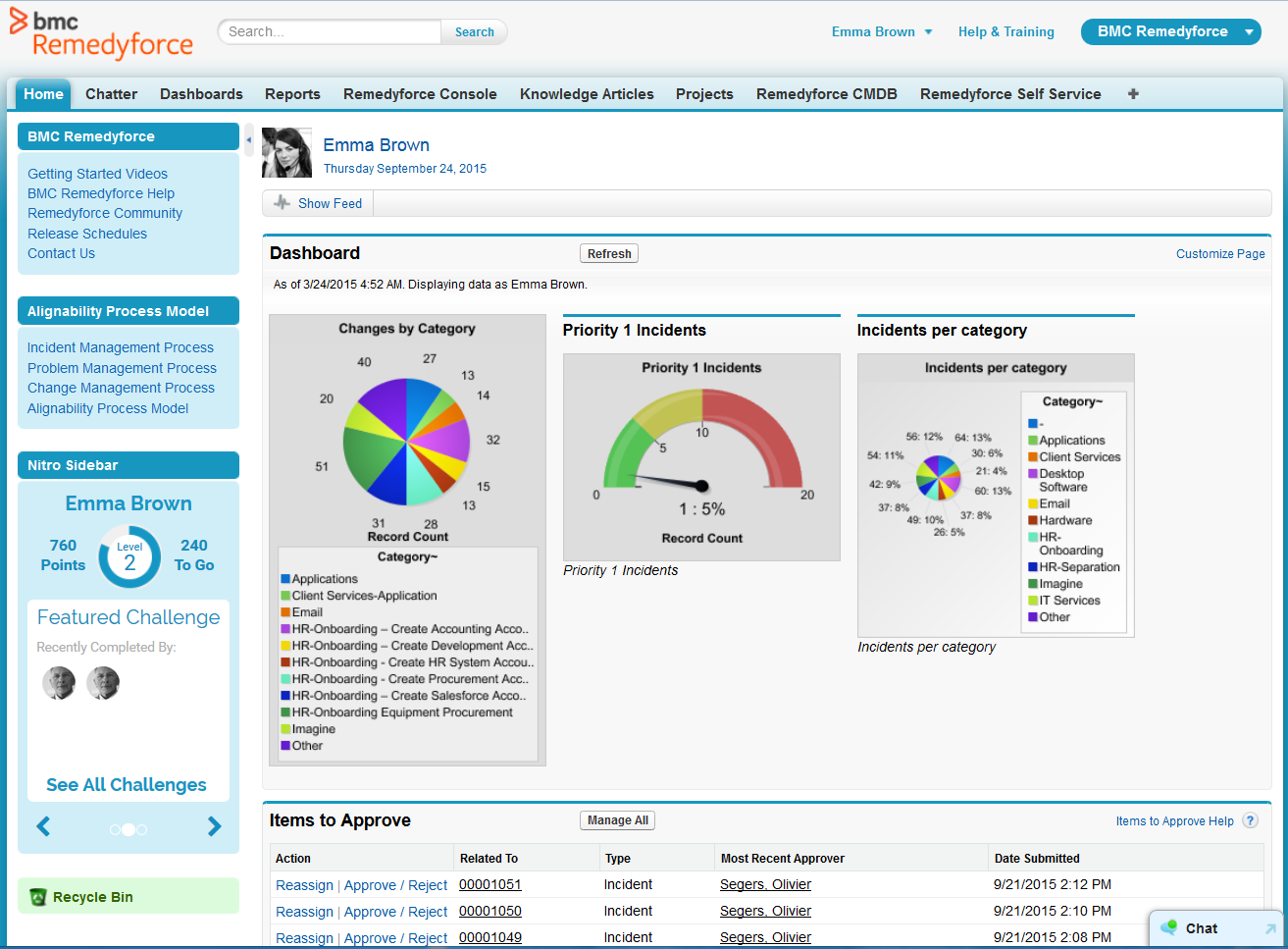
The reports and dashboards allow for a birds-eye view of our daily operations and provide managers and executives the information they need to make important cost saving decisions.
Splunk ITSI has reduced the number of alerts exposed to our Network Operations Center by 100x while increasing the context around outages.
Splunk ITSI has increased the accuracy of our incident detection by leveraging the Event Analytics system to weigh the behavior of the many characteristics of each component together instead of independently.
Splunk ITSI has reduced our incident MTTR (mean time to restore) by detecting issues faster, presenting them more clearly, and surfacing the salient details about the underlying issue.