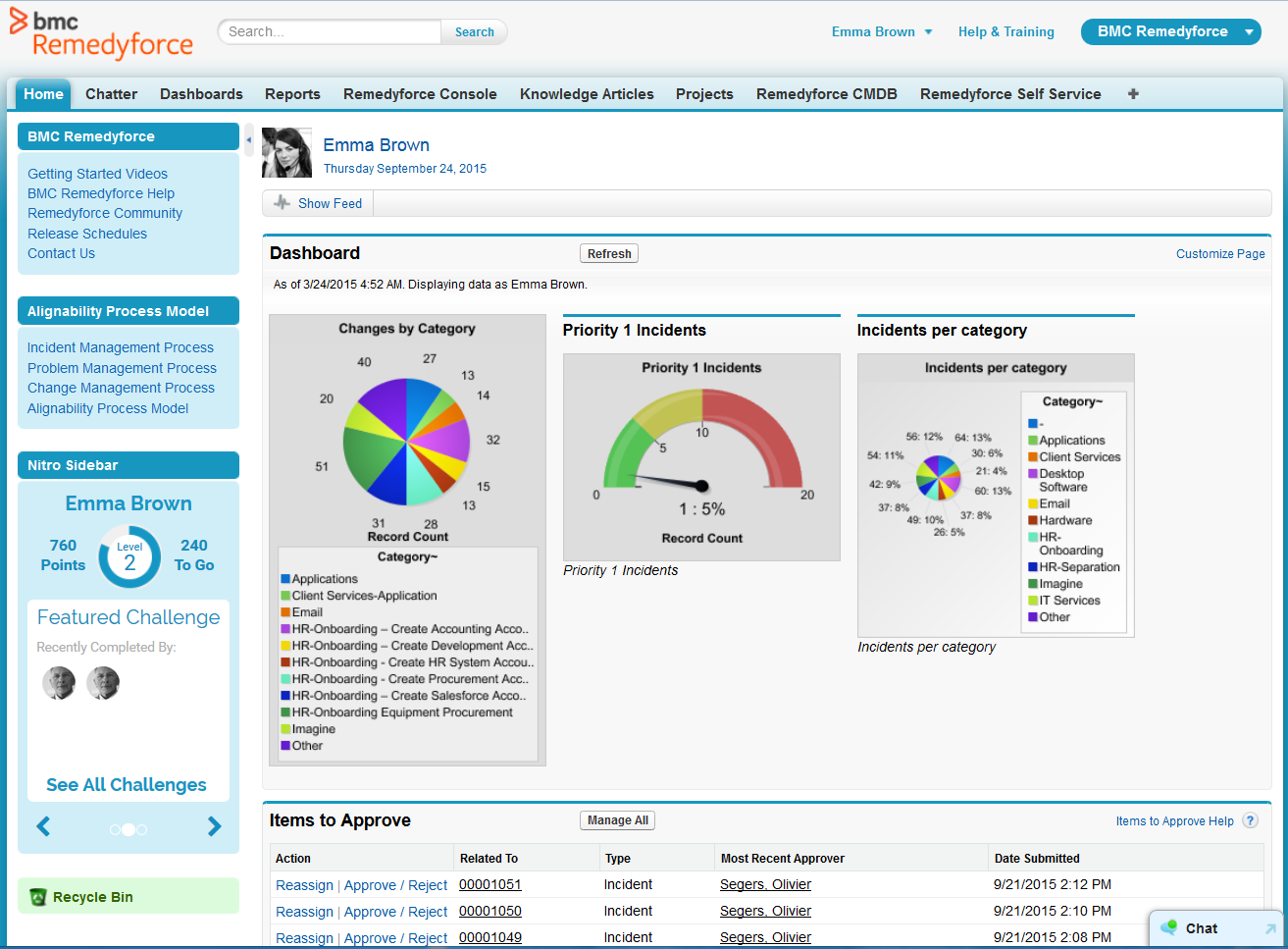
BMC Helix Remedyforce is a cloud-delivered SaaS solution for IT Helpdesk and Ticketing Management.
$67.90
per user/per month
Freshdesk
Score 8.4 out of 10
N/A
Freshdesk (a product of Freshworks Inc.) is a customer service solution with enterprise capability. Freshdesk unifies channels, conversations, AI capabilities, customer insights, and advanced ticketing into the Freshdesk Command Center so agents are ready to resolve. With Freddy, People-first AI, customer service teams can take AI agents live in minutes to fully resolve complex and simple queries, get response and resolution assistance from AI copilot, and stay ahead with AI insights.…
$18
per month per user
Kayako
Score 6.1 out of 10
N/A
Kayako is a help desk and customer support platform that helps businesses automate workflows, improve agent productivity, and deliver personalized customer experiences across email, chat, and social media.
Remedyforce had the most features of any ITSM we reviewed and was the most cost effective. This was the driving force in deciding to purchase the product.
Freshdesk, Zendesk and ServiceNow are all excellent. Other products have good points and bad points, but, in my opinion, are clearly inferior. It really comes down to implementation and how well the ticketing system is integrated with other systems, and customized for your …
[BMC Helix Remedyforce] is probably best suited for an MSP who needs to keep multiple clients separated. If you were an internal IT department I think the additional features it has would be lost. When dealing with an MSP who needs to know what software and what issues have effected specific clients it is very well suited to do that.
I believe Freshdesk is well-suited for companies that manage multiple accounts, such as those in the Business Process Outsourcing industry. It has all the necessary capabilities, such as ticket management that uses omnichannel to receive ticket requests from service requests (managed internally) in the system, emails, etc. There are also several workflow automations that can be built within the platform/system. What is lacking is the API documentation, which limits the possibilities for further automations. Overall, it is a highly recommended tool for managing employee productivity and timeliness.
When it works, It's without a doubt a great help desk solution. It is perfect for our usage, and have rolled it out company-wide. It's great if you have multiple departments. We have it set up so most items come through a single desk that then hands out tickets to their proper department. There may be cheaper options for smaller organizations but for one that is as service-driven as ours, we really think Kayako is a great fit.
An admin user is able to quickly create a request definition with all of its components from one screen. We use to have to go to the 7 or 8 different screens to create each piece of the request definition.
Ability to update multiple Incidents/Service Requests at once with the update button. This allows essentially an inline edit functionality within Remedyforce.
Change management schedule is a great feature as well to be able to see how changes align and what there expected start dates/times are.
No prior experience with similar platforms is required to use Freshdesk. I found its interface to be quite intuitive, at least for the end user.
It's easy to connect with other platforms, so you can sync and manage data from other platforms because the integrations work correctly.
Freshdesk's technical support is quite responsive, with short and effective response times. They have easily handled my questions and issues.
It has tools for customizing automated chats, answering frequently asked questions before transferring to an agent. Its configuration is extensive and highly customizable.
Gives a very good report on an individual level of what is being done for a customer or corporate issue.
Easy to understand who has what, what the tickets are about, how long they have been opened and how many times the customer/employee have gone back and forth with each other.
The ability to monitor/regulate the volume of tickets when you integrate with your monitoring software. We have so many items that trigger alerts, creating a ticket for each is somewhat overwhelming. Would like to be able to better control when an incident should be created.
Being able to report on Service requests and tasks together would be nice. Right now I have to do it separately as they are in different buckets, so to speak.
Remedy console is an improvement from where it started but can still be a cleaner interface for a tech to be able to work out of for their day to day work.
Departments need a bit of work. Even though you can have multiple departments, the only changes that can be made are globally. If you want independent queues within the departments, you have to do a lot of work that can be very confusing.
Survey system is not up to speed. Kayako really needs to add Net Promoter Score into their system. Also, if a staff user removes their name from an incident ticket, it removes them from the survey so you really can't even get a good estimate of how well your staff is in the eyes of the customer.
Very difficult to implement when you already have a customer base. Setting them up in organizations is difficult. Also, the sign-up for new customers is quirky. If you send an email to Kayako, it will say you are not an authorized user, however, it will store your email address. If you try to send an email a second time, it will go through. This is one of many reasons why we decided to move from Kayako to Oracle Service Cloud.
The total amount of time spent from installation to configuration for a minimal ticketing system was 2 hours. Maintenance and customization for the application can be completed with a great amount of ease. In addition having a customer portal is an added benefit that pays for itself
New support agents can learn the system quickly, minimizing training time and maximizing productivity from day one. Agents are more willing to use a system that is simple, reducing resistance to change and ensuring all interactions are logged (a common problem with complex systems). The platform is known for being easy to set up and customize, allowing teams (especially smaller ones) to get started with minimal technical expertise.The platform makes it easy to set and monitor Service Level Agreements (SLAs), ensuring customers get timely responses and helping managers enforce performance standards.
We are grandfathered in on their old Software-assurance pricing and our continued use costs us only a few hundred dollars a year (excluding hosting expenses)
Our team's processes are now heavily ingrained in the system
We have not been shown a more compelling option that is more cost-effective while still offering all the features we've come to expect
Freshdesk is extremely easy to use as implemented it on our own with average technical skills. A lot of the options are straightforward and Freshdesk provides easy-to-understand explanations for some of the more complex-sounding ones. We recently onboarded new specialists and they were able to learn Freshdesk with minimal training.
I have encountered a lot of errors in the Freshdesk, however, they tend to resolve it on priority or at least they will share the timeline by when this can be resolved. Most of the time the issue has been from the other partner's end. They take time to resolve their vendor issues and they don't have any timelines in case of developed app errors.
The reports take a lot of time to download if the time period is large. Also, the tickets take their sweet time to open and load. It is not fast as Zendesk. Only 30 tickets are visible in a single go and there isn't any option to select all. If we need to change the pages and dashboards it takes a lot of time to open.
Because I never worked with a company that responds so quickly to their customer! They are always fast at responding and very open to new ideas and quickly turning them around to include them in future releases. They walk us through when we need assistance and are very good at communicating. Overall top notch support
In-person training is provided to all the agents and it is very easy to learn the basics of the Freshdesk interface. Solving tickets via dashboards, replying to the guest queries in bulk via Freshdesk. The training which is a bit hard is creating the logic according to the ticket flow and intergeration.
This tool is no doubt easy to learn but in-person training is a lot better than online training. It takes time to grasp things in the online training, however, in pandemic we have done all the training online. Apart from a bit more time we haven't faced any issues with online training.
Learning industry best practices or gaining insight on them from either BMC or an implementation partner would have saved some headaches we faced after roll-out.
Was a fairly quick implementation for us. However, we are only doing email integration and not some of the more complex integrations that are possible. One clarification on an earlier question. I selected that Freshdesk doesn't have a given feature, but this is not true. I selected this because there wasn't a selection for I don't use the feature. This is a weakness in the survey.
Three years in we are about as happy with Kayako as we could be. We've had several employee's leave and on-boarding new hires was easier than it has ever been as things are uniform and consistent across the entire application.
I previously worked with tools like Service Manager which were difficult to configure, administer and maintain. The support options were very limited. Remedyforce has local US support, dedicated reps, and a more developed infrastructure to work from to support an organization. This runs on the Salesforce platform so worrying about server failures and unscheduled outages was no longer going to be an issue for us. Self service, knowledge base, and change control were just a few highly utilized features that helped employees support themselves and automate very manual processes.
Compared to Crisp, Freshdesk offers much more organization and is just much more helpful when it comes to having more than one region/team. Not that Crisp is bad, but with Freshdesk, internal communication and collaboration are much easier, which was quite important for our team to grow.
We were using Spiceworks for a few years before switching to Kayako but found that it wasn't as customizable or as user friendly for our customers. The SNMP scanning and inventory features with Spiceworks was nice but we needed more of a Help Desk that would allow us to scale our services to more companies.
I was not very involved with the purchase/contract (my company purchased Fresjdesk before I was brought on), but I will say that pricing per agent made it difficult to grow our support team. Additionally, we were kind of disappointed after our upgrade because it didn't solve our pain points as much as we expected.
My company had Freshdesk agents from support and success. It's generally difficult to customize permissions for different agent "roles." We were a fully distributed company, so "multiple sites" doesn't apply to us. We found Freshdesk features lacking as we grew our customer base, and adding agents wasn't easy because price steeply increases with number of agents.
Remedyforce has allowed us to eliminate other solutions that provided similar features. By now using one true ITSM we have been able to save money which in higher education is always a concern.
The reports and dashboards allow for a birds-eye view of our daily operations and provide managers and executives the information they need to make important cost saving decisions.
Tickets were definitely responded to faster once we implemented the audible alarm that would go off when new tickets came into the queue. This was possible because of the API.
Since the system was email based we could set our monitoring software up to generate tickets automatically via email for customers when it found something out of the ordinary.