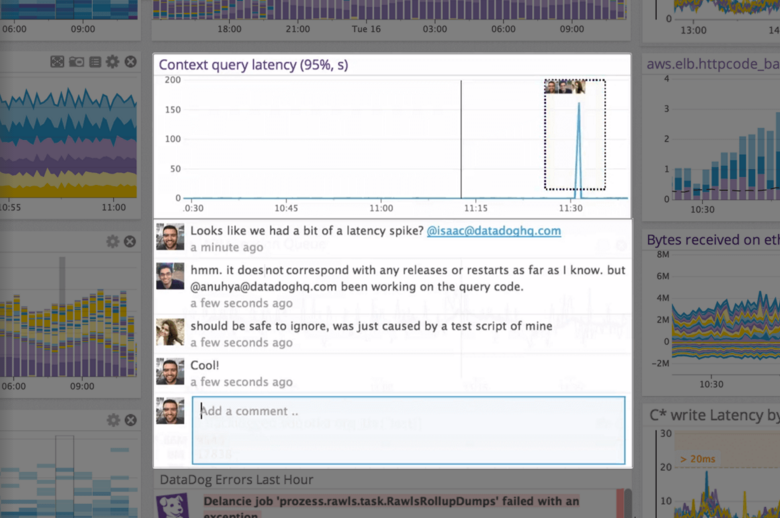
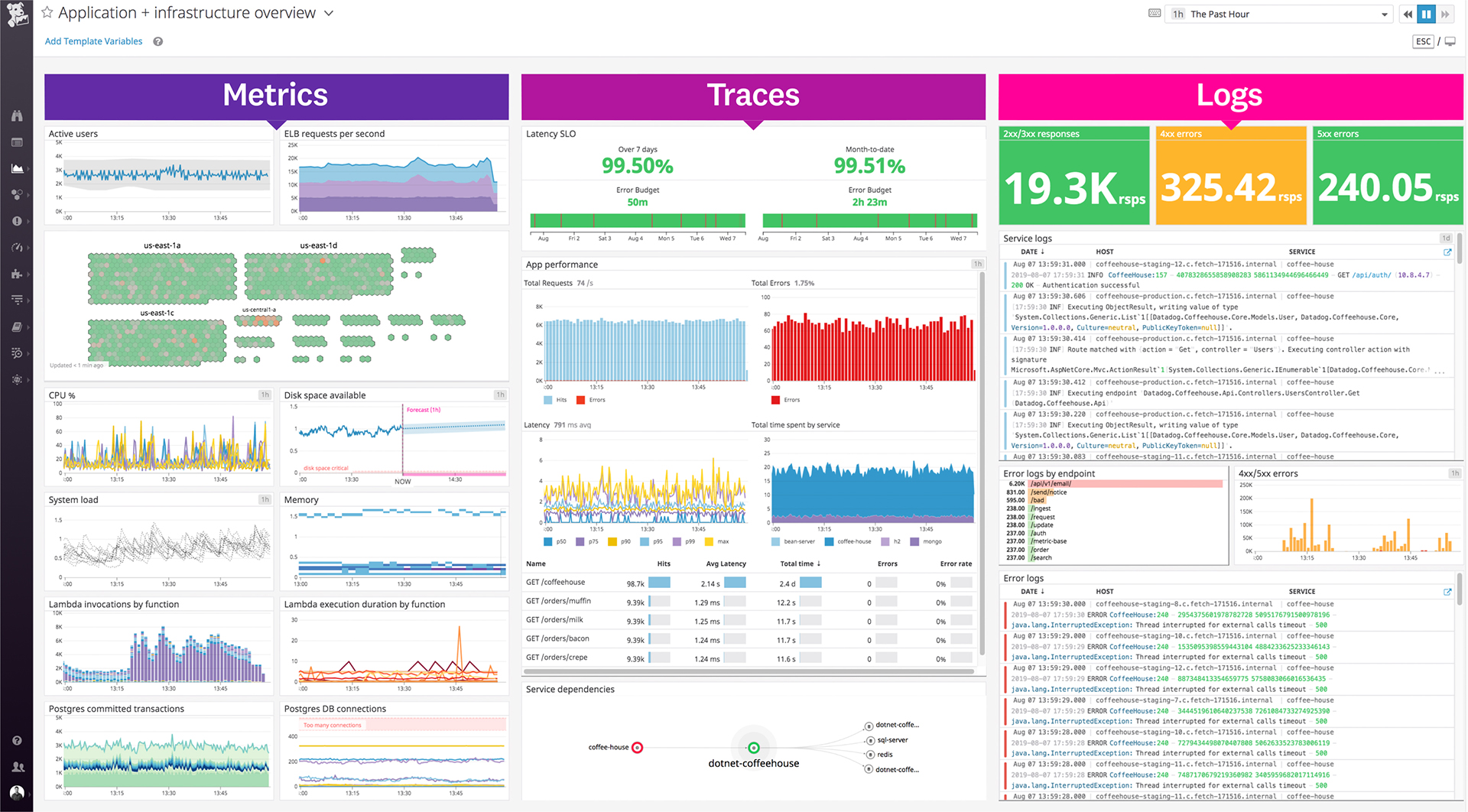
Datadog is a monitoring service for IT, Dev and Ops teams who write and run applications at scale, and want to turn the massive amounts of data produced by their apps, tools and services into actionable insight.
$18
per month per host
Graylog
Score 8.8 out of 10
N/A
Graylog, headquartered in Houston, offers their eponymous platform for centralized log management that helps users find meaning in data faster so as to take action immediately. Graylog is available via Enterprise and Cloud plans, but also has a Small Business Plan, and an Open (free) plan with limited features.
N/A
Splunk Enterprise
Score 8.6 out of 10
N/A
Splunk is software for searching, monitoring, and analyzing machine-generated big data, via a web-style interface. It captures, indexes and correlates real-time data in a searchable repository from which it can generate graphs, reports, alerts, dashboards and visualizations.
N/A
Pricing
Datadog
Graylog
Splunk Enterprise
Editions & Modules
Log Management
$1.27
per month (billed annually) per host
Infrastructure
$15.00
per month (billed annually) per host
Standard
$18
per month per host
Enterprise
$27
per month per host
DevSecOps Pro
$27
per month per host
APM
$31.00
per month (billed annually) per host
DevSecOps Enterprise
$41
per month per host
No answers on this topic
No answers on this topic
Offerings
Pricing Offerings
Datadog
Graylog
Splunk Enterprise
Free Trial
Yes
No
Yes
Free/Freemium Version
Yes
Yes
Yes
Premium Consulting/Integration Services
No
No
No
Entry-level Setup Fee
Optional
No setup fee
No setup fee
Additional Details
Discount available for annual pricing. Multi-Year/Volume discounts available (500+ hosts/mo).
Datadog has been harder to setup out-of-the-box compared to its alternatives, although it's graphs and dashboards have been more useful. Other tools handle individual tasks better. For example, Splunk has been the best logging tool I've used, and New Relic is great for CPU and …
It has been easier to work with Datadog for all our business needs and get things on their roadmap if we found it lacking. Currently we use a mix of various tools as they were existing prior to Datadog came. We are evaluating new offering like Datadog's latest log management to …
I am listing how Datadog is better than below chosen NotSensu - Datadog has more integrations and easy to use UI. Prometheus - Datadog Integration are more in number than, simple installation process
We are still trying other products, but people still like Datadog. After setting up a dashboard, it's great for monitoring instances on Datadog. Also, the DevOps team had a good time setting up Datadog. It means Datadog was way easier to set up compared to those others.
We use the free edition, because it is free and open source. We evaluated numerous other products, but we decided to go down the Graylog track because of initial costs. While the competition (Splunk, AlienVault, etc.) are very good products and come highly recommended, it …
In terms of log aggregation, the free product fully stacks up with the competitors listed. Full control over the data ingests for flexible configuration. Graylog even better on that front than AlienVault USM because you cannot configure the variable mapping. We haven't used …
Graylog does what other similar products that cost more do, but the more expansive one typically has more features or are multiple products wrapped in one. We went with Graylog because it does everything we need it too, and the price was less than other and fit into our budget. …
Splunk was better in terms of analyzing unstructured data. Also Splunk has had a very good and strong community and is also has a more tried and tested performance. I personally found the dash boarding capability of Splunk better than Datadog.
Splunk is the undisputed leader in Security Information and Event Management. Splunk Enterprise Security allows for massive, complex correlation of data across disparate sources. It can be deployed entirely on-premise or in a private cloud, giving total "data sovereignty." Datad…
Splunk Enterprise has been a well-established solution for many clients for a long time and is a major player in the market. Its track record and performance make it the best choice. Furthermore, its ease of use for developing, using, and managing data makes it the best among …
Splunk Enterprise is a very seasoned software , while other comparable software keep on adding new features and keep evolving, Splunk Enterprise has reached a state where new user onboarded doesnt have to request any basic feature or develop modules to simple tasks. Log parsing …
Both Logstash and Greylog are open-source solutions that provide similar capabilities to Splunk. They are excellent products in their own right but tend to follow versus lead. Splunk is definitely a leader in the field.
We are using this because it has lots of advantage over others. And it seems to be a good fit for us. Splunk provides lot more features than others and its UI is user-friendly, so for a new developer, it would not be too difficult to use it and do something around it.
Datadog may be better suited for teams that have a more out-of-the-box infrastructure, on the primary platforms Datadog supports. You may also have better results if you have a bigger team dedicated to devops and/or a bigger budget. We found that trying to adapt it to our use case (small team, .NET on AWS Fargate) wasn't feasible. We continually ran into roadblocks that required us to dig through documentation (and at times, having to figure out some documentation was wrong), go back and forth with support, and in my opinion, waste money on excessive and unintended usages due to opaque pricing models and inaccurate usage reports, as well as broken/non-functional rate sampling controls.
For small companies, Graylog is the best solution possible. It's easy to configure and "just works." Above everything else, it's free. The only thing I hold against it is the fact that it's Linux-based. [This] makes sense because Elasticsearch is Linux-based. But Linux adds a layer of complexity that we don't need for something basic as a logging server. I'm pretty sure that we would have had a logging server years earlier if I had to convince quite a few decision-making people to go ahead with it anyway.
It's well suited for what I do, which is network security operations. And that's for anything from troubleshooting incidents, troubleshooting performance, troubleshooting for the purpose of a compliance and auditing. It's not best suited for users who are new in terms of they're new to the product and they have expectations that probably Splunk cannot meet.
The thing which Datadog does really well, one of them are its broad range of services integrations and features which makes it one step observability solution for all. We can monitor all types of our application, infrastructure, hosts, databases etc with Datadog.
Its custom dashboard feature which helps us to visualize the data in a better way . It supports different types of charts through those charts we can create our dashboard more attractive.
Its AI powered alerting capability though that we can easily identify the root cause and also it has a low noise alerting capability which means it correlated the similar type of issues.
Graylog does a great job of its core function: log aggregation, retention, and searching.
Graylog has a very flexible configuration. The backend for storage is Elasticsearch and MongoDB is used to store the configuration. You have to option to make your configuration as simple as possible by storing everything on one box, or you can scale everything out horizontally by using a cluster of Elasticsearch nodes and MongoDB servers with several Graylog servers pointed to all the necessary nodes.
Graylog does a good job of abstracting away a fair portion of Elasticsearch index management (sharding, creation, deletion, rotation, etc).
Alert windows cause lag in notifications (e.g. if the alert window is X errors in 1 hour, we won't get alerted until the end of the 1 hour range)
I would appreciate more supportive examples for how to filter and view metrics in the explorer
I would like a more clear interface for metrics that are missing in a time frame, rather than only showing tags/etc. for metrics that were collected within the currently viewed time frame
We are using Splunk extensively in our projects and we have recently upgraded to Splunk version 6.0 which is quite efficient and giving expected results. We keep track of updates and new features Splunk introduces periodically and try to introduce those features in our day to day activities for improvement in our reporting system and other tasks.
There are so many features that it can be hard to figure out where you need to go for your own use case. For example, RUM monitoring us buried in a "Digital Experience" sidebar setting when this is one of our key use cases that I sometimes struggle to find in the application. It appears that ECS + Fargate monitoring was recently released which is great because we had to build a lambda reporting solution for ephemeral task monitoring. But this new feature was never on my radar until I starting clicking around the application.
Graylog is easy to deploy. The tricky part is to configure all hosts that are going to send their log data to Graylog, considering the retention period of this data, it will need a lot of disk space to store it. Its rotation works fine. It is very simple to navigate and explore the data you send to it, and very easy to filter and export them too.
You can literally throw in a single word into Splunk and it will pull back all instances of that word across all of your logs for the time span you select (provided you have permission to see that data). We have several users who have taken a few of the free courses from Splunk that are able to pull data out of it everyday with little help at all.
The support team usually gets it right. We did have a rather complicate issue setting up monitoring on a domain controller. However, they are usually responsive and helpful over chat. The downside would be I don’t think they have any phone support. If that is important to you this might not be a good fit.
Community support does not give simple straightforward answers; simply search up Graylog Issues and look at some of the responses on the forums. The documentation is your only hope if you are on the free version, as you can NOT purchase only support. The few times I have worked with Graylog Enterprise support they were great though.
Splunk maintains a well resourced support system that has been consistent since we purchased the product. They help out in a timely manner and provide expert level information as needed. We typically open cases online and communicate when possible via e-mail and are able to resolve most issues with that method.
The online course was simple clear and described the main capabilities of the solution. There is also an initial module that can be done for free so anyone can familiarize themselves with the functionality of this solution. On the other hand, however, there could be more free online courses. Maybe even with a certificate, this would broaden the group of people who are familiar with the platform while increasing familiarity with the solution itself.
Our logs are very important, and Datadog manages them exceptionally well. We frequently use Datadog services for our investigations. Use case: Monitor your apps, infrastructure, APIs, and user experience.
Key features:
Logs, metrics, and APM (Application Performance Monitoring)
Real-time alerting and dashboards
Supports Kubernetes, AWS, GCP, and other integrations
RUM (Real User Monitoring) and Synthetics
✅ Best for backend, server, and distributed systems monitoring.
In terms of log aggregation, the free product fully stacks up with the competitors listed. Full control over the data ingests for flexible configuration. Graylog even better on that front than AlienVault USM because you cannot configure the variable mapping. We haven't used the threat exchange stuff or correlation. But with regex searches, we have created function dashboards that show threat theater pictures of our network based on logs from our firewall.
I didn't get to fully evaluate Logstash as our corporation was already using Logstash, but both seemed like viable solutions to the problem that we were having. I wanted to evaluate Logstash some more, both did seem like they would work for the business needs that we had, we went with splunk as many teams were already using it.
I don't have any numbers to share but Splunk has positively served as a 24/7 monitoring tool that has saved hours of work by self-detecting, saving statistics and alerting problems in the system or from external interfaces as soon as they happen.
Splunk dashboards does a solid job in collecting, analyzing data and creating reports that contain an entire day's activity and then automatically sent out to the business.
Splunk is very easy to learn and very useful to any program or business application.