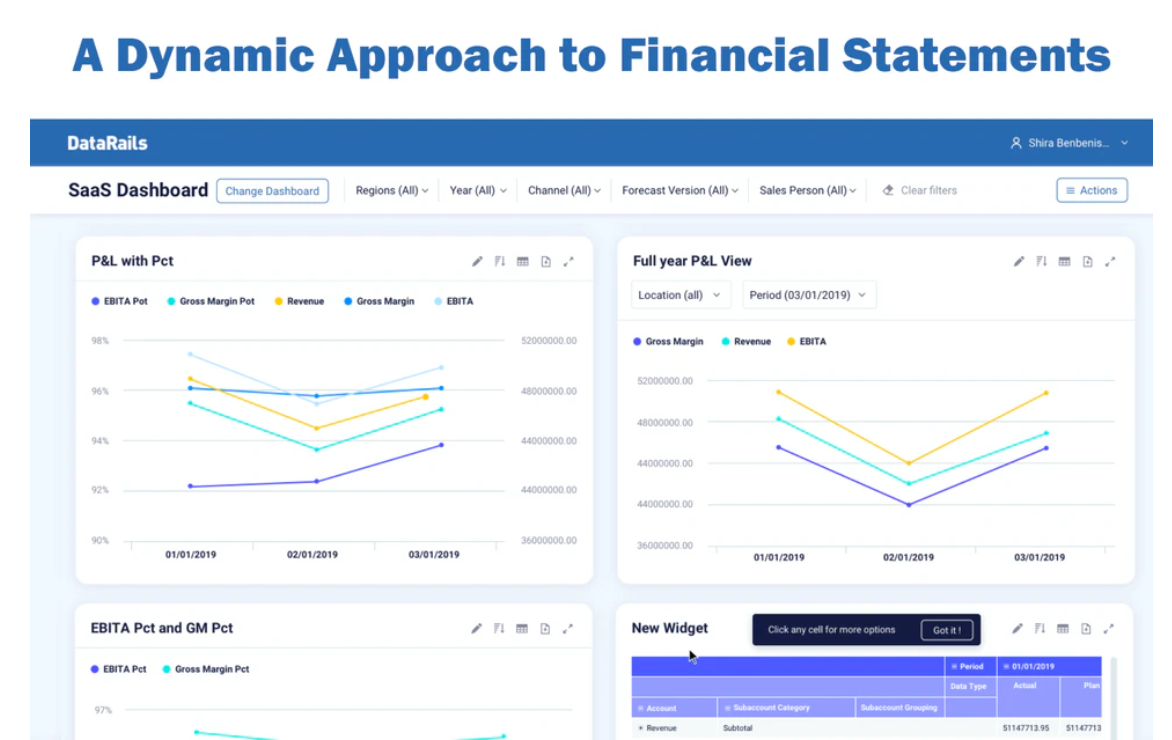
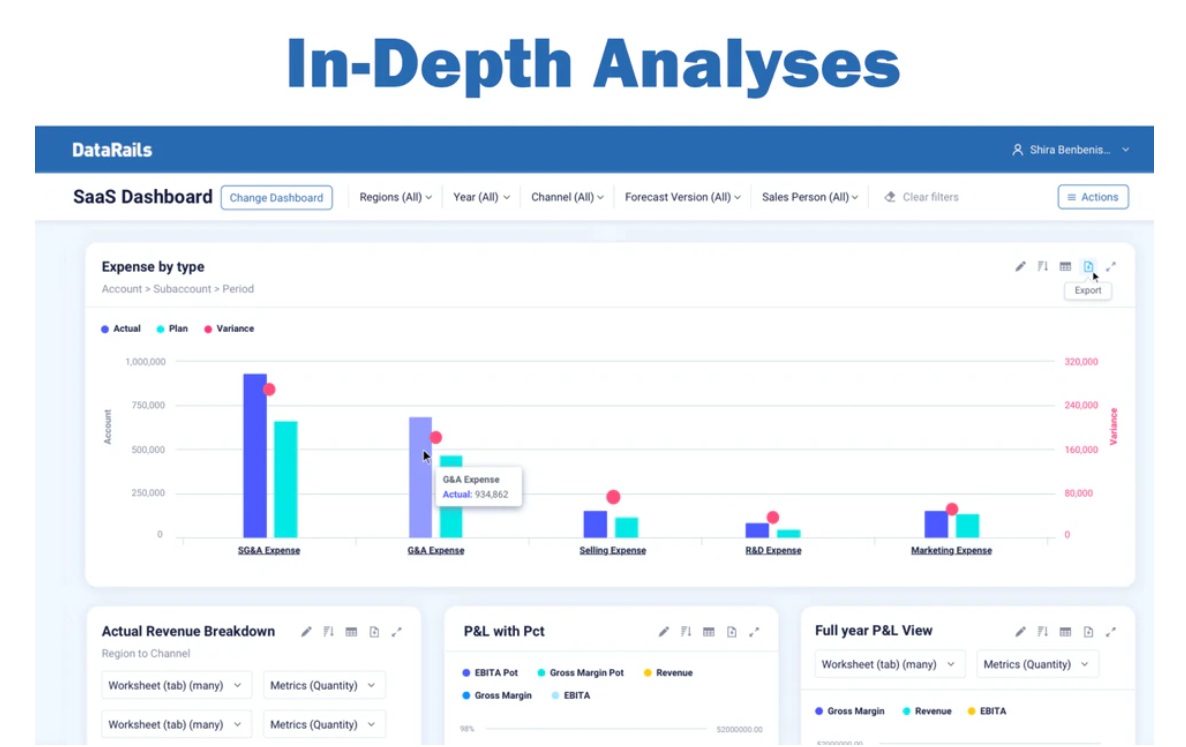
DataRails is an FP&A solution that automatically consolidates data from all existing organizational systems (ERP, GL, CRM, and HR data). It is designed so users can keep working on Excel while benefiting from automated data transformations. The vendor states users will enjoy a 360-degree view of consolidated data for easy reporting, simple visuals, and in-depth analytics. With DataRails, users can perform advanced investigations into data to extract actionable, attainable insights.
N/A
Vena
Score 8.1 out of 10
Mid-Size Companies (51-1,000 employees)
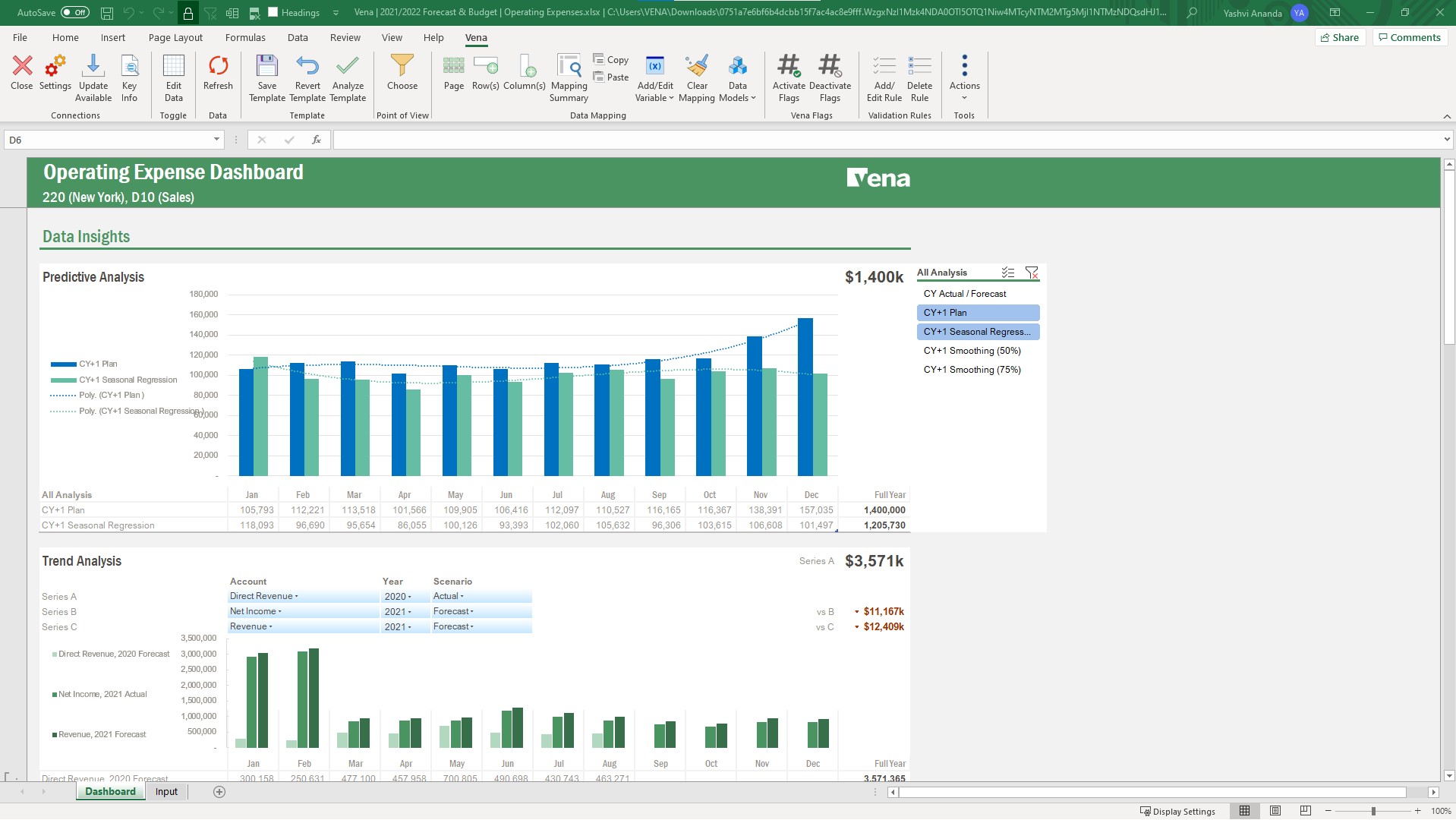
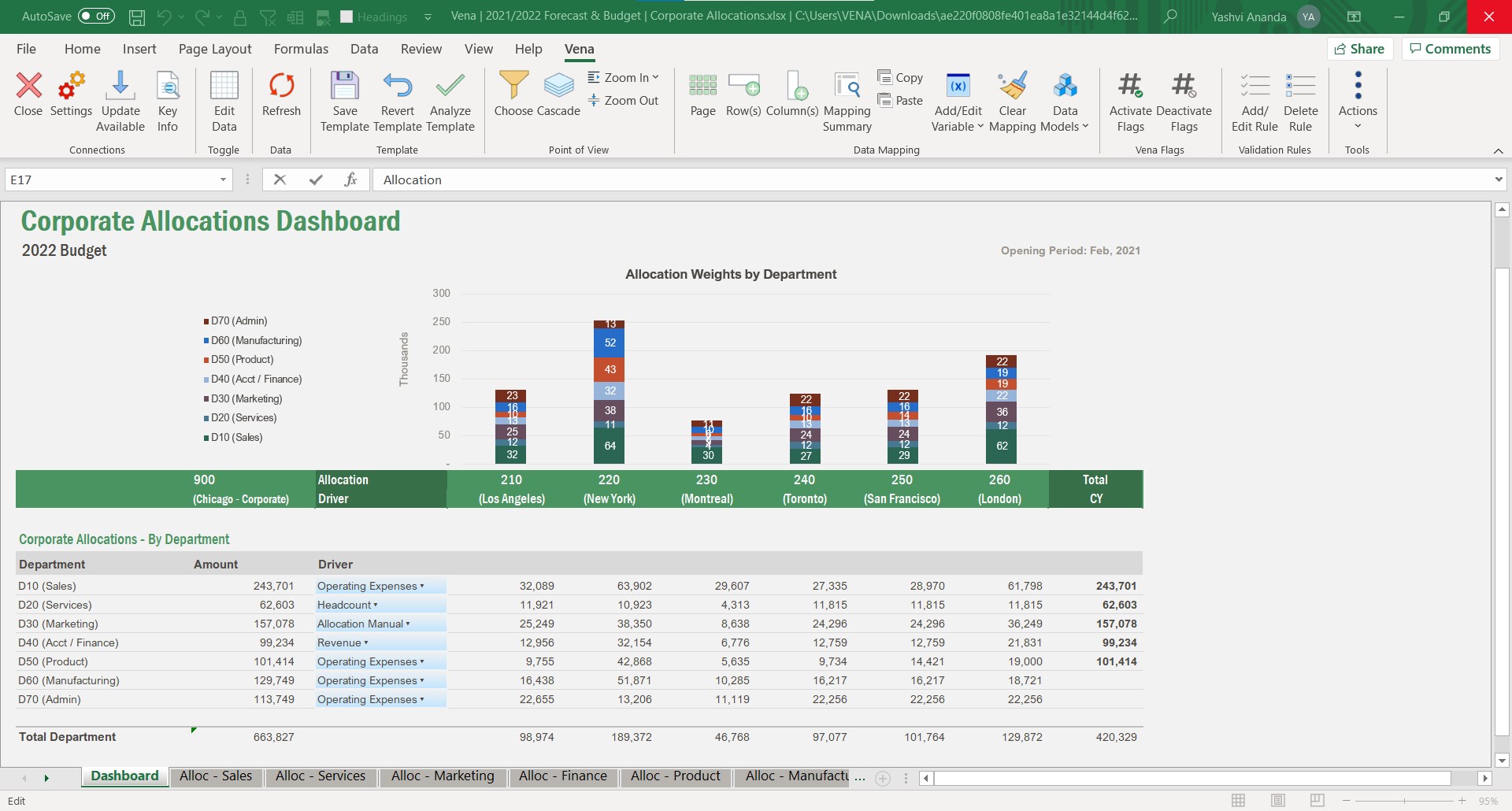
Vena Solutions provides a financial process automation solution to automate Corporate Performance Management, accounting and budgeting, Regulatory & Compliance, and other finance-related processes. It is scaled for medium to large-sized organizations.
N/A
Workday Adaptive Planning
Score 7.7 out of 10
Mid-Size Companies (51-1,000 employees)
Workday Adaptive Planning streamlines planning workflows, using AI and real-time data integration to improve collaboration and provide predictive forecasts for better strategic analysis.
N/A
Pricing
DataRails
Vena
Workday Adaptive Planning
Editions & Modules
No answers on this topic
Professional
N/A
Complete
N/A
No answers on this topic
Offerings
Pricing Offerings
DataRails
Vena
Workday Adaptive Planning
Free Trial
Yes
No
Yes
Free/Freemium Version
No
No
No
Premium Consulting/Integration Services
Yes
Yes
Yes
Entry-level Setup Fee
Required
Optional
Optional
Additional Details
—
The Professional Plan is the most flexible way to get started quickly and can be added onto as a company grows. The plan includes: Vena Platform, Customer Success Manager, Standard Support and Customer Portal.
Complete Plan includes everything in Professional, plus: Vena Insights, Premium Support, Sandbox Environment, and Expert Managed Services.
For a limited time, new customers who use Microsoft Dynamics 365 Business Central (Online) as their primary ERP can get a free year of Vena and 40% off implementation costs.
Vena also offers special pricing for not for profit organizations. To learn more, speak to an expert.
Honestly and in evaluation with other tools , Vena outperformed competitors like Workday Adaptive Planning ,because it offers centralized financial planning with strong automation while still keeping Excel at the core , speeding up the reporting cycles and achieving wider …
DataRails - was the closest to Vena but their product development seemed behind and we were concerned about their ability to continue development as well as supporting us. Cube - poor product for us. Seemed applicable to small businesses. Limited features, inexperienced sales …
We evaluated Vena alongside DataRails, Planful, and Board during our selection process. Each is a credible platform with real strengths, and the right answer depends heavily on the organization's environment, team composition, and what they're trying to accomplish.
We selected …
we liked that Vena was fully integrated into Excel and we were already doing all our manual work within excel and creating all our reports and templates so we thought that only made sense to use Vena as it was most comfortable for us
We really like the features that Vena provides working Excel. the ability for the planning tool to have familiarity for various members throughout the organization was what ultimately led us to choosing Vena. Both tools were very impressive when demoing and felt like either …
Adaptive was not Excel-friendly, very slow, and crashed often. We have attempted to fix our build prior to switching to Vena for several months, and ultimately made the decision that switching was the better approach after having a wonderful sales demo presentation with the …
Ultimately we decided on Vena because of the Excel interface which we knew would improve adoption. We also like the platform agnostic integration and easy-to-use web interface. The OLAP cube was also appealing to allow for a variety of pivoted reports.
Vena allowed for the most customization that made everything easy for us with our complicated system of managing allocations across products and time by employees.
Vena is a little pricier based on what we were quoted but was far better suited to our business, from what I have researched and from the initial pitch we had with both. It also seems to have a wider user base and appeal to larger businesses, which suits us better.
Vena is much faster than other such software which is available in market. If we talking about pricing $$$ so Vena is affordable to smaller companies also. it's help us quicker integrations with other software and User Interface is much better than other software. Vena gives …
Vena is much more flexible than Adaptive. We deeply evaluated Adaptive, looking at database structures, workflows, user interfaces, reporting. While Adaptive is strong in some areas (predictive forecasting using AI etc..) it was not able to meet our needs with complex business …
Vena Solutions is far beyond Yardi Voyager because Vena can put a custom report together in a few minutes instead of hours. You don't have to do a lot of drilling to get the details of the amount and you can see all the history of the amount by click on the cell. It makes the …
We selected Vena because it offered the following features: API connection with many of our tools (Power BI, Sage Intacct, Salesforce), worked well with both MAC and PC, ability to set up workflows with automated emails, ability to set up permissions by multiple dimensions, …
When looking at other tools, we were concerned about end user adoption and Vena stood out because of the use of Excel. It is a familiar format and provides almost endless flexibility when considering business processes that can be added. At first, Adapative was a front runner …
Prophix is powerful, and structures data on the back-end in a very similar way with multiple data models, and I have used it before. But the learning curve is steep. Building complex rules, e.g. for a union personnel model, was much harder than designing the same logic in …
I really like Vena for organizations with smaller finance teams. Excel is at the heart of Vena so there is a less new technology for them to learn. All three solutions have strengths that make them appropriate for specific organizations.
We went with Vena because of its ease of use, i.e. the ease in which the staff was able to adapt the system and use it. We went with Vena because they were very reasonably priced - a huge consideration for a nonprofit like mine. And, we went with Vena because I am able to …
At the end of the day, Vena offered great value without having to involve IT. It was an easy to implement system for us. We could query the data from our financial system and created a process to send it to Vena using Box and Microsoft Power Automation (formerly Flow). Because …
After researching several CPM products, Adaptive and Prophix actually both met our needs quite well. The Adaptive Sales & Design Team went above and beyond in the early stages of exploring whether Adaptive could meet some of our very specific needs. Adaptive's customer …
I prefer Adaptive Planning in comparison to Planful and Data Rails. It feels like is has been easier to use with a quicker learning curve. The other systems were more intimidating for the nonfinance users, like the budget owners who would only need it for reporting or inputting …
Adaptive was more flexible, able to be maintained without heavy IT involvement, cost effective, had no additional hardware requirements, and since it is a cloud platform, updates are automatic.
Vena suited to our environment because we do have so many different budget owners that are in so many different places in our organization and for them to all be able to go onto the software and bring it down in two native Excel where they are all used to work in Excel and putting in the line items and pieces that go with their budget is super helpful a scenario where it might not be as helpful is when we are bringing people on and trying to teach them how to report and map because we struggle with that so much ourselves that it is a difficult situation to try to get people to understand things that we’re you know may be struggling to understand ourselves.
We're a mid-size organization working with a shoestring budget and an IT skeleton crew...not much room to dedicate resources to a platform like this fully. Having it SaaS based is helpful for system management through their Helpdesk system, and a single platform also helps streamline the knowledge needed by our developers when integrating other business aspects to Workday.
It helps create dynamic plans for finances, operations and various functional units in an organization all under one platform
It helps in scenario modeling to help analyze various business events and report by any number of business dimensions including channel, customer or product
It can be integrated with any system including ERP, BI or CRM
Have another license between power user and contributor that allows building reports that aren't ad hoc, but don't have all the admin rights of a power user.
Have a session on best in class Workforce Planning prior to implementation.
Dashboards are not the best for graphs/charts. However, I have heard of companies using the dashboards for forecasting/budgeting. I would like to see Workday Adaptive Planning demonstrate this part of the feature.
Better security or locks to prevent deleting Actuals data - you are literally one click away from doing this.
On the web-based reports, better functionality when needing to reverse the sign in calculations - right now it is only available for revenue vs. expenses.
Vena has become an integral part of finance and our daily process. Without it we would take longer to prepare results and decisions will be delayed. Vena has given the whole organization more visibility of results and budgets so that all departments participate more actively in managing their budgets rather than it being the sole responsibility of finance.
For one we're in way too deep to not move forward with Adaptive. We're integrated with Workday, we do a ton of reporting with Adaptive, and it's working very well for planning and forecasting. No reason to look back or change course.
I would rate Vena's overall usability as an 8 out of 10. Vena offers a user-friendly interface, especially for those familiar with Excel, making it relatively easy to use. Most features are intuitive. However, some advanced functionalities may require more training or time to master, so it's not a perfect score. Overall, Vena provides a solid user experience that supports efficient financial planning.
It is overwhelming at first, but once you really get to know it, you realize it is fairly simple and customizable, and then it has a lot more limitations than you first thought. Realizing those limitations and finding workarounds is when you know you've mastered the software.
Vena is seemingly always available. They plan maintenance windows well in advance and always off hours (typically over a weekend) and communicate clearly throughout maintenance about what will be affected. Over 5 years of using the product, I can only remember one time when the platform was unavailable (I believe due to an underlying server hosting issue from their provider), and they resolved the issue and had everything up and running again within 8 hours.
There haven't been any lately. The only one issue I can think of is when there was an update in Adaptive that altered our reports. Before I realized there was an issue, Adaptive reached out to let me know, so that it could be fixed.
The performance is dependent on how much data and calculations are involved and how complex the security settings are. A simple template or report loads in seconds. A complex template or report can take a while. If there are many users with complex security settings, that will be a factor in the load time.
All aspects of Adaptive Insights perform well. One area that I wish was quicker was integration. When importing data from Intacct our accounting ERP platform, it can sometimes take 4 hours for the import to process. The earlier imports are done, the quicker they complete. My estimate for a quick upload is about two hours.
They are very quick to respond when you submit a ticket and typically fix issues quickly as well. I only didn't give this a 10 because there is still an open issue with our Salesforce connection that we've been waiting on now for a few months.
Whenever we have had any questions, issues, or concerns, the support has been quick and thorough. [This] allow[s] us to be able to fully resolve any issues, or be connected with the right group quickly to attain the result we were after; be it from simple formatting to adding new detailed reporting.
This is the best way to learn and buy-in. The in person effect gives students both a hands on approach but an instruction to be there to customize assistance and understanding. In person also builds greater buy in with your future team on creators. However if your audience is better at on line learning this is another good option.
This was extremely helpful so that they could walk you through the model and teach you more about the complexity of various areas. It is most helpful when it is specific to your organization's model. The larger in-person trainings were helpful but they tended to be more generic and entry level. The trainings that are more tailored to your specific needs are the most helpful.
The training was structured as a group training to learn the basics of creating a data model and mapping a template. While we had nearly 10 participants, I was the only actual implementer so we probably didn't actually need the training and could have just learned the initial skills from the implementation consultant. Two years later, when we hired a new team member, they completed several modules in Vena Academy (a self paced learning course) which allowed them to get up to speed on the basics with just a bit of supplemental guidance from me as our existing admin.
They often times tended to be way too generic or entry level. They would also become sales pitches to upgrade or get new Adaptive Planning products. The questions in the training would be very niche and specific to other organizations. They were rarely helpful to the group at large.
The Vena consultant had great knowledge of both the Vena solution and Excel and Excel functions. He was able to help suggest ways to build our templates that met our requirements using Excel functions we had not previously considered using. And we have been able to use the Excel information he provided in other ways outside of Vena. He was very patient and flexible as we learned the Vena tool and created templates
Trust the expertise of very strong 3rd party implementers. Having deployed Adaptive at a separate company before, I thought I knew it all (hubris, I know). Fortunately, I began to (very quickly) trust the judgment of our Carlson implementation team, and they provided invaluable insights and best-in-class processes that have benefitted me and my team greatly.
Vena is Excel-based, which is what our users wanted. Pigment was web-based, like Adaptive, but our users did not fully trust or adopt it. Adoption drives success for any software. Amy's software, which is not adopted, has a negative ROI by definition. Vena was the right choice for us.
Workday became our choice because it is fully web-based and easily integrates with other systems. The learning curve for Workday was shorter than that of Dynamics. The reporting tools in Workday are more user-friendly than that of Dynamics. However Workday did not have Check Printing tools which are available in Dynamics. The organization started a project to digitize all financial transactions so it was not a priority feature. When it comes to scaling up the functionalities of Workday it was much easier than Dynamics.
Vena solutios is a software that provides robust tools that help different departments in their statistics and we can visualize a lot of promising and visually attractive data. Vena Solutions' level of scalability is high and sustainable over time thanks to the fabulous technical support that is ready to help us at all times
We went from 2 users to 70+ users over a 2 year period of time. The application scaled wonderfully. 65 of those users were non-finance users so they were able to quickly learn the software and prepare budgets quickly and efficiently. That is the power of Adaptive and its ability to scale
Automated monthly financial statements saves us 3 hours a month.
Moving reporting away from IT has begun to save hours of IT involvement, which will only grow as we shift more reports to Vena. This frees up IT to work on more important IT initiatives.
Using budget templates saved hours of copy and paste time when gathering inputs from each department.
It's facilitated a better financial literacy and management by the non-financial managers in the company, giving them a much better ability to see what they're spending, control it, and plan better in the future.
It's hard to quantify the ease of model and version management, but we could never do what we're doing now with our current staff. It would take a small army to replicate anything close to what Adaptive pulls off using Excel, if it's even possible.