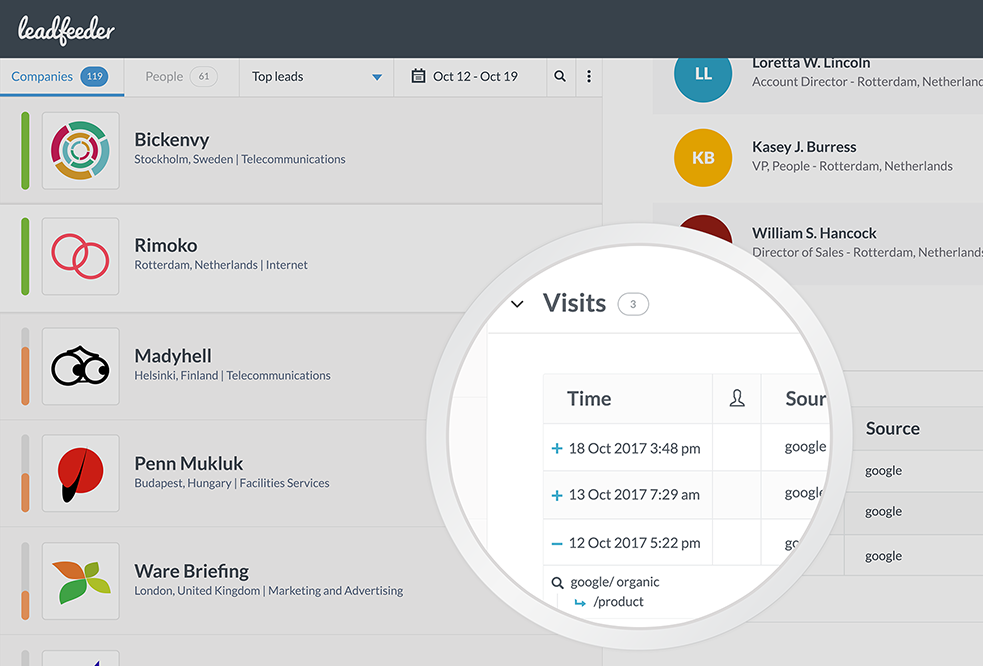
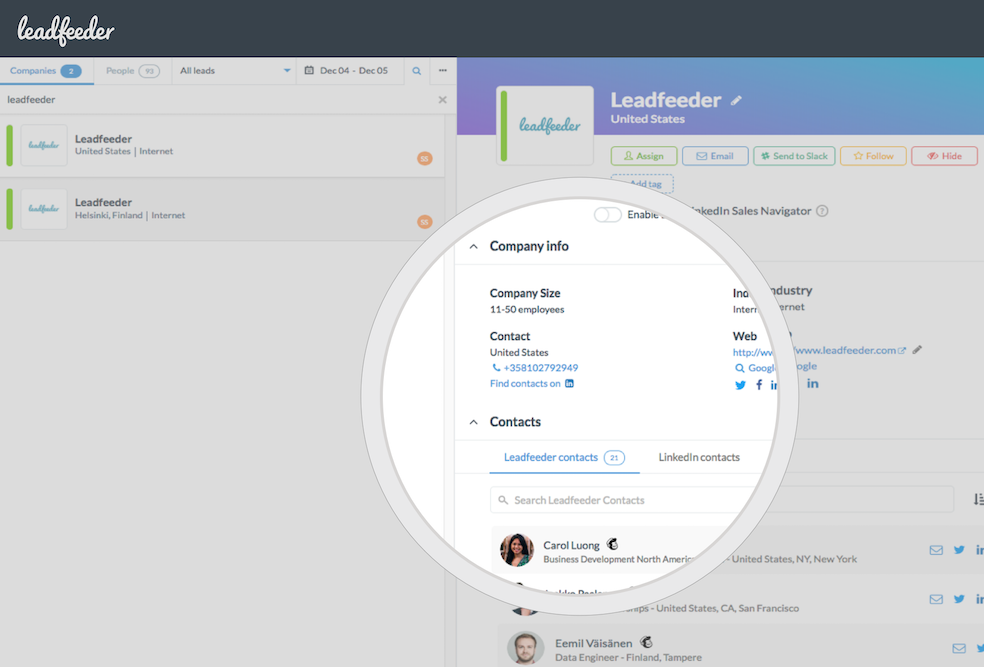
If you're looking to find new sales/customer contacts and are not a fan of complete "cold calling", Leadfeeder is a great source for finding those contacts or companies which may benefit you as they're clearly already looking at you. It weeds out half of the footwork for you.
As I have discussed previously their insights were very useful. The second thing is since it is a Google product you will connect the data very easily from other platforms like Bigquery, Google Drive, etc. and even you can connect Google marketing platform. through this tool, you can track your live campaign how they were performing, and how it will be engaging your customer as well.
Research Quality versus invested Time is absolutely efficient and motivating. Quick Research or Standard Alerts, both are done easily with instant results.
Usability of the User Interface in any of the modules is very supportive. New Team members are trained in short time. Very much self-explaining.
The connectivity between the modules is great and saves time. Each module has its key topic, but in Connection with the other modules this practical tool turns out to be even smarter more and powerful.
It is an excellent cloud analytics platform that is easy to install and configure and easy to deploy and use, allowing us to measure web traffic and other tools.
It is an entirely online tool; it does not take up hard disk space like other desktop tools.
Since this tool is draggable, Google is constantly adding more features.
Even beginners who do not have a custom dashboard can get information. If there is a problem somewhere on the site that needs to be investigated, Google Analytics 360 will notify you.
Leadfeeder has basic lead Tagging capabilities and some native integrations. It would be great to see more lead Activity Tracking and integration capabilities that sync with sales tools so a team could hypothetically keep their eyes on Leadfeeder-only while updating the CRM/sales tool.
Generally I think there is a lot you can do within the tool, but as it is a Google product it means there is limited support - something which I think lets all of the platform stacks down
There could be more visual signifiers to identify if a feature is a normal or 360 feature. This would mean you can really get to grips with what the extra more advanced elements are
Leadfeeder is the best anonymous visitor tracking software platform that I've ever used. Sitting as a layer on top of Google Analytics, the tool consistently provides us with accurate intelligence of what our hottest prospects are looking at while visiting our site. The Leadfeeder customer support is top notch and the company is always coming out with new updates that further improve the technology. On top of all of this, Leadfeeder integrates with Slack and our CRM, allowing me to continue to do my job without having to switch between various platforms throughout the day.
Google Analytics 360 is an upgraded version of the most widely used web/app analytics tracking tools in the market. The price is stable and predictable making it a long-term product of choice. It's easy to use and pairs so well with other Google Marketing Platform products.
Always found the system super intuitive to use. I've never been stuck finding what I'm looking for and the team has some very clear and easy to understand documentation online.
The UI is very easy to navigate and use. The features are well designed and intuitive. As long as the user has a good understanding of basic digital analytics definitions and capabilities, this tool should be quite easy to use. I consider Google Analytics Premium to be the easiest of all of the enterprise solutions out there to use.
If you purchase Premium through a reseller like LunaMetrics, you are going to be taken care of. The additional amount of support and services that a reseller provides to make sure you have the best experience with the product is the reason why the reseller program exists to begin with. Support doesn't have to be just reactive, it can be proactive as well.
There is a ton of information online about Google Analytics, but Google Analytics Premium users will have dedicated support and training from Google or an Authorized Reseller.
If you already have the basic version of GA installed, "getting" GA Premium happens immediately through a virtual flipping of the switch - no need to re-implement. You'll want to expand your use of custom dimensions and metrics (you get 10x the amount with Premium). Ideally, you'll be using a tag management solution to talk with GA Premium, in concert with implementing a dataLayer (to note, Google's Tag Manager platform is covered under the same GA Premium SLA, and it's free). There are some welcomed "configurations" with GA Premium, such as integrating with DoubleClick products, activating data driven attribution models, and building roll-up executive reports - but all of these are easy point and click solutions. In comparison with any other enterprise analytics solution, implementing GA and GA Premium is traditionally easier and more flexible. And if you have any trouble or need an extra set of hands for implementation, GA Certified Partners like LunaMetrics can help
Leadfeeder is very easy to set up, use, and maximize functionality. It is also easy to train. Other tools have a higher cost of acquisition and ownership. Plus, the customer support and training are helpful and very accessible! It's great for small to mid-market businesses.
Unless you have very complex and edge case analytics needs, Google Analytics [360 (formerly Google Analytics Premium)] is likely going to be the best choice. From both a cost and usability stand point, Google wins. Adobe has the edge case when you need to create really custom reports, dimensions, metrics, etc. In my experience, this is rarely the case and you end up biting off more than you can chew. Stick with Google unless you are or plan on hiring an Adobe Analytics expert.
It has helped support us to understand our market and if our website is properly communicating to and providing value to that market
We currently do not have the sales staff to go after potentially qualified organizations that visit the site but don't convert but it is a strategy we will employ at some point.