Google Authenticator is a mobile authentication app.
N/A
WatchGuard AuthPoint
Score 9.0 out of 10
N/A
AuthPoint Total Identity Security provides businesses with a solution to protect user accounts and credentials. With
multi-factor authentication and dark web credential
monitoring, AuthPoint mitigates the risks associated with workforce credential
attacks. AuthPoint adds an extra layer of security by monitoring for
potential credential exposure in the dark web for both personal and corporate
accounts.
N/A
Yubico YubiKeys
Score 9.3 out of 10
N/A
Yubico YubiKeys make the internet safer with phishing-resistant multi-factor authentication (MFA) by providing simple and secure access to computers, mobile devices, servers, and internet accounts. The Yubico YubiKey stops account takeovers at scale by mitigating phishing and ransomware attacks, and delivers users authentication with a simple touch or tap.
I also have to utilize WatchGuard AuthPoint, as it's a proprietary MFA - so I'm stuck with it. Google Authenticator looks nicer, cleaner and doesn't require me to have individual apps for each service I need to access.
There are a few things to keep in mind when using Google Authenticator. Second, it's imperative that everything be kept as simple as possible. Many customers don't understand why they're putting up MFA, therefore adding further difficulty to their daily routines is always a …
Being under the google umbrella gives a level of reassurance to our users. It seems to be cleaner and easier to use for our users. Being able to use a product from an already known vendor helps onboard new users to the software. It is clean and easy to use, all of the users …
First, Google Authenticator meets the security requirements which should be considered "table stakes". Second, simplicity is critical. Many users don' understand why they are setting up MFA (or they just don't care), and so adding additional complications to their day-to-day is …
Other options exist for 2FA: IBM, ATT, RSA, Authy, and other hardware and software-based companies provide 2FA services to individuals and organizations. Google Authenticator was chosen for its ease-of-use, reliability, robust security, and accessibility to the entirety of the …
We use the Microsoft MFA also and I have used the Google Authenticator (only prior to the MS version being released, however). They are similar in terms of functionality of course, but I have not attempted additional integrations using SAML 2.0 or anything like that so cannot …
AuthPoint is a good merge between Authy and Google Authenticator. Authy has a better push notification system while google auth has a better time based. AuthPoint is a perfect mix between the two, and if you need both, it is the obvious solution. Having integration …
WatchGuard AuthPoint is easier to manage on a company-wide scale than Google Authenticator. We do use AuthPoint in conjunction with the Microsoft Authenticator but for different services. WatchGuard also has other features available, like dark web monitoring and device …
Having the Multi-Factor Authentication developed by the same developer of the devices we use is very beneficial when we have to troubleshoot something. Support is great and is very responsive. Clients seem to prefer using their software over another vendor. The app is very …
Started looking at Yubikeys and RSA, but WatchGuard AuthPoint had complete package instead of piecemealing tokens with one vendor and then using softkeys from Microsoft or another vendor.
WatchGuard offers similar performance to other authenticators but allows greater customization of the service and integrates with cybersecurity systems
AuthPoint has a simpler and more intuitive configuration, added to the cloud administration that it provides us, without a doubt it is a point in its favor.
FortiAuthenticator is OTP based only or 2FA. Whereas, WatchGuard AuthPoint has the flexibility of choosing OTP, QR, password, or Push notification. Fortitoken licenses are affixed to a single FortiGate unit and can only be used for FortiGate services only. Whereas WatchGuard …
AuthPoint offers an enterprise level service in comparison to the consumer products that are available. With centralised management of users and tokens, you have peace of mind thanks to the control, auditing and visibility of the secure of your systems. Consumer products …
WatchGuard's AuthPoint has been a breeze to implement and manage as compared to other vendor solutions and its third-party integrations put it in on a level beyond comparison.
We chose WatchGuard for two reasons. 1. We have been using WatchGuard appliances for many years and 2. The AuthPoint licensing prices are reasonable and fit our budget. So I would say that familiarity with WatchGuard products and knowing how good Watchguard support is were …
WatchGuard AuthPoint in my experience has been far easier to setup compared to Duo which I have used extensively in the past, for both engineers and the end users
Authpoint was an easy choice as we use WatchGuard firewalls. This allows us to set up two factor authentication for VPN access easily. With Work-From-Home becoming the norm [rather] than the exception, this extra layer of security is vital. It is nice that there are several …
Verified User
Employee
Chose WatchGuard AuthPoint
AuthPoint has a much broader use, where the competition falls short.
I've found most MFA applications function essentially the same. It's ideal to have all your accounts using the same platform for simplicity. WG's AuthPoint provides that compatibility.
We're a WatchGuard Gold Partner and have been installing WG firewalls and Wireless Access …
AuthPoint protects both cloud/app logins as well as, and most importantly, our corporate login (Active Directory based). WatchGuard AuthPoint gives the option of using hardware OTP tokens for corporate network login, as well as the mobile app which is simple to use, customise, …
Google Authenticator has very limited features available where Yubico can suffice all the authentication method requirements and can be installed on-premises as well. It can completely replace the Google Authenticator. Yubico has hardware based authentication as well apart from …
Google Authenticator and Microsoft Authenticator are both consumer (and commercial) grade products so they are expected to be easy to use. When you move to a more advanced product such as Yubico, there's a reason why you are not using the "easier" methods. The reasons may …
I've never really used any other physical keys, I mean I've used multifactor authentication from Google Authenticator or Duo, but never another physical key, so this is my first experience with that.
If you compare it to authenticator apps, I'd say it's much more easy to set this up for the individual user. Well, it's Swedish. It's also very well documented. There are a lot of guides on how to use them and I have a lot of faith in the security posture of Yubico and how the …
Yubico YubiKeys are way better than those old RNG tokens where you have to type in the number. The YubiKey enters the number for you and often can be used in other modes that don't require number entry at all. It is modern and convenient. I prefer authenticator apps like Google …
Yubico YubiKeys are a nice addition to a TOTP like GA. Since they are not battery based, they are incredibly reliable and always available, even if you've dropped your phone into the toilet. The only downside relative to TOTP is that some devices may not have the appropriate …
I liked the Kensington Verimark fingerprint scanner initially because it made signing into Windows simple and secured it within the household, but didn't like the additional complexities of setting it up and needing a driver. That would have required the IT support team to …
Logging into my work accounts is where Google Authenticator works best. Also, I had a personal account get hacked. I had an account created to book hotels, but someone was constantly resetting my password. To prevent further hacking attempts, I set up Google Authenticator. I do not believe it would be appropriate for banking accounts.
Works great as a 2FA token, for endpoint control, for computer and server updates, for scheduling updates, and for patching security features when exploits become known. Remote connection is very reliable and doesn't drop in and out as many programs do. It may not be as appropriate if you are looking for a plug-and-play control, as it requires more learning and setup to get it set up correctly.
Yubico YubiKeys will likely always be my default recommendation for hardware security keys. It's well suited for environments where key portability is necessary, and for privileged environments where step-up or separate authentication hardware benefits the situation. For example, I can step up my Microsoft rights through PIM, but I'm required to use a Yubico YubiKey (AAGUID filter) even if I'm already using Windows Hello. This means that accessing my workstation doesn't grant rights, accessing my device AND my Yubico YubiKey does. I wouldn't necessarily recommend deploying Yubico YubiKeys to entire user populaces unless the situation calls for it (shared workstations, compliance environments, etc.). This is primarily centered around user training (which is a low bar, but still different), and dealing with loss (you'll want to budget for a % of key loss and be ready to rapidly issue replacements).
So as I said, the second-factor authentication that it does is really well. The response time is really good and all you have to do is just enter the second factor code and that's about it. Right? So that's the good part about using Yubico YubiKeys.
I once performed a factory reset of my smartphone which had Google Authenticator. I didn't have a backup for the device. When I restored my phone with the same google account, I was not able to restore the authenticator app settings. I had to add all the keys back into the app to use it. This is cumbersome, but I understand it is set up this way for security reasons.
I don't like the ease with which it lets you delete a key. If I accidentally delete a key, I am doomed to get my 2FA key reset, unless I still have the QR code saved somewhere.
Email support is SLOW unless I want to allow a stranger to access my production firewall. That is never allowed here, so our hands are tied in terms of being able to get support in less than 48 hours.
Again, support takes far too long because you refuse to employ any staff that works in US time zones during normal business hours.
There has to be another option besides: 1) you take full control of my systems or 2) I wait on SLOW email support that isn't that great.
It can be about access control because either right now it's just you have access or you don't have access. I think there can be a use case where you are allowed a particular set of servers and not a particular set of servers. I think maybe it's there or we don't use it, but I haven't seen that. I think I've used Yubico YubiKeys at two companies and I haven't seen that. Maybe that's something that can be added.
Today to ensure our ISO 27001 certification it is important that we maintain this solution. Today it is part of the way any employee within the organization works, we no longer have any other way of working and it is the simplest way to ensure that access to the workstation is done with MFA.
As for implementing YubiKey its simple so I don't see us using anything else as we have experienced no issues so fare. Adding these to our environment is still new for us currently but in the transition phase I only see us buying YubiKey. It is highly rated and well known and cost is reasonable so no need to find another solution.
It's as easy as opening the app and what I need it for is there. I don't have to fumble with other accounts or getting something else to open it for me. I have all the access that I need for the use of the app within seconds and I can get access to the info that I need.
After initial setup, it practically runs itself. Onboarding new users is fast and easy as it should be. The AuthPoint mobile app is small and simple to use. The only reason I do not give it a 10 is that I frequently get complaints from end users that the AuthPoint app is "constantly downloading". In fact, it's not downloading anything and that what the users are seeing in the app is a timer for the 6-digit code that changes every minute.
I give slightly better than average rating because of the complexity in using a Yubikey. It is not as easy as native push notifications for 2FA products, however, it provides much better strength. Rating this higher or lower would be a disservice to people reading this review. If you are in the market for a hardware 2FA tool, Yubikey will be a great asset in your toolbox.
We have not experienced any issues with availability which is very important when you are dealing with a company that holds the keys to the gate. We have had more issues with availability from our SaaS providers before with authentication but that was on their end. YubiKey has worked every time for us over the course of the last 6 or so months we began testing phase.
We have not seen any lag in loading pages and getting into systems or sites. In comparison to other 2FA and MFA options it is actually faster most of the time to authenticate due to not having to type in. We require users to have long passwords and when there is an option given for password less they jump on it with excitement. As we explore going password less on their PC's the YubiKey is going to make their lives a lot easier to access the resources they need.
I have found Google’s support to be hit or miss. There are times when they are very responsive, and I get my issue resolved quickly, and there are times where a response from them takes weeks. There is no in-between. But my support experience with this particular product is nonexistent because I have not had a problem with it yet. Hopefully, we do not have any problems with it either.
WatchGuard support is always quick and reliable. They have urgency levels that you are able to select when creating your support ticket, and they respond in accordance to the severity that you have set. I have never had an issue with getting someone on the phone in the same business day, even for very low priority issues.
It was an Onsite demo at the ditributor with the benefits of Watchguard Authpoint. Was very nice to see the abilities of the product. This Demo was a few years back, since then Authpoint changed allot. It is very nice for partners that you can get this demo without any aditional cost.
We use the online training for all our employees. There are both sales and technical trainings available and there even is a technical certification. You can use this for the Watchguard Partner Program which can give you aditional benefits. Every now and then you have a webinar that discusses multiple Watchguard products.
the first time it takes more effort. It is helpful to already understand how each authentication type works. Then it's much easier to understand the MFA solution that you implement. It is useful to check the release notes from time to time and update the key parts of the Watchguard Authpoint. Authpoint Gateway, Logon App, RDWeb... Also, it's useful to set up notifications when something goes wrong or sometimes check the statistics of how many requests are being approved/denied, etc.
I figured it all out on my own with the excellent product documentation provided by Yubico. I even managed to produce a backup YubiKey in case I lost my frequently used one. This was crucial when I temporarily lost the original.
First, Google Authenticator meets the security requirements which should be considered "table stakes". Second, simplicity is critical. Many users don' understand why they are setting up MFA (or they just don't care), and so adding additional complications to their day-to-day is always challenging. When it is simple, it makes life a lot easier. Finally, trust (due to the brand name recognition, primarily) removes any notion of "what is this?" that the user may have from being required to install something on their personal device for work purposes.
I would slot Authpoint (as a product) as better than ESET but not Duo. ESET has the same limitations as Watchguard in the OTP support. It also is an on-prem installed console rather than a cloud, which increases cost and maintenance requirements. The duo now supports standard OTP for admin accounts, so it can be managed by a team. Duo support however leaves a lot to be desired and gives Watchguard the edge
Yubico YubiKeys has been a leader in the security key market, and I think they have a new product we just read about two days back and they can store up to a hundred private keys now. So I think this is what it distinguishes them from the market, apart from this, whatever features we need personally and for our customers. So they provide all those features, but versus the other brands.
For us I feel like the ease of deployment has made this product very appealing, overall this will make the scalability very easy for us to push out once we roll out to our users and the management tools that we have looked at will make the admins like me happy as it is clear and easy to use. The rollout process looks to be very straight forward from the demos that we have looked at regarding the enterprise tools.
More secure data = less worried about a data breach.
Takes longer to log in, and if I don't have my phone then I have to go looking for it, so it really makes it so that you can't be without your phone, which in certain instances is annoying or not possible and can hold up work time.
Everyone is willing to use the same program because everyone likes Google—makes it easier to manage.
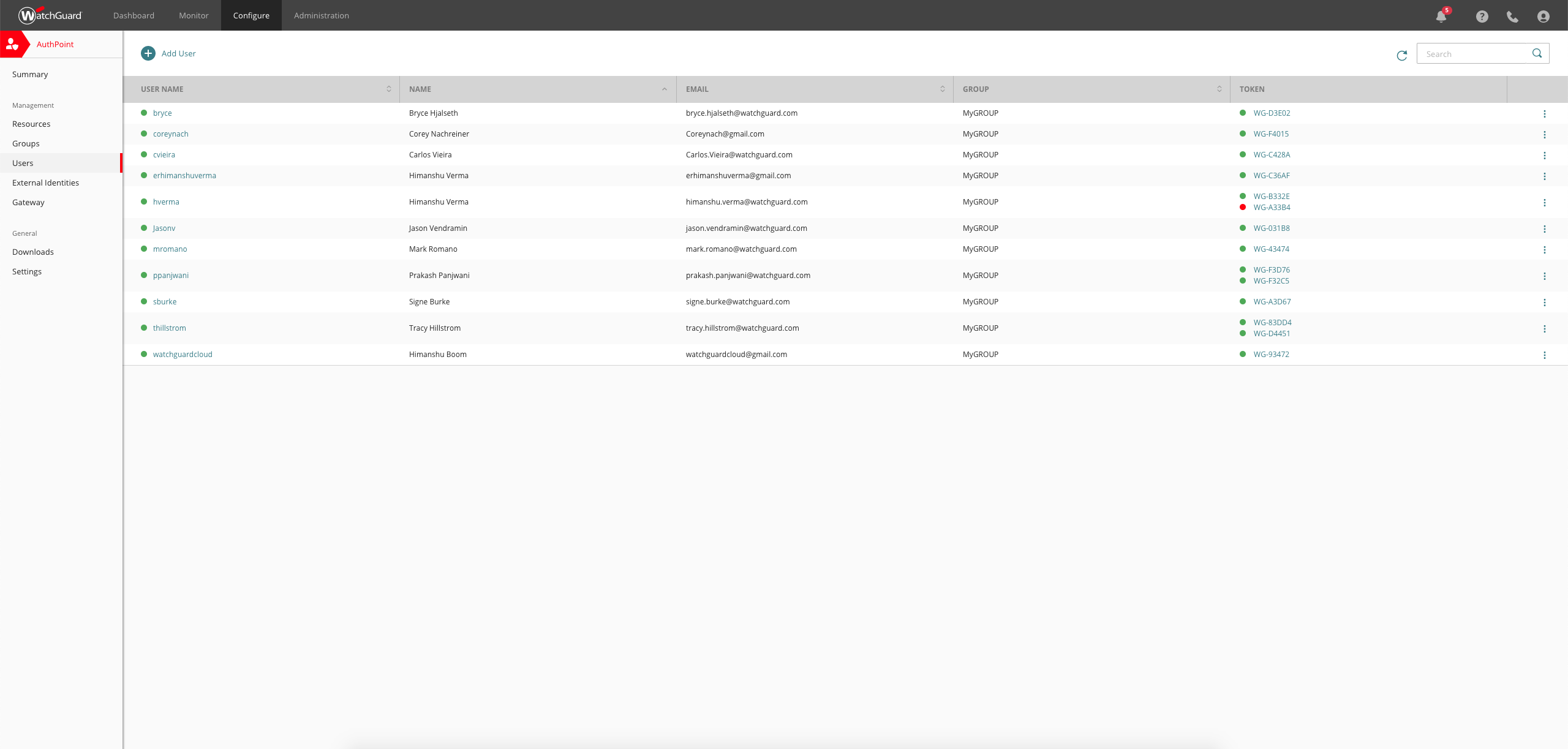
We currently have 300 users on Authpoint, and most of them use insecure passwords. Authpoint gives us peace of mind that we don't have to police individual employee passwords.
In line with the comment above, with so many people in our organization using insecure passwords, I'm sure that Authpoint has already saved us from many potential security breaches.
Security breaches can cost a lot of money. Preventing them saves the company money and helps to achieve our bottom line.
I think it's the flexibility in being able to let users pick the type of authentications that they want to use. Some are comfortable with the touch device on the physical Yubico YubiKeys. Others prefer the mobile app. So it provides flexibility for our users to choose how they want to authenticate without running a file of our security requirements.