Google Authenticator is a mobile authentication app.
N/A
WatchGuard AuthPoint
Score 9.0 out of 10
N/A
AuthPoint Total Identity Security provides businesses with a solution to protect user accounts and credentials. With
multi-factor authentication and dark web credential
monitoring, AuthPoint mitigates the risks associated with workforce credential
attacks. AuthPoint adds an extra layer of security by monitoring for
potential credential exposure in the dark web for both personal and corporate
accounts.
This product doesn't ensure single-use, real-time codes. This puts our data at risk and is not as secure as Google Authenticator. I anticipate using Google Authenticator as long as we continue to use the full Google Suite for business. It helps to streamline data and accounts.
I also have to utilize Watchguard Authpoint, as it's a proprietary MFA - so I'm stuck with it. Google Authenticator looks nicer, cleaner and doesn't require me to have individual apps for each service I need to access.
The other apps I mention are password managers as well as opposed to stand alone authenticator apps. In terms of how it stacks up against authenticator only apps, I'm not sure as I haven't compared against those. Google Authenticator is great to recommend to people who don't …
There are a few things to keep in mind when using Google Authenticator. Second, it's imperative that everything be kept as simple as possible. Many customers don't understand why they're putting up MFA, therefore adding further difficulty to their daily routines is always a …
Being under the google umbrella gives a level of reassurance to our users. It seems to be cleaner and easier to use for our users. Being able to use a product from an already known vendor helps onboard new users to the software. It is clean and easy to use, all of the users …
First, Google Authenticator meets the security requirements which should be considered "table stakes". Second, simplicity is critical. Many users don' understand why they are setting up MFA (or they just don't care), and so adding additional complications to their day-to-day is …
Setup was easier and transferring between accounts is simpler in Google Authenticator when compared against Symantec VIP. The other features kind of are the same where both provide keys in offline mode and work seamlessly. Keys are refreshed every 30 seconds in both the …
For myself and my business, we have not explored any other Authenticator out there. We have had no real issues with Google Authenticator and have no plans to switch.
We were using Duo before in our environment for two-factor environment. But when it comes to availability we were always facing issues such as time-sync & app integration. After using Google Authenticator it resolved our synchronization issues as well as the third-party tool …
Google Authenticator is cost-effective & a bucket of features as compared to other available solutions in the market. Google Authenticator provides a multi-layer of security with ease of integration features.
I used Cisco Secure Access Duo in my organization but I was not happy with [the] services. It creates lots of problems so I switched to google authenticator and it is really good. I am very happy with this software. No need to search [for] another option.
We deploy Google Authenticator in residential and non-managed client scenarios. Google Authenticator can perform the basic functions needed for multi-factor authentication but lacks the more advanced features of solutions like Cisco's Secure Access by Duo. Google …
Google authenticator can only run on mobile devices, which makes for a more secure authentication flow. 1Password's desktop multi-factor authentication is easier to use, but it's the same device so is a weaker form of multi-factor authentication and thus less secure.
Microsoft Authenticator is a nice alternative that you can use in a password-less way. It does this by sending a notification to your phone where you then press the accept button. It does not seem to be supported by as many apps as Google Authenticator though and doesn't work …
Google Authenticator is awesome. We used LastPass in the past. In general, I don't like password saving or authenticating services because it feels like a vault that I am putting all my trust in. With Google, they have made it so easy and secure, I feel confident. I have …
Google Authenticator is only really competing against SMS two-factor. Instead of getting a text from random phone numbers all the time, you go to one app/ website to get access to any account.
In addition, we can allow our members to share the same Google account (with a master …
We are using our WhatsApp Business Account to send OTP to our users, but we can't control our users for having a WhatsApp Account. And WhatsApp API is not free too and so complicated to implement. Google Authenticator is a good alternative and cost-free to our users for getting …
LastPass is the most similar to Authenticator that we're currently using, but I honestly wouldn't say they are all that similar. Authenticator is another step up, security-wise, from password managers as far as internet safety goes.
Using WatchGuard AuthPoint provides an independent layer of restriction with a different vendor than Microsoft. It syncs well with Microsoft active directly and provides a single pane of glass for security insights. It balances security and usability well so that it is easy to …
WatchGuard is superior in one way that is very important for our small team, and that is price, it is much cheaper than intune. It also offers most of the same suite of features as well as some extra (dark web monitoring is the only one I can think of) however the fact that it …
I chose Watchguard for the bundle of features and customer support, not to mention the transparency you get with a paid program versus an open-source version. Mainly, I liked having so many of the solutions I needed in one place without having to find separate programs.
WatchGuard AuthPoint is easier to manage on a company-wide scale than Google Authenticator. We do use AuthPoint in conjunction with the Microsoft Authenticator but for different services. WatchGuard also has other features available, like dark web monitoring and device …
I really like the ease of use of the WatchGuard AuthPoint and it has been a good move when our previous VPN appliance went out of support. Working with and using the WatchGuard AuthPoint has been a very easy transition and great improvement over the Sonicwall we previously …
We use different 2FA providers to secure different things. We are actively using Duo now, as well as WatchGuard AuthPoint. Each provider has different strengths, and you must test the applicability of a service in your own environment.
Started looking at Yubikeys and RSA, but WatchGuard AuthPoint had complete package instead of piecemealing tokens with one vendor and then using softkeys from Microsoft or another vendor.
The biggest reason we selected Watchguard was support. We already use Watchguard firewall products and have received excellent support from our third-party vendor, Watchguard.
If you already have WatchGuard firewall, this just integrates a lot better than any other product. We tried Microsoft Authenticator but not nearly as seemless for the experience as it is with WatchGuard AuthPoint. It is all built into the same portal as the firewall and can be …
WatchGuard AuthPoint is less expensive than most competitors, easier to manage through WatchGuard Cloud, and the MFA solutions is rock solid and secure. We do not worry about vulnerabilities with WatchGuard AuthPoint.
It is supported by virtually all cloud-based software applications for business. I am happy to allow users to use this in addition to other authenticators. Certainly, if your business is in the Google cloud it makes sense, but my approach to the remote/virtual work world these past couple of years has been structured flexibility. Leaving some choice up to the users for their own comfort, particularly when they are using their own devices. I cannot think of a scenario where it is less appropriate - perhaps where you run the risk of "app sprawl". I.e., where you are requiring users to handle multiple authenticators (which can happen with certain pieces of hardware) you may want to encourage consolidation into one to avoid frustration.
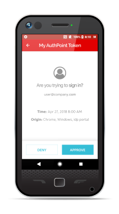
We use multiple authenticators at my company. We use WatchGuard AuthPoint just for our VPN for security purposes. The app works very well and over the past year we've only had a handful of issues with the authentication service, and these were resolved relatively quickly. We do have to remind people to enable push notifications from the app, or have the app open when they need to use it to authenticate, otherwise they won't get the push to approve. The biggest issue I've found is that people will forget to do this and then say that the VPN isn't working - the VPN is working, it's just that they didn't get/approve the push from AuthPoint in time.
Easy implementation: The product is very easy to implement both from embedding it into the application and from end users using it via their smartphones.
You can use Google Authenticator to manage multiple two-factor authentication keys.
Easy to add keys options: You can scan a QR code to set up 2FA in Google Authenticator. You can also do a manual entry using the unique key provided by the application you are setting up 2FA for.
Works well with the free Authpoint client and the OpenVPN clinet.
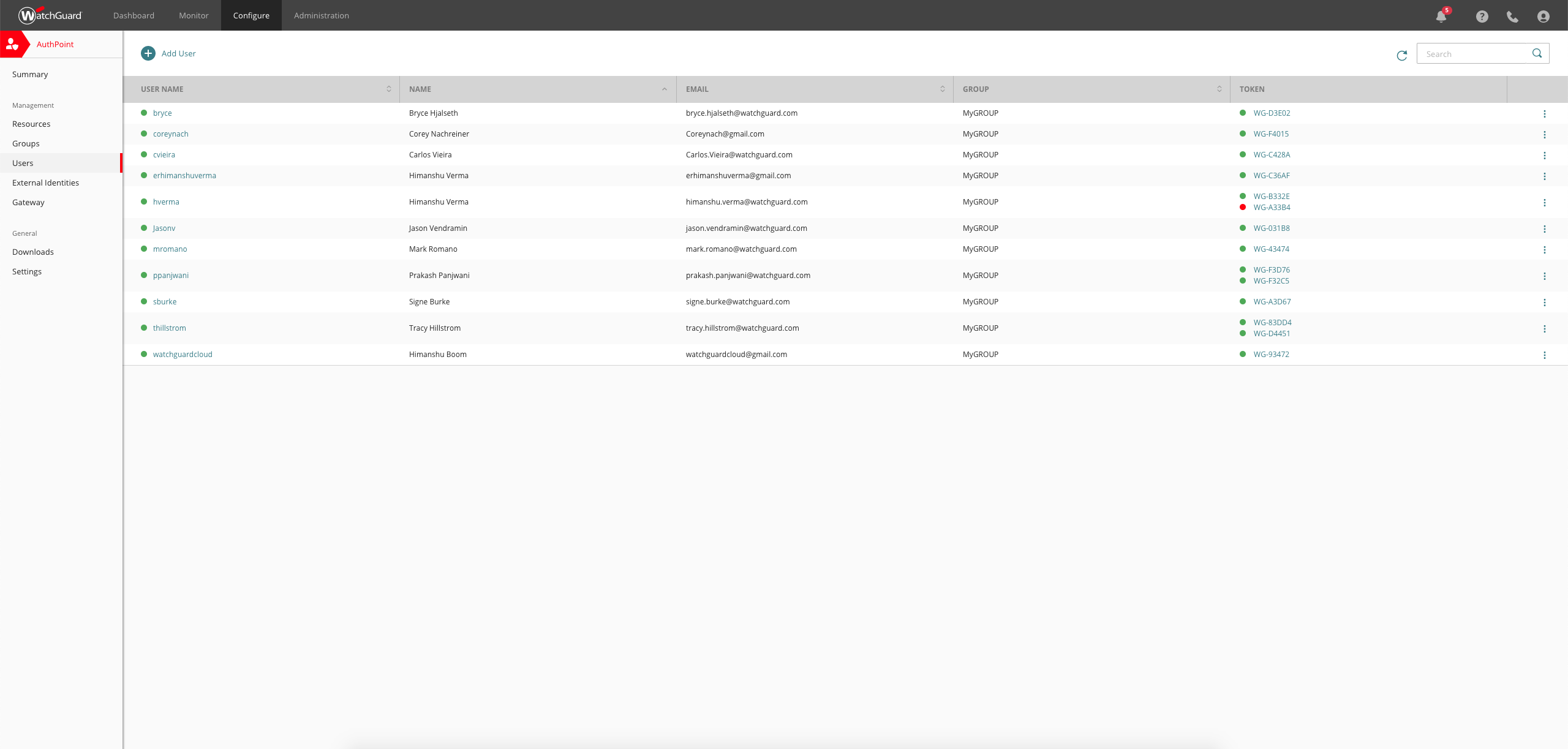
Token management is simple and hosted completely in the cloud to reduce overall complexity
Setup was simple and and staighforward
Suppports several authentication methods we have used both RADIUS and SAML effectively, but ADFS, IDP, RDWeb, and RESTful API, and other custom apps are supported.
Geofencing for RDP has been very useful as it is independant of our firewall geofencing. This is quite useful for organizations like us who do not Geofence at at the firewall level so as to provide global access to resources on the DMZ.
It runs on only a few platforms, specifically Android, iOS, and Blackberry and in my opinion it needs to be available on every platform that is out there.
SA drawback I have noticed is that if you swap phones you have to blitz the entire app and go back and sync up all the accounts again which can be very frustrating for new users.
It can also be risky ( for some ) having all all your data centralized in one place.
Email support is SLOW unless I want to allow a stranger to access my production firewall. That is never allowed here, so our hands are tied in terms of being able to get support in less than 48 hours.
Again, support takes far too long because you refuse to employ any staff that works in US time zones during normal business hours.
There has to be another option besides: 1) you take full control of my systems or 2) I wait on SLOW email support that isn't that great.
We are very happy with Authpoint and see no reason to make any change to it. If only there was a policy to set minimum password strength requirements and to force users change their password every xx days, then it would be a 10!!!
It's as easy as opening the app and what I need it for is there. I don't have to fumble with other accounts or getting something else to open it for me. I have all the access that I need for the use of the app within seconds and I can get access to the info that I need.
After initial setup, it practically runs itself. Onboarding new users is fast and easy as it should be. The AuthPoint mobile app is small and simple to use. The only reason I do not give it a 10 is that I frequently get complaints from end users that the AuthPoint app is "constantly downloading". In fact, it's not downloading anything and that what the users are seeing in the app is a timer for the 6-digit code that changes every minute.
I have found Google’s support to be hit or miss. There are times when they are very responsive, and I get my issue resolved quickly, and there are times where a response from them takes weeks. There is no in-between. But my support experience with this particular product is nonexistent because I have not had a problem with it yet. Hopefully, we do not have any problems with it either.
WatchGuard support is always quick and reliable. They have urgency levels that you are able to select when creating your support ticket, and they respond in accordance to the severity that you have set. I have never had an issue with getting someone on the phone in the same business day, even for very low priority issues.
It was an Onsite demo at the ditributor with the benefits of Watchguard Authpoint. Was very nice to see the abilities of the product. This Demo was a few years back, since then Authpoint changed allot. It is very nice for partners that you can get this demo without any aditional cost.
We use the online training for all our employees. There are both sales and technical trainings available and there even is a technical certification. You can use this for the Watchguard Partner Program which can give you aditional benefits. Every now and then you have a webinar that discusses multiple Watchguard products.
the first time it takes more effort. It is helpful to already understand how each authentication type works. Then it's much easier to understand the MFA solution that you implement. It is useful to check the release notes from time to time and update the key parts of the Watchguard Authpoint. Authpoint Gateway, Logon App, RDWeb... Also, it's useful to set up notifications when something goes wrong or sometimes check the statistics of how many requests are being approved/denied, etc.
This product doesn't ensure single-use, real-time codes. This puts our data at risk and is not as secure as Google Authenticator. I anticipate using Google Authenticator as long as we continue to use the full Google Suite for business. It helps to streamline data and accounts.
I chose Watchguard for the bundle of features and customer support, not to mention the transparency you get with a paid program versus an open-source version. Mainly, I liked having so many of the solutions I needed in one place without having to find separate programs.
I would say from my limited role in the programs deployed and just being a user, this has been a valuable tool so our ROI is high. We get security and can breathe knowing we have authentication for those who have to be on our network and we are able to protect our work.
We currently have 300 users on Authpoint, and most of them use insecure passwords. Authpoint gives us peace of mind that we don't have to police individual employee passwords.
In line with the comment above, with so many people in our organization using insecure passwords, I'm sure that Authpoint has already saved us from many potential security breaches.
Security breaches can cost a lot of money. Preventing them saves the company money and helps to achieve our bottom line.