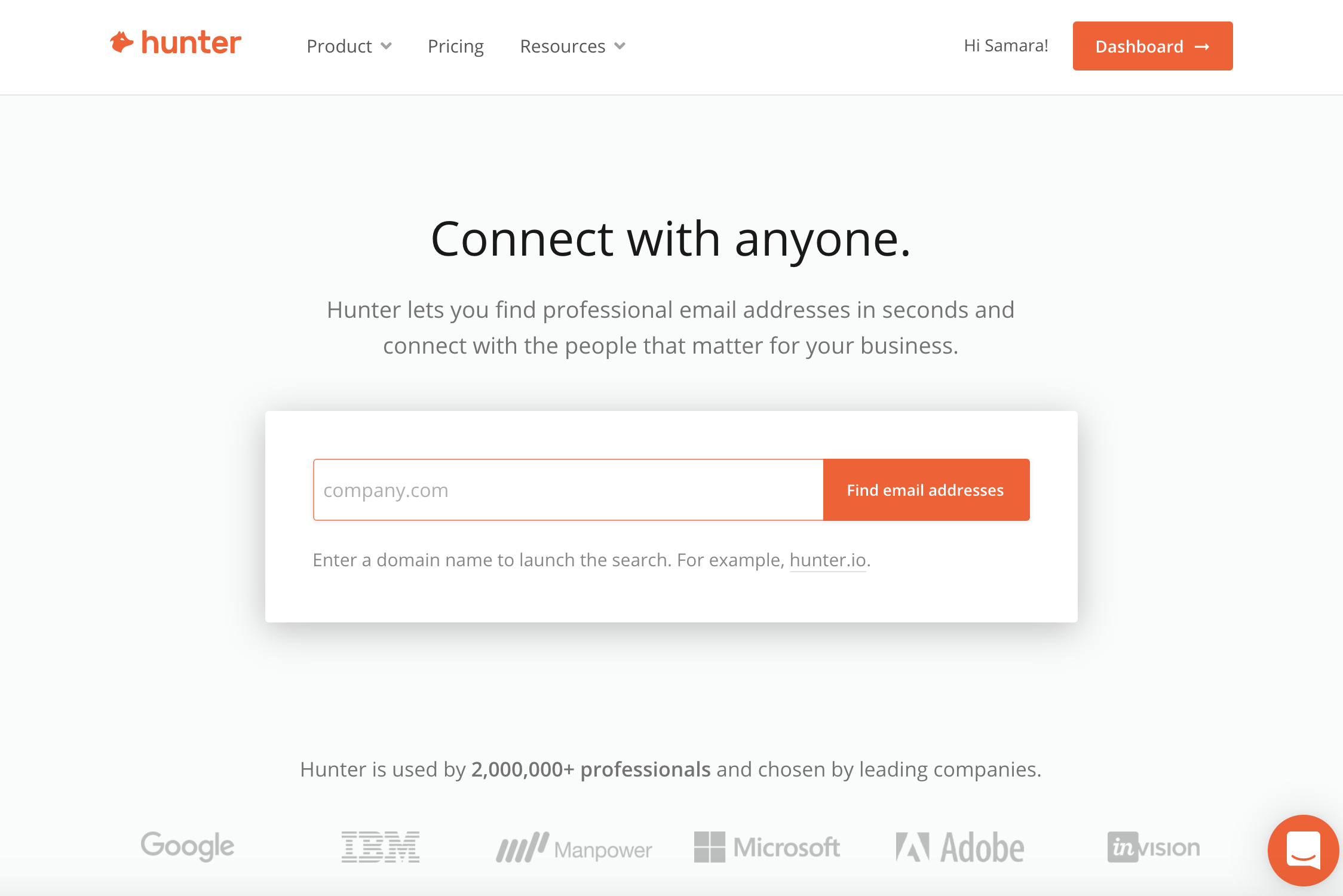
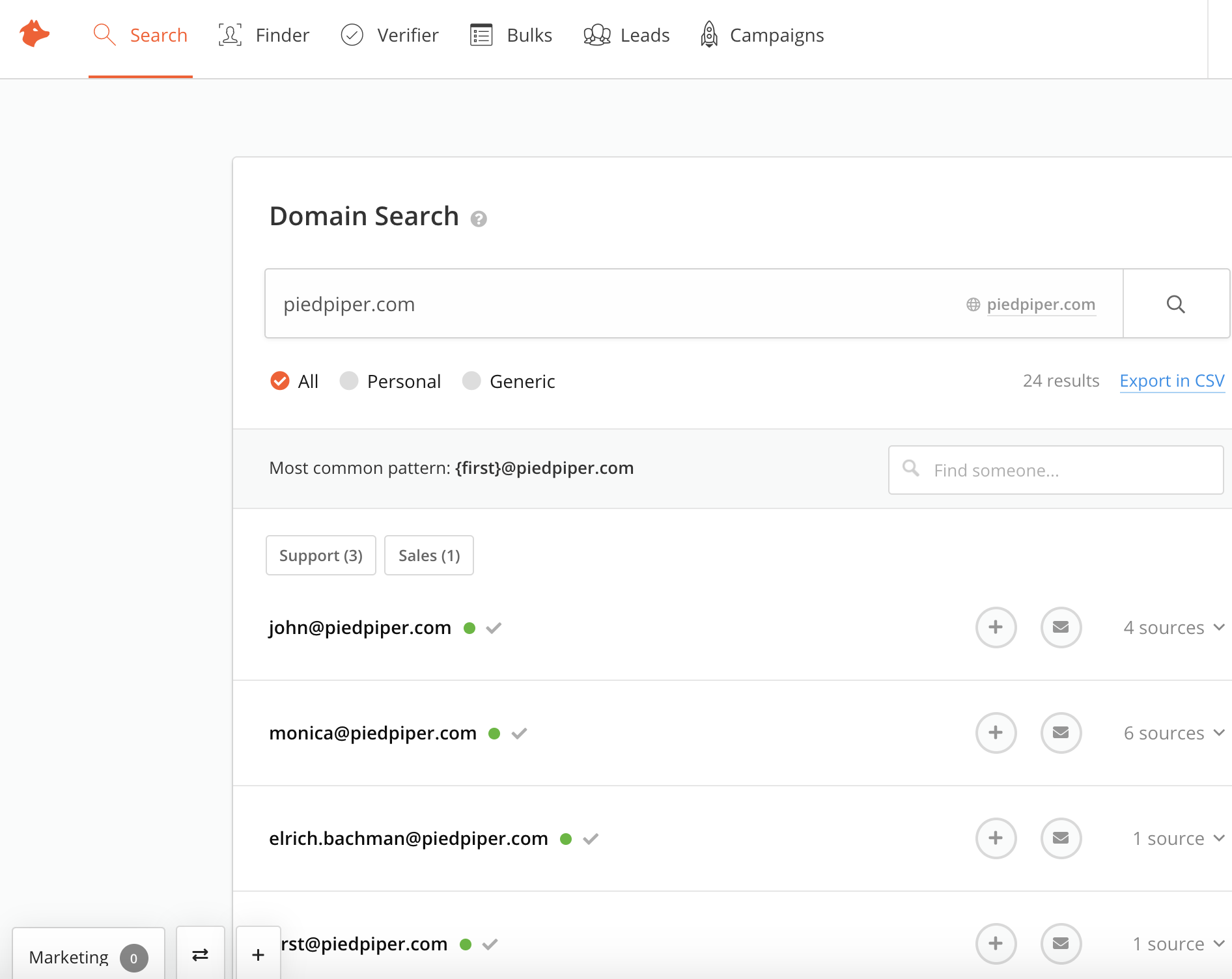
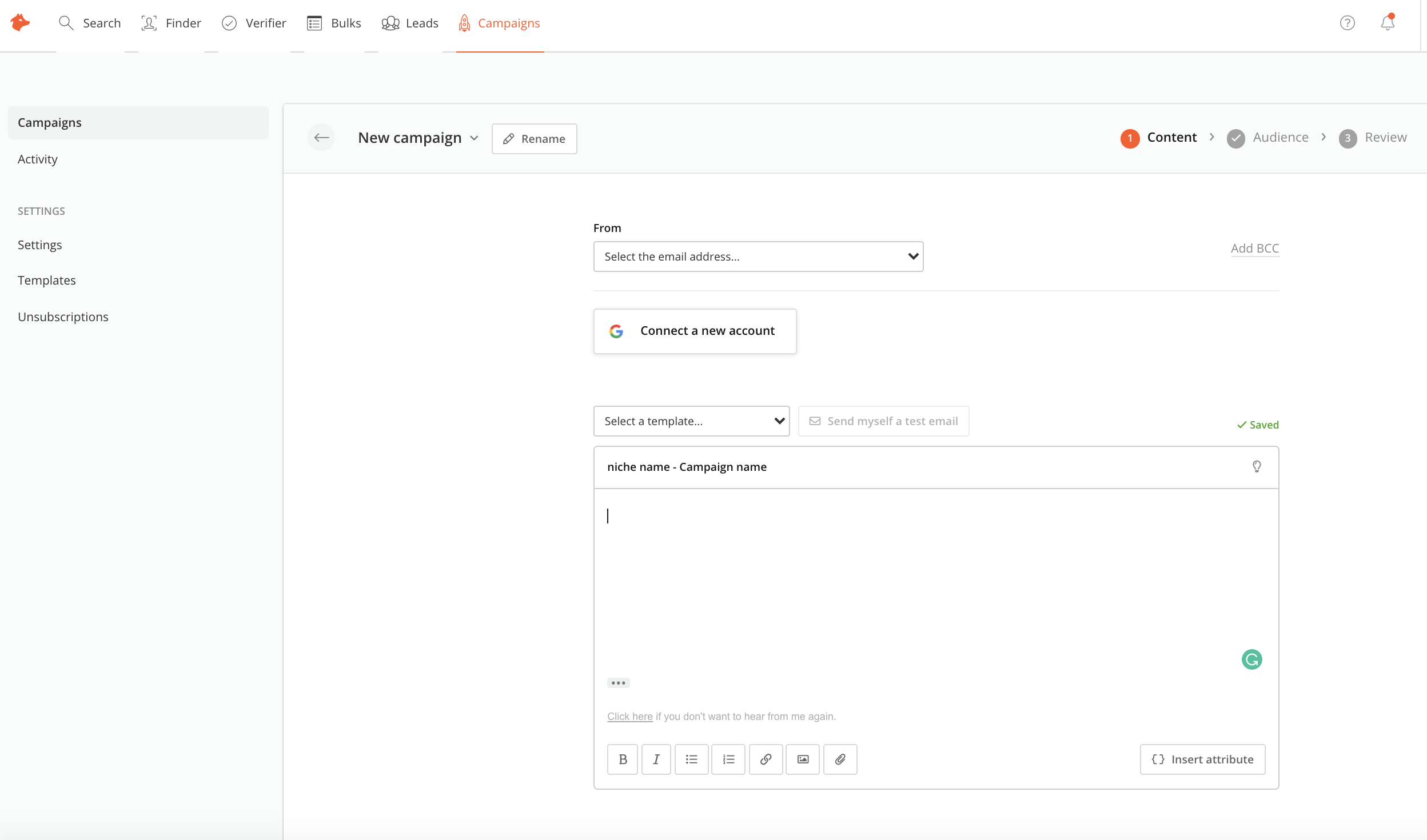
Hunter is a cloud-based email search solution that helps businesses find and verify professional email addresses from domains, companies or a specific professional on the web.
$0
per month
Lusha
Score 8.5 out of 10
N/A
Lusha is a Business-to-Business (B2B) data and Sales Intelligence platform utilized by sales, marketing, recruitment, and Revenue Operations (RevOps) departments to identify professional contacts, enrich database records, and monitor buying signals. The solution integrates with Customer Relationship Management (CRM) systems, automation tools, and existing Go-To-Market (GTM) stacks. According to Lusha, the system provides access to over 300 million business contacts and achieves over 90% direct…
I've also used Apollo.io, and I think they actually work best in tandem. Apollo.io is great for broad research and list building. You can search an organization's name and find all the folks who work there that meet your search criteria. It's great for building a big list of …
Hunter is a good all in one solution, which hasnt always been the case as it used to be a daa only solution. However, other tools like Lemlist as slightly more user friendly and make it so simple to build and launch multi-channel campaigns , and do this slightly better than …
LinkedIn Sales Navigator gives no way to contact leads once you've found them. ZoomInfo is powerful for information but not designed to reach out to leads efficiently.
A great place for reaching information of potential customers. Also, the support team immediately responds to your inquiries, and all team members are so kind. Couldn't have asked for more
I have evaluated Lusha, RocketReach, Mail Tester, etc. but I found Hunter more appropriate because it was the tool that completes my need as I don't require the contact numbers of the particular person. But if I required the contact information of the person then Hunter must …
Hunter is a simple tool that does two things very well. (Identifies the proper email format at target prospect websites & verifies and confirms a leads email address.) It has great data and is helpful for any seller regardless of company and target size. It does not provide …
Zoom is currently our go to platform for finding contact information and email addresses. It is much more expansive than Hunter but it's also much more expensive. The data is some of the best quality in the industry and included direct dial and mobile numbers. If you have the …
Seamless is great, it is a bit more robust as it also includes phone numbers (personal line, office extensions, company line) Also, has CRM integration like Salesforce.
Hunter is a much more user-friendly version of Clearbit. I personally also find it to be more accurate than Clearbit. With Clearbit it felt like too many clicks to get to the information that you wanted. With Hunter, it is a simple copy - paste - click, to get the information …
Hunter is easier to use but it would appear from the limited use of ZoomInfo that their product is more robust. However, it is a paid service so I don't feel it is an apples-to-apples comparison.
Hunter.io is a much cheaper alternative to Data.com, and provides just as accurate data. Data.com does offer more contacts per company as it tries to map out org charts at a company, but you'll often see many of the same contacts at Hunter.io as you would on Data.com. I …
We have been trying to get lead information on SalesTools and PLENTY, however, these two tools are mostly oriented to create follow-up campaigns and the setup is pretty complicated. If you are looking to create just a list of semi-qualified leads, you may try Hunter, but …
SellHack is a superior product. If I were to do an email search of 50 or 100 names, SellHack would win hands down. Hunter would do well, and for that I'm grateful, but it's just not as strong.
I use Hunter in combination with some of the above-mentioned tools. Hunter is faster than any other tool, especially when dealing with large lists. I have also found that Hunter's bounce rate is lower than any other of the dozen tools I've tested.
While LinkedIn Sales Navigator has a larger and greater amount of data available (including mutual connections, etc.), it is hard to overlook the value that Hunter provides in explicitly and simply sharing a contact's information. Added to the fact that Hunter has a Chrome …
Lusha gives me qualified data. The searching is easy and better than Apollo. The UI is better than Lusha. The costing and credits are also better than Apollo's.
Lusha is better at credits management and providing the credits as compared to Apollo. This gives an edge to the small teams when it comes to getting the much-needed data at the start stage. Apollo has credits clubbed together, and usage of credits is much higher than that of …
Most of the above tools can give you accurate email addresses, but mobile number data is either incorrect or unavailable. But Lusha solves this problem by giving us both email ID and mobile number data accurately at the same place, thus eliminating the need to switch platforms …
We use Lusha alongside Apollo. Lusha was chosen as our supplementary data source, as it is super intuitive to use, meaning there was no little to no onboarding time which meant no lost productivity to the business. Stacking up against RocketReach, Lusha has much more data …
Lusha contacts details are always valid for every regions be it asia, africa, us or uk that's not the case with every other tool available in the market. tools available in the market either have relevant data for two or three continents not for all and if you are reaching out …
The data provided by this tool is unique and not repeated the data is fresh the number and email id are always valid like 98% valid which compared to the rest of the tool available in market Lusha as a high value number hardly you'll get a bounce back or mail which went unread …
The data provided by these tools and nice but I bang on Lusha because that's where I get my closure if I don't get any contact number from Lusha like it's not available or dnd sort of things then I reach out to these tools otherwise, my first go to tool in Lusha.
Before adopting Lusha, we also tried using Wiza. They almost have the same capability in terms of integration with Linkedin and CRM. The deal breaker is the data accuracy that Lusha can give over Wiza. Lusha has a broader range in database which made is a stronger fit for our …
Cost is one of the major factors along with similar functions is why we chose Lusha over the other. Despite being a similar tool, the price factor is what made us choose Lusha over all the other tools that we evaluated. Despite not having sales reps contact us, we were able to …
I have a ist usage habbit of using Lusha but I also use other tools since if Lusha misses then I am good to have a way to get to my target prospect via other tools . I am very happy with Lusha's performance and would recommend this tool to all.
Hunter.io is very well suited for any sales rep who is building out lists of contacts for email outreach, or for marketer's looking to reach out to PR and marketing contacts for link building campaigns. The tool is a great free option if you are doing targeted, 1:1 personalized outreach and you need a few contacts. The tool can be expensive if you are needing to reach thousands of people. A paid version of Hunter.io is not a great fit if you already pay for another list building source such as Data.com or Discover.Org.
I leverage Lusha daily to powerfully qualify and enrich my leads in multiple ways: from supercharging data extracted from CSV files to seamlessly populating phone numbers and email addresses directly from LinkedIn.However, the HubSpot CRM integration truly needs simplification. While I frequently use the standard sequences, I strongly believe they could be dramatically improved by combining email, InMail, and even audio messages. And finally, the conversations module, currently in beta, shows immense promise!
Provides email domains very well. While some companies have a different domain for their "info@xyz.com", Hunter is able to find the domain that is being used by individuals at the company.
For American contacts in particular it is very good at finding personal phone numbers.
Helps to enrich the contacts that might be in a company by providing a confirmed list of employees.
As an extra - I really like how easy it is to use. You can input the contacts name and copy-paste from the chrome extension quickly and easily. This saves a load of time when you are trying to find the right address.
There have been times when I've search Hunter for an address on a website and it came back with no results. Then If I search the site I've often found an email address or two. So I'm curious why it wasn't able to find it with the tool, even when I could on my own?
I'm not sure what the reasons were exactly why LinkedIn ordered the cease and desist, but I had hoped they two companies could come to terms or that at the least LinkedIn would acquire Hunter. But alas, it's not been the case.
It would be nice to have a general idea of how many contacts it has information for on a particular account at the very start before scrolling through the different pages.
It would be great to also have the titles of individuals on the list, so it's quicker to sift who to keep in or exclude prior to revealing details.
No product is perfect! Some of the information generated can be inaccurate or generic, e.g., a phone number for a persona may not be direct for that individual but could be a general customer service number for the company and could be the same number listed for multiple prospects.
Hunter is a pretty straightforward tool to use, like most of the tools on the market that execute the same sort of process. I would say it is not quite as user-friendly as some of the other tools on the market, which offer a plug and play process, but it is still fit for purpose.
Simple, clean efficient. No lags and gets us the exact data that we need. No unnecessary terminologies, and it works like a charm every time. From prospecting to lead generation, and intent searching, Lusha is our go to tool and it has stayed ever since we started using it. i would highly recommend.
It is actually pretty easy. If you already worked with Google Chrome's extensions, you're not going to have any problem. It's actually plug & play – you just need to setup your account, install the extension and start prospecting. Lusha gives you an assistant on the browser that easily allows you to crawl information of any LinkedIn profile you're visiting.
Hunter is a much more user-friendly version of Clearbit. I personally also find it to be more accurate than Clearbit. With Clearbit it felt like too many clicks to get to the information that you wanted. With Hunter, it is a simple copy - paste - click, to get the information you need. The additional list of contacts it provides and the verification source is also more readable.
We use Lusha alongside Apollo. Lusha was chosen as our supplementary data source, as it is super intuitive to use, meaning there was no little to no onboarding time which meant no lost productivity to the business. Stacking up against RocketReach, Lusha has much more data availability, and this is also the case for Apollo, whilst Apollo's database might be larger, it often misses contacts that Lusha has, and Lusha has more verified mobile numbers which is super important. In comparison to ZoomInfo is has a much lower price point.
More time Selling, Less Time Searching: B2B selling today is all about how fast you can reach your prospects. Searching for contact information was daunting and painful a few years back. With 1-click imports, integrations and hunts: tools like Lusha are a massive benefit in terms of saving time in the ever laborious task of List Building.
Better Phone Numbers: Especially in regions like EU and APAC, where mobile numbers are not available with tools like ZoomInfo and Apollo, Lusha comes as a saviour.