IBM Cognos is a full-featured business intelligence suite by IBM, designed for larger deployments. It comprises Query Studio, Reporting Studio, Analysis Studio and Event Studio, and Cognos Administration along with tools for Microsoft Office integration, full-text search, and dashboards.
$10
per month per user
Microsoft BI (MSBI)
Score 8.9 out of 10
N/A
Microsoft BI is a business intelligence product used for data analysis and generating reports on server-based data. It features unlimited data analysis capacity with its reporting engine, SQL Server Reporting Services alongside ETL, master data management, and data cleansing.
$14
per month per user
SAP Crystal
Score 7.4 out of 10
N/A
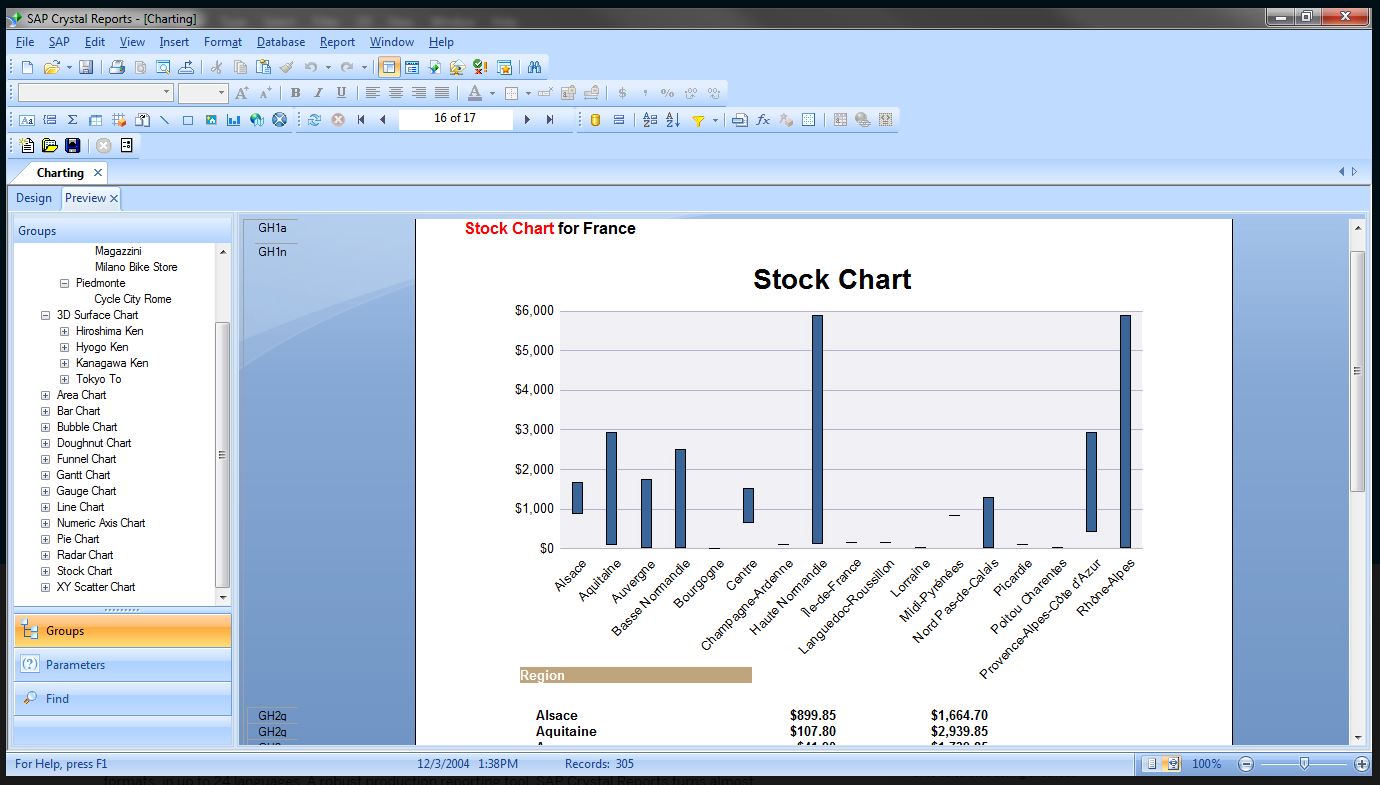
SAP Crystal is an analytics and reporting software solution for SMBs. SAP Crystal comprises Crystal Reports for pixel-perfect reporting, and SAP Crystal Server for automated distribution and self-service access to reports, dashboards and data exploration.
$295
per single user license
Pricing
IBM Cognos Analytics
Microsoft BI (MSBI)
SAP Crystal
Editions & Modules
On Demand - Standard
USD 10.00
per month per user
On Demand - Premium
USD 42.40
per month per user
On Demand - Standard
USD 10.60
per month per user
Power BI Pro
$14
per month per user
Power BI Premium
$24
per month per user
Upgrade Version to SAP Crystal Reports 2020
$295
per single user license
SAP Crystal Reports 2020 64-Bit
$495
per single user license
SAP Crystal Reports 2016 32-Bit
$495
per single user license
SAP Crystal Server 2020 1 NUL
$869
per user license + first year maintenance to be added
SAP Crystal Server 2020 5 CAL
$8,744
5 concurrent users + first year maintenance to be added
Offerings
Pricing Offerings
IBM Cognos Analytics
Microsoft BI (MSBI)
SAP Crystal
Free Trial
Yes
No
Yes
Free/Freemium Version
No
Yes
Yes
Premium Consulting/Integration Services
Yes
No
Yes
Entry-level Setup Fee
Optional
No setup fee
Optional
Additional Details
—
—
* SAP Crystal Reports 2020 Viewer allows you to view static data within a SAP Crystal Reports file.
* SAP Crystal Reports 2020 - Full version allows you to create powerful, richly formatted, and dynamic reports from virtually any data source, delivered in dozens of formats, in up to 28 languages. If you already have an older version of Crystal Reports, buy a license for SAP Crystal Reports 2020 - Upgrade at a discounted, upgrade price.
* SAP Crystal Server 2020, 1 NUL includes 1 license of: SAP Crystal Reports 2020 - SAP Crystal Server 2020.
* As an add-on to SAP Crystal Server 2020 1 NUL, SAP Crystal Server 2020 5 CAL allows you to support a wider, intermittent audience of end users, up to five logged on at the same time.
IBM is a titan in BI innovation but has arduous competitors as I mentioned before. IBM has prestige in BI and the directors and managers know that. On the other hand, complexity is not the strategy of Cognos, that's why if you need big cubes of data, Tableau, and Microsoft BI …
Microsoft Power BI has a more user friendly interface and it is integrated very well with the other Microsoft products but IBM Cognos Analytics has a more advanced reporting and complex data analysis capabilities.
Cost wise, the above products are less expensive and offer tons more upfront, but you will pay for it on the back end. They have vendor limitations and their support mechanism was inline for what we wanted.
We used to use Crystal Reports but transitioned our reports to Cognos when Crystal was no longer supported in conjunction with PeopleSoft. Crystal is a more flexible report-building tool for unique needs, but Cognos has better prompts and is a better server-style report …
It was cost prohibitive to switch platforms we have a huge investment in our Cognos implementation. There was retooling costs for our resources training costs for our users as well as a million $ plus investment in licensing costs. We could have considered a move to the cloud …
There are a number of reporting systems, but these other systems are really data visualization systems that lack the ability deliver information through an enterprise on their own. IBM Cognos is well suited to be the delivery system for an enterprise's analytics and the …
IBM Cognos stood out presumably because of the target market - we have been doing it in telco market so IBM Cognos could be a good fit due to its powerful capacity to establish the reports and data sets.
MS BI: A lot of times we meet customers who are dealing with an MS BI maintenance nightmare and we try to ease their pain by implementing Cognos BI and their reporting and analysis system. Cognos BI is better than MS BI from ease of implementation to production support and …
Cognos has better functionality and it is easier to develop once the package is ready. On the other hand SSRS doesn't need a package, just a connection to DB.
IBM Cognos is a separate product but it allows us to connect to any databases and databases from Microsoft Analysis Services as well. This feature made me choose Cognos.
IBM Cognos shines when it comes to setting up slow changing historical reports that need to be delivered on a predefined schedule to a predetermined set of recipients.
Verified User
Project Manager
Chose IBM Cognos Analytics
I did not select IBM Cognos by choice. It was the report designer that was integrated into our Enterprise Asset Management system. In order to create custom reports for our users, this was they system we needed to use. If I were to have the option of using Crystal Reports …
Cognos is more intuitive and I think easier to use.
Verified User
Director
Chose IBM Cognos Analytics
MSRS was relatively new
Microsoft BI (MSBI)
Verified User
Employee
Chose Microsoft BI (MSBI)
Each of the solutions has their pros and cons, but Microsoft's BI offerings provide the best "bang for the buck." Few solutions available offer the breadth of feature functionality in a single package, with BI and database generally being sold as separate offerings. However, …
Better integration with Microsoft products is one of the advantages of using Business Intelligence (BI). It's simple to understand, and plenty of resources are available to outsource it. Many of our existing clients have Microsoft licensing agreements. It's an obvious path when …
MSBI is great for data collection and reporting, but it lacks the visual appeal and features of Power BI. Even though it's still useful, it falls short of Power BI in terms of features. There's no reason to doubt MSBI's findings. MSBI has a proactive customer service team that …
A lot of our existing client base has licensing agreements in place with Microsoft, couple that with decision-makers wanting to achieve the outcome with the least amount of additional licensing costs added, and it becomes an obvious path, however, it is very crucial to first …
We initially considered Google Analytics, but eventually decided against it due to the licensing terms and the associated software that we would need to incorporate. IBM Cognos is great at what it does, as long as you are trying to integrate with software that is on their …
Specific data displays are some of the strongest aspects of Microsoft BI when compared to alternate programs. It also does a superior job in compatibility with many programs, especially those from Microsoft. Since my company primarily uses Office 365 and other Microsoft …
Microsoft BI is mainly based on Microsoft SQL Server, so it is perfectly integrated. Many of the Microsoft BI components require using SQL Server as the database engine. Generally, the functionalities that are achieved when using SQL Server as a database engine are greater than …
One of the main reasons Microsoft BI was chosen by our company is because it is a reliable program. We tried different programs in the past (and currently also use other ones for certain reporting and analysis needs) but Microsoft BI was the least buggy out of our top choices.
-Tableau is clearly more cutting edge when it comes to data visualization and connecting to multiple data sources (support for MongoDB, Hadoop, etc). -Assuming your data is not that sophisticated, Microsoft BI is a great product. I would say its a good "all around" BI tool. It …
Microstrategy - I went with Microsoft BI because of features, usability, integration capabilities, performance, availability of talent, cost, and end-user (self-service) capabilities.
SAP Crystal
Verified User
Director
Chose SAP Crystal
I tried using Cognos, but I found trhat I prefered Crystal Reports because it does not require you to set up a meta data layer before setting up your reports. That is a real time saver for me.
We actually have all 3 in place and all 3 are used in different situations. Some are bundled with certain products so we continue to use them. Others such as BI from Microsoft are stand alone and allow for easier data visualizations than SAP Crystal does. We chose SAP Crystal …
I found Crystal much more flexible and easier to use for report building than Cognos. Crystal's menu system is similar to Microsoft Word and Excel, so it instantly seemed familiar. I had to do much more hunting in Cognos to modify the properties and formatting of a report. …
They are really two different beasts, Crystal Reports in its stand-alone form is meant for desktop reporting, although the same report can be pushed up to the web or to the enterprise with SAP's more expensive products. As far as I know, Cognos starts at the enterprise level …
Due to its bigger brand and excellent user support, it is better than many competitors. If you have huge organization support, then operating it will make your reporting system much better. Otherwise, you might need better employee support for operating it. Otherwise, the whole …
We are very happy with SAP Crystal Server and we chose to go with SAP Crystal Server because it was the best fit for all the different departments that use it. With the other programs that we evaluated, we could not come to a consensus because certain critical features were …
SAP Crystal Server was chosen because of the scheduled reports capabilities that it had and because we were happier with the end look of the reports. We found the reports that are obtained with SAP Crystal Server easier to interpret than some what some of the other BI programs …
When we evaluated several options, we found SAP Crystal Server to be more reliable than some of its competitors. We wanted something that we could customise to use in several departments and for all different types of situations where reports would be useful. We also use other …
My department actually had a preference for another more powerful product but in the end I think SAP Crystal Server was chosen because it met our needs and it was within the budget we were looking to allocate to this type of software.
Crystal Reports fits a niche for us in standard reporting. We don't use it for creating dashboards or interactive data analysis. That's where Tableau excels. For on-demand reports, we prefer Microsoft Reporting Service and Analysis Services. Crystal Report is very good when it …
Unfortunately, report-writing is just another thing I do, Crystal Reports is all I have used and I can't compare & contrast it to other reporting packages. Our organization uses Cognos and the skill-sets are not interchangeable. But it does indicate that the choice of report …
Crystal Reports is far and away the easiest reporting engine that I have used to date. There is less of a learning curve than with IBM Cognos. To me, Cognos is a bear when it comes to designing the report, however, it is very powerful once the reports are created and made …
Features
IBM Cognos Analytics
Microsoft BI (MSBI)
SAP Crystal
BI Standard Reporting
Comparison of BI Standard Reporting features of Product A and Product B
IBM Cognos Analytics
7.6
130 Ratings
7% below category average
Microsoft BI (MSBI)
9.5
50 Ratings
15% above category average
SAP Crystal
7.8
124 Ratings
5% below category average
Pixel Perfect reports
7.4120 Ratings
9.543 Ratings
8.0113 Ratings
Customizable dashboards
7.7126 Ratings
9.450 Ratings
7.0100 Ratings
Report Formatting Templates
7.5122 Ratings
9.548 Ratings
8.4117 Ratings
Ad-hoc Reporting
Comparison of Ad-hoc Reporting features of Product A and Product B
IBM Cognos Analytics
7.5
130 Ratings
7% below category average
Microsoft BI (MSBI)
9.6
50 Ratings
18% above category average
SAP Crystal
8.3
136 Ratings
3% above category average
Drill-down analysis
6.9127 Ratings
9.545 Ratings
9.0117 Ratings
Formatting capabilities
7.7129 Ratings
9.450 Ratings
8.7135 Ratings
Integration with R or other statistical packages
7.492 Ratings
9.939 Ratings
7.064 Ratings
Report sharing and collaboration
8.1123 Ratings
9.550 Ratings
8.7120 Ratings
Report Output and Scheduling
Comparison of Report Output and Scheduling features of Product A and Product B
IBM Cognos Analytics
8.2
128 Ratings
0% below category average
Microsoft BI (MSBI)
9.6
49 Ratings
15% above category average
SAP Crystal
8.8
136 Ratings
7% above category average
Publish to Web
8.327 Ratings
9.545 Ratings
9.091 Ratings
Publish to PDF
7.7122 Ratings
9.545 Ratings
9.3133 Ratings
Report Versioning
8.626 Ratings
9.541 Ratings
8.094 Ratings
Report Delivery Scheduling
8.2124 Ratings
9.544 Ratings
9.097 Ratings
Delivery to Remote Servers
8.112 Ratings
9.924 Ratings
8.554 Ratings
Data Discovery and Visualization
Comparison of Data Discovery and Visualization features of Product A and Product B
Well suited: Financial reporting - It can handle complex, pixel perfect, muti-page reports with scheduled delivery to stakeholders (like sales report by region on quarterly periodicity) Operational dashboard across departments - It can combine multiple data sources (ERP, CRM, excels etc) with filters, and embedded AI insights Less appropriate: Live dashboards - As stated earlier as well, IBM Cognos Analytics doesn't suit well for live dashboards or event driven data. For ex: live web traffic data or IOT device data, etc Data science - Although IBM Cognos Analytics is great tool for data exploration but it should not be used as a substitute for Python or R, which has edge over advanced modelling and stats based workflows like predictive modelling or clustering
Microsoft BI is well suited for Stream analytics, easy data integration, report creation and UI/UX designs (limited but what all available are great ones) Microsoft BI may be less appropriate for handling huge number of datasets and difficult queries. It may also be difficult for a company with heavy data.
Generation of templated reports is the strong suit of SAP Crystal. Allows users to change formats in templates bases on requirement with minimal effort. Automated report delivery requires the user to be aware of sql which cannot be expected from all users. Should support more document export formats and improve the UI for SAP B1 Users
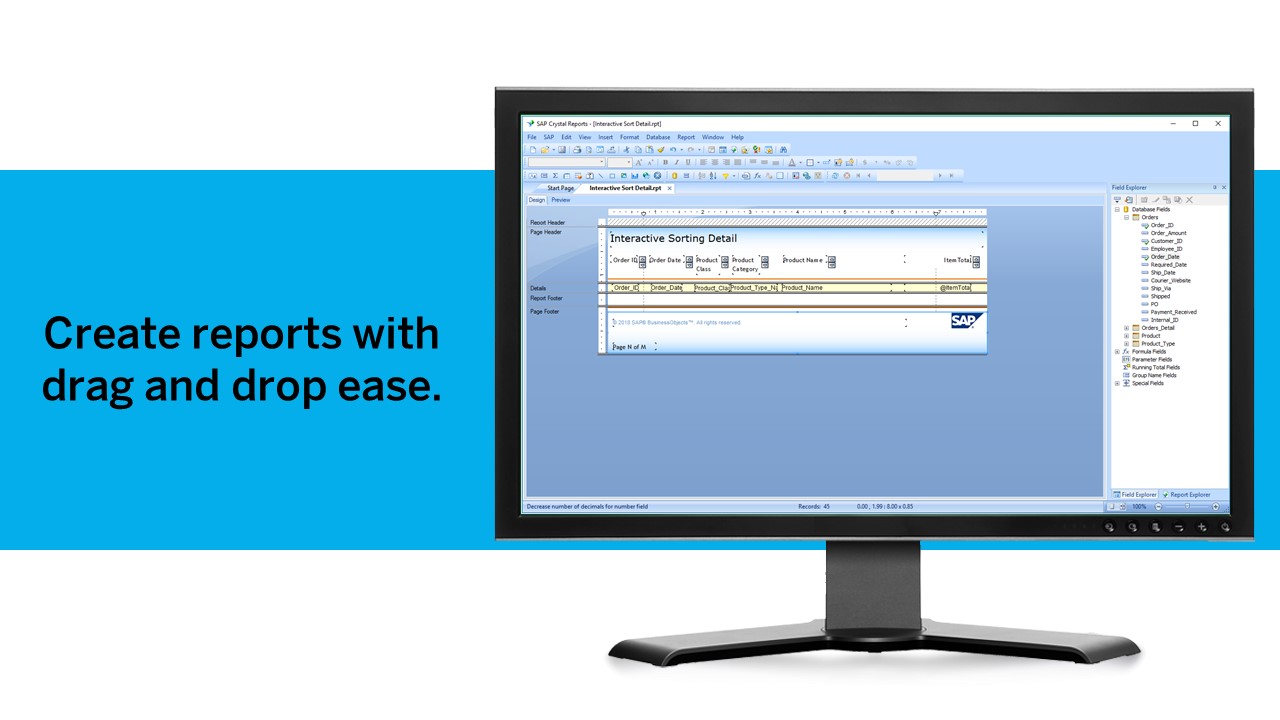
Crystal Reports allows us to create a consistent template for all of our reports.
Crystal Reports and Server allows us to house a repository for all of our reports to make them easy to find and update when necessary.
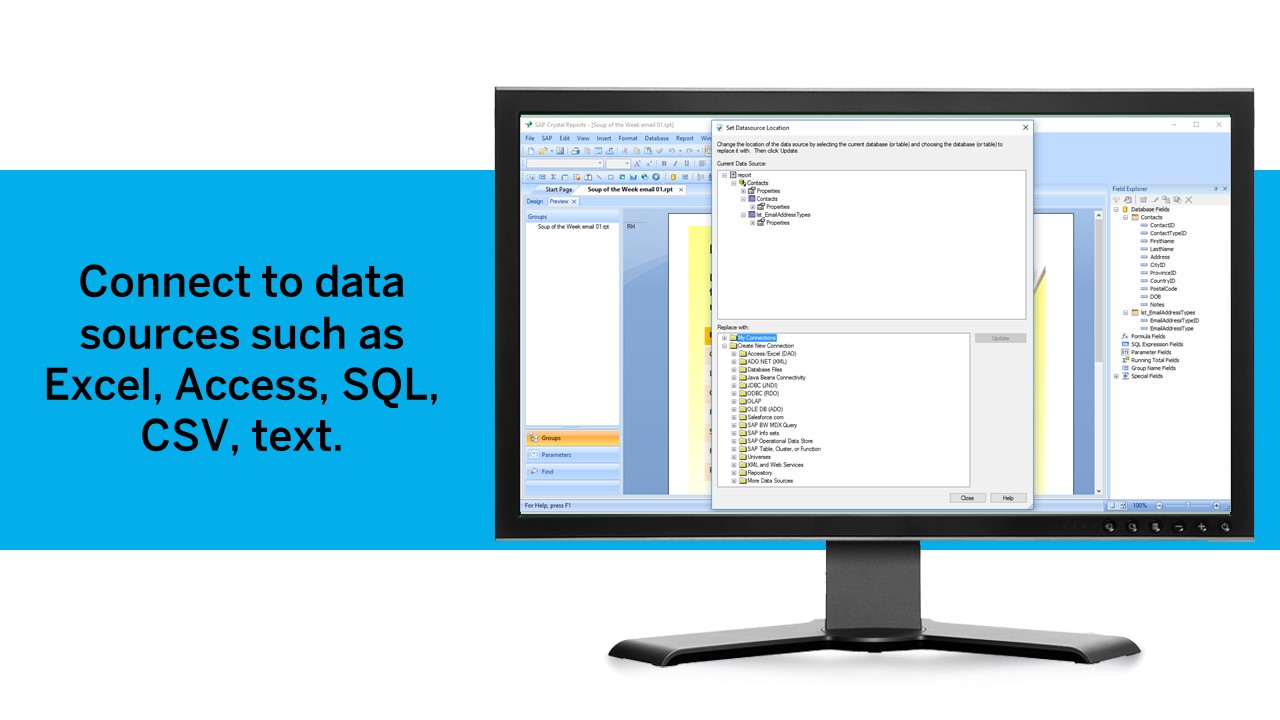
Crystal Reports can connect to a wide variety of data sources.
Crystal Reports can be a little daunting when first implementing. There are a lot of nuances in learning how to truly master this software and it can be frustrating at times.
IBM Cognos Analytics enables customer data segmentation, which is essential for marketing, improving and streamlining purchasing behavior and preferences. This helps companies create more targeted and effective marketing campaigns.
Our clients Through data analysis, we can identify and observe trends in the behavior of other clients, allowing us to anticipate needs and adjust strategies to avoid consequences.
The race to perfect gathering of Non-Traditional datasets is on-going; with Microsoft arguably not the leader of the pack in this category.
Licensing options for PowerBI visualizations may be a factor. I.e. if you need to implement B2C PowerBI visualizations, the cost is considerably high especially for startups.
Some clients are still resistant putting their data on the cloud, which restricts lots of functionality to Power BI.
For an existing solution, renewing licenses does provide a good return on investment. Additionally, while rolling out scorecards and dashboards with little adhoc capabilities, to end users, cognos is very easily scalable. It also allows to create a solution that has a mix of OLAP and relational data-sources, which is a limitation with other tools. Synchronizing with existing security setup is easy too.
Microsoft BI is fundamental to our suite of BI applications. That being said, Northcraft Analytics is focused on delighting our customers, so if the underlying factors of our decision change, we would choose to re-write our BI applications on a different stack. Luckily, mathematics are the fundamental IP of our technology... and is portable across all BI platforms for the foreseeable future.
We have been using this product for so many years and it has truly become a cornerstone to our business processes when it comes to developing and distributing information via reports. We currently have over 500 reports developed to date over about 30 systems and that will continue to grow as user needs change.
We have a strong user base (3500 users) that are highly utilizing this tool. Basic users are able to consume content within the applied security model. We have a set of advanced users that really push the limits of Cognos with Report and Query Studio. These users have created a lot of personal content and stored it in 'My Reports'. Users enjoy this flexibility.
The Microsoft BI tools have great usability for both developers and end users alike. For developers familiar with Visual Studio, there is little learning curve. For those not, the single Visual Studio IDE means not having to learn separate tools for each component. For end-users, the web interface for SSRS is simple to navigate with intuitive controls. For ad-hoc analysis, Excel can connect directly to SSAS and provide a pivot table like experience which is familiar to many users. For database development, there is beginning to be some confusion, as there are now three tool choices (VS, SSMS, Azure Data Studio) for developers. I would like to see Azure Data Studio become the superset of SSMS and eventually supplant it.
Crystal is very robust, but not always easy to use. It create wonderful looking reports, and so deserves a high rating. However, I have to take a couple of points off for the simple fact that I cannot hand it to a user and expect them to be able to do development with it.
Reports can typically be viewed through any browser that can access the server, so the availability is ultimately up to what the company utilizing it is comfortable with allowing, though report development tends to be more picky about browsers and settings as mentioned above. It also has an optional iPad app and general mobile browsing support, but dashboards lack the mobile compatibility. What keeps it from getting a higher score is the desktop tools that are vital to the development process. The compatibility with only Windows when the server has a wide range of compatibility can be a real sore point for a company that outfits its employees exclusively with Mac or Linux machines. Of course, if they are planning on outsourcing the development anyways, it's a rather moot point
Overall no major complaints but it doesn't handle DMR (Dimensionally Modeled for Relational) very well. DMR modelling is a capability that IBM Cognos Framework Manager provides allowing you to specify dimensional information for relational metadata and allows for OLAP-style queries. However, the capability is not very efficient and, for example, if I'm using only 2 columns on a 20-column model, the software is not smart enough to exclude 18 columns and the query side gets progressively larger and larger until it's effectively unusable.
SQL Server Reporting Services (SSRS) can drag at times. We created two report servers and placed them under an F5 load balancer. This configuration has worked well. We have seen sluggish performance at times due to the Windows Firewall.
Why is their web application not working as fast as you think it should? They never know, and it is always a a bunch of shots in the dark to find out. Trying to download software from them is like trying to find a book at the library before computers were invented.
While support from Microsoft isn't necessarily always best of breed, you're also not paying the price for premium support that you would on other platforms. The strength of the stack is in the ecosystem that surrounds it. In contrast to other products, there are hundreds, even thousands of bloggers that post daily as well as vibrant user communities that surround the tool. I've had much better luck finding help with SQL Server related issues than I have with any other product, but that help doesn't always come directly from Microsoft.
The support community can be difficult to navigate. I've also run into issues with my login. The SAP system has a bizarre mechanism for validating users that requires users to have what is called an S-ID. A basic ID may not give you access to all the features in the portal. The limitation may include not being able to perform a simple task like downloading patches and updates. This isn't a big deal for single user license but for teams it can be a pain.
Onsite training provided by IBM Cognos was effective and as expected. They did not perform training with our data which was a bit difficult for our end-users.
The online courses they offer are thorough and presented in such a way that someone who isn't already familiar with the general design methodologies used in this field will be capable of making a good design. The training environments are provided as a fully self contained virtual machine with everything needed already to create the environments. We've had some persisting issues with the environments becoming unavailable, but support has been responsive when these issues arise and straightening them out for us
I have used on-line training from Microsoft and from Pragmatic Works. I would recommend Pragmatic Works as the best way to get up to speed quickly, and then use the Microsoft on-line training to deep dive into specific features that you need to get depth with.
Make sure that any custom tables that you have, are built into your metadata packages. You can still access them via SQL queries in Cognos, but it is much easier to have them as a part of the available metadata packages.
We are a consulting firm and as such our best resources are always billing on client projects. Our internal implementation has weaknesses, but that's true for any company like ours. My rating is based on the product's ease of implementation.
Just like any other implementation: When designing the differing reports, get end users' input, make sure to design the reports so that they display the information that the company requires, in the best and clearest way possible.
Test, test, test, revise when needed, and, particularly, do sufficient training so users are comfortable using Crystal Reports!
Power BI is stronger for quick ad-hoc analysis and dashboards, but IBM Cognos Analytics is better when consistency, precision, and mass distribution matter. Tableau is best for interactive analysis, while IBM Cognos Analytics is better for standardized, repeatable enterprise reporting. Sigma shines for customizable dashboards and drill-down analysis while IBM Cognos Analytics holds an edge in data discovery and visualization.
We have used the built in ConnectWise Manager reports and custom reports. The reports provide static data. PowerBI shows us live data we can drill down into and easily adjust parameters. It's much more useful than a static PDF report.
Crystal reports is useful in case we want to import data from data base . We can write queries in it but Google Charts require to be implemented in our application using code so crystal reports is better than Google Charts.
The Cognos architecture is well suited for scalability. However, the architecture must be designed with scalability in mind from day one of the implementation. We recently upgraded from 10.1 to 10.2.1 and took the opportunity to revamp our architecture. It is now poised for future growth and scalability.
As a SaaS provider we see being able to provide self-service BI to our client users as a competitive advantage. In fact the MSSQL enabled BI is a contributing factor to many winning RFPs we have done for prospective client organisations.
However MSSQL BI requires extensive knowledge and skills to design and develop data warehouses & data models as a foundation to support business analysts and users to interrogate data effectively and efficiently. Often times we find having strong in-house MSSQL expertise is a bless.
It is a decent buy for specific departments in terms of reporting capabilities but updates and cost (frequent) demands are higher with the benefits offered.
So long as the requirements are not ever changing, with scheduling functionality, it's a handsome tool.