Instapage is a growth marketing platform that includes a builder for PPC, SEO, demand generation, A/B testing, personalization, and email automation. It is used to convert visitors into customers, engage them at every touchpoint, and optimize performance across the marketing funnel.
$99
per month per user
Agentforce Marketing
Score7.6 out of 10
N/A
Marketing Cloud is a cloud-based digital marketing platform, used by marketers can segment their audience, deliver personalized messages, track campaign performance, engage leads and accounts, and optimize strategies based on real-time insights.
$1,250
per month per installation
Pricing
Instapage
Agentforce Marketing
Editions & Modules
Create
$99
per month 15,000 unique monthly visitors
Optimize
starting at $199
per month starting with 30,000 unique monthly visitors
Well-suited for simple landing pages which don't have any complex functionality. Great for creating landing pages for lead generation campaigns - as it comes with tons of excellent templates and a variety of forms. Not great for pages that contain a lot of information and can potentially be very long. We found that Instapage is not a great fit for building pages that need to be updated frequently, like a blog page.
A de minimis incentive was given to thank the reviewer for their time. The incentive was not used to bias or drive a particular response, nor was the incentive contingent on a positive endorsement. More Info
I think the product, by definition, is meant for marketing — and we use it exactly for that, for running campaigns. That’s the best-suited use case for the product. I don’t think it’s really meant to be used for anything else — that’s just not how it’s designed.
A de minimis incentive was given to thank the reviewer for their time. The incentive was not used to bias or drive a particular response, nor was the incentive contingent on a positive endorsement. More Info
Instapage makes it easy to frame out a landing page really quickly. They provide template blocks for various components of a landing page (header, features, testimonials, etc.) that you can easily modify for your own needs. Other tools provide whole-page templates, but I much prefer the section-level templating. It's more convenient to assemble a page this way and add the details on top of that versus taking a finished template and peeling away design and functional elements to get what I want.
Instapage's mobile auto-resizer works better than other platforms I've used. I found that I had many fewer adjustments on their auto-resizing of the full page than I've experienced with other tools. I still had to work with text size a bit, but they generally did a better job of ordering elements for mobile the way I would want and maintain proportionality of page elements better.
Instapage has a lot of integrations that marketers will love. I don't know if they particularly stand out in this respect, but this is a particularly important aspect of their tool that most marketers will care about.
A de minimis incentive was given to thank the reviewer for their time. The incentive was not used to bias or drive a particular response, nor was the incentive contingent on a positive endorsement. More Info
A de minimis incentive was given to thank the reviewer for their time. The incentive was not used to bias or drive a particular response, nor was the incentive contingent on a positive endorsement. TR verified that a representative sample of customers was invited. More Info
There are only a couple of minor issues that I dislike. One is offering a Drupal community-approved update to their module. We are using a slightly older version of Drupal and it appears they don't have plans to offer a Drupal-approved update to their module for that version.
There are also random bugs when trying to format text. For example, sometimes a sans serif font appears as a serif and doesn't seem to want to change.
If you work with a template and some code, it can be challenging to edit the default coding.
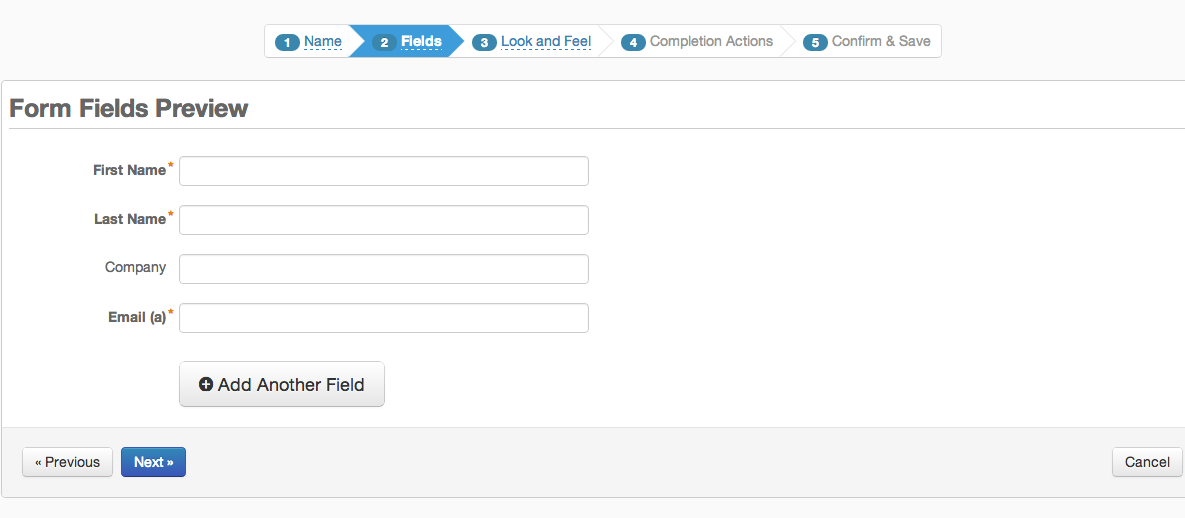
The built-in forms can be a bit limiting.
The program will try to automatically reformat for mobile, but it may not always be exactly the way you want it to look, so there is a bit of redesigning required when going to mobile.
A de minimis incentive was given to thank the reviewer for their time. The incentive was not used to bias or drive a particular response, nor was the incentive contingent on a positive endorsement. More Info
A de minimis incentive was given to thank the reviewer for their time. The incentive was not used to bias or drive a particular response, nor was the incentive contingent on a positive endorsement. TR verified that a representative sample of customers was invited. More Info
As of right now we have not seen any other program that integrates as seamlessly into our Salesforce platform. We have barely scratched the surface of all the features and use cases. It would be irresponsible to make a move to another platform in the near future. We have not come up against any limitations that would prompt a need to switch
I've tried all of the other landing page services on the market, and this is literally the easiest to use. I am not a designer or software developer, just a simple guy and if I can learn how to use it, anyone can. That's what won me over. Their support and pre-made templates are awesome, but the usability is what I love!
You won't find another solution that has as many features as Salesforce Marketing Cloud Interaction Studio. We all know Salesforce, we all know how big they are and it's not for nothing... Their tools do most of the things you want, need and even imagine. Using it is complicated, but the usability is infinite.
A de minimis incentive was given to thank the reviewer for their time. The incentive was not used to bias or drive a particular response, nor was the incentive contingent on a positive endorsement. More Info
Upgrades and timing of the upgrades were communicated well and planned during off hours for our work. If we did have a campaign scheduled during that time, it would kick-off after the system was back active. There were a few unplanned system down times, but it was a rare occurrence and those times were also short in duration.
Though the make up of MA apps is not built this way today, it would be nice to see them become more real-time. The integration between Salesforce and Pardot is not a true real-time integration. If I modify something in Salesforce, those changes are not automatically reflected in Pardot immediately. There is a delay of about 15 minutes before the systems sync. This delay, although not long, is less than ideal We would love the systems to be integrated real time such that changes are propagated from one system to the other immediately.
They are really responsive and more than not solve the problem or give you insight to how you can manage the solution yourself. I do find however sometimes a long delay on the more complex issues when they need to loop in other departments. but overall a good experience with support
A de minimis incentive was given to thank the reviewer for their time. The incentive was not used to bias or drive a particular response, nor was the incentive contingent on a positive endorsement. TR verified that a representative sample of customers was invited. More Info
The trainers at the Pardot user conference (Elevate and Connections) were very knowledgeable and presented the material well. Again, the content was targeted to more of a new user audience, and was not really relevant for folks who had been using the product for 2+ years.
Pardot's online training touches on all topics briefly and vaguely without much indepth exploration into how a final outcome could look, such as Nurturing Campaigns, Email templates, landing page templates, etc... The only true way to uncover Pardot's full capabilities is to have Front End design and coding experience. Without this key skill set, I would not recommend Pardot to another business.
From an IT perspective, once you set up the Javascript beacon and start collecting data there is a waiting game. During this time you can start labeling your site actions which can be labor intensive for a single person, but you don't really have the final end-users on the platform yet. We did a lot of training so users were experienced, but it wasn't until they had their first tasks to accomplish that they started using the system and had questions. I'd recommend setting up some immediate goals for an end-user to start segmenting for the purpose of displaying message campaigns so you can jump start end-user action.
HubSpot was terrible because it required a lot of coding experience if you wanted to work outside the given 4-5 templates. If you wanted a new template built, or to rebrand existing templates, they charged you. Very inflexible program and was very challenged by it. Our main website was built using WordPress, which is great for building webpages, but more difficult to build a landing page without the distraction of the top navigation menu. Instapage literally answered all the problems we were seeking to address: simplicity, customization, ease of use.
A de minimis incentive was given to thank the reviewer for their time. The incentive was not used to bias or drive a particular response, nor was the incentive contingent on a positive endorsement. More Info
We use Salesforce Marketing Cloud for lead management, generating reports, tracking customer and dealer information, inputting orders, and more. I prefer HubSpot for email marketing and automation because it is easier to use and the emails are designed much better. We currently use Salesforce and HubSpot, and we are very happy to have both, as they have different pros/cons.
A de minimis incentive was given to thank the reviewer for their time. The incentive was not used to bias or drive a particular response, nor was the incentive contingent on a positive endorsement. TR verified that a representative sample of customers was invited. More Info
A de minimis incentive was given to thank the reviewer for their time. The incentive was not used to bias or drive a particular response, nor was the incentive contingent on a positive endorsement. TR verified that a representative sample of customers was invited. More Info
Prior to this, we had no solution and literally were doing things on paper in a world where technology is outpacing paper. Having this process optimized has made it easier for the sales and marketing people to change information. From the training perspective, it has allowed us to see holes in where we could create additional support training, so the ROI here has been a lot more than just the optimization of a process.
A de minimis incentive was given to thank the reviewer for their time. The incentive was not used to bias or drive a particular response, nor was the incentive contingent on a positive endorsement. More Info
We've not had much of a conversion rate on some of our landing pages -- but this could be because we are relatively green with the marketing side of things and forget to send people to it. It's not easy for people to find on their own -- so I highly recommend you use some of the "hidden" SEO tools to increase the ROI. Without it, you're not going to be happy with your investment.
A de minimis incentive was given to thank the reviewer for their time. The incentive was not used to bias or drive a particular response, nor was the incentive contingent on a positive endorsement. More Info
Salesforce Marketing Cloud allows us to more efficiently reach out to a higher number of prospects.
Salesforce Marketing Cloud allows us to nimbly communicate important messages in a timely fashion to facilitate conversion.
Salesforce Marketing Cloud allows us to track who is opening our messages so that we can stop sending to those not interested and focus on the most engaged audiences.
A de minimis incentive was given to thank the reviewer for their time. The incentive was not used to bias or drive a particular response, nor was the incentive contingent on a positive endorsement. TR verified that a representative sample of customers was invited. More Info