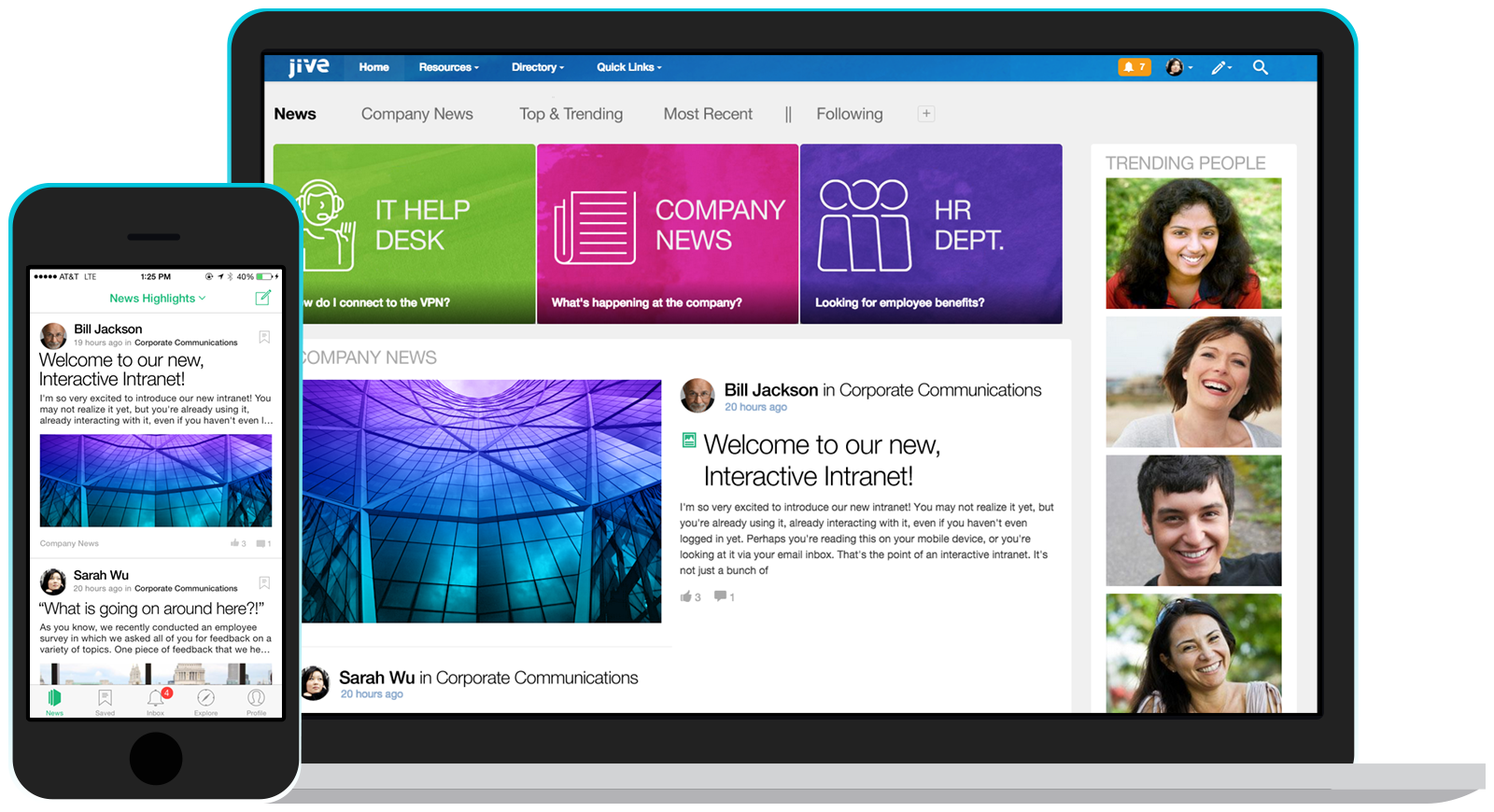
Jive Software, part of the Aurea family of customer experience solutions, provides the gateway to an organization's most important assets – its knowledge and people. Jive's interactive intranet solution promises to connect people, information and ideas to help businesses outpace their competitors. The vendor says the product has more than 30 million users worldwide across every industry, and is consistently recognized as a leader by top analyst firms.
N/A
Rally Software
Score 7.7 out of 10
N/A
Rally Software headquartered in Boulder, Colorado developed the Rally agile software development / ALM platform which was acquired by CA Technologies and rebranded as CA Agile Central. After CA's acquisition by Broadcom the software was once again rebranded as Rally.
N/A
Slack
Score 9.1 out of 10
N/A
Slack is a group messaging or team collaboration app that aims to simplify communication for businesses. Features include open discussions, private groups, and direct messaging, as well as deep contextual search and message archiving, and file sharing. Slack integrates with a number of other tools, such as MailChimp, Dropbox, and Google Drive. Slack was acquired by Salesforce in December 2020.
The product is free to use, and also has paid plans with more features and greater controls.
The…
$8.75
per month per user
Pricing
Jive
Rally Software
Slack
Editions & Modules
No answers on this topic
No answers on this topic
Free
$0
Pro
$7.25*
per month per user
Business+
$12.50*
per month per user
Enterprise
Contact Sales
Offerings
Pricing Offerings
Jive
Rally Software
Slack
Free Trial
No
No
Yes
Free/Freemium Version
No
No
Yes
Premium Consulting/Integration Services
No
No
No
Entry-level Setup Fee
No setup fee
No setup fee
No setup fee
Additional Details
—
—
*Per active user, per month, when paying once a year.
Pro is $8.75 USD per active user when paying month to month. Business+ is $15.00 USD per active user when paying month to month.
More Pricing Information
Community Pulse
Jive
Rally Software
Slack
Considered Multiple Products
Jive
Verified User
Employee
Chose Jive
We also use Skype to communicate in our organization. They are both useful for organizational communication. The good thing is in Jive, you will have your own personal timeline. Jive also has a newsfeed or timeline that you can browse where you can see the latest updates from …
We found that Jive had integrations with the existing IT infrastructure/tools which was nicely aligned with our strategy of playing nice with the existing ecosystem, rather than compete against it. Jive uses a technology stack that is well known by our organisation …
I honestly don't recall what we briefly used before Jive - it wasn't good and didn't last long. I think it was under-utilized because you couldn't really do a whole lot with it. Jive does pretty much everything we need it to do, so for that reason alone, Jive is the superior …
I was not involved in the decision to implement Jive versus competitors. My presumption is that the feature set at the time was attractive compared to options like SharePoint. Useful to note that SharePoint seems to have closed the gap in recent years.
Jive is a little behind the curve in comparison with the latest Microsoft features. Jive's lack of native capabilities to support work that requires process or structure increasingly puts it at a disadvantage.
Our evaluation was done many years ago, but at the time Rally provided the best mix of SCRUM-driven features, visibility and economy for our product engineering teams.
It's definitely worth considering Jive for the type of application we've developed i.e. a central shared repository for all employees to host and discuss information. I can't say I have ever used a superior tool, but they may exist. I'm just not sure I would want to use it exclusively for file hosting, though. It does integrate with various other tools, so perhaps it would be fine if used in conjunction with another tool for that purpose.
Rally Software is well suited for large Agile or scrum teams who do sprints and it helps managing sprints and backlogs. It is well suited for organizations who want visibility into work being done and progress. Suitable for tracking is user stories, defects and release planning. Works well with CI CD too. It would not be suitable for small teams or startups. For teams that don't use agile. Teams who want lightweight tools like Jira. Companies with a limited budget.
Slack is great for tracking commits to new coding projects. You can take parts of code that still need to be implemented later and easily search through the history of comments if there is something that goes wrong with a code commitment. It can be difficult for people that only like Teams to adjust to a new platform if you are using both to communicate.
Presence of Russian language (localization can be independently established)
You can configure several information tapes with different themes. One for work, the second for communication
A newly-arrived network user immediately receives a prepared block for beginners. After completing several game tasks, the user will receive the basics of using Jive.
There is a template for each scenario. There is even a template for planning R&D, and there are more than twenty of them.
Integrates with MS Office, Google Drive, Google Docs
There are all platforms (even Winphone and blackberry)
There are dashboards that provide friendly and useful metrics at the team, program and portfolio levels which help get an easy and quick visual representation of what's going on.
Story management made easier, It offers a quick way of quickly entering a number of user stories without losing the overview, by just typing the title and selecting a few attributes directly in the overview screen.
Sprint management is seamless in CA Agile Central . It allows you to drag stories from the backlog to the sprints and back again. When a story is dragged into an sprint, it automatically checks the velocity for that sprint and indicates how many more story points can be chipped in. No more manual checking needed by scrum master with respect to allocation and team velocity.
Though CA Agile Central has many inbuilt apps, but it also has an App-SDK that allows you to build free app extensions using JavaScript and HTML. So, as per their needs, teams can customize & build various apps & dashboards.
Dashboard is an awesome feature which allows you to select and drag panels with all kinds of graphical information about the current sprints and releases.
It offers tremendous support for scaled Agile & almost all scaling frameworks are supported specifically tuned to SAFe .
CA Agile Central includes several applications but it also integrates well with Jira, Confluence, Jenkins, Eclipse, Subversion, IBM, HP, Salesforce.com and many other products to allow users to organize projects to their specifications. So you can still use Jira at a team level & CA Agile Central at the program & portfolio level for efficient tracking & management.
The custom tags are very helpful in segregating the user stories based on the project needs. Even though it's a very small feature, it is very effective ( you will realize why specifically if you are using Jira).
CA Central Agile enables agile delivery with ease and provides comprehensive features to track time-boxes, Work In Progress items of the forecast increments.
Backlog management is hassle free since you can either drag and drop your user stories to the desired position on the backlog, or change a setting and manually enter priorities as a number.
User management is pretty basic and could be better. For example more filters and reports and more ability to do mass updates.
The report generator is very, very basic and is not WYSIWYG. It has limited filters to generate reports. Often a Scrum master will need to export data to Excel or a tool like Crystal Reports to get enhanced reporting capability.
Would love a better integration with GitHub. For example, notifications when your PR is updated, when review is requested, @-mention in comments, etc.
Improved "Later" tab, for example the ability to create to-do lists or making the "Later" tab into a more powerful to-do list (annotate items with notes)
More powerful integrations, e.g. Google Calendar could render a calendar view within Slack, rather than sending the daily schedule
There are always external factors that can impact this decision but currently, the Jive platform is maintaining its lead in the market place in this area. If the innovation in this space by Jive continues, then this number will remain high. Integration with other systems and adaptability to changes in the market or in client needs will also make this decision hard to predict more then 6 months into the future
To be more transparent, I give 10 because Slack serves our collaboration needs. It provide us a good platform for team communication relaying important update within the company, it has even mobile app where you can install in your phone to monitor any updates within that team that needs your immediate attention and intervention.
It was harder to use that expected. The admin needs to be code savvy to truly customize the system. And users need to trained on the system and the setup. Trainings and monitoring need to continue to enforce use.
Great UI, recent refresh was terrific. Great graphs and metrics, inline editing for updates, and a multitude of views on sprint progress make for a great team collaboration experience. There is also an active community and forums so that if you do need help, it is readily available
My rating was 7. Its intuitive interface and user-friendly features like channels, threads, and integrations make it excellent for team communication and onboarding. However, its usability is held back by the resource-intensive desktop app and cluttered feeling in large workspaces. The mobile app's performance and unreliable notifications have also been noted as weaknesses.
Uptime was OK. But there was one day that the system crashed for a whole day. Our company was unable to operate. And all the plugins to word/excel froze causing those systems to freeze.
Jive posted a statement to the media saying all customers were up, but we were not.
Yes, the app works 24/7. I don't even recall having any period that we could not use since the implementation. Even the maintenance periods are barely noticeable and our work is not impacted by it when it happens.
The screens render relatively quickly but many actions that you would expect to require a single click require multiple clicks and pop-up windows. The extra windows and clicks make the product feel ponderous.
Slack is a soft app, we don't have many issues with it. I recall one or two people complaining about something during our usage period, but I didn't have a bad experience. When the app is slow, usually the problem is with my computer or my internet. The app works just fine.
They did an OK job when I needed them. Except for the one day the system went down. Jive pointed the finger at the hosting company, and the hosting company pointed the finger at Jive. No reliable information came to us.
I've had to use support only one time and my issue was eventually resolved but not because of my ticket--because others complained about the functionality taken away so they brought it back. My ticket was never answered or addressed. So I can't really say much for the support factor for Rally.
Whenever I've had to troubleshoot an issue with Slack (which, to be honest, has not happened very often), their online documentation has been easy to locate, easy to understand, and effective in resolving my issue. Slack's ever-growing popularity also means that there's a large community of practice out there that can be depended upon.
Jive online training is there. It is OK/average. I feel some other companies are doing better. It is not a piece that is required to have a successfully implementation, but it could be useful to improve it
It more or less confirmed that we are using it the way they had in mind. We were hoping for a epiphany in terms of how we could use it better.
They also want to be a go to source for agile processes and have an online resource center. It’s not that great but had a couple of nuggets. It hasn’t really helped us too much and we are not too far off from the classical interpretation of agile.
I would recommend training, in particular for organizations that multiple on-going projects. The product seems optimized for larger, more complex teams and getting proper training on how to configure, administer and use the system would be beneficial
Implementation of RALLY services and program satisfaction among various group,... 1) Dev Outcomes: How were our resiliencies, development, learning & practitioners “make them do the work,” but that they ask you to do it “in a way like before. 2) The Ops group: Just wish to make sure any change won't break current production envirements All the stake holders has to be on the same page
We had a Google phone number set up before and Jive was a lot better option than that. It is more consistent and can be configured much easier and with more advanced settings. Additionally, based on the pricing as well as working with the rep on our account, it was a perfect option for us
Rally and Asana have comparable features and are both valuable project management tools, but Asana's user interface is well-organized and highly intuitive. It's easy to add tasks and collaborators, edit due dates, indicate progress on tasks, close out projects, etc. However, Rally's interface is somewhat cluttered and difficult to navigate. My team ended up choosing Asana over Rally due to these concerns.
I like Slack better than ClickUp, because I would spend 30-60 minutes a day updating my ClickUp tasks. The way ClickUp was used was very micromanaging. I billed by the hour, so I was willing to put in the time to alert the boss what tasks I was working on.
One of my jobs used Hive - I mostly just ran it in the background in case anyone messaged me. I did not use it often.
reduce amount of files/documents scattered & lost across shared drives
increased discovery, awareness and interaction of historically more separated individuals & team functions across the organisation
from an IT perspective, we've benefited from improved IT operations (e.g. troubleshooting info shared and easily searched/found with all team members - such that even junior team members can solve technical problems outside of business hours, lessening the burden for standby/call-in for more senior team members)
it helped organizing many of the processes management use to communicate tasks with engineers, and provided detailed charts on the speed/blockage during any iteration
with time Rally became the main tool we used to track and report tasks/defects in our projects, but frequent service outages made it very hard to continue consider as a reliable solution
too much features is good, but for engineers a few features (User Stories section, iterations, defects, and Kanban boards) are necessary and the rest is just noise
Slack has been incredibly helpful in connecting various tech apps and ecosystems, creating a more streamlined and responsive process.
Slack has made it significantly easier to communicate with our team members across multiple time zones, creating a more engaging environment for our all-remote team.