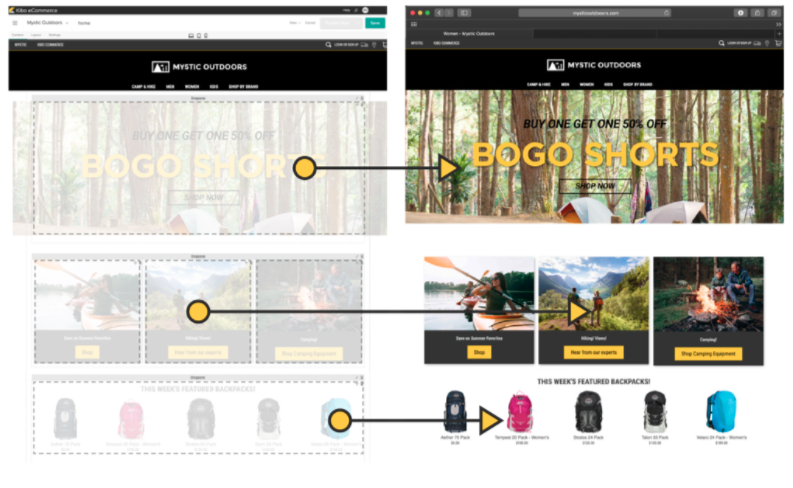
Kibo Software offers Kibo eCommerce (formerly Mozu), designed to support retailers with online offer creation and deployment, content publishing and landing pages, and many tools and widgets out of the box with a retail-oriented ecommerce solution.
Mozu was acquired by Kibo Software from Volusion in October 2016.
N/A
Miva
Score 3.9 out of 10
Small Businesses (1-50 employees)
Miva Merchant is a point-and-click, online store development and management system that allows merchants to build their online store through a web browser, and lets developers provide aftermarket enhancements for the online store.
N/A
Oracle Commerce
Score 7.0 out of 10
N/A
Oracle Commerce is an ecommerce platform that helps B2C and B2B businesses connect customer and sales data from their CRM to their financial and operational data so they can offer personalized experiences to buyers across sales channels.
N/A
Pricing
Kibo eCommerce
Miva
Oracle Commerce
Editions & Modules
No answers on this topic
No answers on this topic
No answers on this topic
Offerings
Pricing Offerings
Kibo eCommerce
Miva
Oracle Commerce
Free Trial
No
No
No
Free/Freemium Version
No
No
No
Premium Consulting/Integration Services
No
Yes
Yes
Entry-level Setup Fee
No setup fee
No setup fee
No setup fee
Additional Details
—
Miva employs a revenue-based pricing model. The Miva platform is best suited to growing mid-size and enterprise merchants that have complex business needs and are making (or planning to make) $1 million or more in annual online revenue.
Contact sales team for pricing
More Pricing Information
Community Pulse
Kibo eCommerce
Miva
Oracle Commerce
Features
Kibo eCommerce
Miva
Oracle Commerce
Online Storefront
Comparison of Online Storefront features of Product A and Product B
Kibo eCommerce
8.3
6 Ratings
7% above category average
Miva
1.0
3 Ratings
154% below category average
Oracle Commerce
9.0
18 Ratings
15% above category average
Product catalog & listings
8.46 Ratings
1.03 Ratings
9.118 Ratings
Product management
8.26 Ratings
1.03 Ratings
9.118 Ratings
Bulk product upload
7.65 Ratings
1.03 Ratings
8.417 Ratings
Branding
8.26 Ratings
1.03 Ratings
8.416 Ratings
Mobile storefront
8.56 Ratings
1.03 Ratings
9.116 Ratings
Product variations
8.55 Ratings
1.03 Ratings
9.018 Ratings
Website integration
8.04 Ratings
1.03 Ratings
9.118 Ratings
Visual customization
8.16 Ratings
1.03 Ratings
9.818 Ratings
CMS
8.74 Ratings
1.03 Ratings
8.515 Ratings
Online Shopping Cart
Comparison of Online Shopping Cart features of Product A and Product B
Kibo eCommerce
9.0
2 Ratings
17% above category average
Miva
1.0
3 Ratings
154% below category average
Oracle Commerce
8.4
18 Ratings
10% above category average
Checkout user experience
9.02 Ratings
1.03 Ratings
8.518 Ratings
Abandoned cart recovery
00 Ratings
1.03 Ratings
8.416 Ratings
Online Payment System
Comparison of Online Payment System features of Product A and Product B
Kibo eCommerce
8.4
6 Ratings
1% above category average
Miva
1.0
3 Ratings
157% below category average
Oracle Commerce
8.5
17 Ratings
2% above category average
eCommerce security
8.46 Ratings
1.03 Ratings
8.517 Ratings
eCommerce Marketing
Comparison of eCommerce Marketing features of Product A and Product B
Kibo eCommerce
7.7
6 Ratings
0% above category average
Miva
1.0
3 Ratings
154% below category average
Oracle Commerce
8.9
18 Ratings
15% above category average
Promotions & discounts
8.56 Ratings
1.03 Ratings
9.017 Ratings
SEO
7.02 Ratings
1.03 Ratings
9.218 Ratings
Personalized recommendations
00 Ratings
1.03 Ratings
8.517 Ratings
eCommerce Business Management
Comparison of eCommerce Business Management features of Product A and Product B
The platform has flexibility at its core and we have made full use of that capability. Even if Kibo [eCommerce] hasn't been ready to provide features and functions we need, we have the opportunity to build them ourselves. The platform started as Mozu and while it was relatively well-developed for DTC, it lacked a lot of basic B2B functionality. As a result, when we were ready to move into that arena, we built a lot for ourselves (including a multi-level account system and a tool to manage it). Keep in mind, too, that Kibo eCommerce is part of a larger suite of tools. The company has purchased a mobile Point-of-Sale system, Baynote, Certona, Monetate, and an OMS. If you need a full-scale solution, they can offer a lot. As I mentioned previously, their support and documentation need shoring up. They're not terrible, but they hinder (rather than help) when it comes to fulfilling the platform's promise of letting the customers be self-service in building out their capabilities.
Miva is a SaaS closed platform. Page builder has bugs and errors, it's not as easy to work with as they say. To work with Miva, you need to work with their professional services or an agency, it's not a cheap platform to make changes to. Has anyone read the latest terms of service update from Miva sent out yesterday 5/21? It's extremely concerning. Miva could shut you off the day after a payment for your subscription fails. Why would they do this to their customers?
Under section C. (ii) Payment Terms: d (ii) Customer shall be in default of this Agreement. If Customer’s Account is not paid in full on the invoice date, Miva reserves the right to interrupt or terminate Customer’s access to and use of the Services and to any other Miva Products and/or Services on the following day. Miva is not responsible for any losses or damages resulting from any interruption or termination of the Services due to outdated or incorrect payment information.
Miva is based in San Diego, CA. Under California law (e.g., California Business and Professions Code § 17200 for unfair business practices), a 24-hour notice period for service suspension could be deemed unreasonable, especially for a critical business service like an ecommerce platform. Courts often expect “reasonable notice” (typically 5-30 days) to allow the customer to cure the default.
This change isn't lawful and it's extremely concerning to anyone who hosts a website on their platform. No opportunity to cure? They used to have a 15 day grace period to cure. One would wonder why they would be unreasonable in taking this away when it's best practice throughout the e-commerce industry.
Oracle CX Commerce (formerly Oracle Commerce Cloud) is very well suited for B2B commerce transactions. The wonderful thing about this software is its ability to regularly update on an automatic basis, and keep up with upgrades. Oracle CX Commerce provides my organization with greater flexibility and quick integration processes. I would recommend this to any organization trying to set up their own storefront.
The ability to quickly change the look and feel of any given page in the store. The storefront, category, product description, and all checkout pages are easily customize-able using simple HTML language.
With minimal effort, more sophisticated changes and behaviors of the store can be modified using MivaScript, the language Miva Merchant is built upon.
New features are very easy to add using a huge selection of 3rd party feature modules that typically sell for less that $100. Miva has so many features already built in, but if there is a major common feature not already in the code, it's almost a sure bet that there is a affordable and easy to install module that will meet your e-commerce business requirements.
Miva corporation provides a high level of free support 7 days a week and 24 hours a day.
It uses an effective algorithm to provide users with product recommendations based on other products they’ve previously viewed.
It comes with a decent support platform, where Oracle is attentive and provides help diagnosing issues that may arise within the environment.
Oracle CX Commerce comes with a developer tool known as the DCU Tool, which is very helpful when it comes to pushing changes from environment to environment. The DCU Tool is also a good resource to use for source control.
Prebuilt Integration - There is not currently a large number of preexisting integrations, but custom integrations are fairly quick
Time to Deploy - Don't get me wrong, We have deployed in the timeline we expected, but if you are trying to get something off the ground fast, Kibo might not be right for you. It is a robust platform that take some time to get up and running.
Complicated Shipping - if you have a complicated shipped process, you might want to look for a tool to help, Kibo does not have very robust out of the box shipping capabilities.
The Miva admin area hasn't been the most user-friendly in the past. However, the admin in the the upcoming new Miva Merchant 9 Release has been completely revamped, is VERY user-friendly, and is formatted for desktop as well as mobile devices.
Some fairly standard ecommerce functionality like Gift Certificates, Coupons, Sale Prices, etc have previously required third-party modules or template customization. However, many of these features are being built into Miva Merchant upcoming releases.
Customer experience - Oracle CX is already a leader and I bet they'll make it even better surpassing all expectations.
They've [been] the best eCommerce model solution for any kind of business at least for book publishing and logistics management - thus can't complain here either.
For most clients, the MIVA Merchant platform, in combination with 3rd party plugins from ADS, Emporium Plus, eMediaSales and Sebenza, has all of the bells and whistles they need. While MIVA is lacking in a mobile friendly option and the ability to easily sell soft goods like mp3's or eBooks, these additions are coming to MIVA soon. The lack of connectivity to popular POS systems is also a negative for us. We will certainly continue to offer MIVA Merchant to clients.
Oracle Commerce Cloud is definitely not my favorite platform to use, however our company has gotten very comfortable with the way our website operates using it so I do not see us switching to a different product any time soon. Over time, I’ve grown to have a love/hate relationship with this product, but as I learn more about what it offers I come to appreciate its functionality more
I won't say usability is all bad with Miva; basic product configuration isn't complicated and assigning products to categories works well. However, when you go beyond the most elementary tasks, things almost always become needlessly cumbersome and the information stored by the platform is inherently poorly organized. They've really hyped that Miva 9 released last year features a re-worked admin interface, but from our perspective they've simply given it a fresh coat of paint, made the layout passably mobile friendly, but yet still have not in a substantive way addressed the glaring deficiencies at the core of the platform itself. Adding custom admin area bookmarks is a band aid, not a proper fix.
I work with multiple Miva sites daily, and uptime is fantastic. Outages are rare from my experience, and any issues have generally been short and handled quickly.
One positive note is that I have always been able to get someone on the phone in support whenever I have called, even at 1 AM. Getting someone on the phone is only half the battle though. In the first few months of using Mozu it often seemed that support didn’t know anymore about Mozu than we did. This has slowly started to change, but as a daily user you are likely to be on par with support in terms of knowing what to do when you encounter a problem. The support phone number is really most useful for having them put in a support ticket for you rather than typing it all out yourself and emailing it. It is very rare that the support reps are actually empowered to solve the problem at hand. Unless the issue you are having is user error, they will just take your information and pass it on the proper department. Your request or problem will then be ignored for months on end. Some day, it might actually get fixed but you are unlikely to be notified that this has happened. Most of these issues are assigned an internal ID that they use for tracking. Support is more than happy to pass this ID along, but it is useless. There is no way to actually see where the issue lies in the endless queue of similar issues.
I would give 10, but there were a couple of times when I was misinformed and I had to do some unnecessary work. When you have to work on every product individually and then you discover you could have done it in bulk it kind of makes you roll your eyes back. I also have an issue still with some shipping settings that no one seems to understand. But the support team is super friendly, they are trying
At the time of our implementation Mozu did not have any processes or procedures set up around going live. We basically were forced to just wing it and hope for the best
Creating the Miva store originally took a reasonable amount of time, 2-3 months, but we were unable to migrate our orders and customer accounts from the old platform. Additional refinements were required over the following 6 months to refine the functionality and features so that they worked properly for our store and fulfillment process.
We had a custom, in-house ecommerce website before moving to Kibo. It was brittle, slow, and wasn't going to scale nearly well enough or fast enough to keep up with our requirements
Each player has positive features and value to add to a business. BigCommerce and Shopify have brand recognition that has lead to them being the more common choice in eCommerce. Overall, they have their place for simple B2C sites, and less complex B2B sites. Miva was the only one where we had access to not only the core of the platform, but every part of our page templates. Most platforms will give you a box to stay in, but Miva lets you define the box, and when it doesn't fit your needs, you can adjust it to bring it where it will benefit your company most. Some of the major benefits that we couldn't find on other platforms: Ability to incorporate APIs at any stage of customer journey Unlimited Custom / Complex Product Configurators and Builders Easy to understand the structure and hierarchy of pages and templates.
The upgrade cycle of OCC and the subscription model ensure we are always on the latest and greatest version of the platform. The responsive design makes it easier for small departments to provide an optimum mobile experience. The stability of the platform is far superior to our on-prem solution.
Miva has proven to be a great solution for smaller mom-and-pop stores through large enterprise-class businesses with tens of thousands of products. Performance is just as strong on enterprise-class stores as on considerably smaller stores, and an increasing number of marketing/sales tools are continually being added to the core Miva functionality to keep up with current marketplace demands.
Running a business in general (and this applies to e-commerce of course) involves not enough time to do too many things. Any place one can automate/streamline/ simplify some of these myriad things, you gain more time to focus on high value activities. We have found that the more we have been able to leverage Miva's capabilities (often with our own tools), the more time we can spend on marketing, sales and product development.