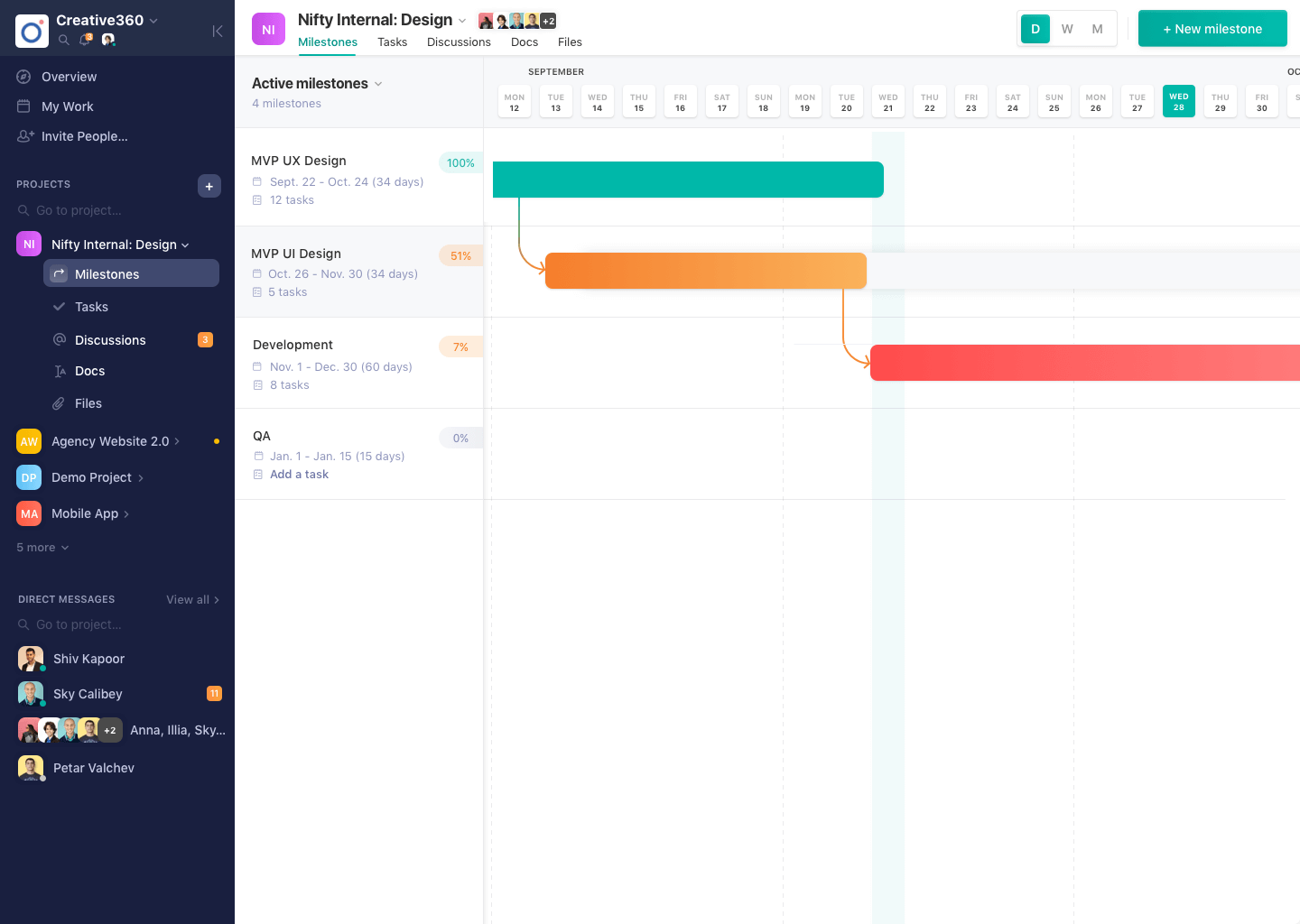
Nifty consolidates projects, work, and communications in one place. Nifty simplifies and automates the tracking of project milestones, communications with teammates and clients, collaborative document creation, and more in a centralized workspace! Nifty enables organizational oversight across projects and teammates with project & team workload overviews. With communications, project management, and workflow collaboration centralized in one place, teams can consolidate their workday as well…
N/A
Pivotal Tracker
Score 5.0 out of 10
N/A
Pivotal Tracker is a project management program primarily for software developers. It is built from the ground up to facilitate the agile development cycle, and is optimized for structuring projects in sprints, or “stories.”
The solution is now owned and supported by VMware, and is part of the Pivotal / Tanzu product line up.
The one thing that makes this nifty stand out from its peers is its ability to support everything that one can think of while working/managing a project! It has got effective timeline management, charting capabilities, chat functionality, document storage, and the ability to …
We've tried several project management tools and most of them lacked the features we exactly needed. Jira was the last we tested and it was complicated to handle as projects grew bigger. Nifty is structured well and has major features that can handle big projects and does well …
There's no comparison. Nifty does what all of these do all in one place (with the exception of slack's community aspect with hashtagging - not sure if Nifty can do this, never tried)
Nifty even has the ability to import directly from many other platforms - I've personally …
For my organization's needs, other tools such as AirTable, JIRA, and Asana have definitely been better. These tools provide more project management capabilities and configurability, so we are able to customize them to meet the team's needs. However, that also comes with a steep …
JIRA is very user friendly. It's ideal for people new to the software development lifecycle and the tracking of the work. They have simply nailed the intuitiveness. Pivotal Tracker might be the better long-term tool because of the flexibility that comes with it. But as …
I have used a number of systems like Pivotal Tracker over the last 15 years. I have had several occasions to use Wrike separate from and alongside Pivotal Tracker. Wrike was more difficult to use and seems to either be locked down by permissions, so I had to "fight" to do my …
The only thing that PT compares to is Salesforce and we now utilize both platforms - Salesforce is a bit more organized in its automated task flow and allows us to connect our other platforms to it for efficient data transfer and data consistency.
I haven't used dev-specific tools other than Pivotal Tracker but it's useful because it is built for a specific use case. The simplicity of an Asana or Trello is great and they have their advantages, but the additional functionality mentioned was worthwhile and a compelling …
It's not necessarily a matter of better vs. worse when it comes to all of these different tools. They all serve a different purpose to different sized teams. I found Pivotal Tracker and monday.com to be a matter of preference while serving a similar purpose. Good for smaller …
Pivotal Tracker keeps users 'close' to the software project(s) by allowing users to understand, in plain words, the tasks and expectations of each software release, whereas other tools are either way too close to the source code or require an extensive amount of maintenance. …
JIRA allows teams to tailor the application workflow to meet their needs, while "opinionated" Pivotal Tracker enforces a consistent workflow approach on all team members. While I, personally, may prefer to have a system configured to my particular habits and desires as a …
We selected Pivotal Tracker because it is highly opinionated about the process. It worked quite well for what we were expecting from it. Other software we tried were much more flexible, so we could implement our own process there.
Pivotal Tracker, Asana and Trello all have free versions making them ideal for smaller companies to try out. All of them blast Kannan boards and issue tracking capabilities. While Trello and Asana are great products in themselves, Pivotal Tracker edges them out with its wealth …
I've used Jira ages ago, and it was still a young product in its initial iterations. The UI was a clunky and was missing a lot of ease with drag and drop for individual stories, uploads, etc. Management of users was useable, but not as ideal as it could be.
We selected Pivotal Tracker because of its simple, elegant workflow. This is the ideal; it's where we want to be. So we continue to improve, and as we get better, we get more out of the software.
The other software products we evaluated were too complex, and we found that …
We have had employees in the past look at Drupal, and other open source project management tools to assist in our needs. Unfortunately each solution took too much time to implement, design and configure that we could not stop the work we were doing for clients to complete a …
We were using JIRA and found it lacking in their UI and some of their services, especially communication. PT communicates much easier with simple links to tasks for execution and QA review.
Basecamp is just really a super note taking and asset depot. I would not consider true …
Compared to other task management tools, Pivotal Tracker has the best blend of functionality and cost. When you need something simpler than Jira, and not solely focused on code or UI related tasks like BugHerd, and have a more direct approach to completing tasks than Trello - I …
Pivotal Tracker, for better or worse, provides a more structured and rigid workflow than most. That makes it easy to get started, but if you have your own workflow you want to integrate into it, it could mean it'll take longer to get used to or customize. It's still more …
Our organization actually does not exclusively use Pivotal. We also have teams on solutions like Trello and LeanKit. It's all preference, those who buy into all the agile features that pivotal provides, love it. Those who do not need all the overhead, simply use a different …
Rally is too complicated - there are far too many fields that all have the same meaning. It's a better agile tool in my opinion since it it was designed purely as an agile tool, but since the CA technologies acquisition, the tool has become more complicated and there are far …
Compared to Rally the tool seems more accessible because or the suite of apps available. It also feels more polished and stable than Rally. It definitely has more tools and features but again it can be overkill for a smaller team or project.
Overall I have found that I prefer using Pivotal over all the competitors I've tried. There are certain aspects of the other products which I do like but as a whole Pivotal does a better job. My one request is that I feel it is very much a web app and the other products have …
I have also used Trello and Jira. A small company with only a couple of projects may be best suited with Trello due to its cost and simplicity, whereas Jira may be better suited for a large company that can afford a dedicated Jira manager, due to its complex configurations and …
Jira is very complex, while tracker is more straightforward to use. Tracker requires less micromanagement and upkeep. Asana is pretty but not useful for product and engineering build. It is more geared towards design projects.
Nifty speeds up project lifecycles, aligns teams to work together to avoid missing deadlines and automates the process of reporting. Individual team members use Nifty to set their own project goals so that they can complete tasks on time. This app brings feedback together and offers teams dynamic collaboration to help them focus on the completion of the project.
The UI of the Pivotal tracker is really beautiful and amazing, which looks trivial, but we have it open all the time, so it's nice for us. In Pivotal tracker for me its very Easy to create tasks or stories anytime without facing any problems. Pivotal tracker provides us a ton of features to track the tasks and manage a team and the projects. Pivotal tracker allows for a entire team to be on the same page of the tool in regards to where is the project right now, right status of every task, what is being worked on and by whom.
Pivotal Tracker helps our team visualize our projects in the form of stories (virtual cards) moving through our workflow. This encourages us to break down projects into manageable chunks and have important conversations about deliverables and scope.
The forced-prioritization allows our team to have a shared understanding about what is most important and make collective decisions about what our team will work on next.
By dividing future iterations by our team's velocity, Pivotal Tracker accurately predicts when we will complete future work.
Used to have a newsfeed-type feature with all the updates from the previous day. They removed it. I liked getting a snapchat of what changed from before.
When signing up for email alerts, can be inundated with emails for every change to the status of a story.
Communication on stories through the comment section can be a little difficult, and not very organized.
It was generally easy to use once you got the hang of it. The searching and tagging of tickets was fine, commenting worked well, and release planning was good. However, it wasn't the most intuitive tool in the beginning. The UI is pretty outdated and could have used upgrades over time.
We've never had to request support in the 5 years I have been using it. A solid solution! Everything I have had questions about is on the website. New features are in their newsletter with more details on their website. Often I am using the new features within a few minutes of reading the article.
There's no comparison. Nifty does what all of these do all in one place (with the exception of Slack's community aspect with hashtagging - not sure if Nifty can do this, never tried) Nifty even has the ability to import directly from many other platforms - I've personally imported projects from Trello and Asana, saving tons of time in migration.
Pivotal Tracker, Asana and Trello all have free versions making them ideal for smaller companies to try out. All of them blast Kannan boards and issue tracking capabilities. While Trello and Asana are great products in themselves, Pivotal Tracker edges them out with its wealth of features including trackability of epics, burndowns, better reporting, and analytics. JIRA, on the other hand, is way more customizable, has more reporting capabilities and more features than Pivotal Tracker but is more expensive too. At the end of the day, it comes down to what you're looking for in an agile project management tool as well as how much you're willing to pay for it.
Pivotal Tracker has been a cost-effective solution for what we need. It has allowed our ROI to be greater than if we went with another system.
Learning curve; with this easy to use tool, it has been a shorter learning curve for new hires to find what they need to accomplish their task.
Flexibility; we are right now stuck at 4 levels of classification; project; Story, Task, Comments. If we were able to expand on this, we would be able to role this out faster to other departments within our business.