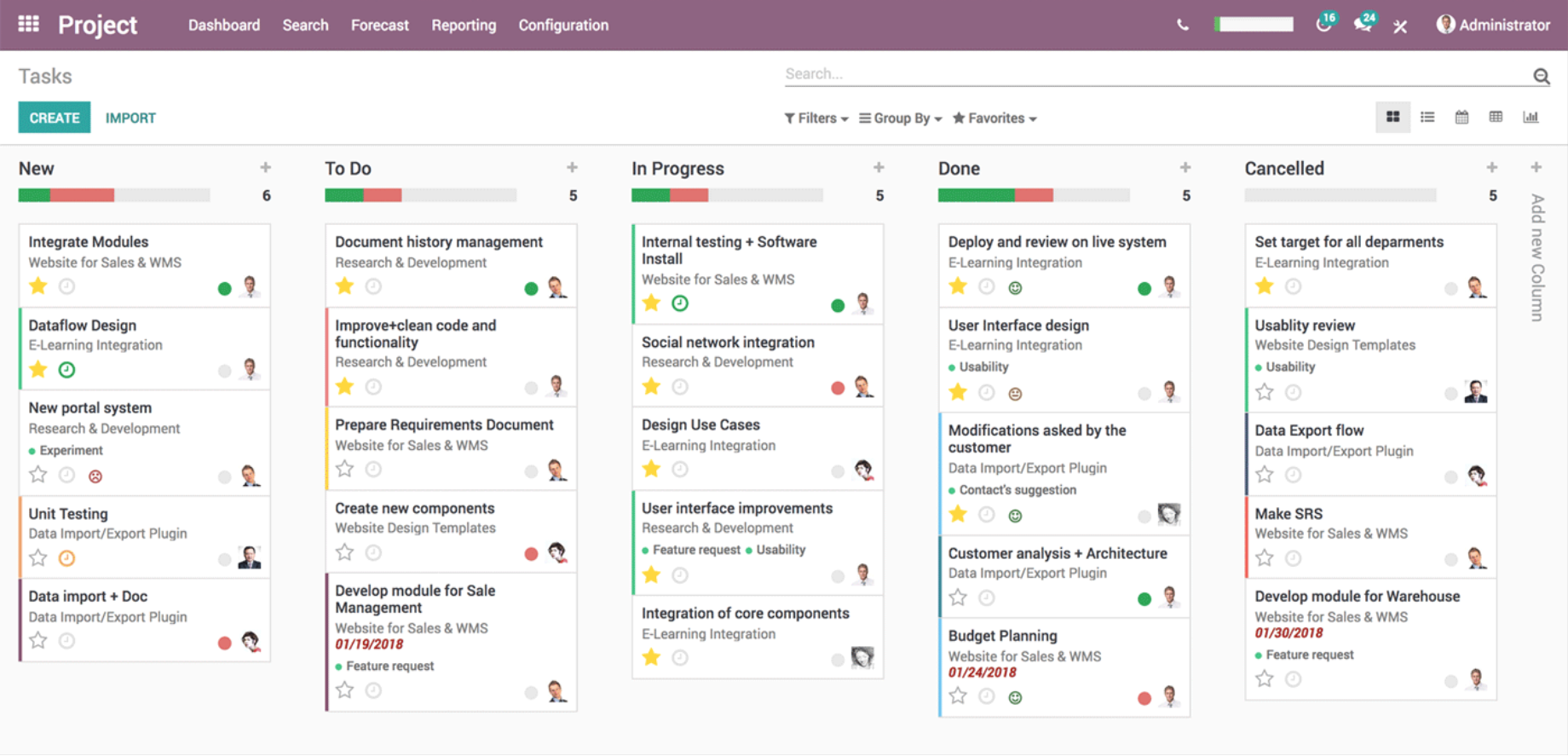
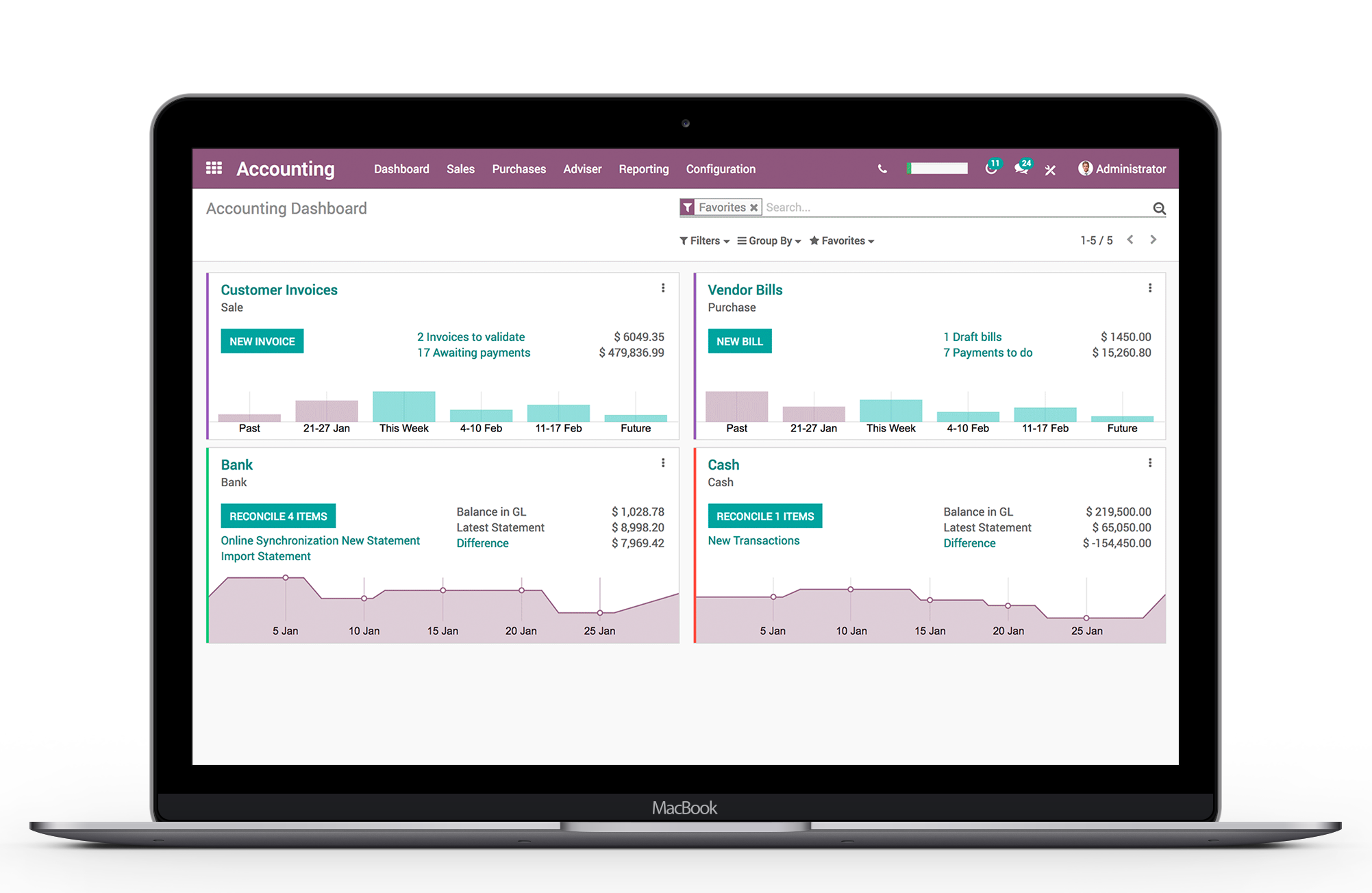
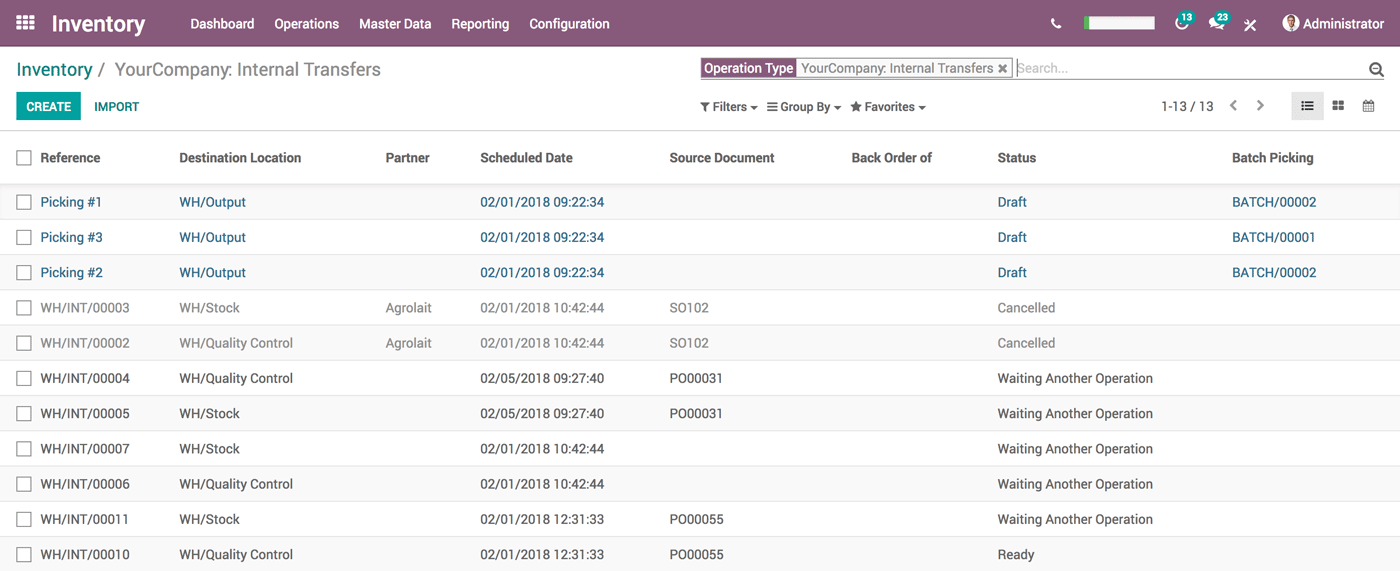
Odoo, from the Belgium-headquartered multinational company of the same name, is a suite of business applications for managing the sales pipeline. It also comprises a PoS and inventory management modules, scaling to a warehouse or retail management solution.
$31.10
per month per user
Agentforce Commerce
Score 8.1 out of 10
N/A
Salesforce Agentforce Commerce (formerly Commerce Cloud, and Demandware before that) is a cloud-based eCommerce solution for enterprises with merchandising tools, such as sorting, filtering, and image zooming, allowing customers to browse products.
N/A
Zoho Inventory
Score 9.0 out of 10
N/A
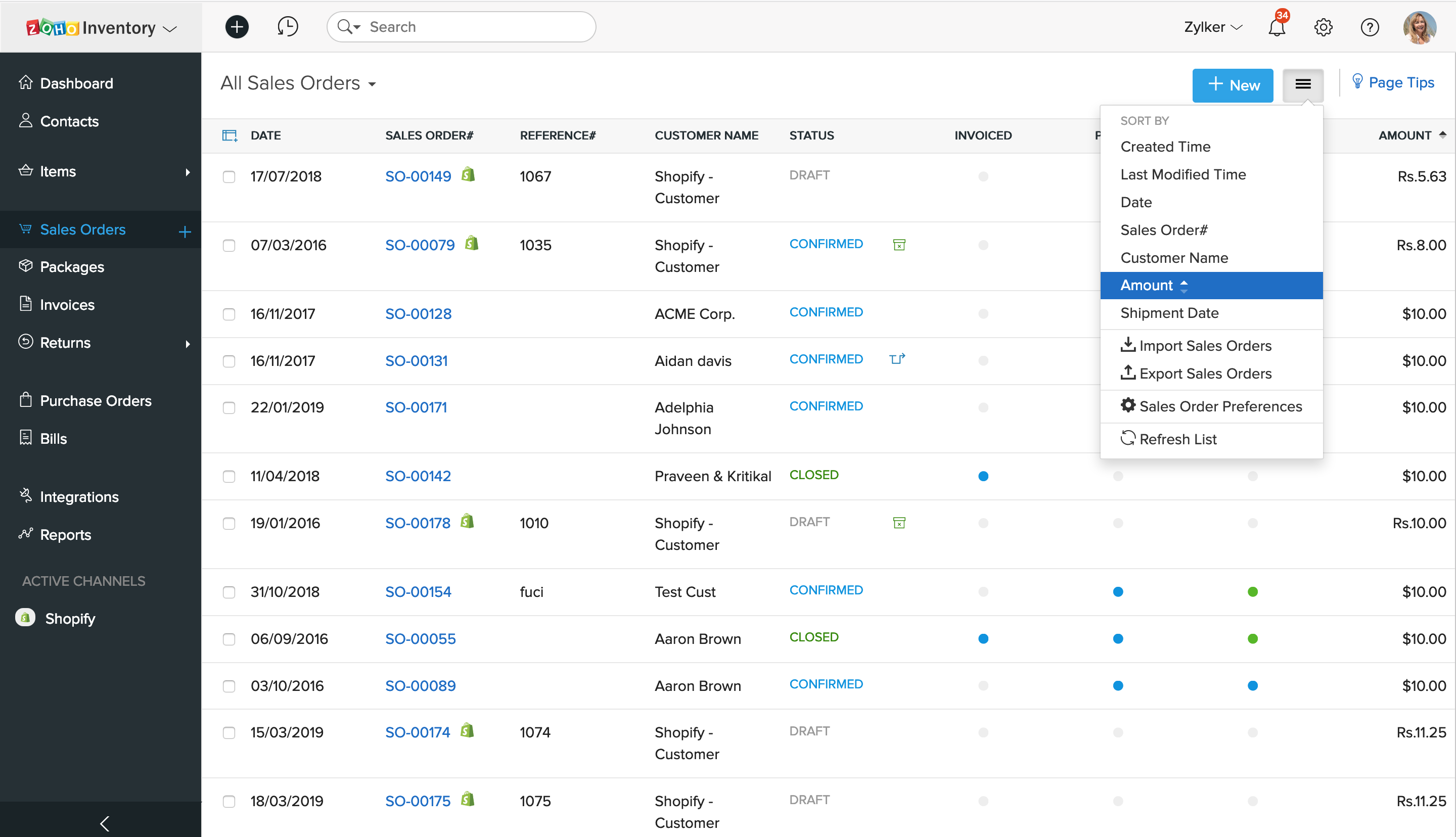
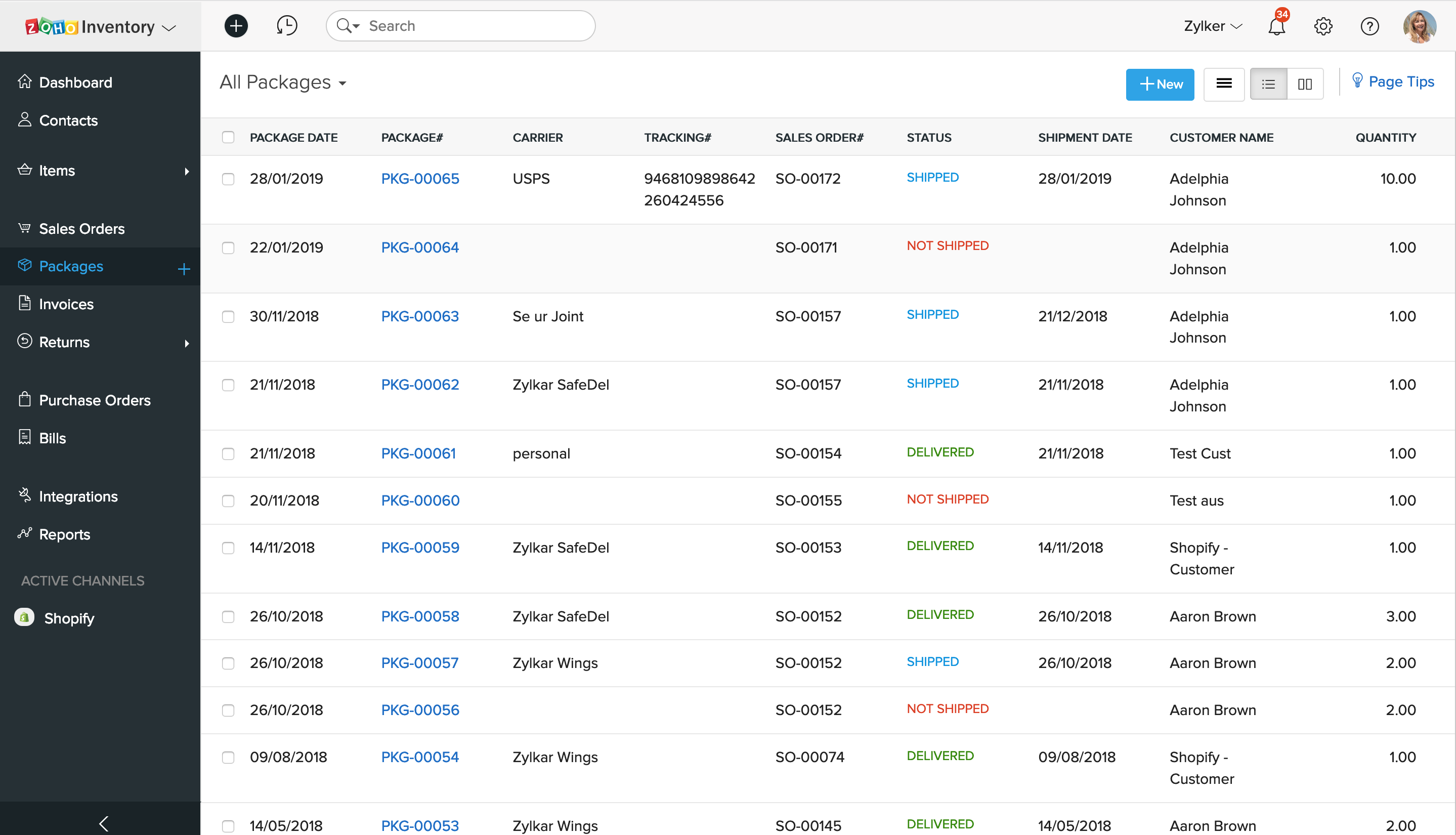
Zoho Inventory is a cloud-based inventory management solution designed for small to midsize businesses. It features inventory management modules including reporting and analysis, and lot traceability. It features mobile compatible apps for Android and iOS devices. Zoho Inventory offers additional capabilities such as built-in shipment estimating, and tracking and delivery confirmation features that allow users to invoice, ship and track products. The solution allows users to create…
$39
per organization / month billed annually ($49.00 billed monthly)
Pricing
Odoo
Salesforce Agentforce Commerce
Zoho Inventory
Editions & Modules
Standard
$31.10
per month per user
Custom
$46.70
per month per user
No answers on this topic
BASIC
$39.00
per organization / month billed annually ($49.00 billed monthly)
STANDARD
$79.00
per organization / month billed annually ($99.00 billed monthly)
STANDARD
$199.00
per organization / month billed annually ($249.00 billed monthly)
Offerings
Pricing Offerings
Odoo
Agentforce Commerce
Zoho Inventory
Free Trial
Yes
No
Yes
Free/Freemium Version
Yes
No
Yes
Premium Consulting/Integration Services
No
No
No
Entry-level Setup Fee
-$49,321,250 per app/ per user/ per month
No setup fee
Optional
Additional Details
A discount is offered for new users for the first 12 months of use for the initial users purchased. ($24.90 instead of $31.10 for Standard)
B2B Commerce:
Starter - $4 price/order
Growth - $6 price/order
Plus - $8 price/order
B2C Commerce:
Starter - 1% Gross Merchandise Value
Growth - 2% Gross Merchandise Value
Plus - 3% Gross Merchandise Value
B2B2C Commerce:
1% Gross Merchandise Value
Well, since I started my current job we use Odoo as ERP for everything, in my previous jobs I used other systems but they have nothing to do with this system, but personally, it is a very friendly and easy to use system, they trained me for a couple of days and it was quite …
Compared to Zoho, I think Odoo lacks some clear ease of use that Zoho provides out of the box. Mainly the easy importation of leads and conversion / tracking. Additionally Zoho analytics is easier to customize the dashboard from the menus. After some tinkering I think you can …
It is simple to use and the features in Odoo are more advanced compared to zoho. The cost of Odoo is also very less comparatively with other competitors that are available in market. Accessing the in depth reports is very easy with Odoo and a person with low executive level can …
Odoo is much easier to use than SAP and is much more adaptable and cost effective. Odoo is much more of a complete system than Quickbooks and more thorough in its approach. If you have a very basic business to run, Quickbooks could work, but if you have any customizations that …
We decided to go with Odoo over Netsuite due to a few factors. Price was a big reason why, Netsuite is the most expensive ERP we vetted. I also did not have a great experience with Netsuite at my last job. I was on the roll out team and it did not work as promised for POS, …
Odoo talks with our other software (shipping, website, etc.) while our old software did not. It is also a web-based product so it is easily accessible from home, mobile, etc. Before, if I needed to work from home for some reason, I had to project my office computer screen to my …
we CAME from NetSuite (and should have stayed there!!) - but we thought Odoo would be better. Brightpearl was too expensive and too slow to implement - and we needed a system that could do the Spanish Legally mandatory Accounting reports...... and even here Odoo fails as no …
They don't even compare. Odoo is so bad with its UI it took me months to learn, and still be confused by it. Within less than a month using HubSpot I've surpassed my limitations and set up far more complex systems.
I selected Odoo because it is all in the cloud online and it is very easy to conect from everywhere, but then it did nos suit what we wanted in other fields and the service was poor,so we deceided to cancel the contract, but never get our money back since november 2020.
Odoo offers great ease of use and time to market. You can build on modules and integration, not an issue since the system will say "before" setup what modules relate to what you want. And in some instances will even install needed modules without your having to guess.
Odoo firmly holds a strong position among its competitors. It is extremely easy to use and getting started is a few clicks away provided that you are using their online services. The good thing about Odoo is they have a good support which gives them slight edges on their …
While comparing Direkto with the Odoo, I'd say, only consideration of the UI is enough to see the vital advantage of the latter. Moreover, the specific functions are way [more] easily searchable through the Odoo than in Direkto.
So far, this is the companies first database that we have utilized besides our accounting system (Foundation) where we keep our customers information for billing purposes.
We used it in the past in my last company but I barely had it. I would say it as solid though. I would say most of the crm mock each other. I would say for bigger companies it makes sense a tool as robust as Salesforce Commerce Cloud but it really does depend on what are you …
Salesforce Commerce Cloud is the leader in CRM and in managing customer contacts and details. It integrates very well with our ERP, NetSuite owned by Oracle Cloud. Salesforce Commerce Cloud is easy to use and has more functionality compared to competitiors. Salesforce Commerce …
1. The learning curve of Shopify is not too steep, so it does create hinderance for non-technical folks 2. I personally found the AI-powered insights in Shopify to be more accurate than the ones provided in Salesforce Commerce Cloud.
I think Salesforce Commerce Cloud is significantly better than ServiceTitan for both ease-of-use and overall functionality. ServiceTitan has a lot of deliverability issues when sending emails that we don't encounter on Salesforce Commerce Cloud thankfully. Also, I think …
Salesforce Commerce Cloud is as good as the other platforms. On some of my past reviews I pointed out what Magento and Shopify do better than Salesforce Commerce Cloud and what Salesforce Commerce Cloud does better. To quickly recap: -Salesforce Commerce Cloud makes it very …
I think Salesforce Commerce Cloud is great. Like mentioned previously, it is easy to use and keep track of our dealer information and customer information. We do also use Hubspot and it would be nice if they intigrated better but they both have good uses. Salesforce Commerce …
We selected Salesforce Commerce Cloud due to the options available on the back-office for merchants. The availability to create complex scenarios. The scalability for multiple countries and languages. The integration with other Salesforce solutions already in place to create …
All relative to your organizational size. Shopify works for small to mid, Magento for small to large, commerce tools would be a large-scale plus. Hire a skilled consultant to help you make a decision of this caliber!
Salesforce Commerce Cloud offers a wide variety of features such as pages, versions, static links etc which makes it unique when compared with any other tool. It has a powerful searching mechanism with which we can search with keywords to find related articles with those …
All the options and demos were good; we see them all efficient and best suites; the option to choose salesforce commerce cloud came into the picture when we thought of integrating customer service and promotions as we already use salesforce service cloud as the support backbone …
We also explored Shopify and thought it did a pretty good job of what we were looking for. I think the thing that really sold us is that we already have Salesforce Sales Cloud and Marketing Cloud so this was an easy addition for us to make. It's a lot easier to have all our …
We selected Salesforce Commerce Cloud over other vendors in order to enhance customer relationships. Maintaining existing customers is comparatively easy. It thus helps to maintain strong customer focus and also to improve partner and supplier relationships. In addition, in …
Salesforce Commerce Cloud might be pricer than competitors but it surely worth the difference. The tool is integrated with Salesforce CRM, and a full usage of Salesforce asset adds value to its adoption. The implementation of the tool was smooth and fast. All the team that use …
Salesforce Commerce Cloud offered more product variables than Shopify. Salesforce was a proper SAAS solution whereas CS-cart wasn't and required more internal dev
We did not bother shopping around before or after the experience we had. We gave up on trying for the time being as the headache is not worth the fight. We are better suited [to] growing our business natively, locally, and through more economically sound methods.
Shopify's similarities to Salesforce Commerce Cloud are mainly with bulk uploading, shipments, and customization. [Shopify] doesn't let you add team members from different departments, as it's a blank back end store CRM. The commerce cloud goes above and beyond with seamless …
As I said before, I feel as though Salesforce Commerce Cloud stacks up well. It is definitely the market leader but when someone is the market leader they can get complacent and be less responsive to client needs than someone might not want to admit to. All in all, I think it …
Associate Director, Client Leadership for Michelin
Chose Agentforce Commerce
Since we are operating within the Salesforce platform such as the DMP and Marketing Cloud, integrating Commerce Cloud was an efficient and consistent way to streamline the processes.
In the end, we just wanted something that felt like SFDC which could translate better to our commerce needs. We wanted to stick with one ecosystem over multiple products for the sake of integration. We plan to stay within the salesforce world for a while to come so this worked …
The inventory management is better than QuickBooks however you give up an awful lot to get that benefit. The reporting in QuickBooks is far superior. The reporting in Inventory is terrible with every few options to customize the reports. For example, pulling in a …
Shopify manages our storefront and Zoho Inventory manages the stock we allocate to it. It is by no means seamless and there are occasionally issues with how the two integrate but we have been able to manage these.
Implementation was a terrible experience for us. Because it required a third party, we ended up way over budget and schedule. While Odoo advertises that it works with many systems, these third-party integrations often don't work out of the box and require extensive coding to set up. Furthermore, these "apps" can frequently break or lose integration.
Salesforce Commerce Cloud is well suited for medium to large sized eCommerce platforms (mainly B2C but B2B could work as well) who are looking to streamline their web processes and website functionalities while incorporating multiple departments. If you are a small business and have tighter margins, this may not be the best choice for you as there may not be as many opportunities to utilize all of the CRM's features and you may be at a financial loss because of it. Otherwise, this platform is great for organization and providing a helping hand in your eCommerce roadmap!
Requires a lot of customisation to get started. Very limited customer support, support appeared to not be that knowledgable with issues that aren't the usual issues most users get. Forms aren't optimised for conversions. Zoho offers a lot of features but the depth of its functionality proves limited as our demands increase.
Demandware business manager features a very robust set of options to accomplish many merchandising and content tasks out of the box. For typical retailers, there are usually very simple ways to accomplish common tasks.
The ability to schedule content and tie unique content to session data is particularly useful and fully featured.
Many features that would typically be missing from a home-grown CMS and would require development are included in business manager and easily controlled by marketers.
The #1 pain with Demandware as a developer has been Pipelines. Originally development on this platform was designed as a visual drag, drop, and configure model. You would create these logic flows (pipelines) in the visual editor, made up of nodes (pipelets) and connectors. These quickly got out of hand and turned into a spiderweb. Worse they were not like anything that most developers are used to. Pipelines save to XML but the markup was not clean and difficult to merge or diff, to say the least. I guess they were aiming for a more simple model but quickly realized that was not sufficient for real-world applications. To their credit, Demandware recognized this and has been steadily moving toward a clean, pure-code model.
The benefits of SaaS and the quick release cycle can be a mixed blessing. Features and API's can and do change from time to time. When you're using a platform like this you cannot build it and forget about it. It's not obvious to everyone but you're signing up for some amount of maintenance over time to keep things up to date.
The platform has a flaw that still hasn't been resolved. Each Demandware customer "realm" has many instances for development, staging, production, etc. All of the instances have their own user accounts and passwords, and you have to log in to each instance separately. It's very frustrating as an admin or developer, though less so to business users who will only need to access one instance. Demandware could really use a Single Sign On!
Demandware has a marketplace for third-party extensions to add pre-build integrations with other systems. While there is a reasonably broad selection of third-party vendors, I have to point out that the quality of many of these components has been sub-par. There are a few gems but many are clunky and quickly cobbled together, and surely require further investment of time. Demandware needs to do a better job of quality assurance with third-party vendors.
Templates within Zoho Inventory are very weak. You can't customize many including package slips, shipment docs, etc...
When an order has multiple packages, it's next to impossible to find the item you are looking for. Scenario, a large order has many packages and a customer has cancelled one of the items. You must click through every package to find the item, edit the package and remove it before you can cancel the item.
The reports within Inventory are extremely basic and many of them are useless
The packing slip module is useless as it does not print out bin locations
It's an inventory management system but it does not have bin locations
The backorder system is useless. If you "backorder" something then the whole order is locked until the backorder arrives in. Scenario.... a client orders 20 items, 1 is on backorder. You "backorder" that one item but want to ship the other 19... not possible. The order gets completely locked.
You can't print out RMA requests. There is just no option to do it, you have to do a screen shot
Integration with Amazon or other 3rd party e-commerce providers is troublesome.
A huge factor influencing our decision to remain on the Demandware platform is that our new parent company is standardizing all its luxury brands in the US on it. We are fortunate. However, even if we had remained an independent company, I believe we would continue on the Demandware platform for all the reasons outlined in this review. I appreciate the stability the platform has provided to our eCommerce site in the last three years as well as the continuous improvements and technological advances being rolled out that will allow us to keep the site fresh, engaging, modern and stable. I've heard many horror stories from colleagues on other platforms who struggle with the expense and complexity involved with making what should be minor and simple changes and updates to their sites.
It is relatively easy to customise but the problem is sometimes it is not easy to see where this customisation is available. Also the integrations with external systems can prove problematic both during installation and ongoing development and maintenance. It's great for small companies with a simple inventory or even larger organisations with smaller product lines. And it is reasonably priced if you ar eprepared to put the time in.
Once you complete the training with Odoo, you have a great grasp of how the system works, and most every feature is intuitive- There is rarely a task within Odoo that I get frustrated trying to figure out- I can typically look through the system and find what I need to do, and if I ever do need support, the Odoo Support team is excellent
The overall ease of using the system. Consolidation in location for our team members. Mobile application for on the go research, as many of our team members are constantly traveling to job sites or to meet clients. No more duplicate calls to current customers, since we have 12 different divisions that span the company. Mostly the ability to look at the database when our team members begin cultivating a new lead/prospect with a potential customer to see if anyone within the team has a relationship with that person or the company they work for.
Easy - there is NO SUPPORT (like in ABSOLUTELY NOTHING!!!!!!!). Even for legally mandatory requirements where the system MUST work, they will gladly take a month to get back to you with a NON-answer. We couldn't even get our bank statements correctly into Odoo for 2 months - leading to no reconciliation and the company accounts were a mess (still are!!) as a result - Completely irresponsible. Have not EVEN had an apology from Odoo - they couldn't care less !!
They are very responsive and a support technician will be assigned quickly. Even if there is further clarification needed for the ticket, or a solution is not immediately available, you feel that someone is there and staying on top of the issue. Most common issues are resolved quickly and satisfactorily.
Compared to Zoho, I think Odoo lacks some clear ease of use that Zoho provides out of the box. Mainly the easy importation of leads and conversion / tracking. Additionally Zoho analytics is easier to customize the dashboard from the menus. After some tinkering I think you can get the same thing with Odoo, it's language and logic just take some geting used to. Airtable provides similarly easy to customize dashboards that are aesthetically appealing. but lacks the ability to track the customer journey as effectively as Odoo or Zoho systems.
All relative to your organizational size. Shopify works for small to mid, Magento for small to large, commerce tools would be a large-scale plus. Hire a skilled consultant to help you make a decision of this caliber!
The inventory management is better than QuickBooks however you give up an awful lot to get that benefit. The reporting in QuickBooks is far superior. The reporting in Inventory is terrible with every few options to customize the reports. For example, pulling in a salesperson report that factors in returns is not possible. You can't pull a report to see what items need to be picked for all open orders.
It has helped us improve our purchasing and sales flow, now it is more organized, we can see which product was purchased from which supplier and which price is more convenient, very good
It helps to manage payments efficiently, and in less time than when it was managed manually, so it is a positive point that we can rescue in our organization.
In my case, managing inventory helps me more easily locate the most specific products that I require. Currently, we do not have details of mismatches with the products, so my inventory and my stock are kept perfectly updated.
Salesforce Commerce Cloud ends up paying for itself in the long run so long as customers are taking advantage of its full capabilities.
I would highly recommend trying it or consulting a partner like us about it if you have an interest and think you could benefit. A thorough business analysis will tell you if this segment of Salesforce is right for your objectives.